Too many warehouses buy a picking cart the way they buy an office chair: glance at a photo, ask the price, order a batch. Then the carts arrive and the tote does not fit between shelves, orders get mixed in shared bins, the loaded cart feels like hauling bricks, and a brake that only sort of works lets the cart roll half a meter on a slope. The frame is not broken. The setup math was never done. A proper warehouse picking cart setup starts with layers, dividers, load, and wheels, not with the catalog picture, because the money saved on a cheap cart usually comes back as mispicks, rework, and sore backs.
Start With the Job: The Picking Cart Follows the Order, Not the Rack
Think of a picking cart as a moving workstation. You can think of it as a workbench on wheels: its quality is measured by how many times the picker reaches, bends, and walks a wasted step, not by how tidy it looks parked in a row. In November 2023, an e-commerce warehouse in eastern China replaced its carts just before peak season. The new shelves were evenly spaced at 30 centimeters, which looked neat on paper. The problem was that the standard 28-centimeter tote left almost no finger room at the rim, so pickers had to lift each tote by its edge more than 400 extra times a day. A month later the team removed one middle shelf. Average pick time per order fell from 4 minutes 10 seconds to 3 minutes 35 seconds. One fewer layer, faster work.
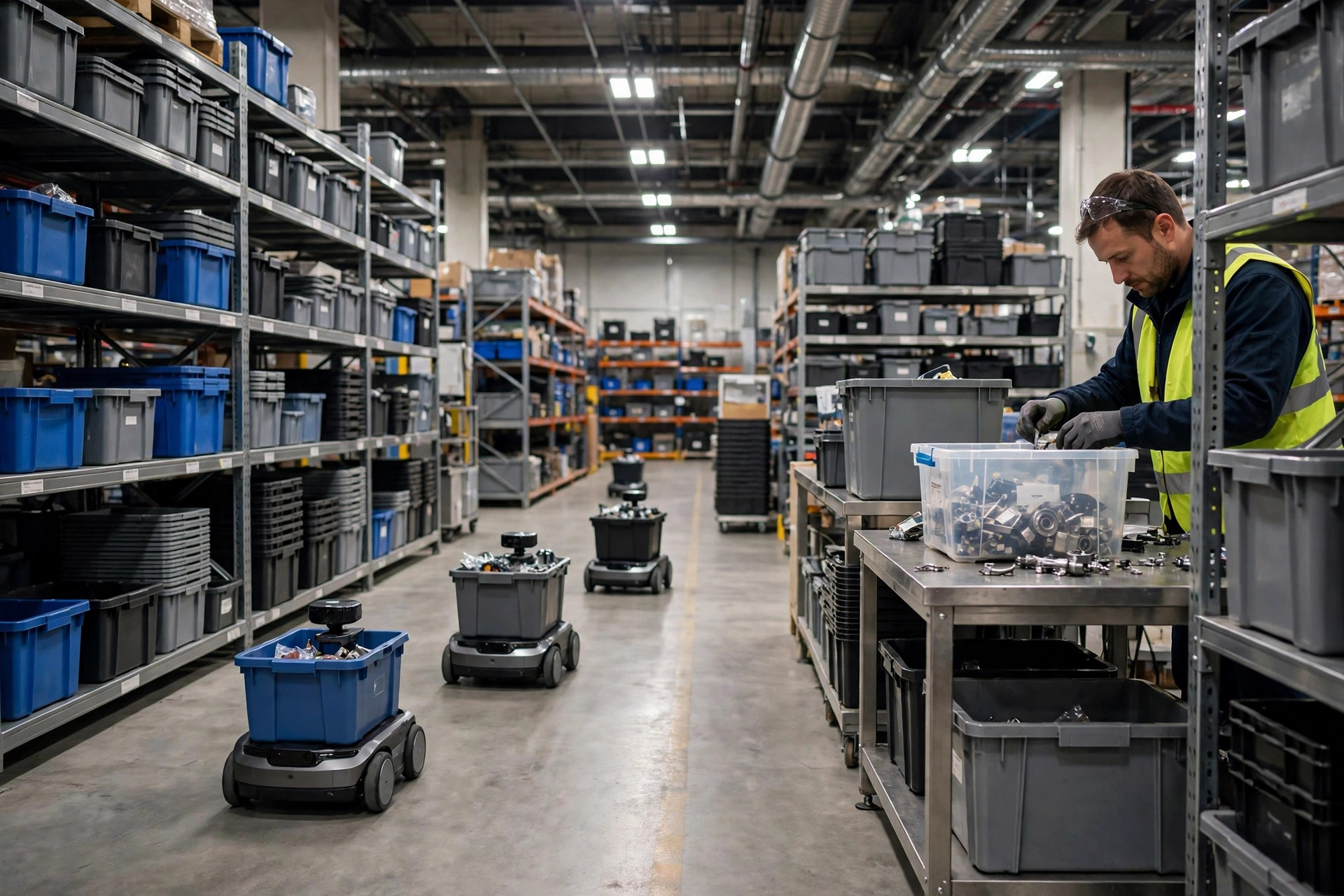
A second mistake is treating a cart like a small rack. A rack is about storage density. A cart is about turnover speed. Single-order picking and multi-order batch picking pull the design in different directions. For one order, a layer for the active tote and a layer for an empty tote is plenty, and lighter is better. For several orders at once, every bin must map to exactly one order. When bins run short, pickers start relying on memory to split goods, and the error rate climbs immediately.
Warehouse Picking Cart Setup: Layers and Dividers
There is a practical boundary for layer height. For a picker working standing up, the comfortable reach zone runs roughly from 60 to 150 centimeters. Above that, the top layer means standing on tiptoe. Below it, the bottom layer means crouching. Repeated a few hundred times a day, both cost speed and accuracy. Three layers are the ceiling for most warehouses. A fourth layer only makes sense for light, small items, and then the top should hold empty totes or paperwork, never heavy goods. More layers do not mean more capacity. Each extra layer adds another bend and another bin that can receive the wrong item.
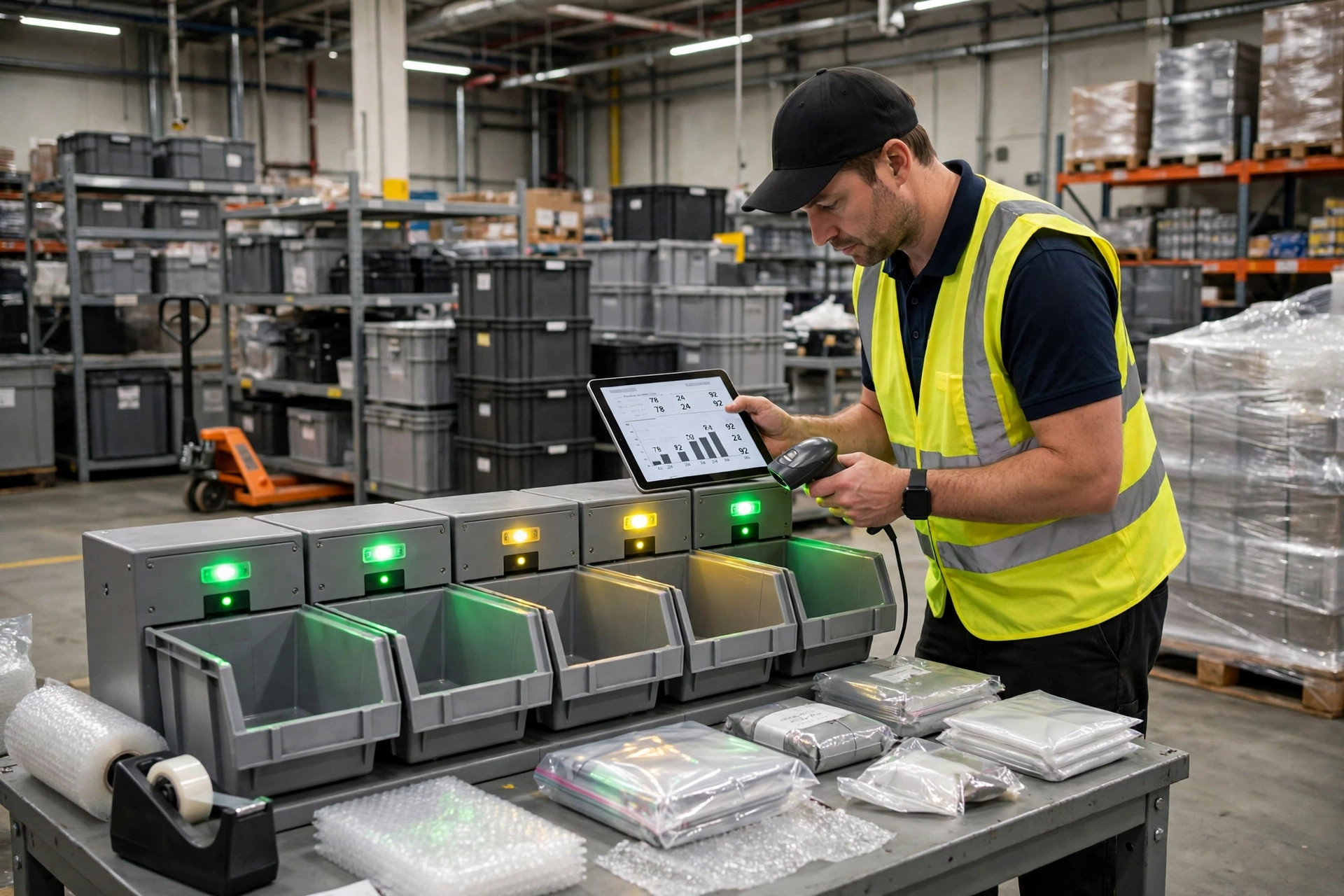
Dividers deserve the same discipline. I once compared two setups running 12 orders in parallel. One used 12 separate bins in a row. The other used 6 bins, two orders per bin, separated by colored cards. The first setup ran a 0.4 percent mispick rate. The second ran 1.7 percent. The rule that falls out of those numbers is simple: one bin, one order, one product type. An empty bin is better than a shared bin. Dividers should be removable and adjustable, because order profiles change, and a welded divider layout will be wrong within three months.
A quick decision table helps size the cart before anyone signs a purchase order:
| Parallel orders | Suggested bins | Layers | Notes |
|---|---|---|---|
| 1 | 2 | 2 | One bin picking, one for an empty tote |
| 4–6 | 6 | 2–3 | One bin per order, plus one for exceptions |
| 8–12 | 12 | 3 | Top layer for paperwork or empty totes only |
| More than 12 | Do not force it | — | Move to a put wall or conveyor; the cart has hit its limit |
In June 2024, a small-appliance warehouse in southern China came to me with an 8-bin cart and a business that had grown to 12 parallel orders. Pickers stuffed paper notes into bins to tell orders apart. When a note fell out, orders crossed. That month produced 37 returns from crossed orders, and the customer service and re-picking labor cost more than a batch of 12-bin carts would have. The fix was not a bigger cart. The team split work into waves of 8 orders, staggered, and crossed orders fell to 3 the next month. When bins run short, change the wave first. Do not force more orders onto the cart.
Load, Wheels, and Brakes: The Three Places Not to Cut Corners
Load ratings must be calculated at full load, not for an empty cart. One tote of small electronics at 15 kilograms is unremarkable. Four totes come to 60 kilograms. Add a 25-kilogram cart body and the rolling total is 85 kilograms. A cart rated for 100 kilograms will sag at the shelf level after six months of running at that weight every day. My boundary is 70 percent: full load should stay under 70 percent of the rated capacity, leaving margin for shelf flex and uneven floors. Past that line, the money saved on the cart becomes money spent on replacements and repairs.
Wheels matter more than most buyers expect. Wheels under 100 millimeters in diameter roll fine on smooth epoxy, then catch on expansion joints and floor mats. A 125-millimeter wheel crosses those bumps far more easily and takes less effort to push at 85 kilograms. Mix the wheel types: two swivel wheels at the front, two fixed wheels at the back. That combination tracks straight and still turns. Four swivel wheels look agile, but a loaded cart will drift sideways down the aisle, and the picker spends the whole trip steering it back.
Brakes are the non-negotiable item. Some cheap carts brake only one wheel, which means the cart still slides on a slope. In the winter of 2022, at a warehouse in northern China, a picker let go of a cart on a dock ramp to grab a pick slip. The cart rolled into a rack and shattered a full tote of glassware. After that, the rule was written into the shift handover checklist: brakes must lock two wheels, and a stopped cart must not move when pushed by hand. Carts without working brakes are not allowed on the dock ramp.
Here is the counterintuitive part: a heavier, tougher cart is not automatically a better cart. A thick-steel cart with a 40-kilogram empty weight is already tiring before anything is loaded. Over an 8-kilometer picking day, that fatigue shows up as slower picks and more bumps into racks, and it costs more than the extra two years of frame life are worth. Lightweight is not cheap construction. It means hitting the load rating while keeping empty weight down. Weigh the empty cart before you buy. That number is more honest than any sales pitch.
One more boundary needs drawing: carts, totes, and conveyors each have their own job. The tote is the container. The cart moves totes. Do not weld totes onto a cart as fixed bins, because the day the tote size changes, the whole cart is obsolete. Conveyors suit high, stable volume on a fixed route toward packing. Carts suit fluctuating volume across scattered locations. When volume grows past what carts can shuttle back and forth, connect a conveyor instead of buying more carts. A jammed aisle costs more than the equipment.
Maintenance has its own traps, mostly at the wheels and shelf edges. Tape and strapping wrap around wheel axles, the cart starts jerking, and pickers push with their shoulders to compensate. That is how strain injuries start. A shelf edge dented into a burr will tear packaging, and a damaged unit can slip into a normal order and turn into a complaint. My routine takes twenty minutes a week: clear wheel axles, test the brakes, run a hand along every shelf edge. That is far cheaper than rework after something breaks.
So the whole question of warehouse picking cart setup comes down to three checks. Layers must respect the height a picker can actually reach. Dividers must respect one order per bin. Load and wheels must be sized for full load with margin. Draw a clear line between single-order and multi-order work, and when volume passes what the cart can handle, change the wave or move to put-wall equipment instead of blaming the cart. Whether the money was well spent comes down to one number: after the change, did pick time per order fall, and did the mispick rate fall? If neither moved, the new carts were a waste.
By Da Liu, Automation Engineer