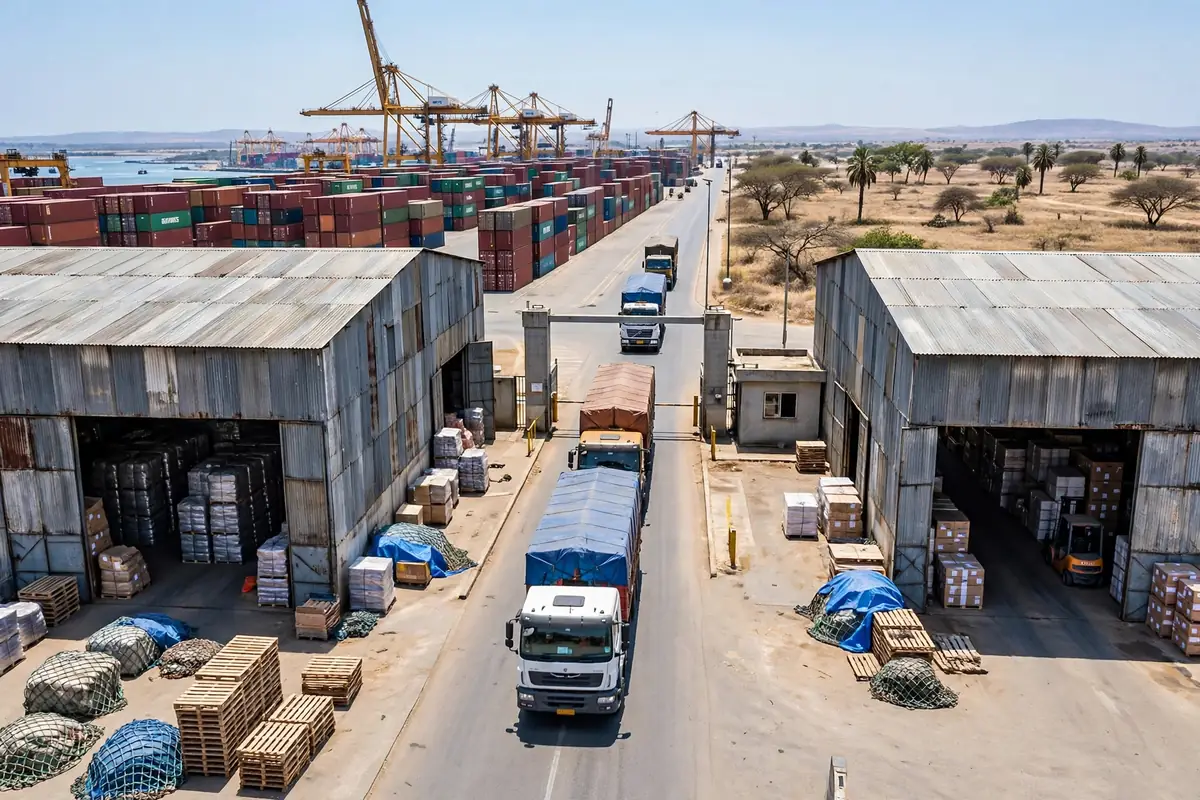
Our little warehouse cannot afford to burn money like that. I will put my favorite sentence first, because everything about beira mozambique port warehouse logistics sounds huge: a corridor, a gateway, a port serving several inland countries including Zimbabwe. I run a three-thousand-square-meter warehouse. When I hear words that big, I touch my wallet and translate them into three small questions. How does freight actually get out of the port? How does it sit in a warehouse without getting damaged? And how does it leave for the inland leg without giving the profit back to the road? The Beira port in central Mozambique genuinely is an important outlet for landlocked countries in the region. But corridor opportunity is never divided equally among warehouses. It goes to whoever handles the handoffs.
Start with our kind of embarrassment. All figures below are a hypothetical worked example, not live local prices; port charges, duties and transport rates must be confirmed against current official and carrier quotes. A shipment of consumer goods enters through Beira bound for an inland wholesale market. The shipper compared only the short port-to-warehouse haul and the rent, chose the cheapest combination, and hired nobody to watch the clearance handoff. The container sat at the port for extra days while detention and storage charges ticked upward. When the goods finally reached the warehouse, the inland truck had not been booked into the right slot, so the freight sat for nearly two more weeks. Final tally: the cheapest combination cost roughly a tenth more than the neighbor's boring, slightly pricier setup. In corridor business, the most expensive thing is rarely rent. It is waiting. Wherever freight stops, a meter starts running. That rule holds at every port on earth.
Beira Mozambique Port Warehouse Logistics Is About Handoffs, Not Floor Space
When I look at a warehouse near Beira, I check handoff strength before floor space. A handoff means four things: how fast containers are collected from the port, how reliable the clearance agent is, whether the receiving windows flex around vessel schedules, and whether inland linehaul capacity is steady. If any one of those four limps, a big warehouse is just a big parking lot with a roof. A modest site with fast pickup, smooth devanning and disciplined dispatch will turn inventory far faster than a giant shed with weak connections. Small warehouses like mine survive on turns, not on hoarding.
Here is the judgment people resist. On a corridor route, being near the inland departure point can be worth as much as being near the port fence. Port-side waiting burns money by the day, so a short pickup radius matters. But the inland leg is long and full of variables, and a warehouse that dispatches smoothly onto that leg protects the whole chain's timing. My view on a Beira site is to judge both ends: short collection distance from the port, clean access to the inland departure flow. A cheap site that fails both ends is not cheap.
A second hypothetical scenario, again with illustrative figures only. A trader shipping agricultural processing equipment through Beira to an inland buyer used an ordinary warehouse for the first order. In the rainy season the building sweated with humidity, several motors took on moisture, and the damage only appeared when the machines were powered up at destination. Repairs and compensation consumed the entire margin of that order. The second order went into a warehouse with proper moisture control, raised racking and dehumidification. Rent was noticeably higher. The equipment arrived intact, and the buyer renewed. The lesson is where corridor money should go: moisture protection, security and damage prevention look like overhead on a spreadsheet. On a long chain they are the profit, because there is no recovery point later. Once that truck leaves your gate, the next chance to fix anything is hundreds of kilometers away.
A Small Team's Corridor Checklist, Built From Cheap Mistakes
We cannot buy the systems big companies run, so we run habits instead. First, use one reliable local clearance and pickup agent on a long-term basis instead of switching every shipment. Corridor ports run on windows, sequences and local knowledge, and a good agent quietly prevents days of pointless waiting. That fee is among the last I would cut. Second, zone the warehouse by destination and clearance status. Corridor freight must never mix: goods for different countries and goods at different clearance stages need physical separation and controlled access. I have seen cleared and uncleared freight staged in one area; at dispatch the whole lot was held for re-inspection, and the delay was measured in days, not hours.
Third, lock inland departures early. Trucks on a corridor are not a taxi fleet waiting for your call. Agree vehicle types and departure slots with carriers in advance so that when freight is ready, wheels are ready. Every day cut from warehouse dwell time goes straight to the bottom line. Fourth, give documents a named owner. A corridor file chains bills of lading, clearance papers and transit documents together, and one wrong field can stall freight at a border or at destination. We have no fancy system, so we use the oldest tool in warehousing: one folder per shipment and one movement card that gets signed at every step by whoever handled it. It looks primitive. When something goes wrong, it also tells you within five minutes exactly which link in the chain is holding your freight. A system you actually use beats a platform you cannot afford.
One more honest warning for operators my size: price the time, not just the moves. Corridor freight occupies cash for a long time between port, warehouse and inland delivery. If you quote customers on local short-haul payment logic, volume will grow while your cash flow quietly strangles. Talk about transit and waiting time openly before the first shipment, not after the third invoice. And because duties, port tariffs and each destination country's clearance rules change, I am deliberately writing no fixed figures here; verify everything against current Mozambican and destination-country official sources and licensed local agents before committing.
The Beira Mozambique Port Warehouse Logistics Total: Why Rent Is the Smallest Line
This table is a structural illustration, again a hypothetical worked example. Replace every weight with your own real quotes before making decisions; the point is the shape of beira mozambique port warehouse logistics costs, not any price.
| Cost block | What gets missed | Impact on total |
|---|---|---|
| Port waiting | Detention and storage grow daily | High, worst when uncontrolled |
| Clearance agent | One error by a cheap agent | Medium, small saving, big loss |
| Cargo protection | Moisture and theft damage | High, one claim eats many orders |
| Inland linehaul | Unstable capacity causing dwell | High |
| Cash tied up | Long transit stretches payment cycles | Medium, invisible but real |
Read that table and you see why I keep calling corridor work a total-cost business. No single line looks frightening. Stack them, multiply by days, and the total becomes a different animal. My advice to any small operator is to pilot one or two complete port-to-door shipments first, measure the true time and cost at every handoff, and only then decide whether to scale. Do not dive in because somebody told you the corridor is booming. The boom belongs to everyone. The bill belongs to you.
Small warehouses have their own way of living. The Beira corridor is a real opportunity, but it rewards operators who sweat the handoffs and count the total, not operators who win the rent comparison. We cannot outspend the big sheds. We can out-wait nobody, out-damage nobody, and lose one less day at the port than the warehouse next door. Do that consistently, and even on a very big corridor, there is a meal on the table for a very small warehouse.
By Xiao Ma, Small Warehouse Owner