We have a client, a small home-appliance brand, that signed a 3PL contract in Bangkok last year. One big warehouse in Lat Krabang, close to Suvarnabhumi Airport and on the way to Laem Chabang port. The location looked perfect. The client even called me to say, "Susan, this warehouse pick was a good one. Everything flows in and out."
Then late September this year, he called again, and his voice had changed completely. Days of heavy rain had put all 50 of Bangkok's districts under disaster declarations. Around Lat Krabang and Bang Kapi, water stood 40 centimeters deep on some roads — too deep for small vehicles. He had a shipment bound for a supermarket on Sukhumvit. Normally a two-hour run. That day, the slowest truck took nine hours, and the driver called the warehouse from the road to say the street ahead was closed and he could not even turn around. The delivery landed two days late, and the supermarket deducted a penalty under the contract. "Should we have rented a second warehouse?" he asked me on the phone.
I get asked that question several times a year. And here is the thing most people get wrong about Bangkok Thailand urban warehouse distribution: they only count the freight bill. The freight bill is the smallest part of the math.
In Bangkok Urban Warehouse Distribution, Congestion Is Normal and Rain Makes It Worse
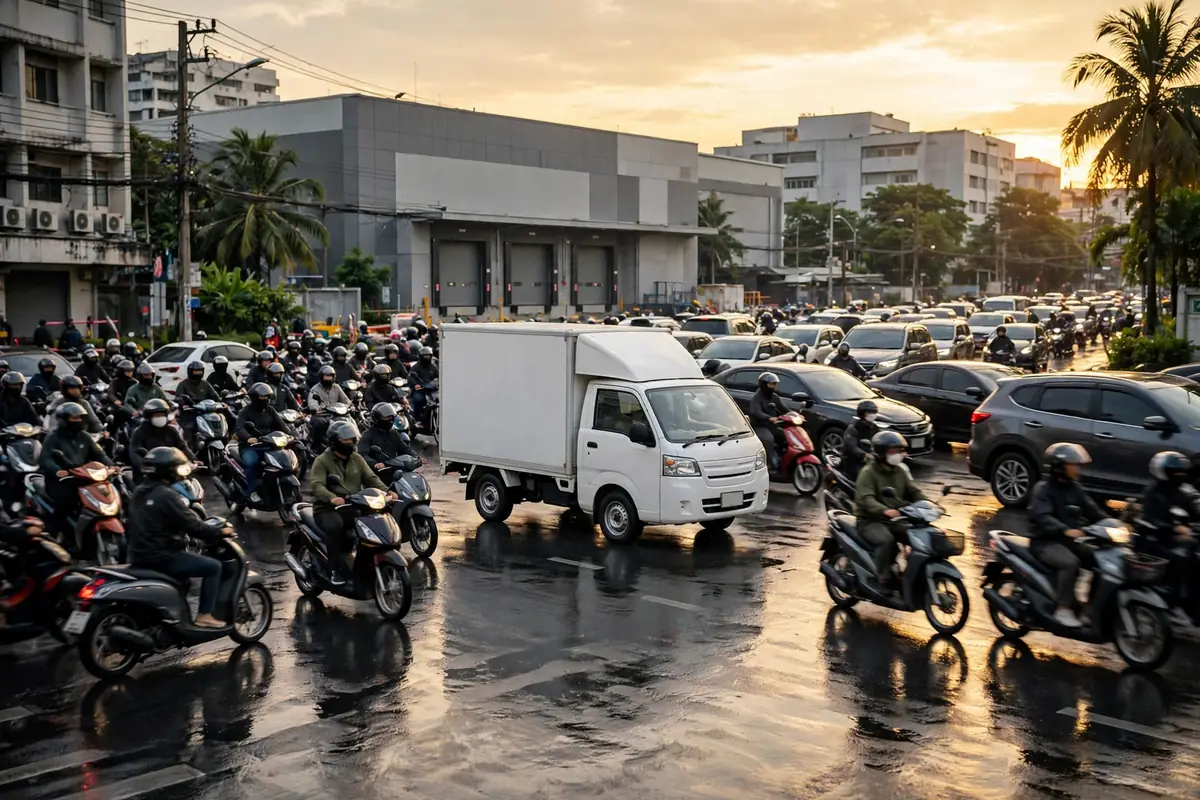
Let me tell you something a 3PL will only admit off the record: in Bangkok, you cannot plan delivery times by distance on a map. The city is famous for its traffic. Crawl-and-stop on the main roads at rush hour is everyday life, and rain adds another gear of delay. A study using probe-vehicle data from 2018 to 2020 found that rainfall measurably cuts traffic speeds in The city, worst at morning and evening peaks, on low-lying streets and narrow roads. That is not a one-year anomaly. It is how the city works.
The September 2026 rains were a magnifying glass. Some areas recorded 100 to 300 millimeters of rainfall in a matter of days, 93 roads flooded, and the corridor between the Lat Krabang inland container depot and Laem Chabang port was disrupted. What freight fears most is not the rain itself — it is not knowing how long the roads will stay closed. Officials estimated floodwater would need two to three rain-free days to drain, and logistics would take longer still to return to normal. So one big storm means planning with three to five extra days of slack. A schedule built tight is a schedule built on luck.
That is where our client got hurt. His delivery promises were written for sunny-day roads: same-day and next-day across the city, all neatly printed. When the rains came, every promise broke at once. The penalty was the small part. The supermarket cut its next order in half. That is the real loss. So rule one of The Thai capital urban warehouse distribution: write two service levels into your promises, one for the dry season and one for the rainy season. Make the rainy-season one conservative. Never oversell speed to win an order.
There is a detail most people miss: the hardest places in the rainy season are not downtown. They are the industrial zones where the warehouses sit — Lat Krabang, Bang Na, Samut Prakan. Low ground, slow drainage, and the highest concentration of freight. When the road outside the warehouse gate floods, trucks can neither leave nor enter, and the warehouse just waits. If you pick a warehouse on rent and floor area alone, without checking the drainage and elevation of the street outside, the rainy season will charge you tuition.
One Warehouse or Two in Bangkok? Run the Numbers This Way
When the client asked whether to rent a second warehouse, my answer was: do the math first, not the feeling.
We built him a comparison table from two real quotations he already had. Every operator's numbers differ, so read this for the logic, not the rates:
| Cost item | One big warehouse (Lat Krabang) | Two warehouses (Lat Krabang + Bang Na) |
|---|---|---|
| Monthly rent | One large site, low unit rate | Two smaller sites, combined rate roughly 20% higher |
| Inventory | Centralized, fast turnover | Safety stock split, total stock about 10% higher |
| City delivery | Many cross-city runs, high cost per order | Ship from the nearer site, cost per order down about 30% |
| Transfers | None needed | Two to three shuttle runs between sites per week |
| Rainy-season risk | One flood stops the whole network | One flood still leaves the other site running |
Month to month, split warehousing costs more in hard cash, but the delivery savings cover most of the difference. What tips the balance is not either of those lines. It is the last one: risk. With a single warehouse, one big storm can stop all The city deliveries. With two, at least half your freight keeps moving. For a supermarket-channel client, never going out of stock is worth far more than the rent saved.
But here is the counterintuitive part: more warehouses are not better. Central The Thai capital space is brutally expensive. I have seen a client rent a small downtown satellite warehouse on impulse, only to find the rent ate every baht of delivery savings, the space could not hold the stock anyway, and the site ended up as a storeroom for slow-moving goods. My judgment: in a city like The city, two warehouses are the sweet spot — one covering the east and the port direction, one covering the west and downtown. Three or more mostly buys you management headaches. Inventory accuracy and transfer punctuality both slide, and the savings leak out through management cost.
There is a middle path, especially good for sellers still small in The Thai capital: do not lease a second warehouse. Sign a rainy-season flex agreement with a local 3PL instead. Run your own warehouse in normal times, and shift part of the city orders to their network at peak rainy season, billed per order. It costs far less than a year-round lease. The key is writing the trigger into the contract — for example, automatic switching once flooding delays outbound trucks from your main warehouse by more than half a day — so nobody has to argue on the phone mid-crisis.
Put the Bangkok Rainy Season in the Contract
Finally, the contract. Most clients negotiating with a 3PL hammer on the unit price, walk away feeling they won, and only discover in the rainy season that the contract says nothing about extreme weather. Who owns a missed delivery window, at what point a delay is excused, and who pays for the backup warehouse — if those three are not written down, somebody eats the loss when things go wrong.
For The city clients we now make rainy-season clauses standard. First, service promises come in two tiers, dry season and rainy season, with the rainy-season delivery time relaxed but with a hard latest-delivery deadline — no open-ended delay. Second, the trigger is defined in advance: an official disaster declaration or a main-road closure automatically switches service to the rainy-season tier, no fresh negotiation each time. Third, the backup delivery plan and its cost split are agreed upfront, executed on trigger, and settled against records afterward.
Next time you negotiate a contract, ask these three questions: which tier is the rainy-season promise written at? Who decides to switch to the backup warehouse when the roads fail? And whose account does the delay land on in the end? Get those three answered clearly, and however heavy The Thai capital's rains get, your distribution math will not fall apart.
By Susan, 3PL Sales Director