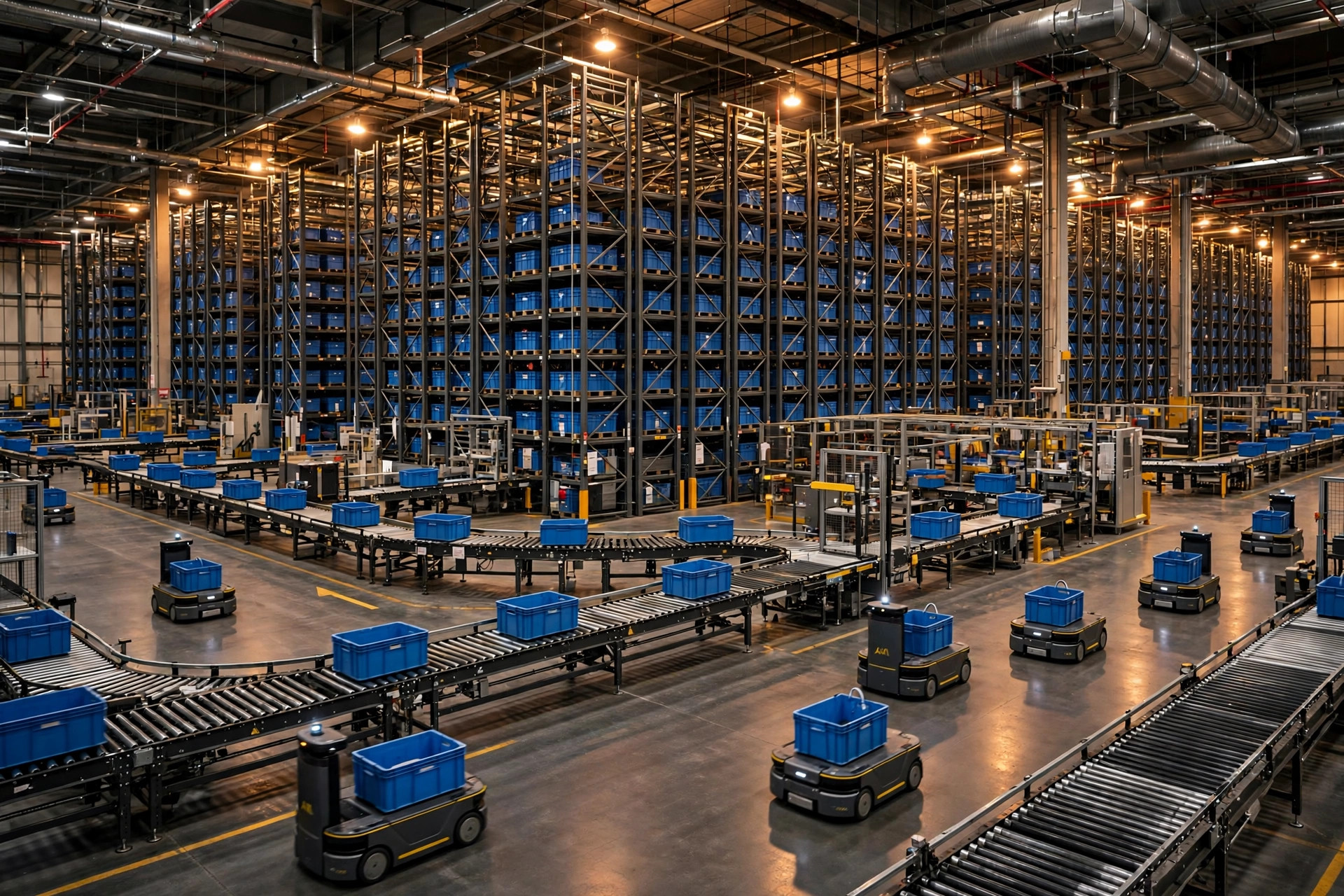
A friend of mine runs a 3PL in Rialto, California. Spring of 2023, he showed up for coffee with an ROI spreadsheet that looked beautiful: a $2.8 million automated storage and retrieval system, night-shift labor eliminated, a 30,000-square-foot overflow lease he could finally walk away from. Payback in two years. He asked me if I saw any red flags in the equipment selection. I told him the equipment was fine. The red flag was the payment schedule.
Six months later he called me, voice shot. The system was still in commissioning. His cash was nearly gone.
Here's what nobody tells first-time automation buyers: an ROI spreadsheet answers "how long until this pays for itself." Cash flow answers "will you still be alive on that day." Those are two completely different questions, and the second one kills more projects than bad equipment ever will.
Where the money actually goes
Let me show you his contract, because it's the most common milestone structure I've seen in this industry: 30% at signing, another 55% before shipment, 10% on final acceptance, and the last 5% held until the warranty period ends. Do the math: $2.38 million — 85% of the total — leaves his account before the system saves him a single dollar.
This isn't a bad deal someone tricked him into. It's how the industry works. Steel, motors, stacker cranes — the integrator's suppliers demand deposits too, so no integrator is going to float that cost for you. "Most of the money before shipment" is standard practice. The only real variable is the percentage. I've seen signing deposits anywhere from 20% to 50%, and yes, there's room to negotiate, but the overall shape doesn't change much.
How much room? A real example from a couple of years ago: an e-commerce warehouse in Ontario was putting in a cross-belt sorter line, and the integrator opened at 40% down. The owner was cash-constrained, so we went back and forth twice and landed at 30% — in exchange for a slightly higher total price, because the integrator had to cover its own financing cost. That's the trade-off, stated plainly: easier payment terms cost you a little more on the headline number. Whether that's worth it depends on whether you're short on money or short on cash. For a small company, my answer is usually yes, it's worth it.

The spreadsheet's blind spot
The ROI model quietly assumes benefits start flowing in month one after acceptance: labor savings, throughput gains, the overflow lease canceled. In reality, the stretch from signing to final acceptance runs six months at best and well over a year at worst. My friend's project lost months to building permits and fire-marshal sign-offs, then commissioning ran another four months long. For the better part of a year, $2.38 million was gone and the system earned nothing — while the old warehouse rent kept billing, the new building sat half-empty waiting for equipment, temp labor filled the gap, and the project manager's salary ticked along.
There's another line the spreadsheet never shows: the cost of the money itself. An $840,000 signing deposit sitting in someone else's account for the better part of a year is, functionally, an interest-free loan you made to your vendor. I've watched companies draw on a credit line to cover the deposit — paying interest on money for a project that doesn't exist yet. Money that leaves early doesn't just make you "tight." It costs real dollars.
And here's the planning mistake I see most often: everyone budgets for acceptance happening on time. In my experience, a first-pass clean acceptance on an automation project is the exception, not the rule. Two or three months of commissioning overrun is normal. If your cash plan assumes everything goes right, your cash plan is fiction.
My rule of thumb for smaller operators: after the signing deposit goes out, you should still be able to cover six months of fixed overhead plus every unpaid dollar of the project. If you can't, don't sign — or go sort out financing first. And honestly, I'd go further: the payment schedule determines whether a small company can afford automation far more than the total price does. A $5 million project with milestone payments spread thin can be safer than a $2.8 million project that takes 30% on day one. Read the payment table before the ROI table. That order is non-negotiable.
The clauses that actually protect you
Payment terms aren't carved in stone. Several things are negotiable before signing, and each one can save you.
First, push the retention percentage up. Ten percent held back to final acceptance is the common line; higher is better if you can get it. Retention is the only leverage you have. An integrator looking at 5% held back behaves very differently from one looking at 15%.
Second, tie retention to "final acceptance" — and define final acceptance in the contract, with the acceptance criteria, the deadline, and who signs off. The worst clause I've seen reads "delivery constitutes acceptance." The equipment arrives, the money's gone, commissioning drags for half a year, and you have nothing. Acceptance criteria should be concrete: how many consecutive days of operation, what throughput rate, whose signature counts.
Third, late-delivery penalties, calculated weekly, in the body of the contract. Plenty of contracts say "to be resolved by mutual agreement," which means nothing. You may never collect the penalty. That's not the point. The point is that when the integrator prioritizes its project queue, yours has a number attached to it.
Fourth, the warranty clock starts at final acceptance, not at shipment. Equipment sitting in your building for three months waiting on construction shouldn't burn through its warranty doing nothing.
Fifth, get an equipment financing or lease quote before signing, and compare total lifetime cost against a cash purchase. Typical structure: a modest down payment, monthly payments over several years. Total cost runs higher than cash — that's the price. What you buy is a flattened cash-flow curve, and the interest is generally tax-deductible in the US (ask your accountant; I'm not one). My take: for a cash-constrained company, paying more to stay alive beats paying less and gambling the business. No universal answer here — it depends on your bank balance.
Sixth, demand a bank guarantee for large advance payments. Hundreds of thousands of dollars in deposits, and if the integrator runs into trouble mid-project, whether you ever see that money again comes down to one piece of paper. Most small buyers never think to ask until it's too late. The guarantee usually costs the vendor, not you — just ask for it during negotiation.
One practical note on financing: lenders will want to see several years of financials and bank statements. Young companies and startups get tougher terms. Start that conversation early, not the week before signing.
Run through these one by one before you sign:
- Milestone table: no more than 70% of total paid before shipment; retention of 10% or more
- Retention tied to defined "final acceptance" — criteria, deadline, and signatory in the contract; never accept "delivery constitutes acceptance"
- Late-delivery penalties calculated weekly, written into the contract itself
- Warranty period starts at final acceptance, not shipment
- Financing/lease quote in hand; total lifetime cost compared against cash purchase before deciding
- After the signing deposit, remaining cash covers six months of fixed costs plus all unpaid project balance; if not, secure funding before signing
My friend in Rialto made it through. He refinanced the remaining progress payments into an equipment loan and white-knuckled it to acceptance. The system runs well today. He told me the real lesson wasn't the AS/RS — it was that on every project since, the first page he reads isn't the ROI spreadsheet anymore. It's the payment schedule. The payment schedule is the actual gate a small company has to get through. Clear that, and the ROI finally means something.