Let me open with a bill.
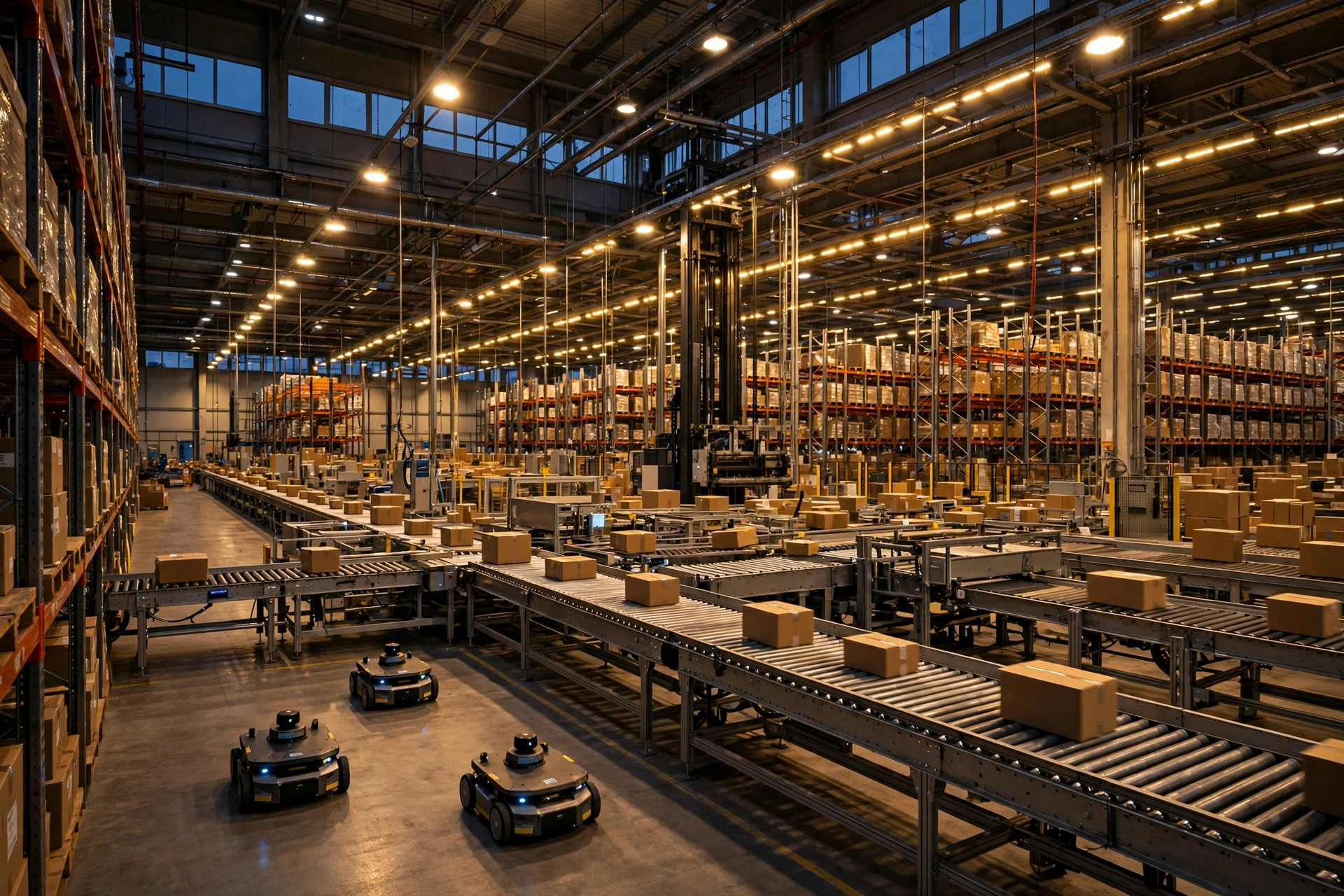
In 2024, a California 3PL running e-commerce fulfillment out of a roughly 60,000-square-foot warehouse installed a cross-belt sorter plus 22 AMRs. Equipment and integration came to about $3.8 million. The project deck was crisp: automation would save roughly $1.2 million a year in labor, payback in just over three years. The owner signed happily.
A year later I looked at their operating books and found a new line item: electricity, about $94,000 a year. The original ROI model had carried electricity at "about $20,000/year" — a guess. Reality was 4.7 times the guess.
Nobody stole that money and nobody wasted it. It sat quietly on the utility bill. The only failure was that nobody had bothered to calculate it before signing.
First, take it apart: what each machine actually draws
Most people have no feel for how much power automation equipment consumes. Here is an order-of-magnitude table for a typical setup (US commercial rates run roughly $0.12–$0.20 per kWh, higher in California; always use your local utility's current rate — these are magnitudes, not quotes):
| Equipment | Installed power (order of magnitude) | Annual electricity (16 hrs/day basis) |
|---|---|---|
| Cross-belt sorter (single, about 200 m line) | 30–50 kW | $25,000–$40,000 |
| AMR fleet (20 units, charging) | 20–40 kW | $15,000–$30,000 |
| AS/RS cranes (4) + warehouse lighting | 40–60 kW | $30,000–$50,000 |
| Chargers, compressed air, control cabinets | 10–20 kW | $8,000–$15,000 |
Add it up: a mid-size automated warehouse routinely burns $80,000–$140,000 a year in electricity. That is not pocket change — it is a middle manager's annual salary.
And that assumes 16 operating hours a day. Many facilities run 24 hours, which pushes the number higher.
Standby power: the invisible killer on the bill
The table above only counts electricity spent doing work. The real damage is the electricity spent doing nothing.
Automation equipment rarely runs at full load around the clock. A typical e-commerce warehouse runs hard 10–12 hours a day in peak season and genuinely busy only 6–8 hours on a normal day. The rest of the time, equipment idles: conveyor motors turning slowly, AMRs trickle-charging at their docks, crane servos on standby, control cabinets and lighting fully on.
Standby draw is typically 20%–40% of full load. Do the math:
- 8 hours at full load × 100 kW = 800 kWh
- 16 hours on standby × 30 kW = 480 kWh
Standby accounts for roughly 37% of total consumption. More than a third of the electricity is burned while the machines are standing still.
An e-commerce warehouse in Dongguan, China, learned this in 2024. Their 30 AMRs picked beautifully during the day. But on quiet nights with no orders, the whole fleet sat at the charging stations while chargers, air conditioning, and lighting ran untouched. At year-end, nighttime standby had eaten 40% of the annual electricity bill. They made two changes — shutting down half the chargers during no-order night windows, putting idle AMRs into deep sleep, and shifting charging to off-peak hours — and saved roughly 60,000 yuan a year. That is about two AMRs' worth of annual depreciation, for free.
Money spent for nothing. You tell me whether that stings.
What share of 5-year TCO is electricity, really?
Put electricity into a 5-year TCO and it stops looking like a footnote. Using the California project above (rounded, structure only):
| Cost item | 5-year amount (approx.) | Share |
|---|---|---|
| Equipment purchase | $3.2M | 62% |
| Implementation & integration | $0.6M | 12% |
| Electricity (actual $94K/yr) | $0.47M | 9% |
| Maintenance & spares | $0.5M | 10% |
| Other (training, retrofit) | $0.35M | 7% |
Electricity is 9% of five-year total cost — one point shy of maintenance and spares. Yet the original ROI model, carrying electricity at $20,000 a year, showed it at 2%. The estimate was off by a factor of 4.7.
What does that error do to the ROI? Original model: $1.2M annual labor savings minus about $850K annual cost (depreciation + maintenance + estimated electricity) = $350K net per year, payback around 3.2 years. Recalculated with actual electricity: about $920K annual cost, $280K net per year, payback around 4 years.
Payback stretched by eight months. Those eight months are the price of "forgetting the electricity."
Here is the counterintuitive takeaway: the most dangerous number in an automation ROI model is not the equipment quote — at least the quote was negotiated. The most dangerous numbers are the operating costs somebody filled in with "about," and electricity has the largest error bar of them all. The vendor quotes peak efficiency; the utility bill quotes 24-hour reality.
Four levers that actually cut the bill
Electricity you cannot reduce is fate; electricity you reduce is skill. Four levers, ranked by impact:
First, shift load off-peak. Many US utilities, like China's, run time-of-use pricing — off-peak rates can be less than half of peak rates. Schedule non-urgent work like AMR charging and AS/RS replenishment for off-peak windows. The Dongguan warehouse saved the bulk of its money this way. Get a time-of-use rate sheet from your utility first; that one page is worth tens of thousands.
Second, write variable-speed drives and standby behavior into acceptance criteria. A conveyor on a variable-frequency drive idling at low speed uses 30%–50% less power than one spinning at full speed with no freight — that is an order-of-magnitude fact. At sign-off, don't just test "how fast it runs"; add one line: "auto slow-down to standby after 10 minutes with no freight." Every vendor can do it. They just won't volunteer it.
Third, zone your lighting. Use occupancy-sensing lights in AS/RS aisles and high-bay areas that dim when nobody is working there. Lighting can be 15%–20% of an automated warehouse's electricity bill, and it is the easiest win on the list.
Fourth, bid on energy per unit. Add one criterion to the tender scorecard: electricity consumed per sorted order. Two sorters may differ 10% on price, but if one uses 20% less energy per unit, five years of electricity wipes out the price gap and then some. If you can't verify it, ask the vendor for third-party test data.
A formula to take home
Before signing any automation project, run this number:
Annual electricity ≈ installed power (kW) × annual operating hours × blended load factor (use 0.5–0.7) × local electricity rate
And one rule of thumb: if the result exceeds 30% of the equipment's average annual depreciation, the ROI model must be redone.
Electricity never disappears on its own. When you don't calculate it, it quietly eats your margin. Calculated, it is a cost. Uncalculated, it is tuition.
By Lao Zhou, Logistics Cost Analyst