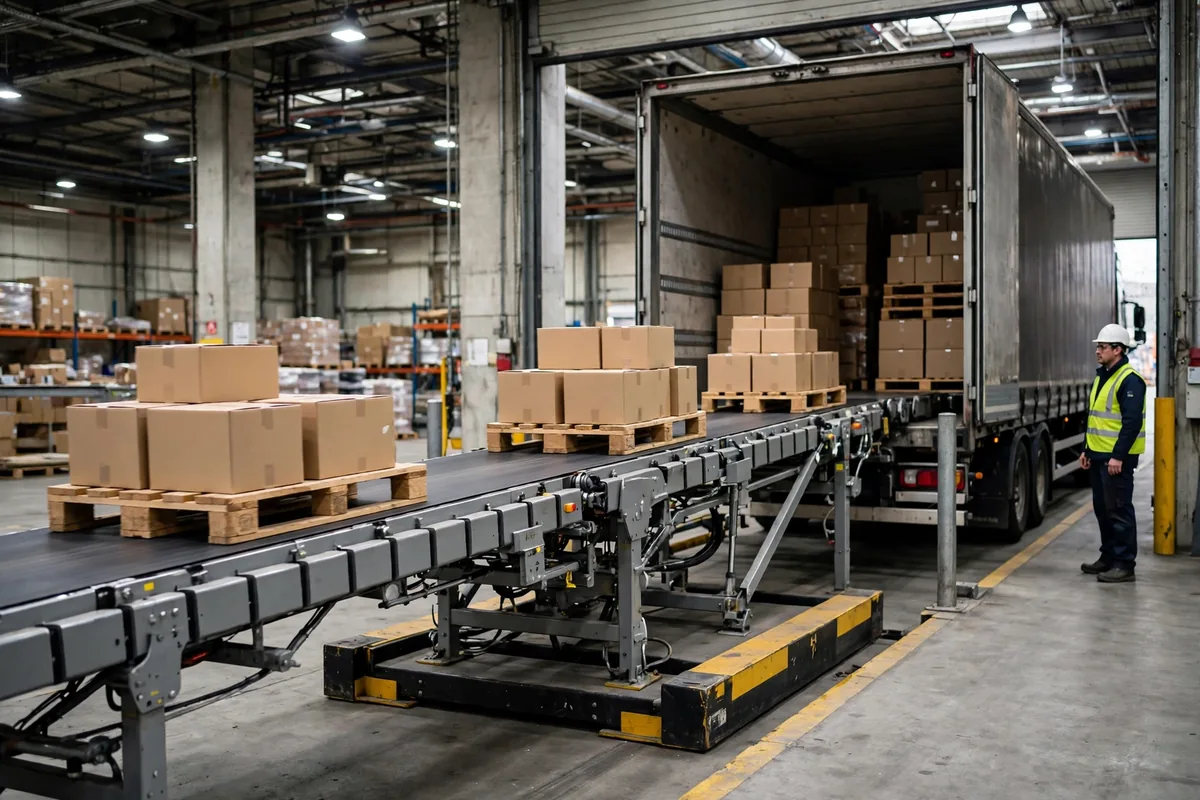
Last October I watched an automated truck loading system at work on the dock of a beverage distributor in California's Inland Empire. Two telescopic conveyors reached into the trailer, an operator tapped a button at the dock edge, and one pallet of drinks after another slid into the trailer and stacked itself neatly. The warehouse manager stood next to me with that look people get after spending serious money — half proud, half nervous — and asked me one question: Da Liu, is this thing actually worth it?
I didn't answer on the spot. There is no standard answer to that question, only a way to do the math. And one thing needs saying first: it never saves you the act of loading itself. It saves the people, the time, and the mistakes behind that act. Asking how fast the equipment runs before asking what your freight looks like is like buying a car by its top speed without asking what roads you drive every day.
How an Automated Truck Loading System Actually Gets Freight Into a Trailer
Roughly three designs dominate the market. The first is the telescopic belt conveyor: the belt extends section by section into the trailer and cartons ride in one by one. Think of it as an arm that grows longer on demand — a good fit for cased goods with neat, consistent stacking. The second is full-pallet push loading: a whole row of pallets is shoved into the trailer at once. It is the fastest of the three, and also the least forgiving — it demands standardized pallets and disciplined stacking. The third uses a dock shuttle or loading vehicle: freight is staged on the dock first, then carried into the trailer as a complete load. Flexible, but the slowest cycle of the three.
Different principles, same weak point: alignment. The trailer floor, the dock surface, and the conveyor have to agree on height and centerline within a few centimeters, or freight jams at the threshold or lands crooked. The real engineering in loading automation is not making things move; it is making them line up right every single time.
So before you look at the speed numbers in a brochure, look at your own dock. Uneven dock heights, a sloped apron, trailers whose floors sit at different levels — any one of those cuts the system's real performance in half before it loads a single pallet. I have seen a warehouse where the equipment was fine but the dock was built twenty years earlier for older trailers; a new trailer's floor sat a few centimeters higher, the conveyor needed manual shimming every time, and the "automation" ended up semi-automatic, with the operator busier than before.
The Dividing Lines: Which Warehouses Should Actually Buy an Automated Truck Loading System
Is there a hard cutoff? Yes, and it is harder than most vendors will admit. I keep a table I pull out every time a client asks about an automated truck loading system:
| Your situation | My recommendation |
|---|---|
| Fewer than 10 trucks a day | Don't touch it. Fix dock scheduling and staging rhythm first |
| 10–25 trucks a day, mixed freight, mixed pallets | Standardize first. The equipment conversation comes later |
| 25+ trucks a day, uniform freight, uniform pallets | Worth a serious conversation. The numbers usually work |
| 40+ trucks a day, running multiple shifts | Skip automation and the dock becomes your bottleneck |
Take the beverage warehouse from the start of this story and run the labor math. One trailer holds 26 pallets. By hand, two people needed about ninety minutes to load it. With the system in place, one operator watches it finish in roughly 35 minutes. At 30 trucks a day, that is more than seventy labor-hours a day freed up. It sounds great, and it is — but only if those hours have somewhere to go. If picking and staging are already short-handed, the savings are real. If the freed-up people just stand somewhere else in the warehouse, the savings on paper are a fiction you are telling yourself.
The second story is a warning. In the spring of 2023, a paper products warehouse near Dallas called us in: their loading system had been running for three months and they wanted to rip it out. The equipment was not the problem. Their pallets were. Three pallet sizes in circulation, differing by a couple of centimeters, with inconsistent stack heights — the push loader jammed at the trailer door two or three times out of ten. The fix was not a tuning job. They replaced every pallet in the building, wrote off the old ones, and rewrote their stacking rules. Nobody had measured the pallets before automating. A loading system has a temper: it takes every inconsistency upstream and magnifies it. Everything a human loader can fudge, it cannot fudge at all.
Here is the counterintuitive part: the faster you load, the worse your dock congestion can get. Once loading time drops, the bottleneck moves upstream in a hurry. Staging cannot keep up, trucks queue at the dock door, drivers get impatient, and dock scheduling turns messier than it was before automation. I saw a 3PL in Ohio in 2022 cut its loading time in half with automation, only to end up with a line of trucks stretching out to the street — because the staging area could only prepare two trailers' worth of freight at a time. The vendor's acceptance report looked beautiful. The warehouse manager lost half his hair. Automation is never a single-point speedup. It is a whole-chain speedup, and the slowest link in the chain decides how fast you actually go.
The Maintenance Traps Nobody Puts in the Proposal
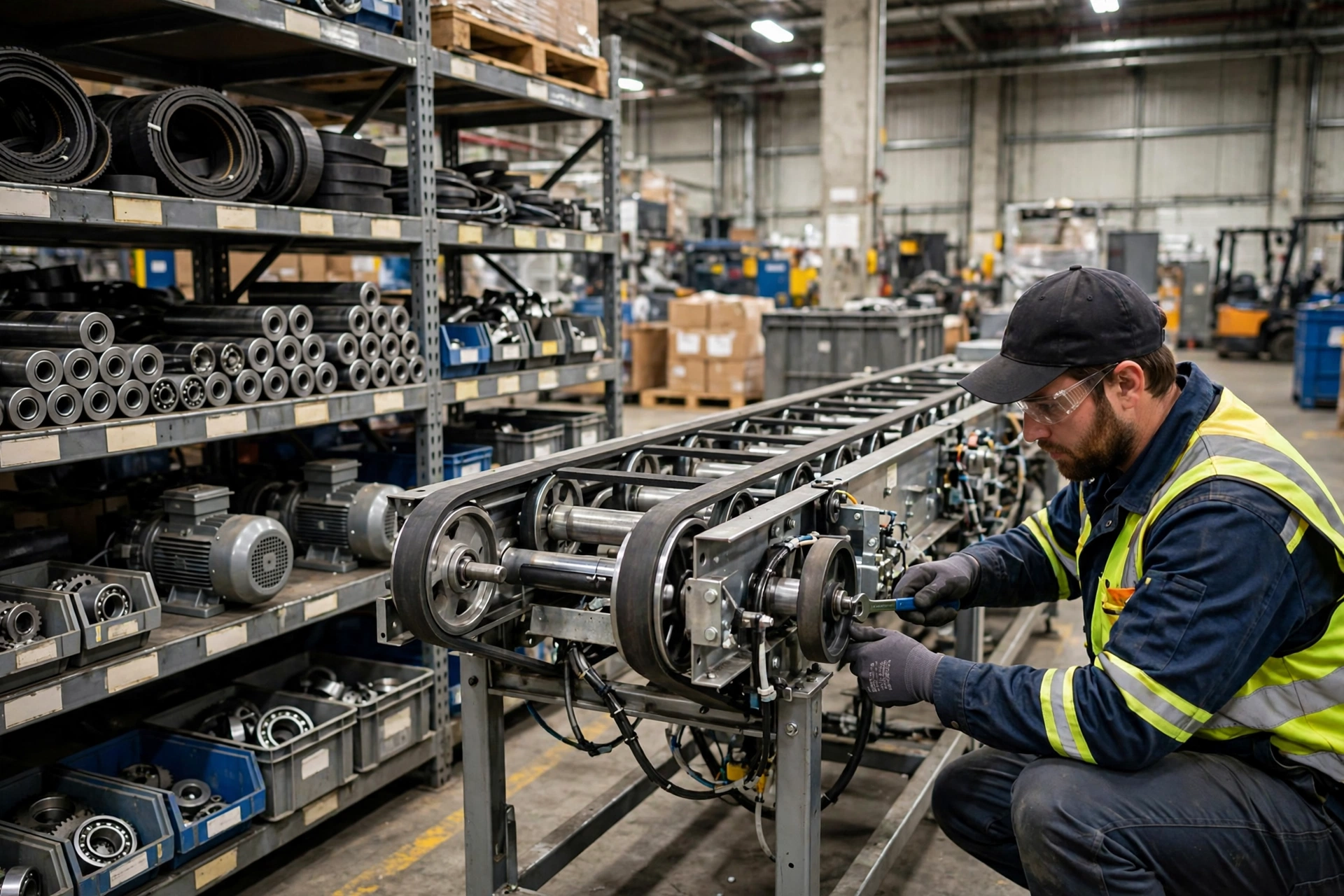
Move-in day is the happiest day of the project. The real test starts after. The most common failures I see fall into three buckets: sensors throwing false alarms because of dust, belts tracking off center, and chains and rollers wearing out. Sensors are the fussy ones. Dock dust is relentless, one thin layer over a photoeye and the system decides there is an obstacle in the trailer and stops the whole line until someone wipes it down. Think of the system as a clean freak: the dirtier the warehouse, the more it complains.
Spare parts are the second trap. Lead times on proprietary telescopic conveyor parts are not short, and if the critical spares are not sitting in your building, one breakdown sends the dock straight back to manual loading. Get the spares list and delivery times written into the contract, and stock three months' worth of wear parts on site. Do not accept "we can get it to you anytime." The vendor will not do that downtime math for you, so do it yourself before you sign.
Then there is uptime. Treat the brochure's availability figure as a rumor. Dust, temperature swings, and operator habits all drag it down. The numbers that matter are your own: over the past three months, what share of the time was the system actually available? How many times a week did it stop, and for how long? Three months of those three numbers beats any brochure.
I have no patience for fake demand here: a warehouse running fewer than 10 trucks a day that insists on an automated truck loading system is usually buying something that looks good on a tour. Automation is built for volume, standards, and stability. Without the volume, the equipment spends most of its life idle while the maintenance bill arrives in full. That is paying good money to buy yourself anxiety. Get the truck volume up, standardize the pallets, and straighten out staging first, and the automation decision makes itself.
So back to the question the beverage warehouse manager asked me. Is the money worth it? It comes down to one number: your steady daily truck count. Not the peak-season spike, not the sales target — the count on the most ordinary day of the last three months. Multiply that by the labor-hours saved per trailer, set it against the real cost of the equipment and its upkeep, and the answer works itself out. And if that number is not there yet, don't buy the equipment. Unify the pallets and fix the staging first. That work costs little, and it decides whether the system you eventually buy is a helper or a very expensive decoration.
By Da Liu, Automation Engineer