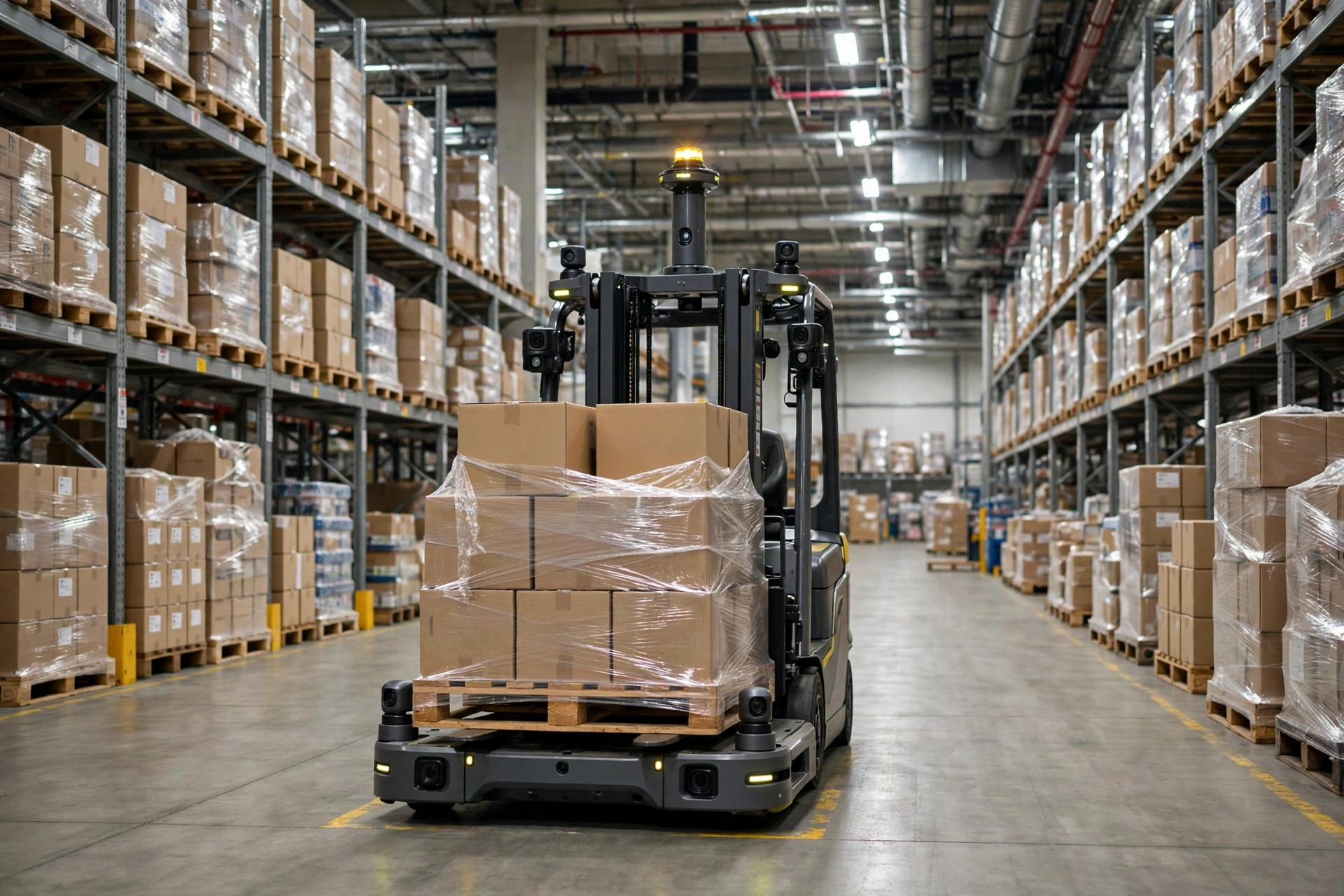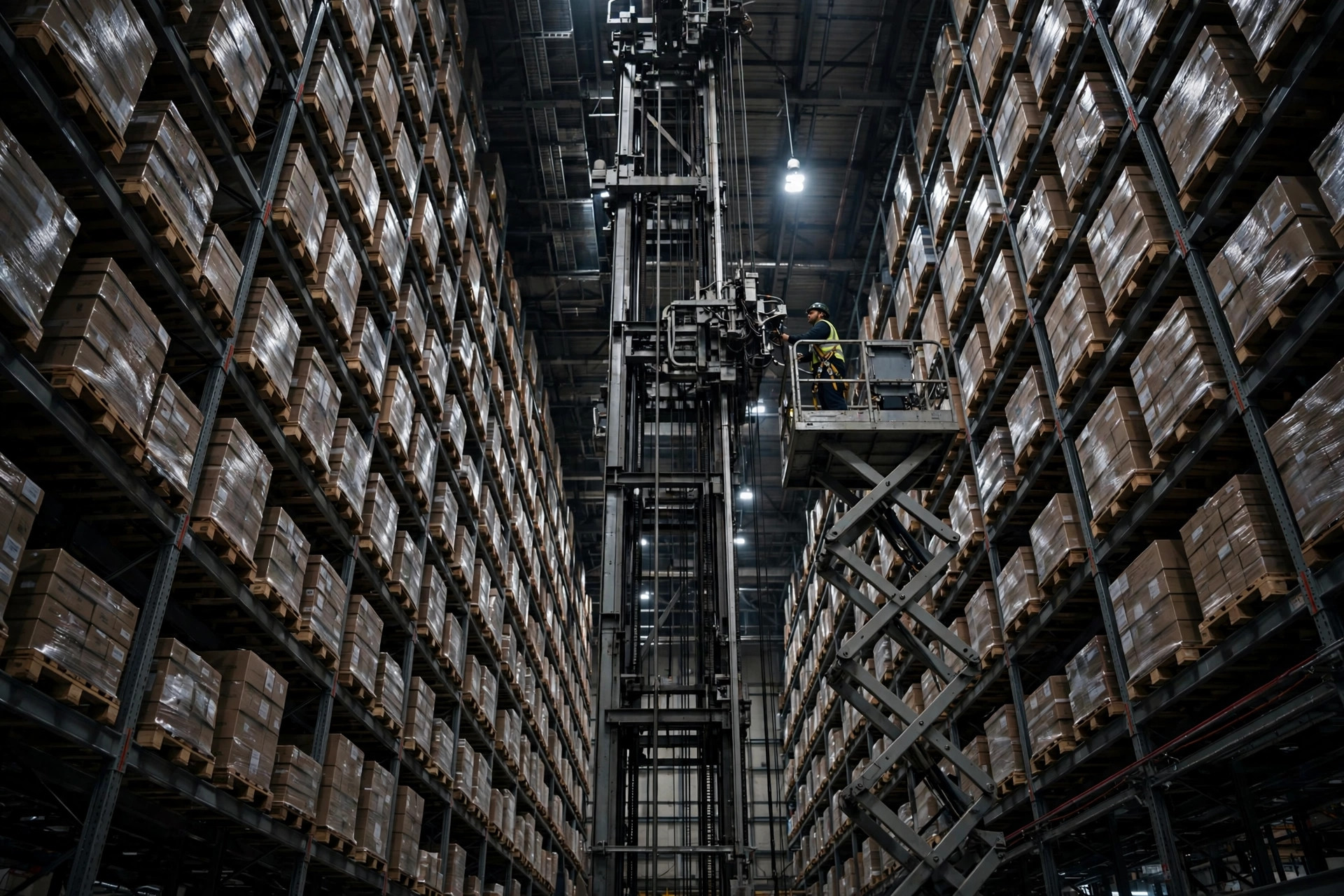
If you've ever searched "amr maintenance checklist warehouse," you've seen the results: wipe this, check that, tighten those. Correct, and useless. Most amr maintenance checklist guides stop at "wipe and inspect" — none of them tell you when the three wear parts actually need replacing. During my years as a tech lead at a systems integrator, I managed AMR fleets across four warehouses, and here's what I learned: a checklist doesn't need to be long. It needs to be right. An AMR has exactly three parts that die slowly: tires, LiDAR, and batteries. Everything else either doesn't break, or breaks in a way you can't fix yourself — call the vendor.
Do the math and you'll see why only these three matter. A mid-size AMR carrying 500 kg runs 18–22 km a day inside a warehouse. Over 300 operating days a year, that's 5,500–6,500 km — the mileage your car does in two years, except your car gets serviced and the AMR gets nothing. Most warehouses park the fleet on day one and forget it until a robot starts weaving down the aisle like it's drunk and kissing every rack. That's like buying a car, never checking tire pressure, and then complaining about build quality.
The physics: why the checklist has only three parts
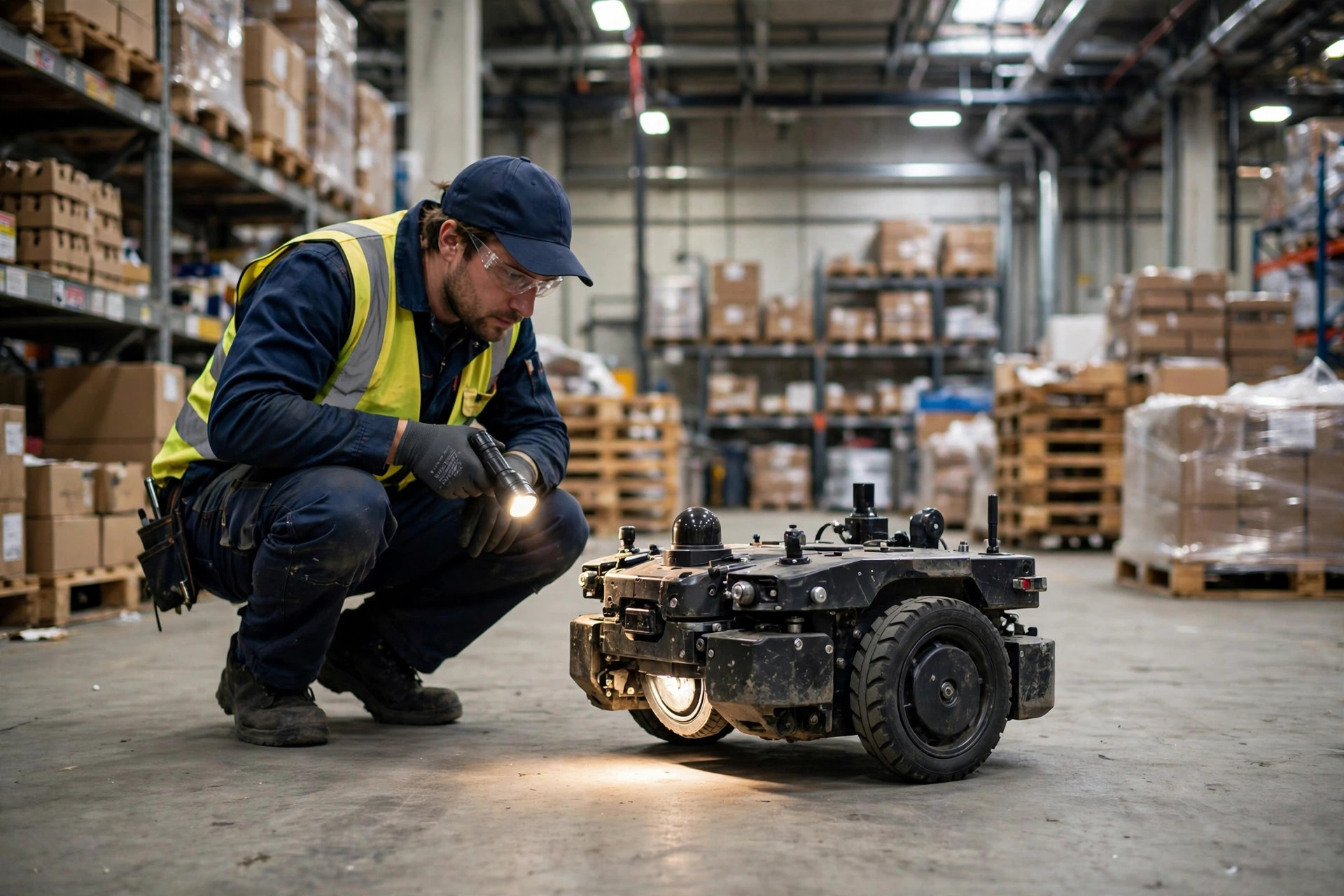
Tires are the AMR's feet — and its ruler. Most AMRs run polyurethane drive wheels paired with casters, and odometry counts wheel revolutions to measure distance. Think of the wheels as the robot's tape measure. Every millimeter of tread worn off shrinks the diameter by two millimeters, and the odometer starts systematically under-counting distance. You won't notice at first. But once drift hits ±50 mm, the robot can't square up to rack positions anymore — it shuffles, re-adjusts, spins in place, and cycle time drops 10–15%.
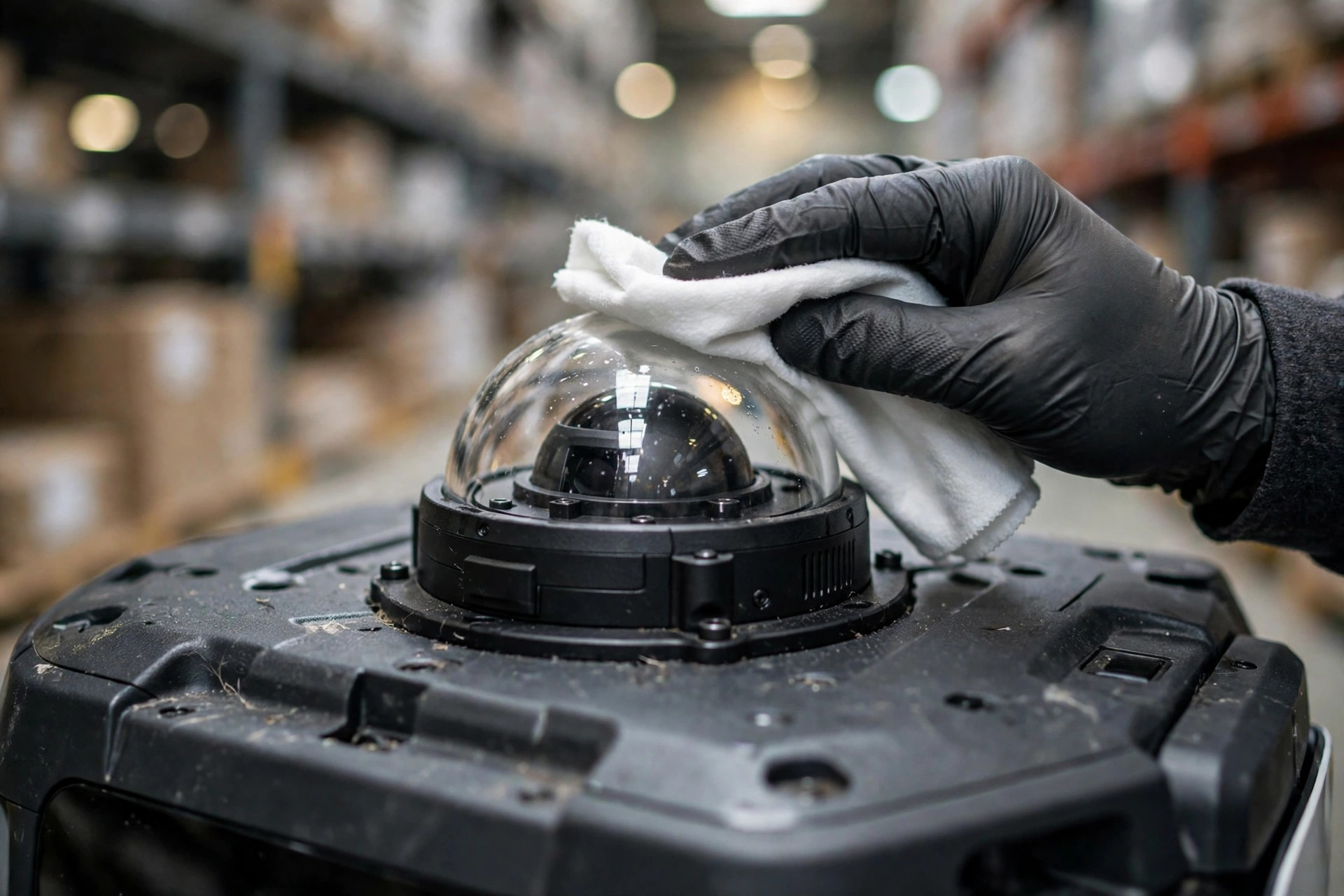
LiDAR is the AMR's eyes. That spinning (or solid-state) puck on top fires tens of thousands of points per second and builds a point cloud to answer two questions: where am I, and what's ahead. Think of it as constantly looking around. When the lens gets dirty, the point cloud fills with noise — like wearing fogged-up glasses. The AMR then does one of two things: frequent protective stops, or worse, treats noise as obstacles and plans longer and longer detours.
The battery is the AMR's stomach. Warehouse fleets overwhelmingly run lithium (mostly LFP these days), and battery life isn't measured in years — it's measured in two numbers: cycle count and calendar age. LFP cells typically hit end-of-life after 2,000–3,000 cycles, where end-of-life means capacity below 80% of new. And here's the counterintuitive part: what kills batteries fastest isn't hard use — it's sitting at full charge doing nothing. Calendar aging at high state-of-charge eats capacity faster than daily cycling. Those spare robots you keep fully charged in the corner for peak season? Three months of that and they come out with 20% less range.
The replacement thresholds: three numbers, no debate
Physics covered. Now the hard goods. One replacement threshold per part — don't spend before it, don't hesitate after it:
| Part | Replace when | How to measure | Cost of waiting |
|---|---|---|---|
| Drive wheels | Tread worn ≥3 mm, or diameter ≥5 mm smaller than new | Caliper the diameter; check if tread is bald | Odometry drift ±50 mm, missed dock alignments, 10–15% slower cycles |
| LiDAR | Lens scratched or coating peeling, or protective stops still >3/day after cleaning | Eyeball + flashlight on the lens; pull stop logs | Frequent e-stops, uptime down 3–5 points; worst case, a collision |
| Battery | Full-charge runtime <80% of new, or charge frequency 1.5× new | Time one full-to-alarm run; read cycle count from BMS | Robots run home to charge mid-task; the whole fleet's rhythm breaks |
Note the LiDAR row: replace only when the lens is scratched. Dirty? Just wipe it. This is where I go after my first piece of snake oil: "self-cleaning LiDAR" — a little wiper blade that sweeps on a timer, for a few thousand dollars extra. Think of it as windshield wipers for glasses. The problem: warehouse dust is oily and electrostatically charged. Dry-wiping just grinds the coating off. A two-minute manual wipe solves what a few-thousand-dollar gadget pretends to. I've seen three warehouses buy the feature; two went back to hand-wiping, and the third removed the wiper after it scratched a lens — and the replacement lens cost more than the wiper did.
The maintenance traps: three breakdowns, all from skipping the checklist
Fall 2023, a 3PL cross-dock in Ontario, California, running 12 AMRs. The site lead told me the robots "felt floaty." I walked the floor: all 12 drive wheels worn bald, and unevenly — the two running the narrow aisle, spinning in place all day, were worst. Odometry drift had them weaving S-curves down a 2.8-meter aisle, kissing a rack about once a week. Uptime slid from 98.5% to 93% — effectively one robot out of twelve permanently limping. A set of drive wheels runs $300–500 a pair; we swapped all twelve in half a day, and uptime was back above 98% within a week. The rack beam and damaged goods from one of those kisses cost over $4,000 — enough for eight sets of wheels.
Trap two was a freezer. Early 2024, a −20°C cold-storage site: dozens of protective stops a day, and the site was ready to order six replacement LiDAR units at nearly $10,000 each. I asked them to try one thing first: a two-minute lens wipe at every shift handover, plus a five-minute pause in the ambient buffer zone when robots came out of the freezer, to let condensation evaporate. A week later, stops were down to two or three a day. The LiDAR was never broken — frost and condensation on the lens were filling the point cloud with noise. Sixty thousand dollars of sensors saved, for two minutes a shift. That's why my checklist says wipe every shift, not every week.
Trap three was batteries. Late 2024, an e-commerce fulfillment center called: the fleet "kept getting tired." Eight hours of runtime had decayed to five; robots queued at chargers all day and wave schedules fell apart. The BMS told the story: 2,400+ cycles, 71% capacity. Past the end-of-life line — no trick saves it, only a new pack. A battery pack is 20–30% of the robot's cost; twelve robots at once is six figures. The postmortem found their charging policy: opportunity-charge constantly, always topped to 100%, robots napping on the charger whenever idle — exactly what lithium hates most. They switched to schedule-based charging and parked idle robots at 50–60% state-of-charge. The new packs are aging visibly slower.
Putting the checklist on the shift schedule: ten minutes a day
The checklist itself is short. The trick is making it a non-negotiable ten minutes on the shift plan. This amr maintenance checklist doesn't try to cover everything — it answers one question: when to replace each of the three parts, and what to do before that day comes:
- Every shift (2 min): Wipe the LiDAR lens — lint-free cloth, one direction, no circles. Glance at the drive wheels for wrapped stretch film or strap — the two most common "foreign objects" in any warehouse.
- Weekly (10 min): Caliper two robots' drive-wheel diameters and write it down — yes, pen and paper, no system needed. Spin the casters by hand; check battery contacts for oxidation.
- Monthly (30 min): Pull three numbers from the fleet dashboard — protective-stop count, average task cycle time, charge frequency. If any of them worsens more than 20% month over month, go back to the threshold table and find the cause.
The total math: a 12-robot fleet costs about one labor-hour a day for inspections — a few thousand dollars a year. One breakdown: $4,000+ in Ontario, six figures for the battery packs. You can do this arithmetic yourself.
Worth it or not? Watch this one number
Is the inspection effort worth it? I watch exactly one number: uptime. A fleet holding 98%+ uptime year-round means the checklist is working. Drop below 95% and don't rush to buy spares — ask three questions first: did you measure the wheels? Did you wipe the lens? Did you check the cycle count? Nine times out of ten, the answer is in those three questions.
An AMR isn't a device you buy and forget. It's a fleet. And fleet management is one sentence long: don't wait for it to break down — one breakdown costs more than a year of wiping lenses.
By Da Liu, Automation Engineer