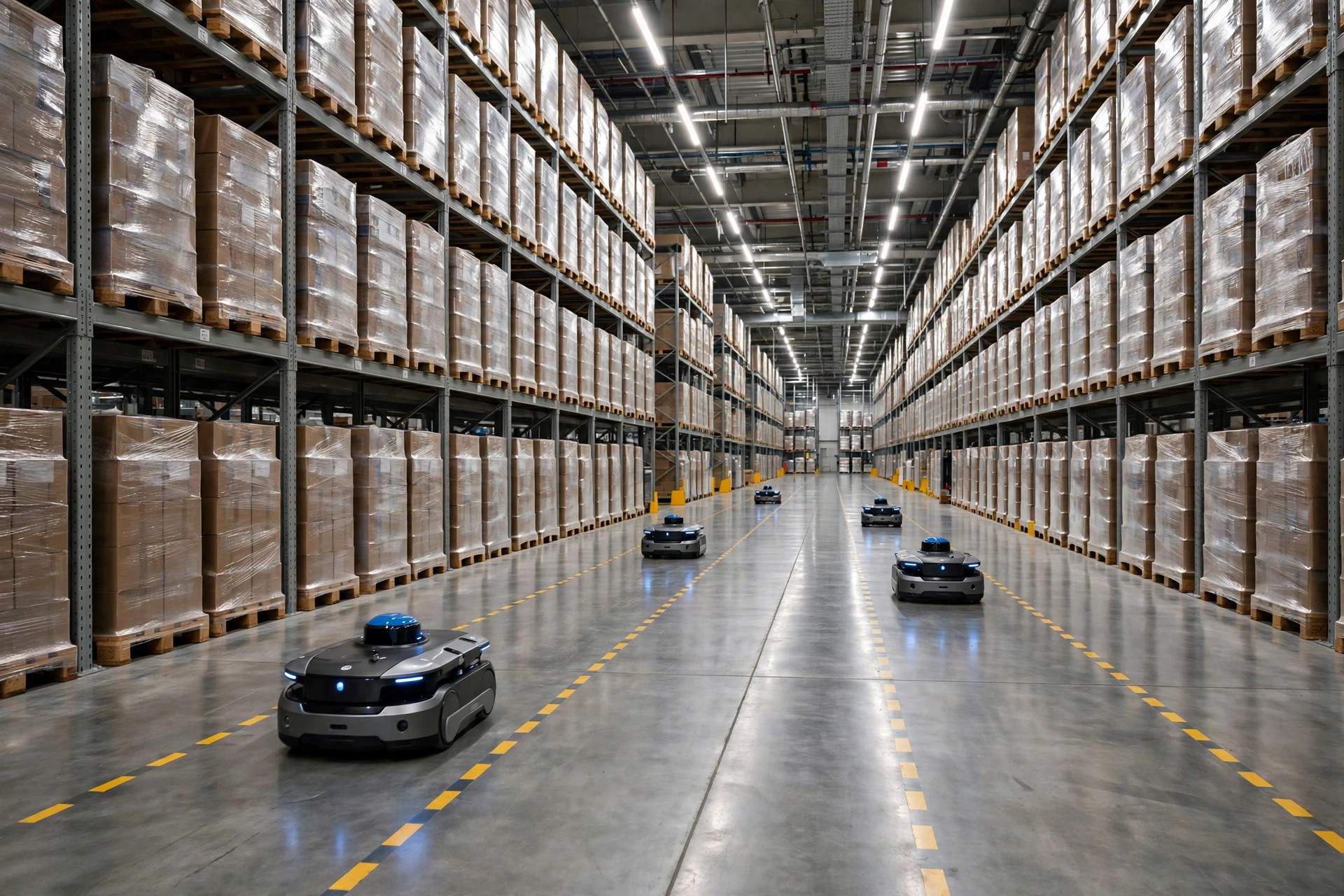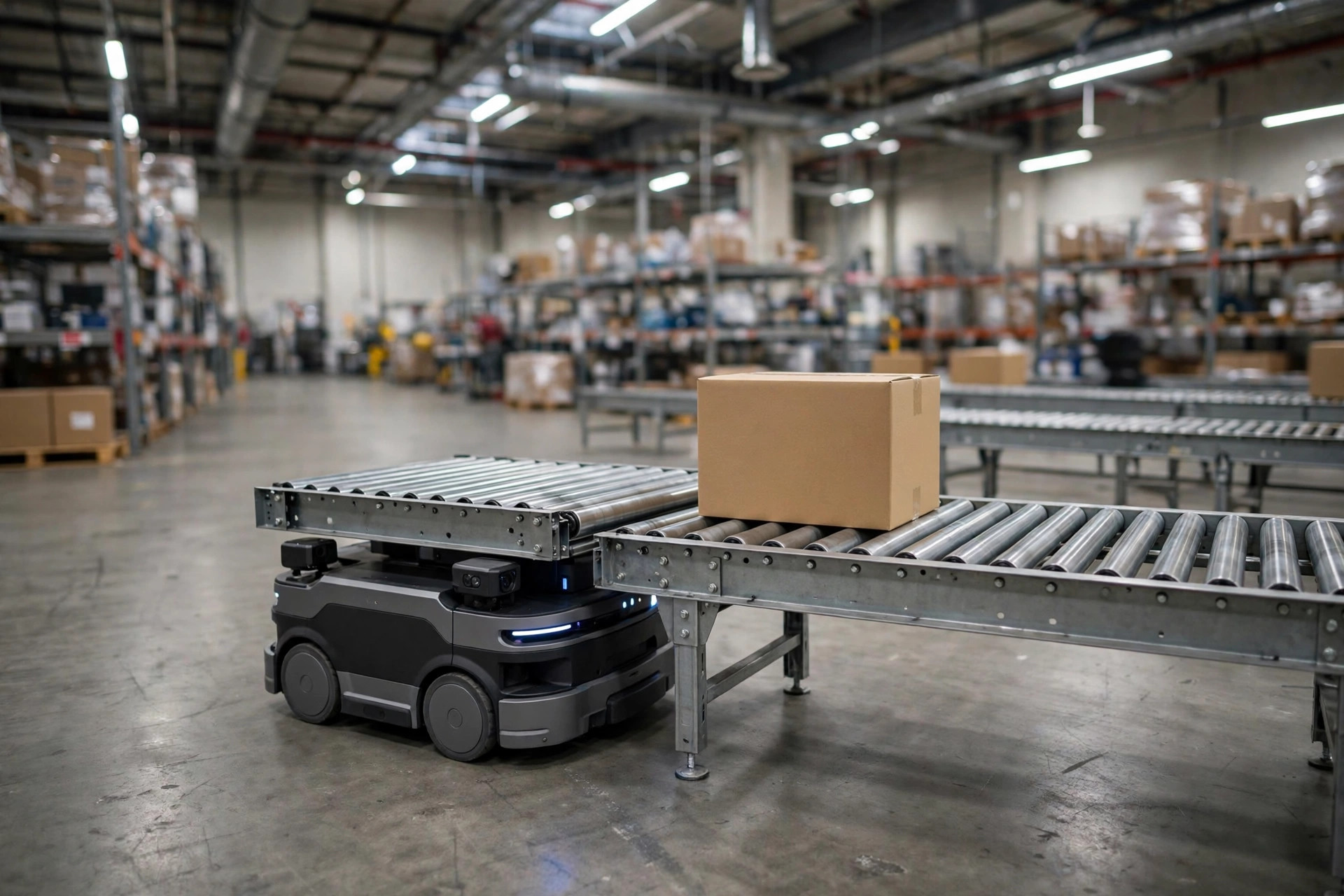
The day our three AMRs arrived last November, I almost set off fireworks. A 3,000-square-meter warehouse finally stepping into automation — I felt like we'd made it.
That feeling lasted about a week. Then the charging docks nearly took down our entire night shift.
The sales rep had promised "docks come with the robots, just plug and play." So we installed all three chargers in a dead corner at the far end of the warehouse. It was empty space, after all — why waste good real estate? The first week was quiet. Then one night at 9:40 PM, two robots hit low battery at the same time and queued up to charge right at the mouth of the main aisle. Forklifts couldn't pass. Pickers couldn't pass. Two AMRs sat there side by side like a pair of drunks who'd passed out in the middle of the highway. Our night shift is two people. They spent 40 minutes manually moving robots, rebooting, re-routing. We shipped 60-plus fewer orders that night.
I sat by the aisle that night (I don't even smoke, normally) and figured something out: the big-company playbook — one dock per robot, a dedicated charging zone designed by consultants — is something warehouses like mine can't afford and can't use. But get the dock count and placement wrong, and even the best robots just become expensive traffic cones.
How Bad It Got
Our warehouse is in Bao'an, Shenzhen. Rented, 3,000 square meters, 6-meter ceilings. Three domestically-made AMRs, 500-kg class, hauling picked pallets from the picking zone to packing. Buying those three robots had already wiped out two years of my equipment budget, so the charging budget was whatever was left in the couch cushions.
The original layout is embarrassing to describe now: three chargers crammed into the far corner, a two-and-a-half-minute walk from the main work area. Every charge run meant five minutes of deadhead travel round-trip. Two charges a day, twenty minutes burned just driving to the plug. Worse, that corner happened to sit on the forklift's main route into the pallet area. A charging robot parked there was basically a toll booth in the middle of a freeway.
A buddy of mine in Dongguan runs an auto-parts warehouse, 4,000 square meters, five robots. He had it worse: his chargers went up next to a fire exit, the property management warned him twice, and he ended up spending 8,000 yuan re-running cable to move them. That money was pure tuition.
How Many Chargers? My Back-of-Napkin Formula
The big vendors love to write "one dock per robot." Sounds great, hurts the wallet. Small warehouses play a different game: you can have fewer docks than robots, as long as you nail the staggering.
Here's my formula:
Chargers needed ≥ fleet size × (single charge time ÷ daily charge windows)
Our math: 3 robots, 2 hours to go from 20% to full. Our real idle windows are two per day — lunch, 12:00–1:00 PM, and the shift change, 5:30–6:30 PM. That's 2.5 hours total. 3 × 2 ÷ 2.5 = 2.4, round up: at least 3 chargers.
Wait — that still gives 3 chargers. What's the difference from "one dock per robot"? The usage. Big companies do one-dock-per-robot, charge whenever. We do fewer docks, scheduled top-ups. An AMR doesn't need a full charge every time; 60–70% buys you another two or three hours of work. We changed the dispatch logic: during lunch, the three robots take turns on the docks, 50 minutes each; same again at shift change. Honestly two docks would cover it — I keep the third as redundancy, because if one dock dies, I don't want the whole fleet down.
Here's the counterintuitive part: more chargers isn't better. Every idle dock is paying rent. Each dock position eats 2–3 square meters, and warehouse rent in Bao'an is what it is. An empty charging spot is square footage that earns nothing. In a small warehouse, every square meter has to pull its weight.
Wrong Spot, Wasted Money
We re-laid the chargers this March and came away with three lessons written in blood:
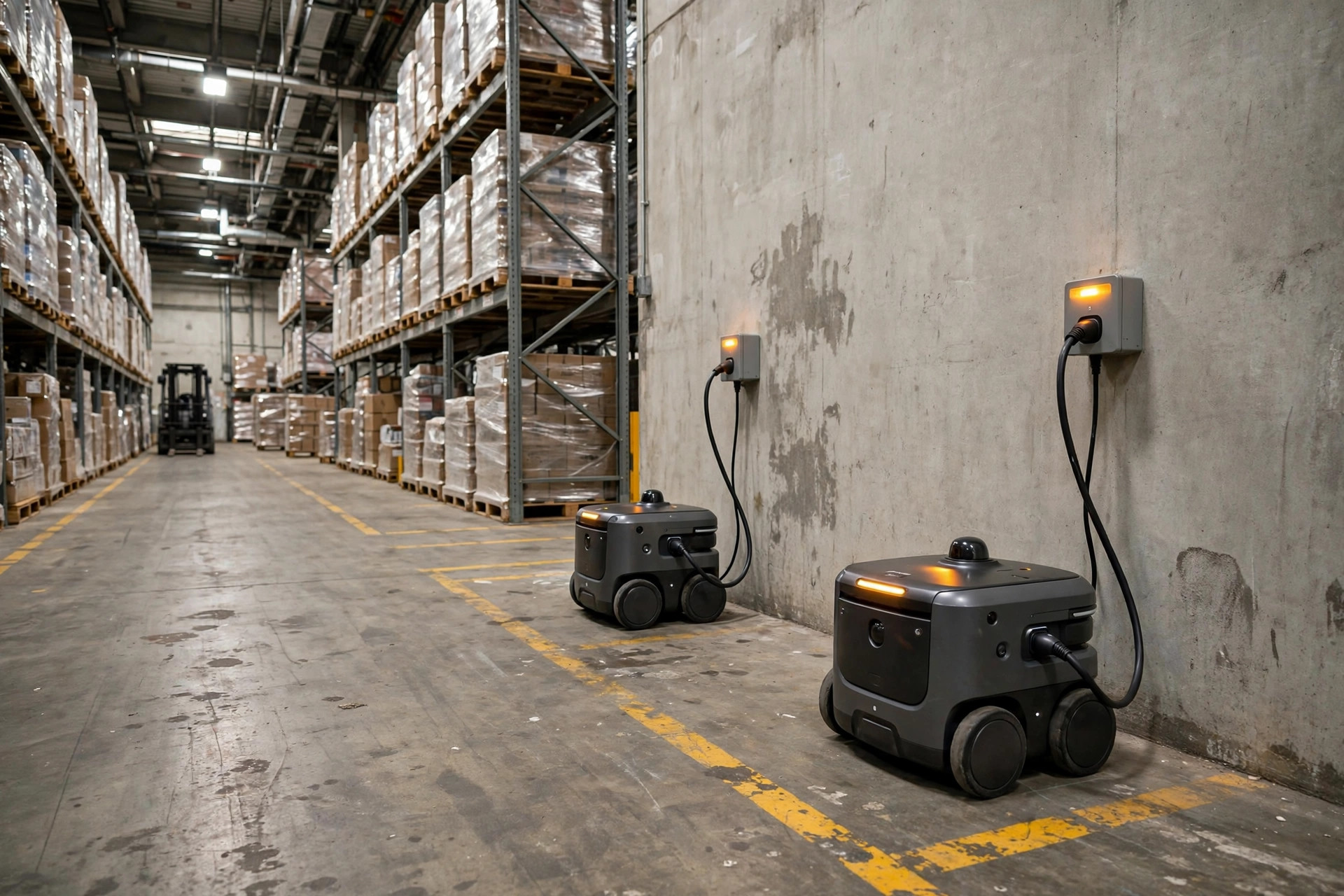
First, hug the wall, not the aisle. The sweet spot for chargers: against a wall, next to dead space, within a one-minute walk of the main work zone. We ended up on an unused wall beside the picking area — docks in a row flat against the wall, a yellow taped box on the floor, two traffic cones. Robots charge hugging the wall, zero aisle blocked. Too close to the action and charging robots fight working robots for road space; too far and you burn battery just getting there. One minute on foot — that's the sweet spot I measured.
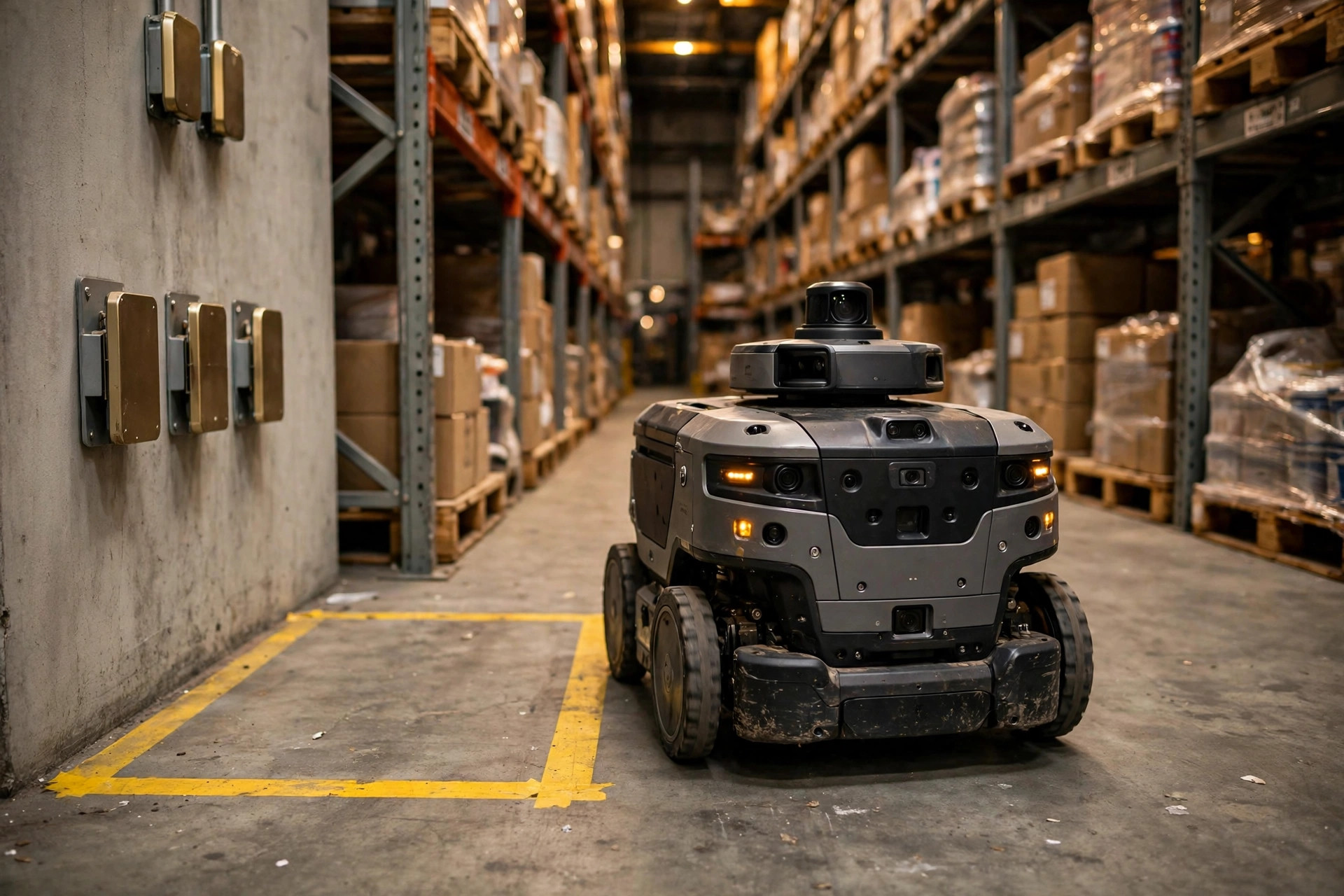
Second, the wiring costs more than the dock — check your breaker panel first. This is where people get fleeced. The charger itself is cheap; running cable and upgrading capacity is where the money goes. Our electrician took one look at our panel, found spare capacity, and ran a line off a spare circuit — 3,000 yuan, done. If we'd needed a capacity upgrade, that's tens of thousands and a month or two of paperwork. So the order is always: electrician checks the panel first, then you pick dock spots, then you buy robots. Buying robots before sorting out power is the rookie-tax order of operations.
Third, skip the vanity charging lounge. Big companies build charging zones with electronic fencing, climate control, monitoring dashboards. Us? Yellow floor tape, two cones, 200 yuan total. For cooling, one industrial fan pointed at the docks. Don't laugh — last summer at 38°C, our docks ran straight through without a single failure.
After the rework I logged two weeks of data: average queue time for charging dropped from 47 minutes to 12, and deadhead mileage fell by about 6 km a day (per the robots' own odometers). Barely spent anything. Night-and-day difference.
A Few Cheap Tricks for Small Warehouses
For fellow small-warehouse owners, the tricks we've actually validated:
- Charge on off-peak power. Nighttime off-peak rates run meaningfully cheaper than peak (check your local utility's published schedule for the exact spread). Night shifts are quiet anyway — let the robots fill up when the power's cheap. We save several hundred a month on electricity. That's two midnight snack runs for the crew.
- Pre-wire for docks you haven't bought. When running cable, bury two extra conduits in the wall. When the fleet grows to five or eight robots, adding a dock is a few screws. Re-trenching cable once will hurt for half a year.
- Paint the charge routes separately from the work routes. Different floor colors — yellow for work traffic, white for charging runs. Drivers and pickers get it at a glance. Don't rely on common sense; common sense evaporates the moment things get busy.
- Keep one "spare" dock. That redundant dock normally serves whichever robot is lowest, and in a pinch it's a lifesaver. One day of fleet downtime eats every yuan you saved by skimping.
At the end of the day, charging layout is one of those things where big companies have their playbook and we have ours. They're not short on money; we're short on money we're allowed to waste. Pick the right spots, do the math on the count, stagger the charging, and a three-robot fleet runs just fine.
Small warehouses have their own way of surviving. Next time a fellow owner visits, the first thing I'll show them is our charging row — two yellow lines and two traffic cones, the cheapest and best-value "automation investment" in the building.
By Xiao Ma, Small Warehouse Owner