A 20-ton hot-rolled coil takes up 3 square meters lying in a saddle, 5 standing on end. Same warehouse, same product — flip the posture and capacity swings by 40%. That's steel warehousing: everyone else counts pieces or pallets. We count tons.
Think of it like building a house. A normal warehouse starts with a racking layout. A steel warehouse starts with the foundation.
The Physics First: Steel Warehousing Is About Gravity, Not Space
Normal warehousing optimizes cubic meters. Steel warehousing optimizes tons per square meter. A hot-rolled coil typically runs 8–25 tons, a bundle of plate 5–10 tons, a bundle of 12-meter H-beams easily 3 tons. Everything you set on the floor has an elephant sitting on it.
So the first design input is not rack height — it's floor loading. A typical industrial slab handles a few tons per square meter of live load (check your structural drawings), but a 20-ton coil bears through just two saddles on under 2 square meters. Local pressure multiplies several times over. Get the structural engineer to verify slab capacity before you draw a layout line.
Coil Storage: Lying Down or Standing Up? The Saddle Decides
Coils sit in two postures. Eye-to-side (axis horizontal) is the workhorse: compact footprint, low center of gravity — but it demands a coil saddle, a V-shaped steel cradle that grips the coil's outer diameter and stops it rolling. A coil is a 20-ton cylinder; without a cradle, one nudge from a forklift sends it rolling, and a rolling 20-ton coil will snap a building column.
The saddle lesson cost real money. In 2023 I was on a steel-market project in Foshan where the client welded their own saddles from angle iron: narrow, hard contact edges. Three months later the outer-wrap scrap rate was visible to the naked eye. Every yuan saved on saddles came back as scrap.
Eye-to-sky (axis vertical): forklifts and C-hooks work the coil eye directly, no flipping, lower risk of edge damage. But it eats floor space, raises the center of gravity, and usually stays single-high. It fits high-value, surface-critical product — cold-rolled, galvanized, silicon steel. The dividing line is clean: hot-rolled commodity coils go eye-to-side into saddles; anything that can't take a dent stands up.
How High Can You Stack Plate? And Why Sections Need Cantilever Racks
Plate ships in bundles, and stack height should stay under 2 meters — that's common industry practice; follow your customer's spec for the final number. Why? Above three bundles, vibration and handling loosen the bottom bundle's strapping, and the whole pack "bursts" and slides. In May 2024, a steel trader's warehouse in Tianjin stacked 6 mm thin plate to 2.4 meters. Overnight temperature swings slackened the middle bundle's straps, and the pack slid into the aisle like dominoes — luckily at 3 a.m. Thin plate is the worst: big surface area, low friction, a loaded spring when stacked high.
Three anti-collapse habits: align your dunnage top to bottom so the load transfers straight down, never staggered; strap each bundle individually instead of trusting the weight above to hold it; separate grades and specs — no mixing. Six out of ten steel yards I visit have crooked dunnage.
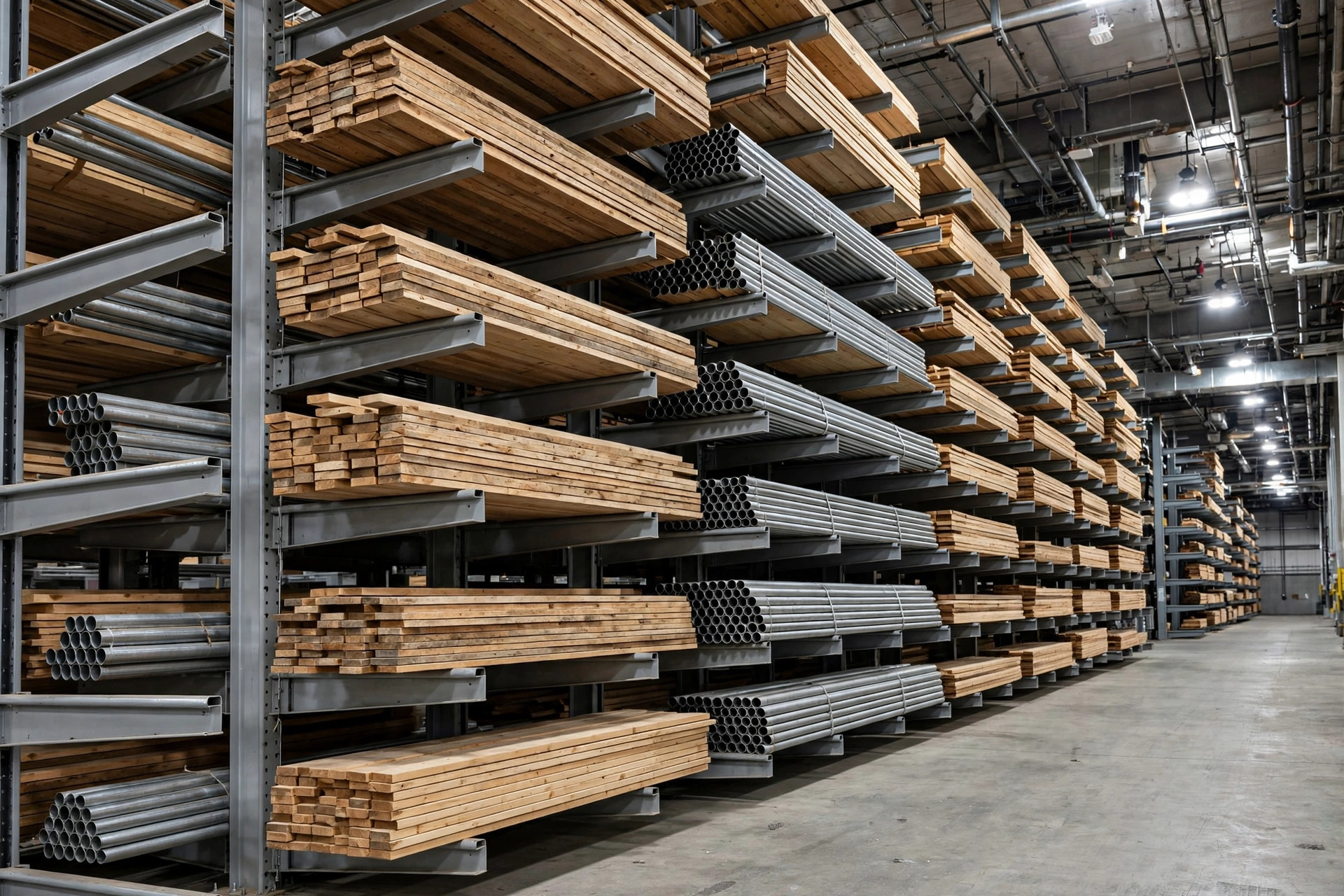
Long products — sections and bars in 6–12 meter lengths — play by different rules: cantilever racks. Long stock's nightmare is "pull one bundle, topple the row." Cantilever racks carry each arm independently with no front column in the way, so you lift one bundle and disturb nothing. Think of it this way: standard beam racking is a bookshelf, and a 12-meter beam is a bamboo pole you're trying to shelve — pull one, knock over a row. Cantilever racking is a row of coat hooks: each piece on its own, nothing interferes. Spec each arm at ton-scale capacity (check the manufacturer's data sheet).

Overhead Crane or Forklift: Run the Numbers Separately
Steel warehouses move product on two tracks — overhead (bridge) cranes and forklift-plus-lifting-gear — with the dividing line around 10 tons per piece.
| Overhead crane (20-ton class) | Forklift + gear (10-ton forklift) | |
|---|---|---|
| Typical capacity | 10 / 20 / 32-ton classes | Up to ~10 tons |
| Best fit | Full coils and bundles, long cross-bay moves | Break-bulk, short shuttles, truck loading |
| Cycle time | Slow and steady | Fast, suits high-frequency small lots |
| Capex | High (runways + building steel) | Low |
| Safety watch-outs | Dropped loads, clear the runway zone | Overloading, blind spots, floor pressure |
The math: 30+ coils a day at 10 tons and up — the crane wins; a forklift doing that work bills you in tires and hydraulics. A dozen coils a day in mixed specs — the crane is a cannon for a mosquito, and it sits idle. Most real yards run a hybrid: crane for full in/full out, forklifts for break-bulk and loading.
Here's the contrarian bit: the biggest efficiency killer in a steel warehouse isn't slow lifting — it's slow finding. Coil number, spec, heat number illegible — the crane operator lifts three coils before finding the right one, and the whole cycle time dies. A simple location-and-tag discipline (even a spreadsheet plus spray paint) saves more lifts than any equipment upgrade.
Rust: Oil, Humidity, and the Outdoor Question
Steel fears two things: water and salt. Three defenses:
- Rust-preventive oil. Applied at the mill; in storage the job is not to rub it off. Keep contact surfaces smooth — cold-rolled and galvanized coils carry a thin film, so handle them gently.
- Humidity control. Indoor yards need ventilation and dryness. Outdoor storage: block coils at least 200 mm off the ground, tarp the top but leave the sides vented — a fully sealed cover traps condensation and rusts faster.
- Outdoor vs. indoor. Outdoor saves rent, but rust loss and surface-quality claims are the hidden bill. Run the math as rust rate × cargo value, not just the rent delta. In 2022 I worked with a structural-steel fabricator in Shandong: H-beams stored outdoors for two years, surface rust, customer rejection. The de-rusting and price concessions alone would have paid for three years of indoor rent. Rust always collects its debt.
Billing: By the Ton or by the Square Meter
- Per-ton billing fits standardized heavy product — coils, plate. It tracks cargo value and handling effort. The catch: light, bulky stock gets punished.
- Per-area billing fits sections, long products, slow-moving stock. You pay for the ground you occupy — fair. The catch: stacking high or low costs the same, so customers have no incentive to stack efficiently.
Quoted rates I've seen range from a few to over ten yuan per ton per month — treat any number as "verify against actual quotes." What matters more than the rate is the formula: billed on inbound tonnage × days, or on month-end inventory? For a fast-turning trader, the two formulas diverge by a wide margin. Write the formula into the contract; never leave "as actual" as a loophole.
Time to Rant: Automated High-Bay Racking for a Small-Lot Steel Yard Is a Vanity Project
Every year someone asks me: can a steel warehouse go automated — AS/RS, AGVs? Blunt answer: for a trader moving dozens of coils a day in mixed specs, an automated high-bay is a money fire.
Three hard problems. First, load: standard AS/RS pallets top out around 1–1.5 tons (verify against equipment specs); a coil runs 8–25 tons, so you need custom heavy-duty stacker cranes at multiples of the price. Second, SKU chaos: automation lives on standardized unit loads, and coils vary in diameter, width, and weight — slot utilization would be miserable. Third, throughput: one stacker crane does tens of cycles an hour while a crane-plus-forklift crew is faster and more flexible.
Automation's correct place in a steel warehouse is information automation — location management, coil traceability, lift-task dispatch — not equipment automation. Spend the money on a WMS and tagging; the ROI beats a high-bay by an order of magnitude. Heavy, non-standard, low-frequency: the highest-value automation decision is not buying it.
Worth It or Not? One Number Tells
Crane, cantilever racks, rust control, floor reinforcement — it all adds up. Worth it? Don't listen to the vendor's story. Watch one number: warehousing cost per ton = (rent + equipment depreciation + labor + rust loss) ÷ annual throughput tons.
If that number goes down, the plan is right. If it doesn't, the shiniest equipment is decoration. Steel warehousing is, at its core, the cheapest safe way to bring tens of tons of iron in and send it out intact. Get the per-ton math right; everything else is detail.
By Da Liu, Automation Engineer