Let me give you the conclusion first: the most underestimated room in an ecommerce warehouse is the sample room.
Most owners think of it as just a little corner for taking pictures — throw up a white sheet, set up two lamps, done. I've seen too many warehouses think that way, and they all paid for it in that little room eventually. Best case, your white-background photos come out yellow-tinted and the marketplace rejects your listings. Worst case, samples bleed into sellable inventory, get shipped to customers, and one wave of returns eats the entire profit of a hot SKU.
There are two sides to this. The sample room looks like a vanity project — photos, livestreams — but underneath it's an operations project: QC, segregation, and sample accounting. Get the vanity side wrong and your conversion rate suffers. Get the operations side wrong and you lose real money. Today I'll break this little room wide open: location, layout, and sample accounting.
Two Pits I've Fallen Into (So You Don't Have To): Samples Shipped by Mistake, and a Livestream With No Samples
Back in 2021, a cross-border seller of small home appliances in Yiwu asked me to review their process. The moment I walked in, I frowned: samples and sellable stock sat on the same rack, distinguished only by handwritten "sample" notes taped to the boxes — two of which had already fallen off.
Sure enough, it blew up. They had just launched a humidifier. The engineering sample looked identical to the mass-production unit, except the firmware: the sample ran a test build, and every menu on boot-up was gibberish. A rushed picker grabbed units from the sample cartons and shipped them. A couple hundred orders went out before anyone noticed. Returns flooded back in. Between return shipping, refunds, and the one-star reviews piling up, the owner told me that single episode cost them deep into the six figures in RMB. Worse, the product was just gaining traction — the bad reviews crushed its ranking, and rebuilding the rating took three months.
The root cause wasn't the picker. It was the missing sample room — or more precisely, the missing identity for samples. Samples had no dedicated physical space and no independent identity in the system. They were ghost inventory: nobody could say for sure whether they were on the books, and finding the physical units depended entirely on some veteran's memory.
The second pit: 2023, a beauty seller's warehouse in Guangzhou. Their livestream studio sat right above the warehouse, connected to the sample room — sounds efficient, right? The problem was that nobody tracked where samples went. A bestselling face mask had its samples used up shooting listing photos, then a few more boxes were mailed to influencers for reviews, and the sample cabinet was empty. That evening the host decided to feature the mask in an impromptu session, reached into the cabinet, and found nothing. She said on camera, "give me a minute, I'll grab it from the warehouse" — a third of the viewers left on the spot, and conversion was cut in half.
Two pits, mirror images: samples went out that never should have; samples missing when they were needed. A sample room was never about the room. It's about the ledger of what comes in and what goes out.
Where to Put the Sample Room: Three Options, Costs First
Location is the first trade-off, and I'll lead with the cost of each option, as always:
| Location | Upside | Price you pay |
|---|---|---|
| Next to receiving / QC | New arrivals get photographed and inspected immediately, zero walking | Mixed into the inbound flow — samples "conveniently" slip into inventory |
| Next to the office area | Quiet, lighting is easy to control, great for livestreams | Far from the goods; every sample run becomes a chore nobody wants to do when it's busy |
| Standalone partitioned room (my pick) | Clean material flow, physical separation between samples and stock | Takes floor space; small-warehouse owners call it "waste" |
I've seen too many warehouses pick the first option — stuffing the sample room next to receiving because it's convenient. It feels fast short-term; long-term, the odds of samples contaminating inventory climb steadily. Here's the counterintuitive rule to tattoo on your wall: the closer the sample room sits to the pick zone, the more mis-ships you'll get. Close means convenient. Convenient means uncontrolled. Between samples and inventory there has to be a wall of inconvenience.
And don't skimp on size. A room doing photos, livestreams, and QC at once needs a couple dozen square meters at minimum: photo zone, stream corner, inspection bench, sample cabinets. Cram all four into a ten-square-meter closet and none of them will work.
Ecommerce Warehouse Sample Room Layout Checklist: Light, Backdrop, Partition
The checklist is short, and every item was paid for in losses:
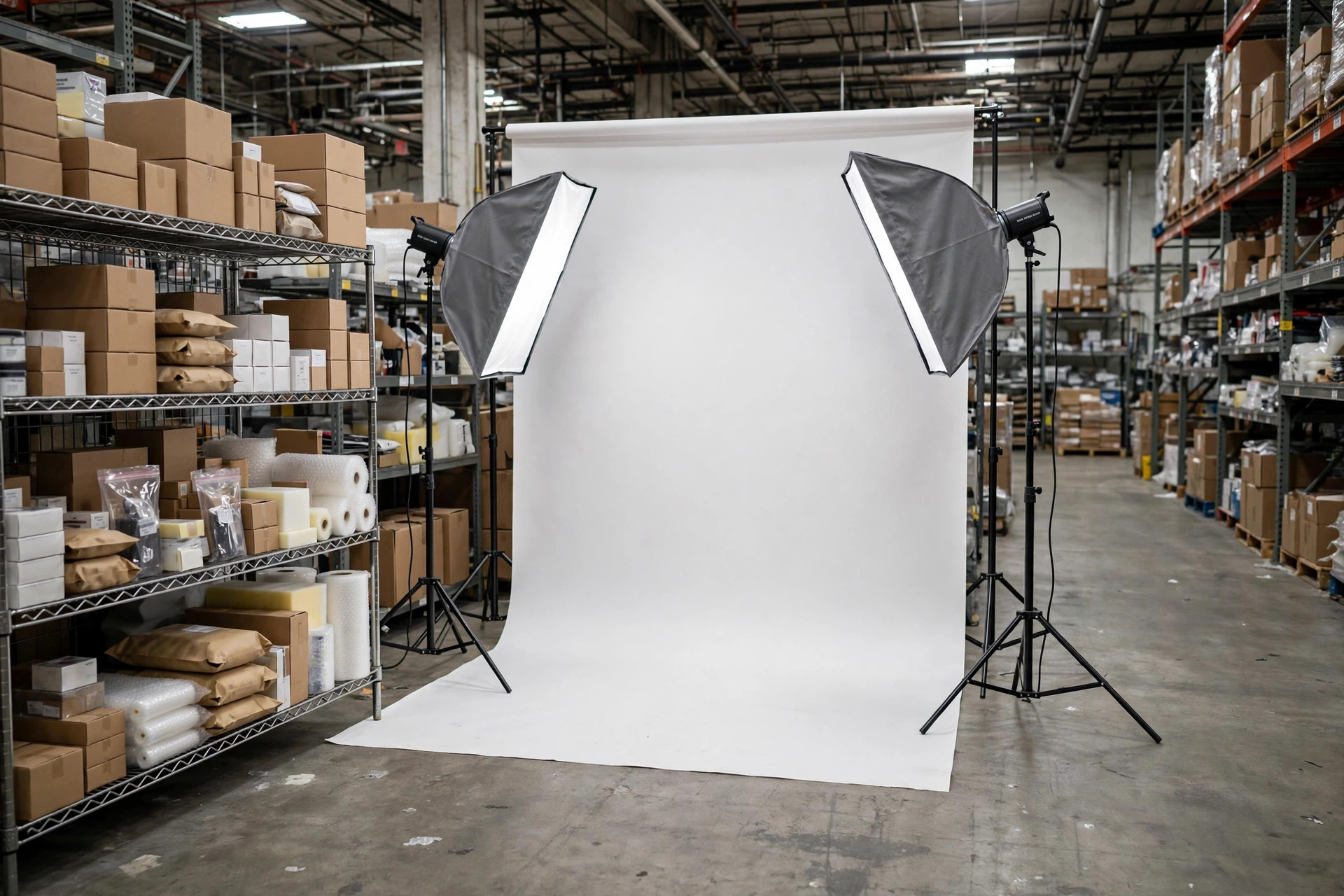
- Lighting. Use daylight-balanced white light, with at least one softbox on each side. Never borrow the warehouse's yellow high-bay lights — your white-background shots will come out yellow, the marketplace will reject them, and the whole shoot's labor goes down the drain. Lighting is the one place in the sample room worth spending real money.
- Backdrop. A seamless white paper backdrop in a standard wide roll covers nearly all small and mid-size products; use fabric on stands for oversized items. Backdrop paper is a consumable — replace it when it's dirty or creased, don't cry over the cost.
- Partition. Physically separate the room from the storage area, with its own door. Sound isolation is non-negotiable for livestreams — one forklift beep or PA announcement and your audience hears everything.
- Sample cabinets. Lockable, organized by category, with an inventory list taped on the door. This is the cheapest "system" you'll ever buy — more reliable than the sample accounting in most warehouses' WMS.
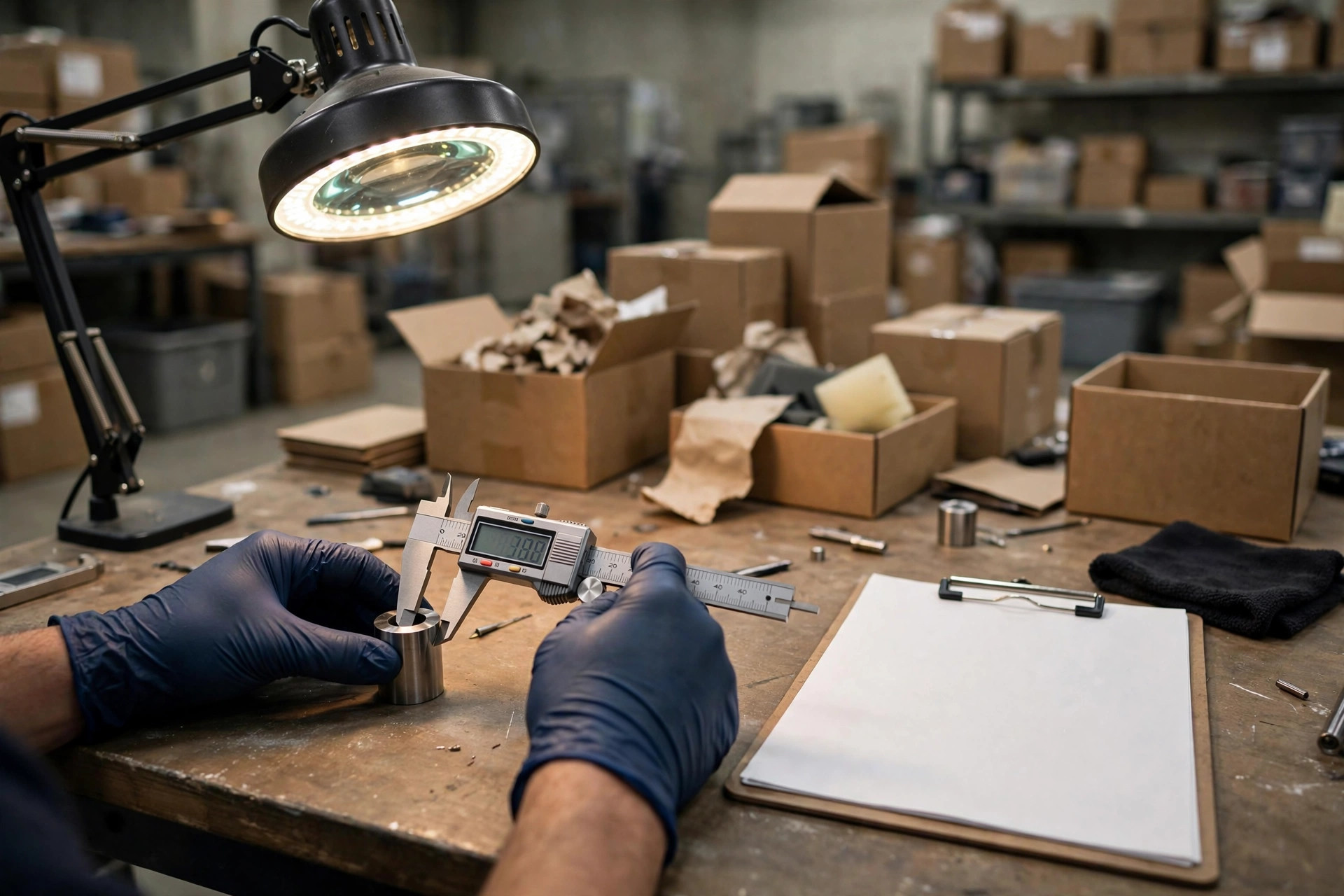
- Inspection bench. Big enough, bright enough, with room for calipers, color cards, and record sheets. In most ecommerce warehouses, QC is "a glance." The bench in the sample room is what turns "a glance" into "a process."
Sample Accounting: Three Iron Rules for Everything In and Out
The room is built. Now the management. Sample accounting comes down to three iron rules:
One: independent identity. Samples must have their own identity in the system — a dedicated virtual location in the WMS (a "SAMPLE" bin or sub-warehouse), physically mapped to those locked cabinets. Incoming samples go onto the sample books, never onto inventory books. Nobody pulls shippable units straight from the sample cabinet. That's a red line.
Two: log every movement. Who took it, how many, for what (photos, livestream, seeding, QC), and when it's coming back. It's one spreadsheet — and nine out of ten warehouses don't have it. Samples mailed out get logged with the tracking number, so three months later you can still trace where that box went. Skip this and you'll walk straight into the Yiwu pit.
Three: close the loop on disposition. Once a sample is done with photos, streams, or inspection, it may only go three places: back to stock (only after re-inspection, re-labeling, and re-receipt into inventory — all three, no shortcuts), scrap (opened, used, or damaged units go through the scrap process), or seeded out (to influencers or customers, with the destination logged). The deadliest habit is "just set it down after the shoot" — that box will show up on a pick ticket tomorrow.
Running the Numbers: What This Little Room Is Actually Worth
Building a sample room — partition, two softbox lights, backdrop paper, cabinets, inspection bench — runs a few thousand US dollars all-in. Add a part-time photographer or an outsourced shoot package, a few hundred a month. Sounds like overhead, right?
Now the other side. One mis-ship: round-trip shipping on the return, refund fees, and the labor to process it — tens of dollars per order, easy. A couple hundred orders and you're looking at five figures of direct loss. That doesn't count the review damage — a rising listing hammered by one-star reviews can burn months of ad spend. That Guangzhou beauty warehouse lost half a livestream's conversion in one evening; the GMV left on the table would have built ten sample rooms.
Put simply: the sample room isn't a cost. It's insurance. A few thousand in premium, protecting your hero listings and your store rating.
One Piece of Advice
Stop asking whether a sample room is worth building. Ask yourself this instead: right now, are your warehouse's samples locked in a cabinet with clean books — or sitting on a rack somewhere, waiting for the day someone ships them by accident?
By Lao Mi, Supply Chain Veteran (20 yrs)