Last fall I walked a 3PL apparel fulfillment site in Southern California. Thirty AMRs running goods-to-person, over $800K invested in the fleet, and the first thing the project manager told me wasn't about the dispatch algorithm or pick rates. It was this: "Every day around 3 PM, a few bots just die in the aisles. Somebody has to go push them." Charging strategy is the thing nobody takes seriously during the design phase — and then it slaps you every single day after go-live.
In the field, there are really only two options. No third one.
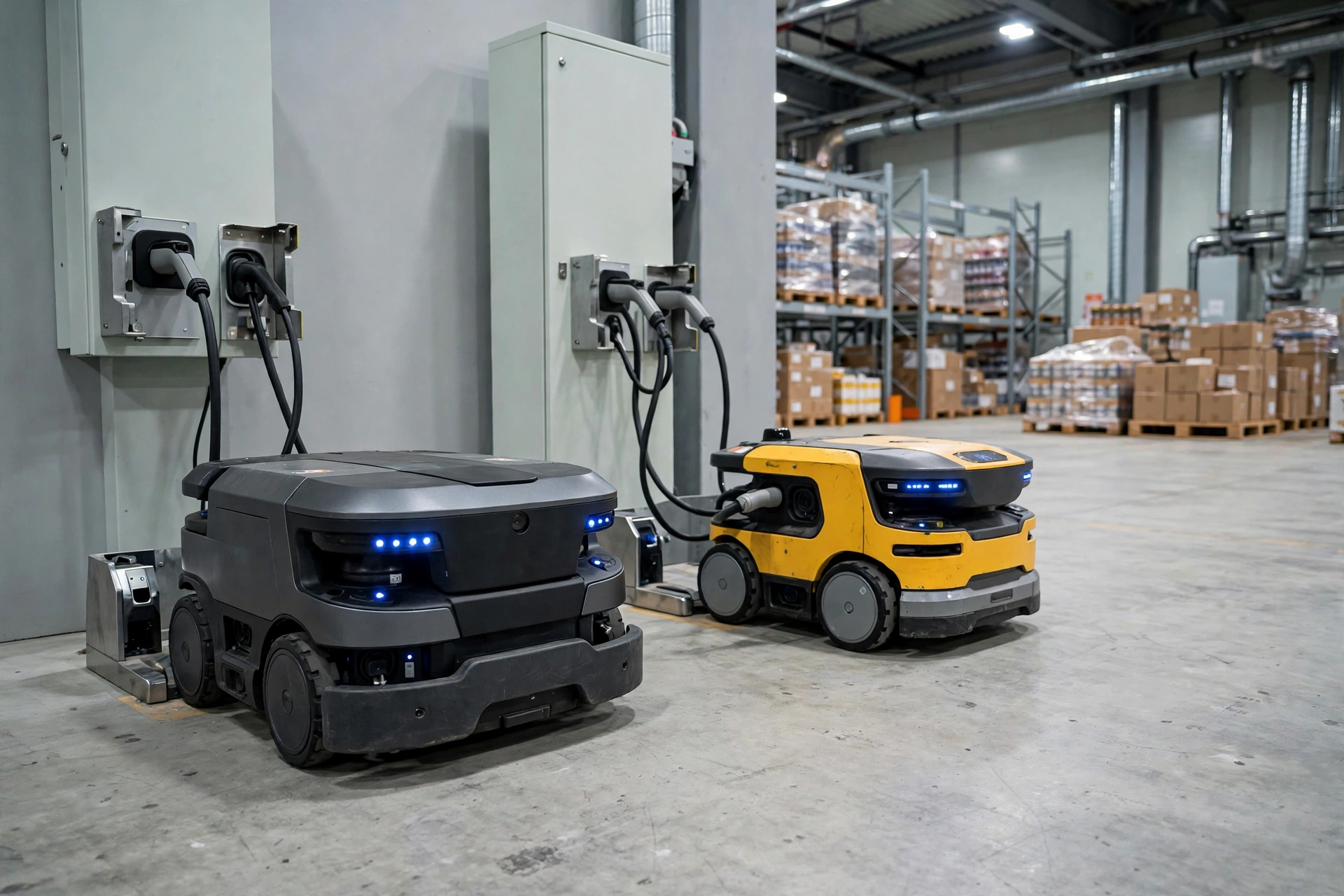
Option one: automatic opportunity charging. When a robot has a gap in its task queue, it drives itself to a floor charger, docks, tops up for 15 to 20 minutes, and goes back to work. Fully unattended, minimal changes to the building. In practice, dock success rate is a metric you need to watch — dust on the floor contacts, a pallet nudging a charger slightly out of position, one failed dock and the bot sits there waiting for a human while the dispatcher has to reassign its tasks.
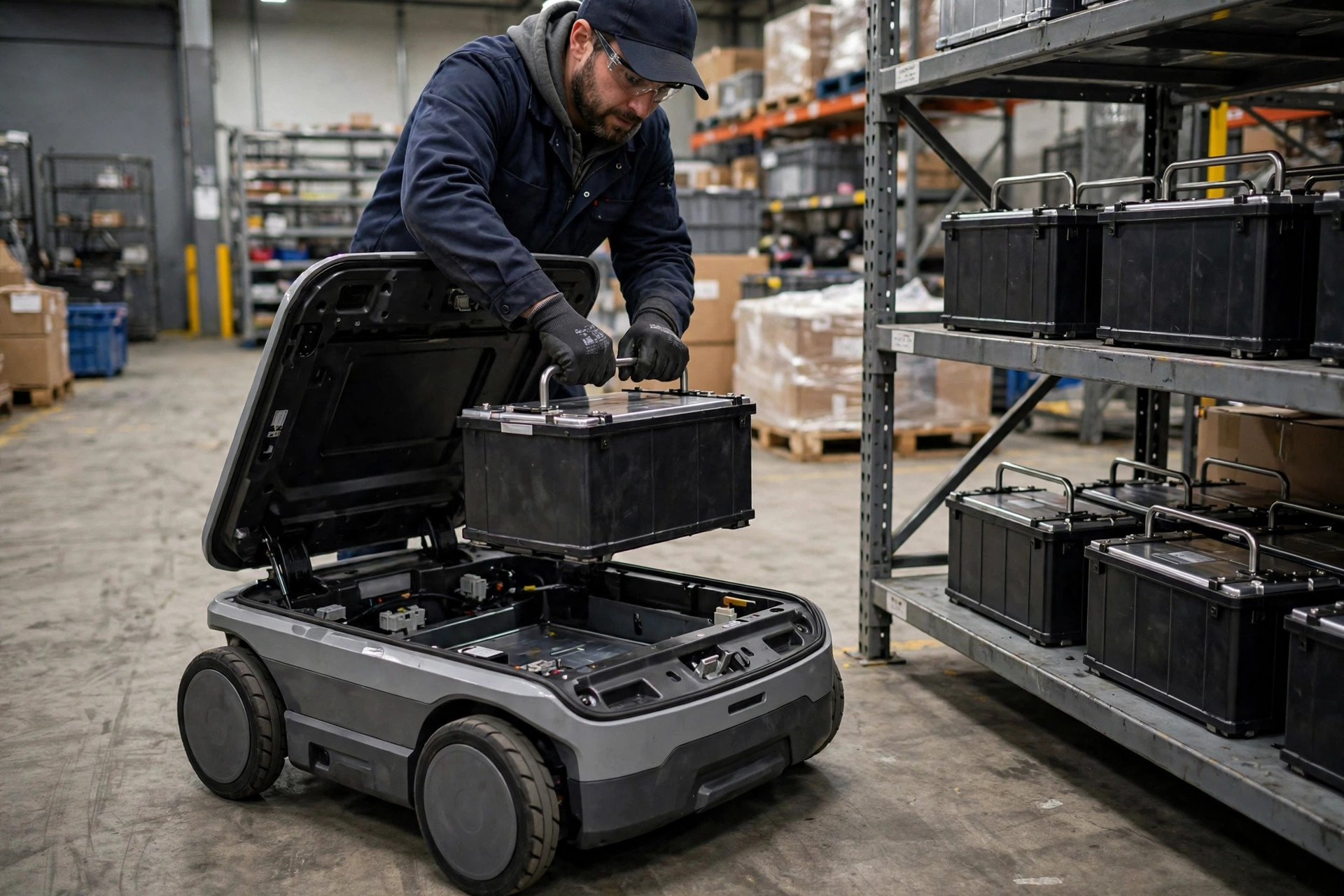
Option two: battery swap. The battery pack is a swappable module. A depleted robot drives to a swap station, and a person or a manipulator swaps in a fresh pack in two or three minutes. The depleted packs recharge slowly on a charging rack. The robots barely stop — that's the whole appeal of swapping.
Let's talk about the safety bill for swapping first, because most people underestimate it. Lithium battery charging racks cannot share space with operations. They need physical separation, smoke detection, and fire suppression as standard — follow your local fire code and the equipment vendor's requirements. A manual-swap battery pack weighs tens of kilos; drops and impacts are a fire risk, and operators need dedicated training. This money and this floor space are the items that "accidentally" go missing from proposal documents. One more thing people forget: the depleted packs need to be "nursed" on the rack. You can't slam them with fast charging — they need a gentle charge rate to refill properly. Size the rack for your battery rotation rhythm. Undersize it, and the swap station becomes a very expensive decoration because there are never enough charged packs ready.
Where the money and the time actually go
Four numbers drive the whole calculation: runtime per charge, daily operating hours, charge rate, and fleet size. The formulas are simple — plug in your own numbers:
Daily charge sessions per robot = daily operating hours ÷ runtime per full charge Number of chargers = peak robots charging simultaneously × 1.2 buffer
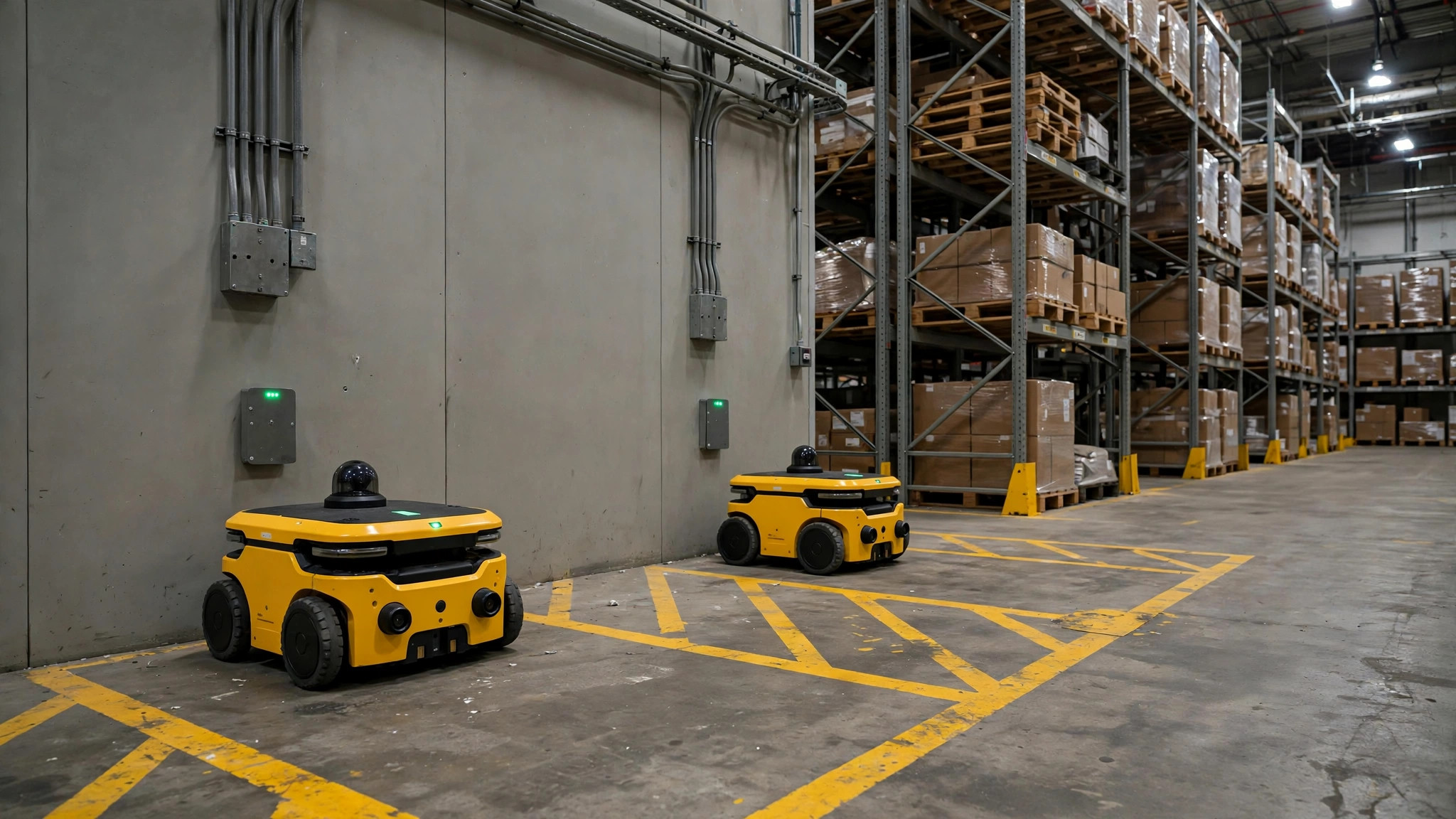
Take an example. An AMR runs 2 hours on a full charge and needs to operate 18 hours a day — that's 9 charging sessions per robot per day. Say each fast charge takes 40 minutes. With 30 robots staggering their charge windows, roughly 6 to 8 will be charging at peak, so charger count is 8 × 1.2, about 10 chargers. Ten chargers lined up against a wall — make sure you know exactly how much floor that eats. If you can't estimate peak concurrent charging at first, start conservative at 25 to 30 percent of fleet size, then tune it after go-live using queue data from the dispatch logs. Adding a charger later is easy; moving a badly placed row of chargers is not.
Swapping has a different ledger. For 30 robots at a 1.3 to 1.5 battery-to-robot ratio, you need 40 to 45 packs — 12 to 15 extra packs. One industrial battery pack costs several thousand dollars, and that money goes out the door on day one. Then add the swap station itself. An automatic swap station's price varies by vendor — check the spec sheet. A manual swap station is far cheaper, but someone has to staff battery swaps on night shift, so don't forget the labor scheduling cost. A swap takes 3 minutes and the robot barely loses any cycle time. When you total it up, don't forget residual value and replacement cycles: those 30 to 50 percent extra packs age and need replacement just like the rest. They're not a one-time cost; they're an ongoing one.
The traps the proposal never mentions
The biggest trap with opportunity charging is floor space — and it eats the good space. Where do the chargers go? Ten chargers against a wall is the ideal picture. In reality, many sites park them next to the main picking aisle to save a walk, and when peak season hits, robots queued up to charge block the main aisle and the whole line's takt time collapses. I've seen a site where charging robots queued so far back they blocked the manual pickers' path. Iron rule: chargers never go in main aisles or narrow lanes. Against walls, in corners, and always leave buffer room for the queue.
Swapping's traps are the hidden costs. Thirty to fifty percent extra batteries. A separate, isolated area for the charging rack. Training and shift scheduling for manual swaps — who's doing the 2 AM swap? An automatic swap station saves the labor but brings its own equipment and maintenance bill. Then there's degradation: the harder you push the charge rate, the faster cycle life falls off. Lithium iron phosphate is rated for thousands of cycles, but hammering it with high-rate fast charging every day means few packs actually get there. When you model ROI, don't use the nameplate cycle count — take 70 percent of it and sleep better.
And there's one failure mode neither strategy escapes: a robot dying mid-aisle. Even the perfect strategy has bots lying in the lane for all kinds of reasons — failed docks, cold-weather voltage sag, software freezes. Without a recovery plan, one dead robot can block half a zone. The dispatch system needs a clearance routine: auto-send a tow robot or alert a person, and get the lane open within 15 minutes. If this isn't in the design, the first week after go-live will teach it to you. The worst I saw: a robot died in the main aisle at 2 AM, one operator on night shift, and by the time he got there with a manual pallet jack, 40 minutes of tasks had piled up.
My decision framework, plus five field-tested rules
Here's my verdict. Under 20 robots, operating 16 hours a day or less, with natural gaps in the schedule (shift changes, lunch breaks) — go with automatic charging. Simple, reliable, don't overcomplicate it. Running 24/7 with no stops, fleets over 50 robots, takt time that can't tolerate idle robots, or a building so tight you can't fit a charger array — seriously evaluate swapping, or a hybrid: opportunity charging during the day, swap to cover the night peak.
Five rules I earned the hard way:
First, pick charger locations by aisle width first, distance to the work zone second. In that order.
Second, if you go with swapping, start at 30 to 40 percent spare batteries per 8 to 10 robots. That's the floor, not the ceiling.
Third, watch cell temperatures. Abnormal cell temperature during charging is the warning sign before a fire. Battery management system alarms need a human response, not just a log entry.
Fourth, hard-code the low-battery return threshold in your dispatch rules. Don't wait until 5 percent to head for a charger — send them back at 15 to 20 percent and keep the margin. Running on the edge saves minutes and costs you a full recovery operation.
Fifth, don't max out the charge rate. If 1C gets you full, don't use 2C. A battery that lives one extra year saves you more in replacement cost than the cycle time you squeezed out.
My bias is clear: most US warehouses should start with automatic charging and get three things right — charger placement, return thresholds, and the recovery plan. Add swapping when the fleet genuinely scales up and you're running around the clock. Going all-in on a swap station on day one usually means paying for uptime you don't need yet.
Here's something you can do tomorrow: walk your floor and count two numbers. How many square feet do your chargers occupy? And this month, how many robots went down from "dead battery" versus "real fault"? Those two numbers are your answer on whether it's time to change strategy.