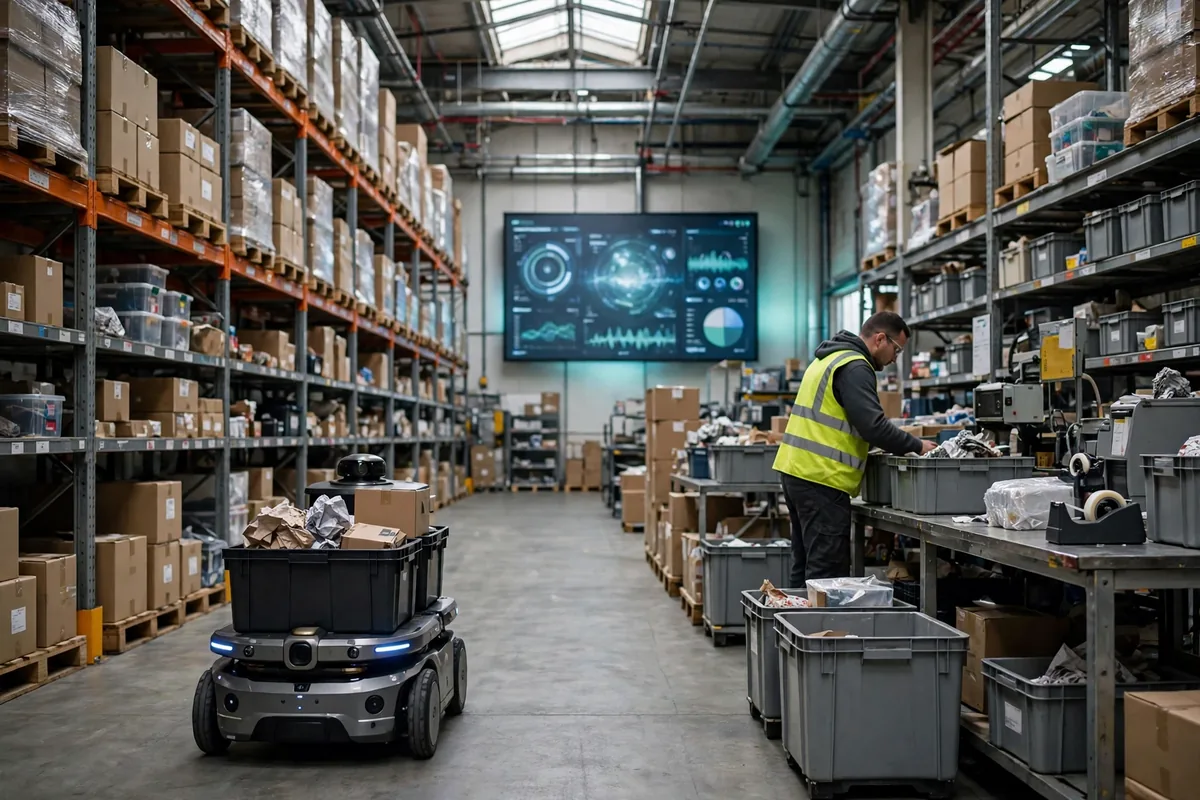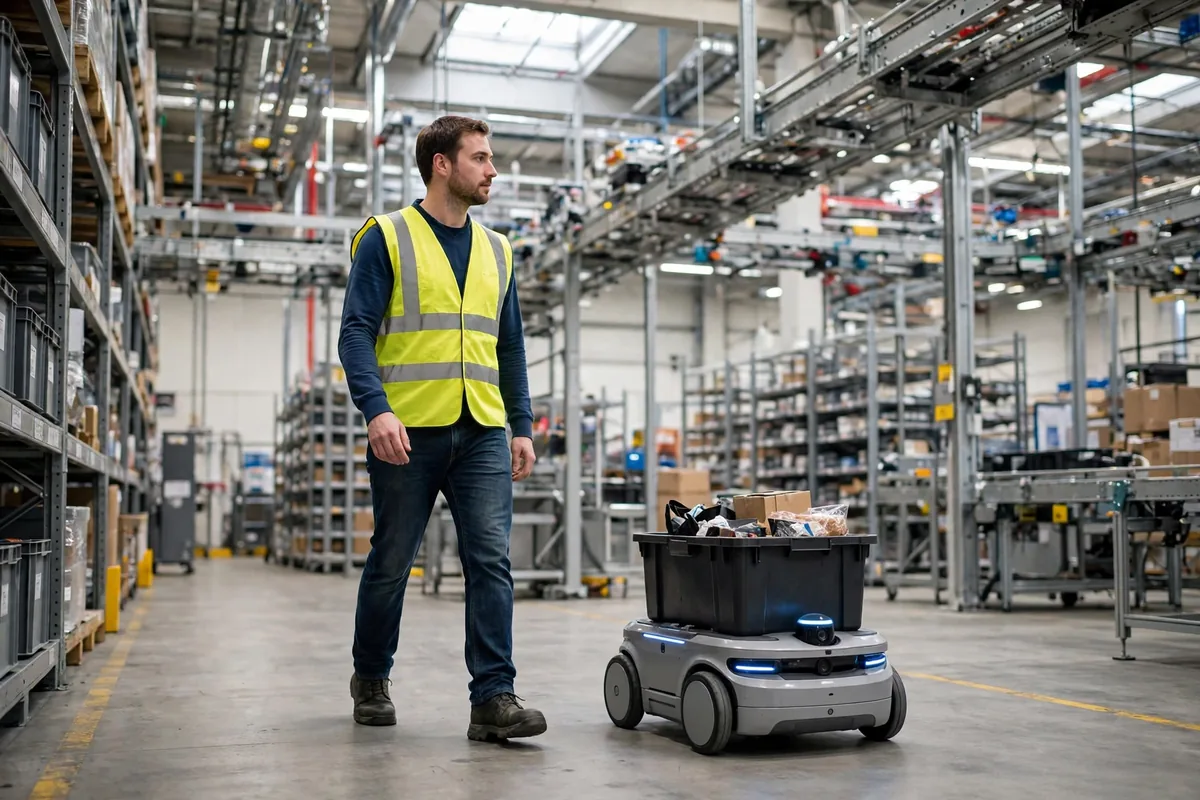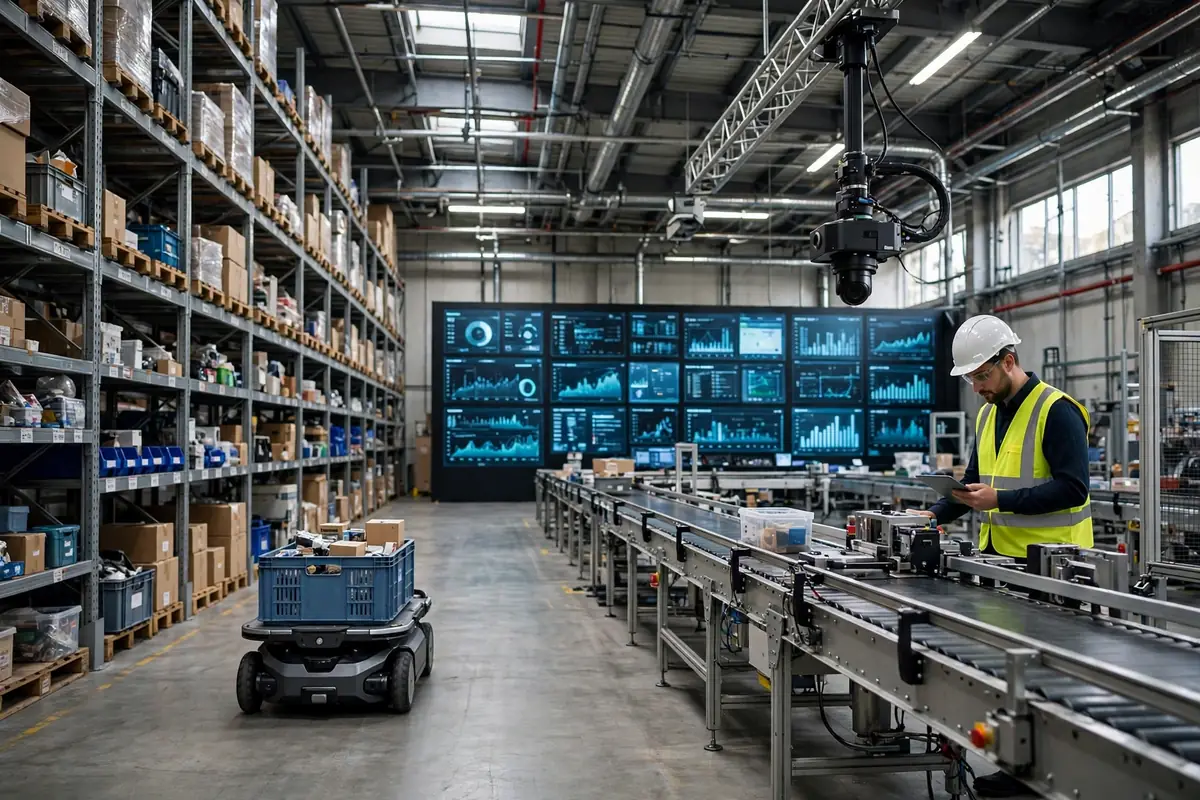
AI warehouse adoption in three stages is a useful way to describe what is actually happening on warehouse floors, because talk about AI in warehousing has grown much louder than deployment itself. At one industry conference, one operator will be talking about a first vision camera at the packing bench, another about coordinating mobile robots, and a third about letting a system propose tomorrow's wave plan overnight. According to industry reports and vendor case material, they differ in what is being bought, what the organisation has to change, and how the return is measured, and mistaking one stage for another is where most of the wasted spending begins.
Stage One of AI Warehouse Adoption: Fix One Task, and Prove It Pays
The first stage is narrow by design. AI takes over one well-defined task, the rest of the workflow stays untouched, and a person remains in the loop to confirm the exceptions. Typical starting points are visual inspection, document recognition, damage detection, and pick-path suggestions: the problem is frequent, the correct answer is reasonably clear, and the result can be checked the same day.
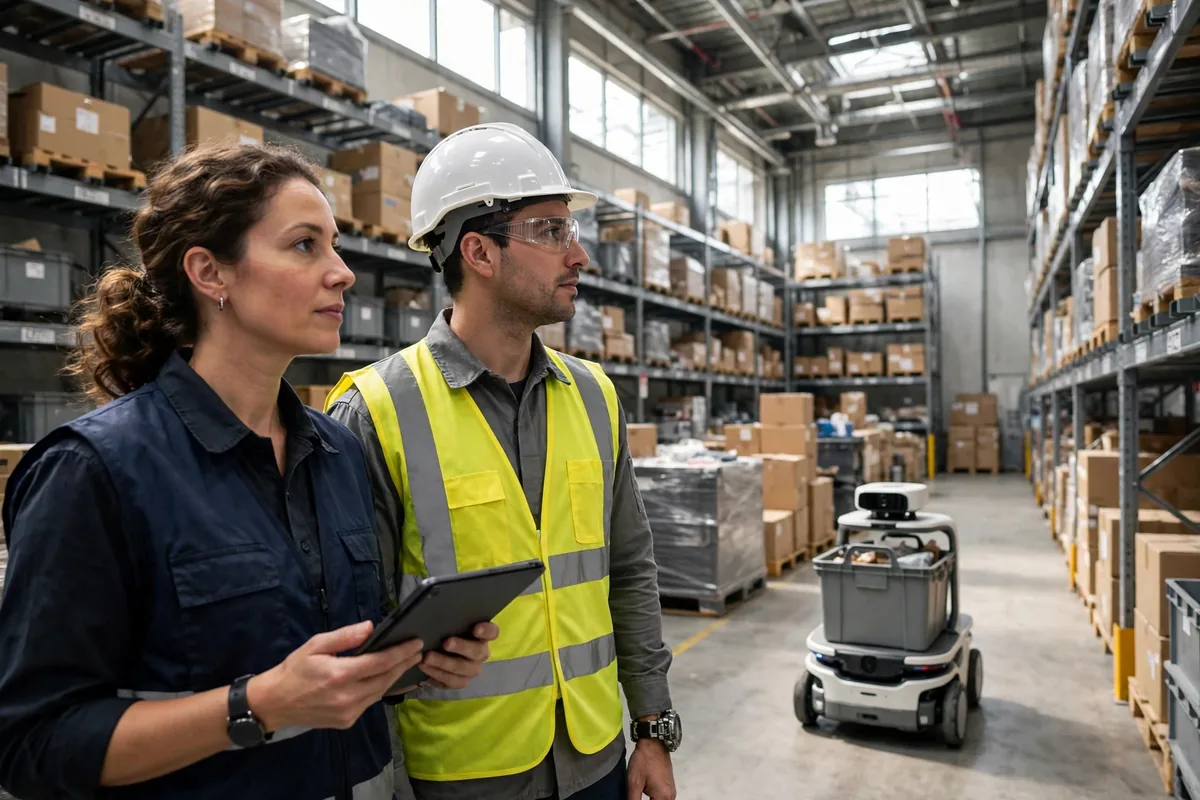
In the autumn of 2024, a third-party logistics warehouse of roughly 80,000 square feet in Ontario, California, installed a vision inspection camera at outbound quality control to catch damaged cartons and misapplied labels. Before the change, inspectors checked each parcel by eye, several thousand a day in peak season, and misses and rework were a recurring cost. After the change, the camera photographed every carton, passed the clear cases straight through, and diverted only the doubtful ones to a human for a second look. Nothing in the warehouse management system had to be rebuilt, and no new conveyor was added. The inspection standard now lived in the system, so a new hire could apply the same rule as a veteran.
The economics of stage one are correspondingly simple. Spending concentrates on hardware, implementation, and the first few months of tuning, while the return shows up in labour saved at that one station, fewer errors, and faster throughput. The ceiling is also low: saving labour at one station does not make the whole warehouse faster, and pushing recognition accuracy from the low nineties toward near-perfection can cost several times the original tuning effort, while a human review step is often cheaper. The test for entering stage one is therefore not whether the technology is new, but whether the task is frequent enough, defined enough, and owned by someone willing to keep feeding the system corrections for the first few months.
Stage Two of AI Warehouse Adoption: Connect the Flow, and Mind the Data
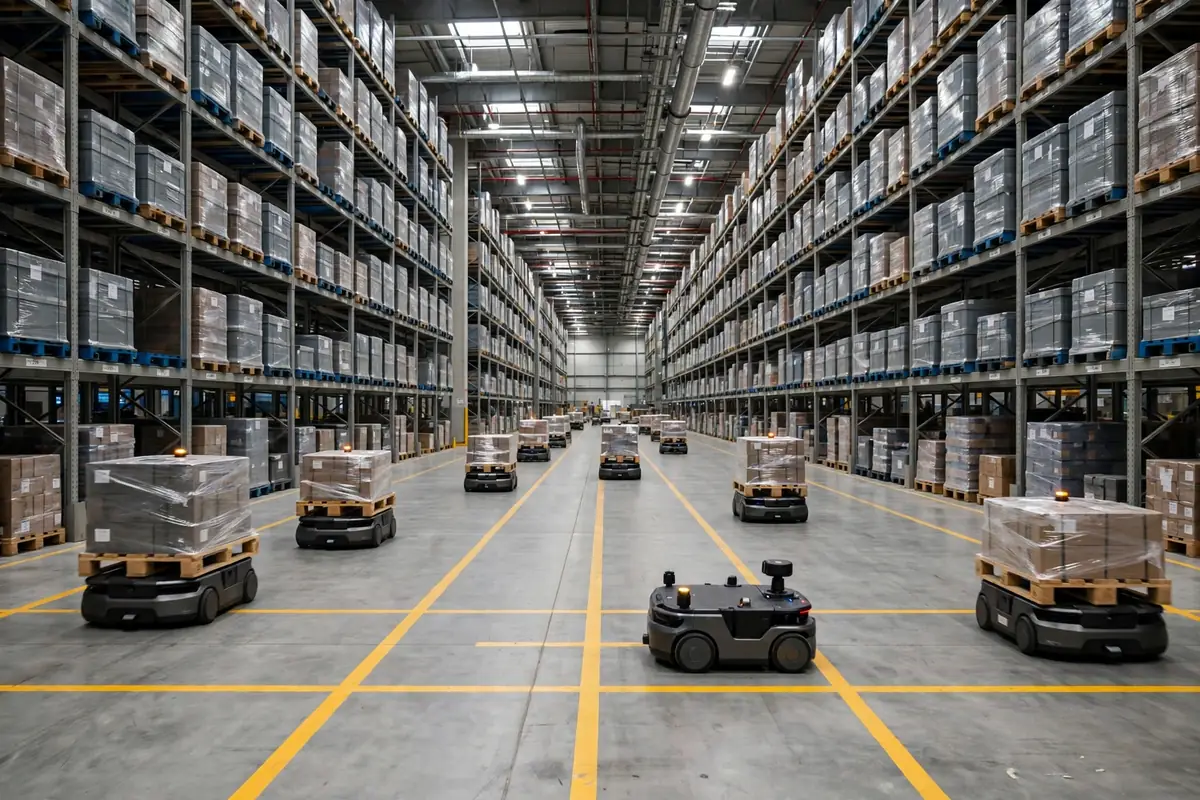
Once a single-point tool is running reliably, some warehouses move to a second stage, in which AI coordinates several steps at once: mobile robots, conveyors, the warehouse management system, and wave planning have to work together, and the system starts allocating work rather than merely advising. Investment rises sharply, and so does the risk.
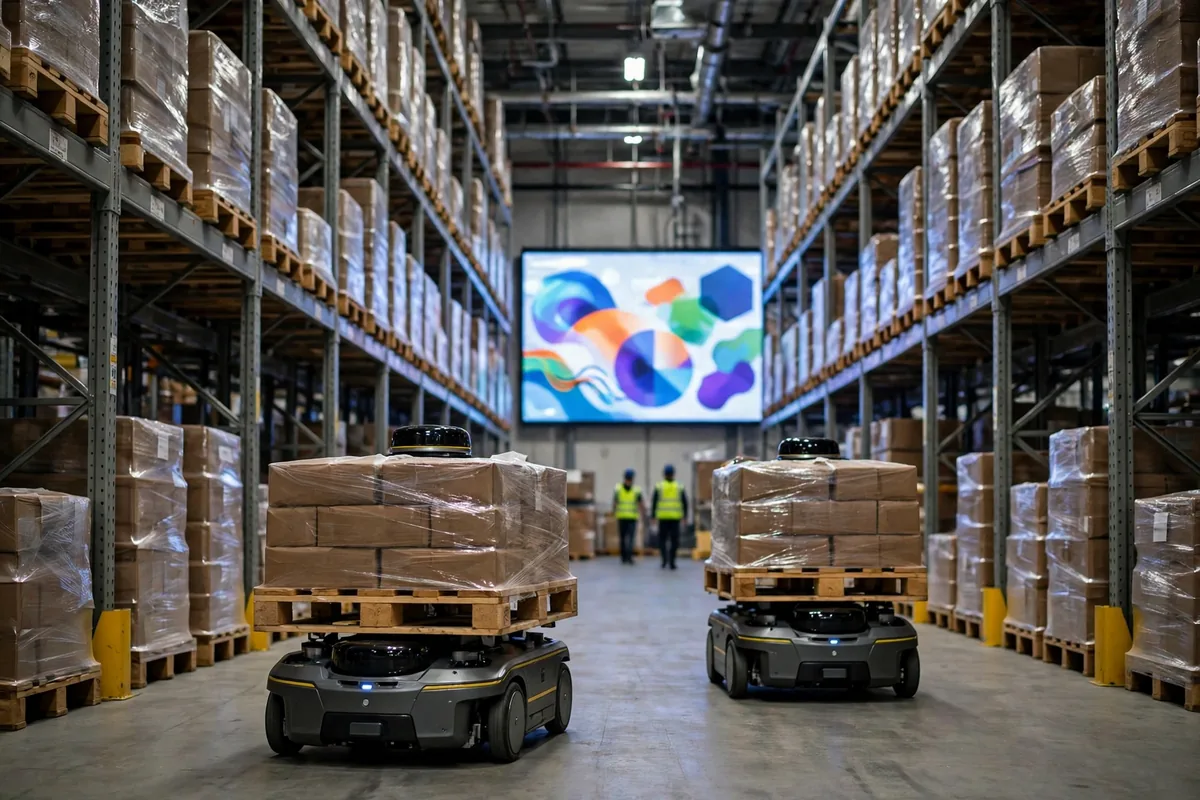
In the spring of 2025, an e-commerce fulfilment warehouse in the American Midwest expanded its mobile robot fleet from a dozen units to several dozen, and let its system reassign goods-to-person stations dynamically by order urgency, product location, and live station load. Under the old setup, robots followed fixed routes and carried racks to pickers, which left some stations idle while others queued. Under the new setup, the system could rebalance the queue as conditions changed. The equipment itself was not the slow part. The slow part was two months of preparation: location data had to be cleaned, exception rules rewritten, and shift rhythms adjusted, with the vendor, the integrator, and the operations team meeting weekly.
There is a counterintuitive pattern here. Many warehouses spend more in stage two than they will in stage three, while finding the return hardest to explain, because stage two tests the warehouse's fundamentals rather than its algorithms. If locations are wrong, inventory is wrong, or order data is dirty, a more active scheduling system simply makes mistakes faster. Some operators, encouraged by a stage-one pilot, treat stage two as buying more equipment, and discover that the equipment arrives while the process does not follow. The real question is whether the warehouse is ready to be scheduled by a system at all: whether the data can be trusted, whether exceptions have a defined fallback, and whether the team will hand over part of the allocation decision.
Stage Three: When the System Starts to Plan the Work
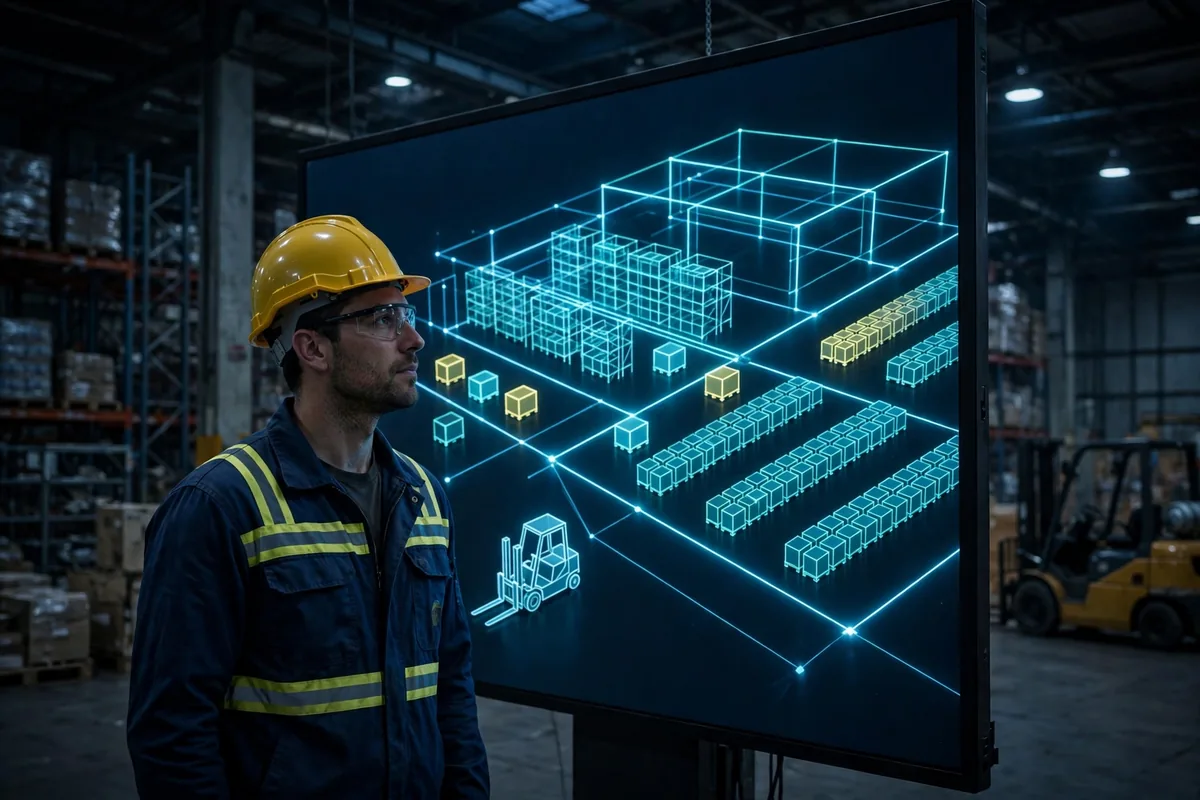
The third stage is marked by a move from execution to planning. AI begins to take part in forecasting and preparation, for example by anticipating the next day's wave structure from order history and seasonal patterns, suggesting location changes in advance, or warning that inbound volume will require reserved capacity. The technical barrier is not necessarily the highest. The organisational barrier is, because it asks the warehouse to hand over the basis of its planning, and to accept that the system's judgement may differ from an experienced manager's instinct.
So far, the warehouses that have made this stage work tend to share a narrow profile: a relatively stable order mix and a reasonably complete history, such as a retail distribution warehouse with a stable product range or an e-commerce warehouse with a clear seasonal rhythm. One such warehouse runs a daily routine in which the system produces next-day recommendations each evening, covering wave splits, staffing, and priority locations, and the manager may adjust them but must record the reason, so the next round can take those adjustments into account. The value does not lie in any single day's suggestion being right, but in accumulating a record of decisions in which human experience and system judgement can be checked against each other over time.
The payback period is also longer than in the earlier stages. A single month's productivity gain will not prove the case, and the demand for clean data will expose shortcuts taken earlier, when temporary fixes built during stage two return as noise the planning system cannot interpret. The three stages form a sequence that is difficult to skip: rushing to forecasting without the intermediate work usually means paying for the missing groundwork later, at a higher price.
The Three Stages Side by Side: Different Spending, Different Returns
| Dimension | Stage One: Single Task | Stage Two: Connected Flow | Stage Three: System Planning |
|---|---|---|---|
| Typical AI warehouse adoption work | Visual inspection, document recognition, single-task assistance | Robot scheduling, wave optimisation, multi-step coordination | Demand forecasting, wave planning, location and staffing advice |
| Scale of investment | Relatively modest, centred on one tool and its implementation | Materially higher, with equipment, integration, and process change together | Weighted toward data governance and organisational adjustment |
| How the return appears | Labour saved and errors reduced at one station | Faster flow across the chain, less waiting and empty travel | More stable planning and better preparation for peak periods |
| Main risk | Low ceiling, with tuning costs rising steeply | Dirty data amplified, long period of adjustment | Opaque reasoning, hard to validate in the short term |
| Best suited to | A warehouse with a clear, frequent, standalone problem | A warehouse with sound data and stable order volume | A warehouse with a stable order mix and complete history |
The table makes one point that is easy to lose in a budget meeting: returns cannot be compared directly across stages. Stage-one ROI is the easiest to calculate, and the easiest to mistake for the whole answer. Stage-two returns have to be judged across the chain, because robot utilisation alone will mislead, and stage-three returns over a quarter or a year, because one day's suggestion means very little on its own. Before approving spending, a warehouse should ask a plainer question than which vendor to choose: is the scarcest thing right now efficiency at one station, coordination across a chain, or a planning method that can be reused?
The stages are not a ladder that every warehouse must climb. Staying in stage one can be a sound decision, and staying in stage two is not a failure. What should raise concern is using a stage-three story to justify stage-two spending, or a stage-one tool to solve a stage-two problem, while the data and the process are not yet ready. As more warehouses accumulate real operating data, the boundaries between the stages may blur. What is less likely to change is the discipline behind them: a warehouse that can say where it stands, why it is staying there, and what would have to change before moving on is stronger than one that can only describe a technology roadmap. Which stage is your warehouse in, and what evidence supports that judgement?
By Dr. Chen, Supply Chain Researcher