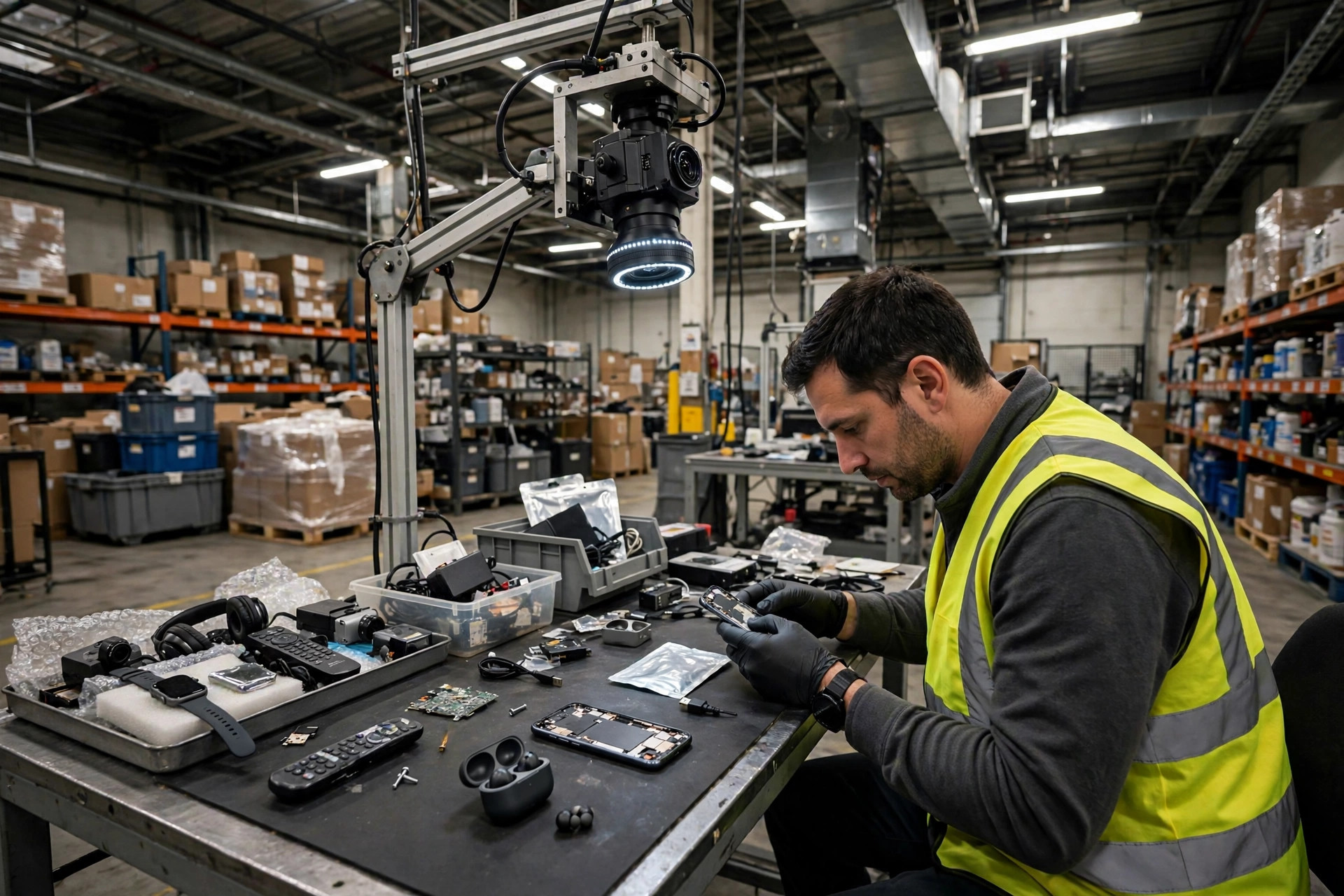
AI returns grading has one job at the noisiest corner of a returns warehouse — the inspection bench. Not "seeing accurately." Seeing consistently.
Last year I visited a 3C refurbishment returns facility where two inspectors were arguing over a returned tablet: one said the scratch on the top-right corner was "at worst Grade A-minus," the other insisted "the primer is showing, that's defective grade." The supervisor walked over, glanced at it, ruled it defective — and the first inspector's face went dark, because the residual value gap between A-minus and defective can be 40%. You see the real problem with condition grading: it looks like a technical question, but underneath it's a money question. The same item, two different people, conclusions hundreds of dollars apart.
The punchline writes itself: the fight was never about the scratch. It was about whose standard counts — and that's exactly what a machine is good at settling.
What AI Returns Grading Actually Looks At: Two Models, Worlds Apart in Difficulty
Most people think vision-based grading is "take a photo, AI spits out a grade." Think of it as two completely different tasks, an order of magnitude apart in difficulty.
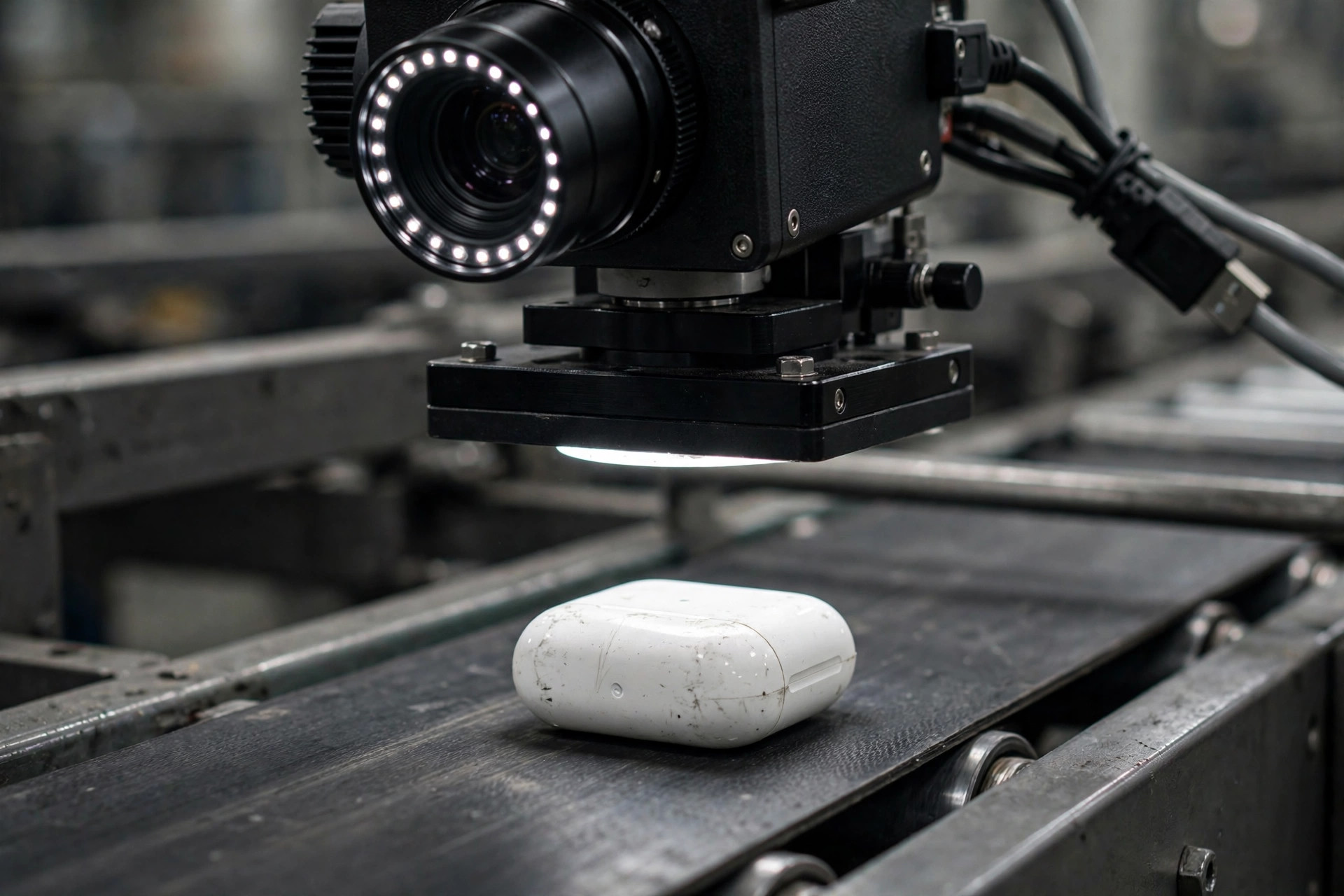
Layer one is defect detection: does this item have damage? This is like a chest X-ray — scratches, dents, paint chips, deformation; the model outputs "yes/no plus location." This layer is mature technology, borrowed from industrial inspection where it's been running for over a decade. Ported to returns, 95%+ accuracy is routine. Fixed lighting, multi-angle photos in, a defect heatmap out, and the inspector sees exactly where the damage is.
Layer two is condition grading: given the damage, how bad is it, and does it warrant a downgrade? This is like a doctor reading that X-ray — the same shadow, the veteran says "watch it," the rookie says "operate." Why is grading hard? Because the standard itself is subjective. Who defines the boundary between "Grade A-minus" and "Grade B"? It varies between companies, and sometimes between supervisors in the same building. The AI isn't learning objective truth; it's learning your labeling team's subjective standard. So on day one, a grading model might hit 70% accuracy, and only climb past 85% after three months and tens of thousands of labeled images.
Bottom line up front: defect detection is something you buy off the shelf. Condition grading is something you raise yourself. If a vendor promises a box that outputs "A-minus / defective / scrap" on day one, that's a slide-deck story, not an engineering story.
Which Categories Work, Which Don't: Look at the Goods Before the AI
The same AI returns grading system performs wildly differently across categories. Here's my ranking, most to least reliable:
Tier one: 3C electronics. Boxy, regular surfaces, enumerable defect types (scratches, dents, paint chips, dead pixels). In 2024, a phone refurbishment returns warehouse in Shenzhen deployed vision pre-screening: 12 inspectors down to 7, with the remaining 5 dedicated to cases the AI couldn't call. They drew the line cleanly — the AI only did a binary "damaged / undamaged" split, humans still assigned the grade. That one step cut per-unit inspection time from roughly 90 seconds to about 35.
Tier two: apparel and footwear. The problem is flexible goods — a wrinkle in fabric gets misread as "deformation," and reflective variation across shoe materials is brutal. The reliable play is "detection by subtraction": the AI only hunts for hard defects (open seams, holes, stains) and never touches grading. An apparel returns warehouse in Hangzhou found that AI pre-screening auto-cleared the 60% of items with "obviously no issues," leaving inspectors the remaining 40%. Headcount halved, disputes actually dropped — because the boundary between "cleared" and "needs review" was drawn by a machine, and nobody argues with a machine.
Tier three: beauty and personal care. Small bottles, busy labels, big batch-to-batch variation — vision can do little here. The one reliable scenario is authentication and batch verification: scan the printed batch code, match it against the system, confirm it's genuine and not near expiry. That's identity verification, not condition grading. Don't confuse the two.
The do-not-touch list: irregular-shaped items (can't even photograph them completely), categories dominated by subjective flaws (secondhand luxury, where "signs of wear" is entirely the authenticator's judgment), and low-volume long-tail SKUs (you'll never accumulate enough samples; the model never matures). Deploy AI on these three and you're burning money.
Three Deployment Hurdles for AI Returns Grading: Samples, Lighting, Integration
Principles understood, category chosen — three hurdles remain, each more grinding than the last.
Hurdle one: sample labeling. A grading model needs your own labeled data, tens of thousands of images minimum. Where's the trap? Your labeling team starts fighting first — that tablet-scratch argument replays itself a hundred times during labeling. The correct approach: have supervisors write a visual grading manual first (every defect type paired with "counts / doesn't count" example photos), and labelers follow the manual, not their gut. Without the manual, it's garbage in, garbage out.
Hurdle two: lighting. The oldest cliché in industrial vision, and returns is where it bites hardest: returned goods arrive in every surface condition imaginable — grease, fingerprints, protective film never removed — all of it corrupts the image. Design your lighting rig for the dirtiest item, not the cleanest sample. The worst case I saw: a vendor-tuned system that lost 20 points of accuracy on day one in the warehouse, because the showroom lighting and the warehouse lighting differed by 1500K in color temperature.
Hurdle three: integration with the returns system. The AI grades an item "defective" — that verdict has to land in the RMA record and trigger the right downstream flow (refurbish / markdown / scrap). Many projects die here: the vision system runs standalone, results get re-entered by hand, inspectors find it annoying and stop using it. Integration must be grade-and-write: the verdict hits the database automatically with a confidence score, and low-confidence cases route to humans. Humans stay in the loop, but only handle the 10–20% of hard cases.
Calling Out the Pseudo-Requirement: AI Signing Off Instead of Inspectors? Dream On
Time for something unpopular. The wildest requirement I've heard in the last two years: "Once vision AI is live, can we cut inspectors to zero and let the AI sign off?"
No. Three reasons.
First, condition grading is a commercial decision, not a technical judgment. "A-minus or defective" is a residual-value pricing call. It's money. Who takes responsibility when the AI signs off on money? Not the vendor. And you wouldn't dare either.
Second, the long tail never ends. The model has seen 100,000 scratches; it has never seen a customer write on the chassis in marker pen. The day your sample set covers the long tail is the day your returns mix stops changing — never.
Third, disputes need a human to absorb them. A supplier challenges your grading; you say "the AI said so," they don't buy it. You say "our inspection supervisor reviewed it," they buy it. Sign-off authority is an organizational-trust problem, not an accuracy problem.
So the correct positioning for AI returns grading, in eight words: machine pre-screens and triages, humans assign grades. The AI quickly clears the 70% of "obviously fine" and "obviously scrap," and people focus on the 30% in the middle that actually needs judgment. That's the job it's meant to do.
Is the money worth it? It comes down to one number: cost per inspected unit. Work out how many units one inspector clears per day, and what that costs you per unit in labor. The target for vision pre-screening: get the "machine plus skeleton crew" per-unit cost below 60% of the all-human cost, while pushing the "grading dispute rate" (two people disagreeing on the same item) under 5%. Hit both numbers and the money is well spent. Miss either one — don't buy the hardware yet. Go back and write the grading manual first. It's free, and it might outperform the AI.
By Da Liu, Automation Engineer