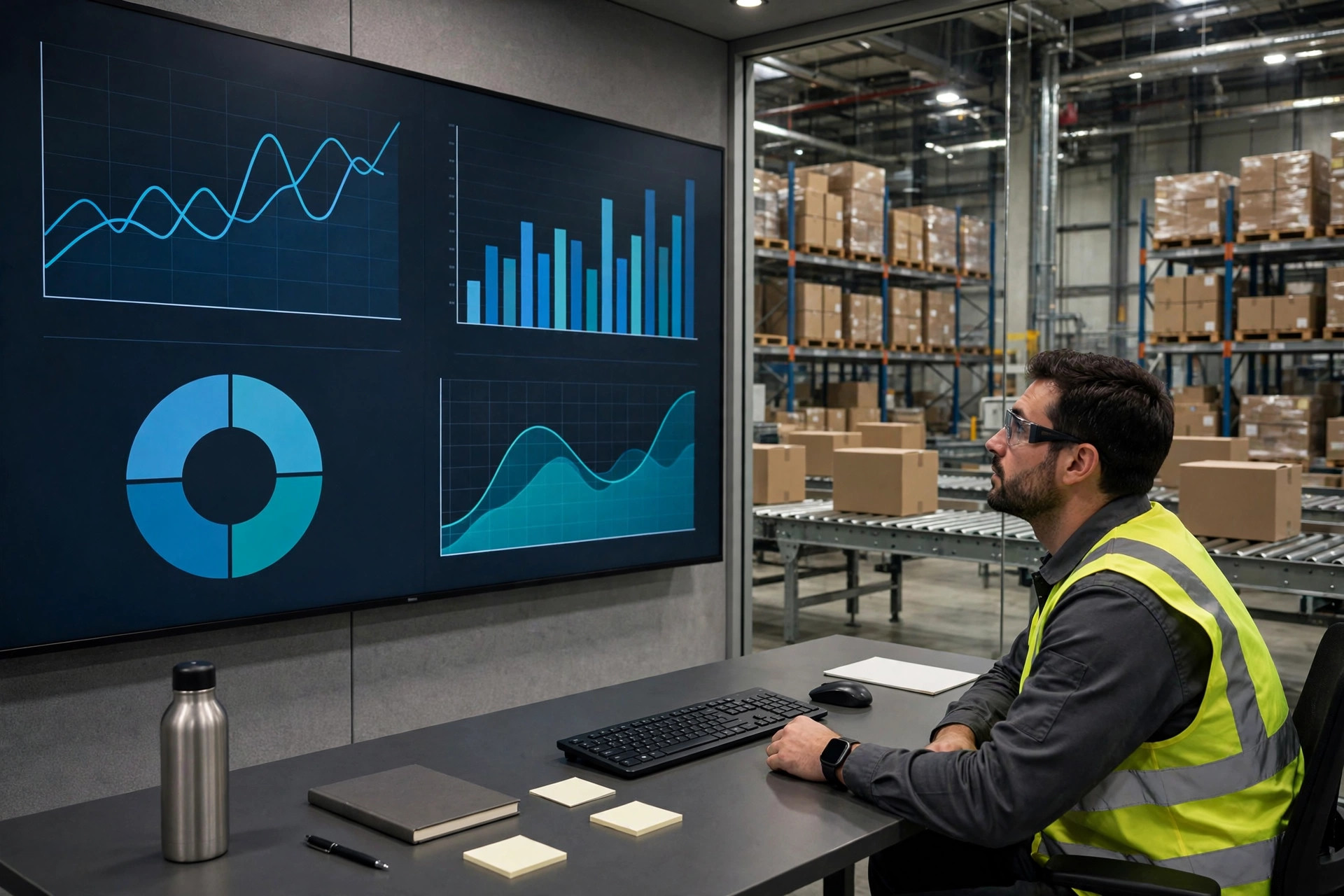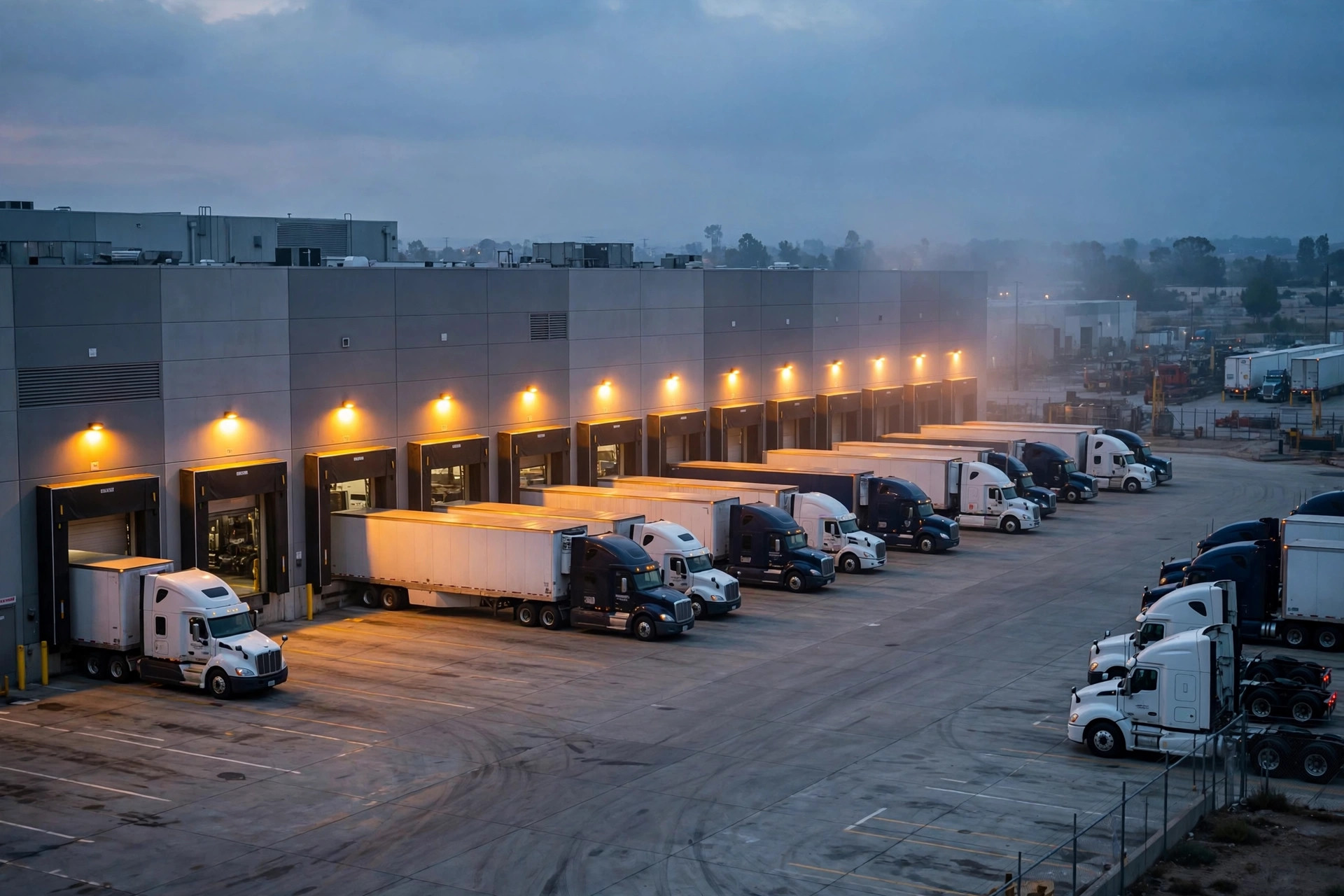
AI dock scheduling is turning the dock from a timetable into a living system: when a truck's ETA starts to drift, the system reschedules the appointment on its own, releases the door, and notifies the next driver — before anyone picks up the phone. What changes is not the act of scheduling, but who notices the change first.
What the 36-hour email thread is really costing you
The routine will be familiar to anyone who has run a distribution center. A carrier books a 10:00 door three days out. On Monday night the driver hits congestion, and the ETA slides from 09:00 to 13:00. The dispatcher learns this on a phone call at 08:00 Tuesday. The 10:00 door sits empty — the 11:00 driver is already rolling and can't be moved — and then the 13:00 arrival collides with the 13:30 booking, and the yard backs up. What follows is the familiar 36-hour email thread: reschedule, apologize, argue over who pays detention.
There is a public price tag on every hour of that chaos. Per ATRI's research convention, the industry treats two hours as free time; beyond that, carriers in the survey billed detention at an average of about $63.71 per hour (a surveyed figure — actual contracts vary widely). In the same research program, roughly 39.3% of stops involved detention (driver survey, 2023 data). AI dock scheduling exists to eat that cost pool.
AI dock scheduling isn't about scheduling better — it's about being wrong faster
This is the conceptual leap that matters. Traditional dock optimization tries to "schedule right the first time," but ETA drift is the norm, and reality will defeat even the best static plan. The three capabilities of AI dock scheduling all answer the same question: what happens after the plan breaks.
Layer one: ETA-drift detection and automatic rescheduling. The system continuously compares live truck ETAs against appointment windows; when drift exceeds a threshold, it finds a new feasible window and rebooks. FourKites' 2026 release of Alan, an AI scheduling agent, follows exactly this pattern: a shipment twin feeds live ETAs, the agent compares them against appointment windows, selects a new window based on door availability and priority rules, and reschedules through the carrier portal API, email, or EDI — escalating to a human coordinator only when it can't resolve the conflict. FourKites publicly claims 28% better dock adherence and 35% lower wait times. Treat vendor numbers with a discount, but note the direction: rescheduling shifts from human response to event-driven automation.
Layer two: no-show prediction. Instead of reacting to the truck that never arrived, the system scores every appointment for no-show risk about 24 hours out. The features are unglamorous: the carrier's no-show rate over the past 90 days, day of week, pre-holiday effects, weather, and whether the load is floor-loaded (unload-time variance is high). High-risk appointments get a confirmation call or are released to a standby list — turning no-shows from incidents into planned events.
Layer three: dynamic slot planning. The first two layers constantly create fragmented idle slots; the third stitches them back into usable capacity and ties them to labor planning — how many unload crews at which hours stops being a guess.
Public vendor case studies trace the value chain. In a case disclosed by queueme, a large distribution center was spending over $50,000 a month on detention; appointment analytics found three root causes — arrivals over-concentrated between 8 and 10 a.m., two carriers habitually overrunning their windows, and floor-loaded freight unloading 30% slower than planned. Targeted fixes (off-peak incentives, carrier scorecards, dedicated doors for floor-loaded freight) cut detention 70% in six months, roughly $35,000 a month in savings. That was the human-analysis version; the AI proposition is to make the find-fix-review loop real-time and automatic. Another public data point, from Opendock's blog: food-and-beverage 3PL Ralph Moyle Inc. cut the labor devoted to dock scheduling by more than 30% after implementing a dock scheduling platform.
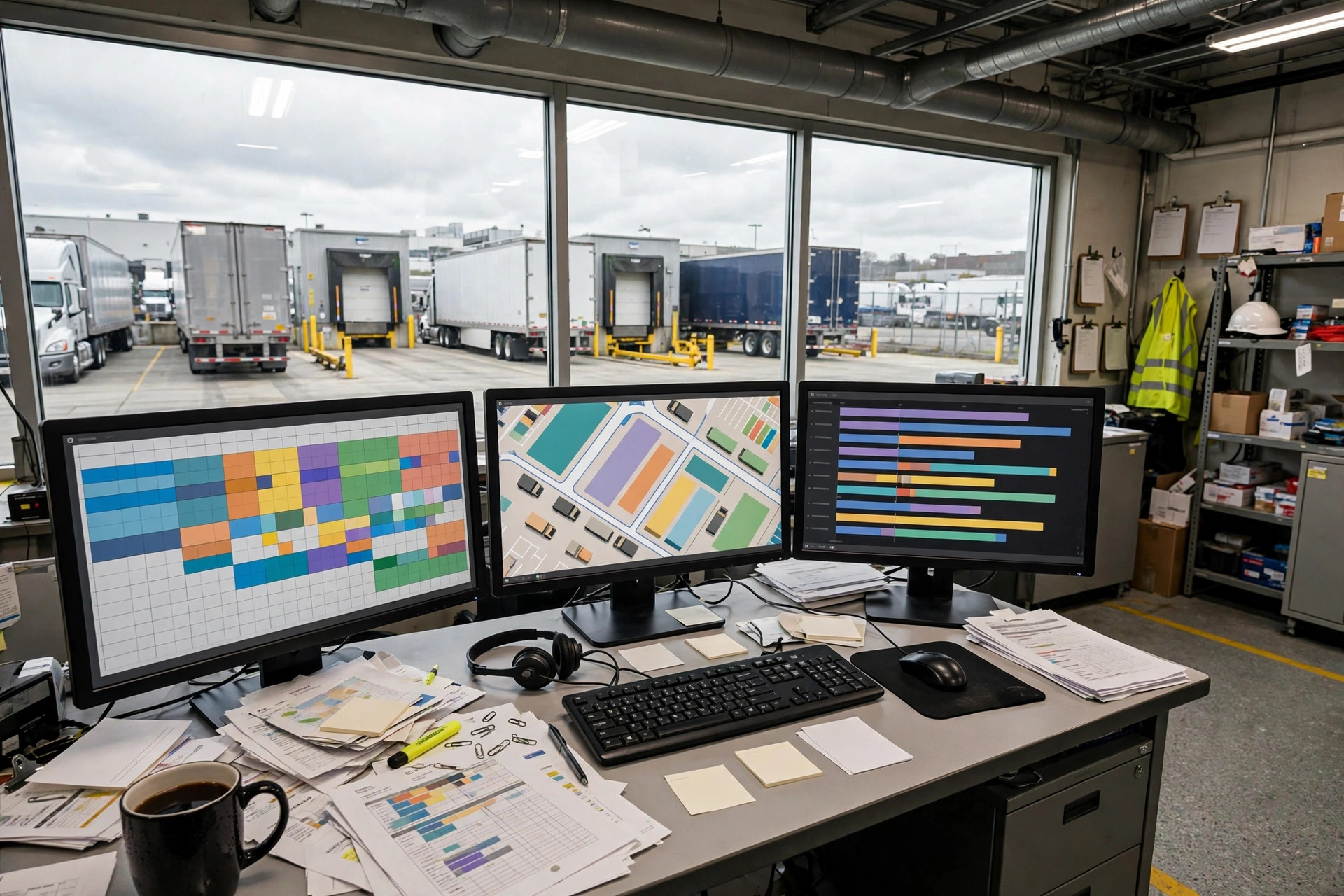
Doing the math: the rescheduling economics of a 200-truck-a-day DC
What follows is a worked model. Every assumption is on the table — its purpose is not a precise number, but to tell you which three numbers to go measure:
- Assume 30% of 200 daily trucks (60 trucks) experience ETA drift over one hour;
- Manual rescheduling lags about 2 hours on average (discover, call, confirm, update the system); automated rescheduling compresses that to 15 minutes;
- Each hour of lag produces, on average, 0.8 hours of idle door or waiting driver.
Daily wasted waiting from slow rescheduling is approximately 60 × (2 − 0.25) × 0.8 ≈ 84 truck-hours. At ATRI's $63.71/hour benchmark, that is roughly $5,350 a day, or about $139,000 a month (26 operating days) of risk exposure. Note carefully: that is the price tag of the chaos, not the savings. Even if automation captures only 30% of it, the monthly order of magnitude is around $40,000 — against the subscription and integration cost of a dock scheduling system, the math usually comes out positive. But only if your drift rate, response lag, and wait coefficient are measured, not copied from my assumptions.
| Maturity | L1 Manual | L2 System booking | L3 AI scheduling |
|---|---|---|---|
| Rescheduling | Phone/email, hours of lag | Manual rebooking inside the system | ETA-driven automatic rescheduling |
| No-shows | Backfill after the fact | Standby list, manual call-up | Risk prediction + automatic release |
| Fits | <50 trucks/day | 50–150 trucks/day | >150/day or high volatility |
| Data prerequisite | None | Booking records | GPS/ETA feed + no-show history |
| Investment | Headcount | Subscription | Subscription + integration |
The counterintuitive part: 90% dock utilization is the enemy of AI dock scheduling
Many warehouses treat "dock utilization above 90%" as a scoreboard win. From the AI scheduling perspective, the fuller the schedule, the less room there is to absorb drift — one truck running three hours late topples the five appointments behind it. The correct move is the opposite: reserve 10–15% of capacity as flex slots. Flex slots aren't waste; they're the shock absorbers that let the system digest uncertainty. Without them, automatic rescheduling has nowhere to reschedule to, and the smartest AI can only watch.
The second counterintuitive point: don't chase 100% automation. Priority insertions, key-account rush orders, dead-ends with no window available — roughly 15% of exceptions belong to humans. FourKites' Alan design includes an explicit escalation path: when it can't resolve a conflict, it hands the full context plus recommended options to a human coordinator. Full automation is vendor-slideware; human-machine division of labor is what actually deploys. When evaluating a system, ask one question: what does the exception escalation path look like? If there's no good answer, be cautious.
Where this is heading: dock appointments are becoming a reflex, not a module. Three timeline-backed judgments:
- Within 2026, ETA-driven automatic rescheduling becomes table stakes for dock scheduling. Evidence: FourKites productized it as a standalone AI agent in 2026, and the leaders are now bundling "appointments" with in-transit visibility; followers typically catch up within 12–18 months.
- 2026–2027: no-show prediction moves from carrier profiles to per-load risk scores. Evidence: the three data feeds it needs — no-show history, live ETA, weather/holiday features — are all commodities; the modeling bar is low, and the only moat is who wires the data first.
- After 2027, the dock appointment stops being a standalone module. It merges downward with yard management and upward with TMS linehaul planning — appointment, yard move, and dispatch become one optimization problem. Warehouses debating "whether to adopt AI scheduling" today will be debating "whether my YMS/TMS data can feed it" in two years.
An open question to end on: when rescheduling, prediction, and slot planning are all automated, what does the dispatcher role become? And the more immediate one: where does the live GPS and ETA data come from — will carriers share it? In many projects, what stalls is never the algorithm; it's the negotiation over data supply. How far AI dock scheduling goes may ultimately depend on shippers' data bargaining power over carriers, not on model accuracy.
By Dr. Chen, Supply Chain Researcher