If AI can't even figure out how many people you'll need next week, would you let it write the schedule?
I've asked that question of more than ten warehouse owners, and the answer is remarkably consistent: AI keeps getting better at forecasting order volume — but when it spits out a headcount number, the floor supervisor shakes his head on sight. That gap is exactly where AI scheduling stands today.
Why is AI decent at volume forecasting?
Because volume is clean data. Historical orders, seasonality, promo calendars, even weather — the inputs are structured, and the WMS holds years of records. The patterns the model needs to learn are relatively simple: volume tripled in the two weeks before Black Friday last year, so it'll probably do the same this year.
Last year I saw an e-commerce warehouse in Indiana adopt a volume forecasting tool, and their peak-season staffing error shrank from thirty or forty percent down to just over ten. The owner's exact words: "It's better than my gut. At least I don't discover in November that I'm short on people."
Volume forecasting is essentially a solved problem for AI. What remains is engineering, not intelligence.
Why does labor productivity forecasting keep falling short?
But between "80,000 orders next week" and "Tuesday morning shift needs 47 people" lies an entire swamp.
Productivity isn't volume divided by headcount. The same 80,000 orders pick at wildly different rates when they're all small parcels versus half oversized furniture. New hires run thirty percent slower than veterans as a matter of course. Night shifts are inherently less productive than day shifts. And for two weeks after a pick-path change, the whole building's productivity is still climbing back.
Worse, scheduling isn't just math — it's management. AI calculates "47 people Tuesday morning is optimal," but your full-timers are on fixed shifts, temps need 48 hours' notice, and only a handful of people hold forklift certifications. An optimal solution you can't actually staff is no solution at all.
So the honest state of AI scheduling today: AI forecasts the volume, humans write the schedule, AI offers a reference at best. Any vendor pitching "one-click scheduling" should first explain why your night shift is slower — if they can't, you wouldn't dare use their one-click output anyway.
What data does productivity modeling actually need
"Productivity modeling" sounds easy until you ask: where does the data come from?
Three layers, bottom up. Layer one is order data — the WMS has it: volume, lines, units, weight, freight profile. Layer two is labor-hours data — who worked which zone for how long. Most warehouses track this on the supervisor's clipboard, far too coarse. Layer three is motion data — pick paths, verification counts, exception-handling time. Almost no warehouse has this layer today.
My advice: don't be greedy. Nail layer two first. Badge into zones, bind RF gun logins to people, and record "who worked where for how long" accurately. Three months of that gives you a respectable productivity baseline. With that table, AI forecasting has a foundation; without it, any software purchase is a castle in the air.
Before buying software: three moves that cost nothing
First: pull three years of "volume vs. headcount vs. overtime" into one table. Many owners are stunned to find the volume-headcount correlation visible to the naked eye. That table becomes your leverage with any AI vendor — when he claims his model is accurate, you verify against it.
Second: set a productivity baseline per zone. No need for decimal precision — "120 lines per hour for veterans in picking, 80 for new hires" is plenty. Baselines exist to spot anomalies, not to punish — don't tie them to pay yet, or the data distorts instantly.
Third: write down every peak-season postmortem. Which day blew up which year, how you added people, where the chain broke — in prose. Those war stories will never enter a model, but they'll enter next year's scheduling meeting. AI handles averages well; humans handle extremes — provided humans remember.
None of these cost money, but they move a warehouse from "scheduling by gut" to "scheduling by data." Get this step solid first, and your odds of succeeding with AI scheduling more than double.
What a warehouse already seeing returns looks like
After all this "not ready yet," is anyone actually running? I know a 3PL distribution center in the Midwest that's further along than most. Their path is worth studying — not because the tech is exotic, but because they got the sequence right.
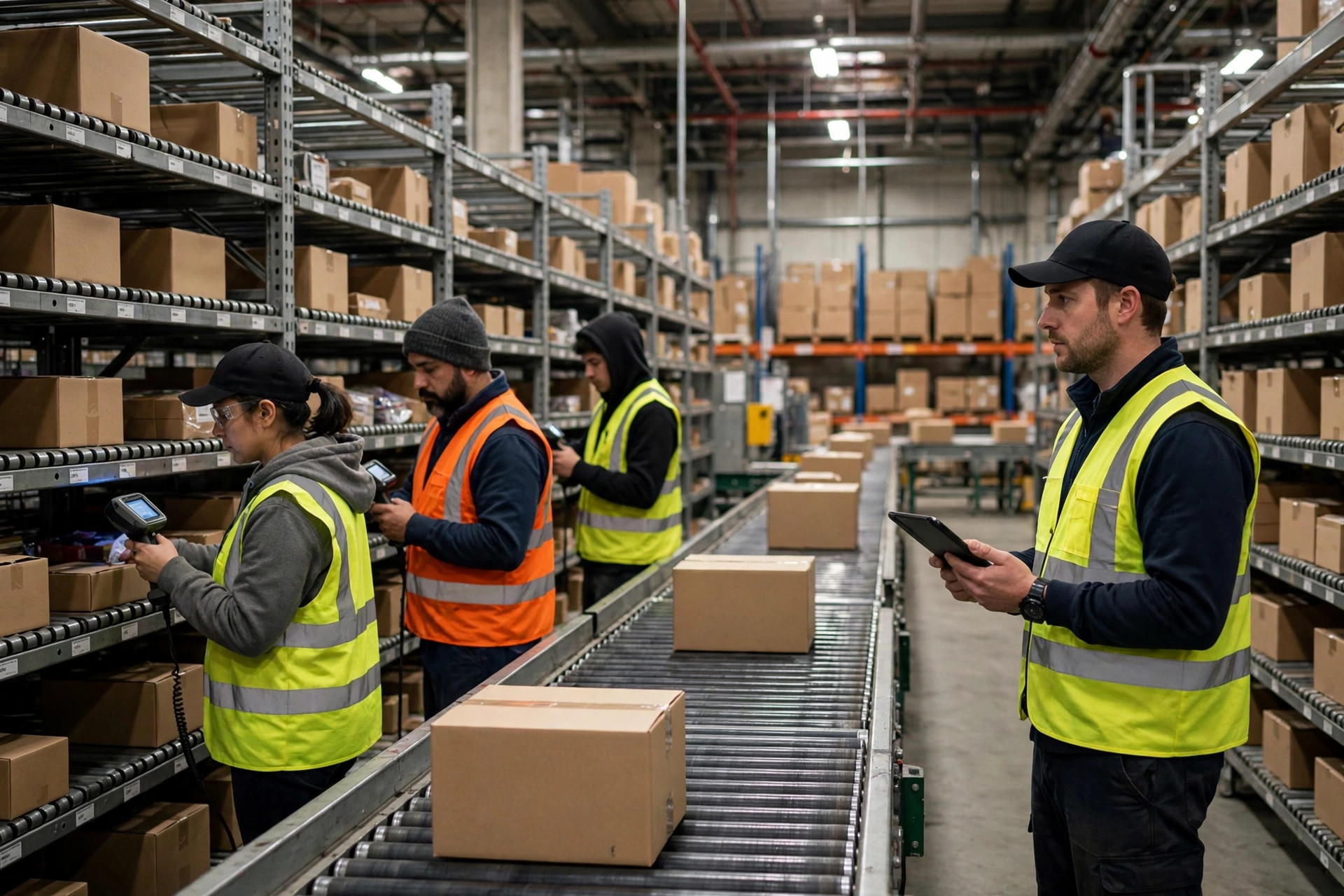
Year one: no AI software at all. One job only — record "who worked which zone for how long" accurately. Two hundred-plus people badging into zones, data flowing into their own BI. Year two: they built volume-vs-labor-demand tables from that data, and scheduling meetings went from gut-feel to reading the table. Year three: they finally brought in an external forecasting tool — for volume forecasting only, keeping their own baseline for productivity.
Three years in, their peak-season temp hiring dropped by a fifth — not fewer people working, but hiring done right, knowing the gaps two weeks ahead. That's the compounding of data assets: the earlier you start recording, the earlier the payoff.
Note the sequence: data first, then the comparison table, then AI. Everyone I've seen skip the first two steps and jump straight to AI has flipped over. Not because the tech fails — because the foundation wasn't poured.
How long is this road?
Here's my call: within a year or two, volume forecasting becomes a standard feature of warehouse software — not worth buying standalone. The real battleground is productivity modeling: warehouses that turn per-shift, per-zone, per-freight-type productivity into a data asset will eat the gains first.
Full auto-scheduling gets my three-to-five-year timeline, and only lands first in warehouses with simple labor structures — all hourly workers, flexible shifts, uniform freight profiles. In buildings with complex shift rules and a veteran-heavy workforce, humans will keep signing off on the schedule no matter how accurate the AI gets — because a schedule is about people, not numbers.
Technology will first solve "calculate accurately," then "produce a workable roster," and only last "get everyone to accept it." That sequence can't be rushed.
Where is your warehouse on that journey?