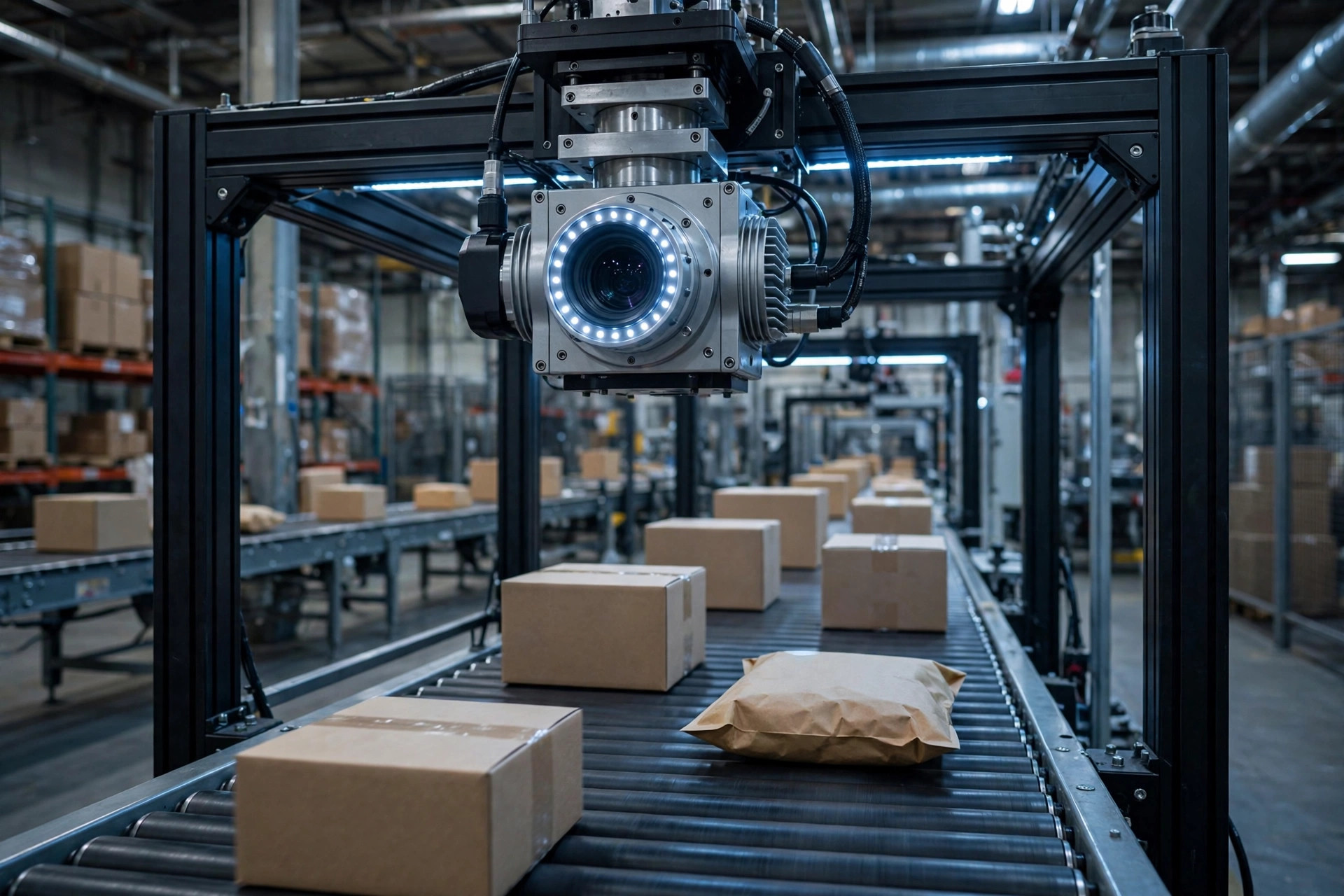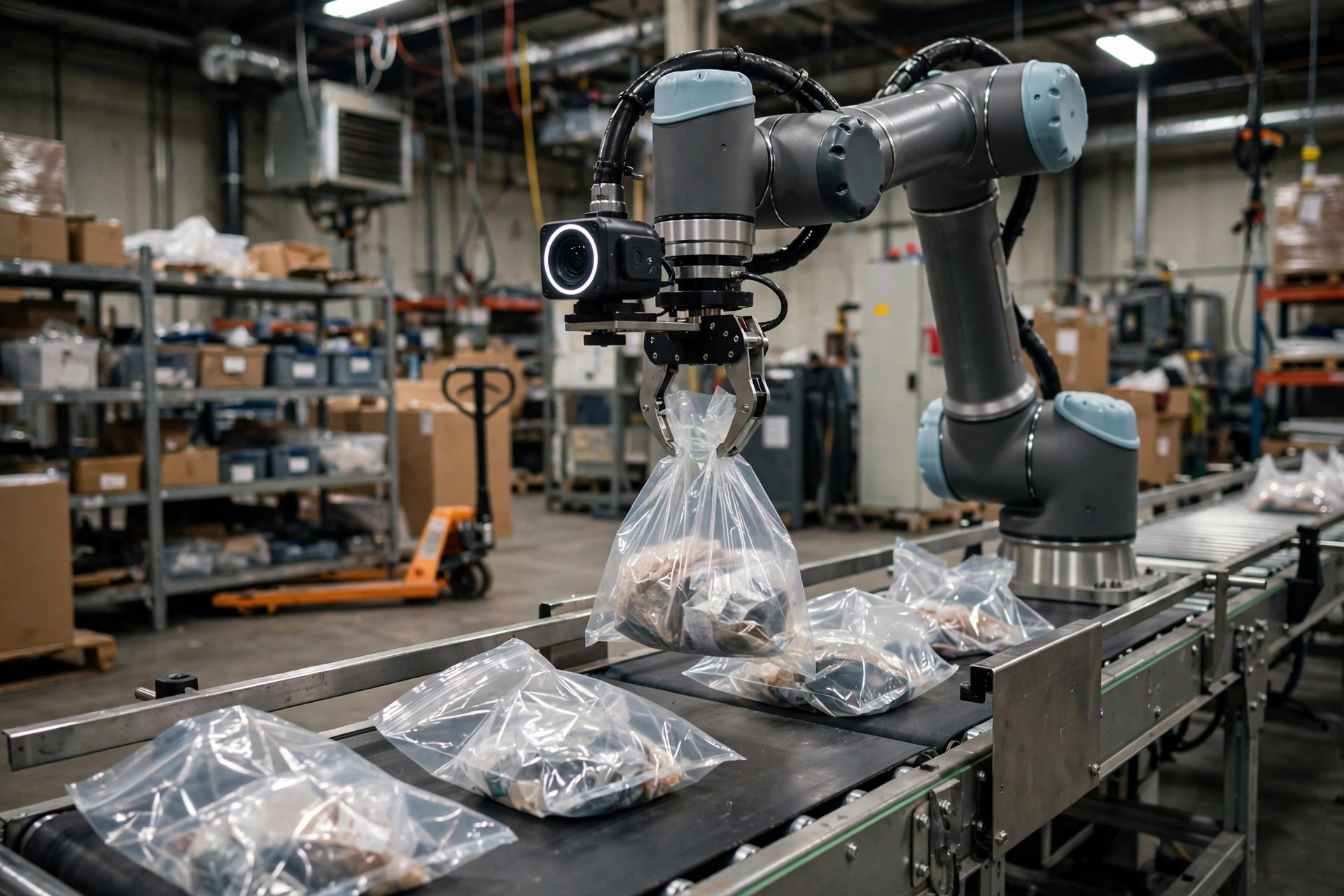
Here's a fact that makes every integrator groan: the same vision-guided picking system that hits 99% on cardboard cartons drops into the low 80s the moment it meets clear polybags. It's not the algorithm's fault. Physics just doesn't cooperate — which is exactly why "how robot vision handles transparent items" keeps coming up as a recurring question on every industry forum I follow.
Why Ordinary Cameras Can't See Transparent Items
A 2D camera finds objects by looking for edges — places where brightness changes sharply in the image. But a transparent bag lets light through, so the bag blends into the background and edge detection simply fails. Think of it like trying to spot a glass sitting on a glass table: under good light you catch a glint, shift the angle slightly, and it vanishes.
3D structured light doesn't fare much better. The principle is to project stripes or speckle patterns onto the object and compute depth from how they deform — you can think of it as giving the object a temporary tattoo and reading the shape from how the tattoo warps. But transparent packaging transmits the light and glossy film reflects it like a mirror, so the projected pattern either passes straight through or bounces away. The point cloud ends up with a big hole where the bag should be. The camera sees the conveyor belt behind the bag, not the bag itself.
I ran into this in 2024 at an apparel returns sortation center in Dongguan. Clear polybags made up more than 60% of the flow, and in the first week after go-live, roughly one in seven picks missed — the arm either grasped thin air or shoved the bag across the belt. At tens of thousands of units a day during peak season, that miss rate had everyone on site looking pale.
A 3C accessories warehouse in Shenzhen was even weirder in 2023: chargers wrapped in glossy shrink film became literally invisible to the 3D camera at one specific lighting angle. The team spent three days on site tuning the lighting, adding shrouds and changing angles before the recognition rate came back to an acceptable level. Remember this: transparency and reflectivity are two different enemies, but they love showing up together.
Three Approaches to How Robot Vision Handles Transparent Items
The industry has exactly three routes today, each with its own price tag. No silver bullets.
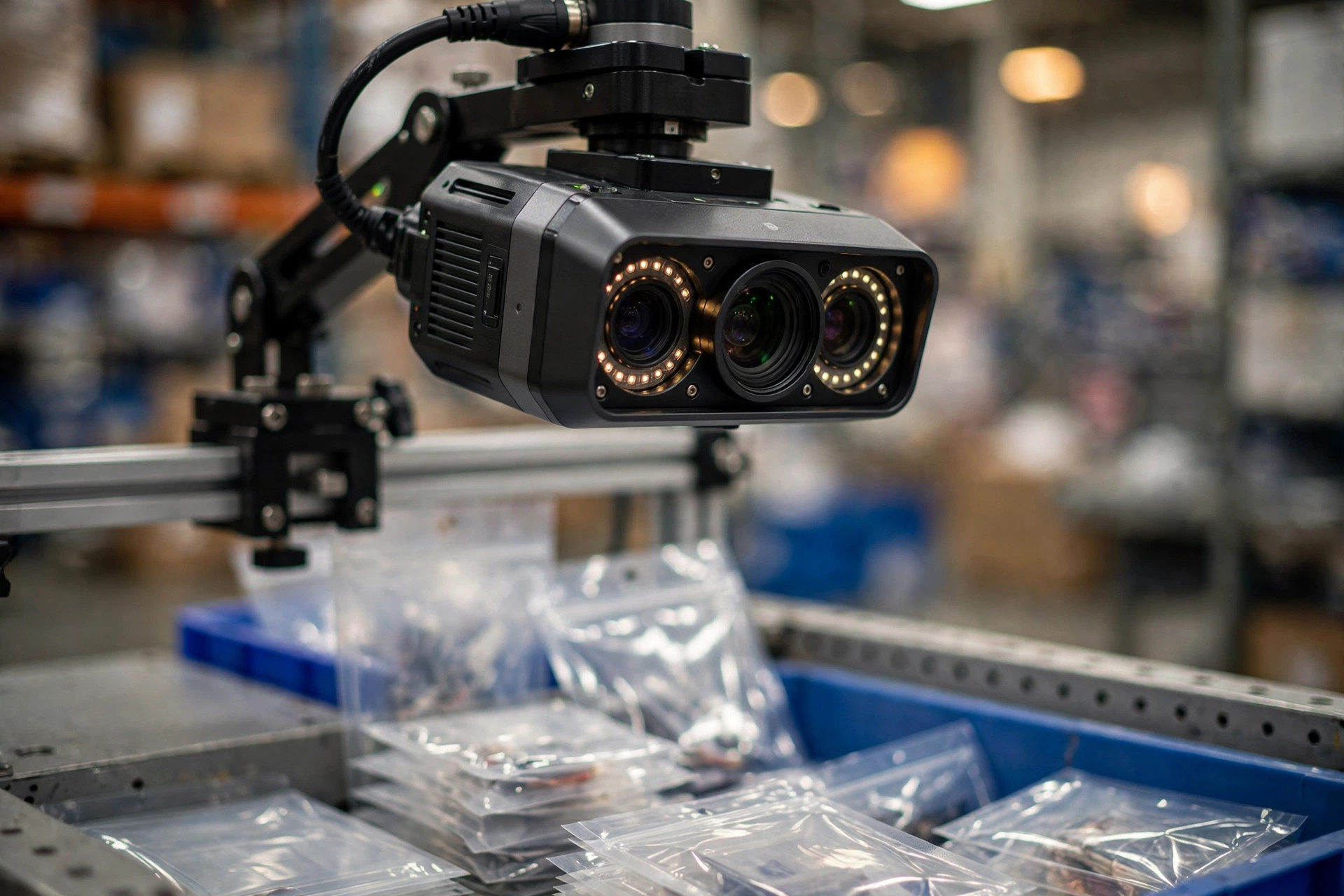
Route one: polarization imaging. Put a polarizing filter in front of the lens to kill specular reflection and keep only diffuse reflection — think of it like wearing polarized sunglasses on the water: the glare disappears and you can finally see the fish. This is the most direct answer to glossy bags and shrink film. The cost: heavy light loss, so you need supplemental lighting; and the polarizer is a consumable that ages fast in dusty environments and has to be replaced on a schedule. A full setup runs in the hundreds of thousands of yuan (varies by vendor and configuration).
Route two: multi-view fusion. Multiple cameras shoot from different angles and cover each other's blind spots — three heads are better than one. What one angle can't see, another might catch. The cost: complex calibration, slower cycle time (several exposures per pick pushes cycle time up), and cost that scales linearly with camera count. Best for stable item profiles where takt time isn't extreme.
Route three: deep learning completion. Train a model on large amounts of transparent-item data and let it "guess" the shape from texture and context. Sounds the smartest, and the pitfalls run deepest: data collection and annotation for transparent items is brutally expensive, and generalization is poor — switch to a new batch of packaging and you may need to retrain. Inference also eats compute; a decent GPU in the industrial PC is the starting point.
| Route | Best against | Upfront investment | Ongoing cost | Biggest fear |
|---|---|---|---|---|
| Polarization imaging | Glossy bags, shrink film | Hundreds of thousands | Filter consumables, lighting power | Dust, strong ambient light |
| Multi-view fusion | Odd-shaped transparent items | Scales with camera count | Calibration upkeep | Knocked camera mounts, tight takt |
| Deep learning completion | Fast-changing transparent items | Heavy data + compute spend | Retraining, data team | New packaging, long-tail items |
Where's the dividing line? If transparent items are under 10% of your flow and the item profile is stable — don't overthink it; standard vision plus manual backup is the cheapest answer. Over 30% and stable long-term — polarization imaging gives the most honest ROI. Item profile changing daily, like a returns warehouse — deep learning is the only real option, but budget for it properly and staff a data team. Glossy or mirror-finish film — pick polarization or multi-view; don't expect an algorithm hack to beat physics.
Before Upgrading Vision: Changing the Packaging Can Be 10x Cheaper
Here's the counterintuitive part: most of the time, changing the packaging is an order of magnitude cheaper than upgrading the vision system.
Switching from clear to frosted bags costs a few extra cents per bag. Slapping on an adhesive label as a "vision anchor" costs essentially nothing. A polarization imaging setup, on the other hand, is a six-figure investment plus commissioning time plus ongoing maintenance. I've run this math for clients more than once: the packaging engineer changes one line in the spec, and the vision engineer keeps half his hair.
Of course, changing packaging isn't always possible. Some brands mandate clear bags — apparel is the classic case, where shoppers need to see the garment. If you can't change it, take the technical route honestly. But for private labels, inner packaging, and returnable flows, ask one question first: "Does this really have to be a clear bag?" In eight out of ten projects, that single question eliminates all the downstream pain.
The Maintenance Pitfalls: Go-Live Is Just the Beginning
Once the selection is made, the maintenance traps are still waiting.
Polarizers are consumables. In a dusty warehouse, aging and scratching are the norm; if replacement isn't on a preventive schedule, recognition rate quietly slides six months in and nobody knows why.
Multi-view systems fear one thing above all: getting bumped. A forklift clips the camera mount, calibration drifts, and uptime tanks. Build in collision protection on site and make the recalibration procedure foolproof — don't count on calling the integrator every time; the travel bill costs more than the parts.
Deep learning setups fear "new packaging." A new batch of bags with different material or reflectivity, and the model degrades. Keep retraining money and data-collection headcount in the budget, or you'll have a system that works great in year one and flails in year two.
Whether the money is worth it comes down to one number: transparent items as a share of your total throughput. Over 30%, a dedicated vision solution is worth discussing. Under 10%, change the packaging first. Run that one number, and eight out of ten projects get their answer on the spot.
By Da Liu, Automation Engineer