Yiwu small commodities make money on volume and turnover, never on unit price. But I've watched too many sellers buy cheap in Yiwu and then lose it all in the warehouse — one order with 200 SKUs, pickers running themselves ragged, a container that takes three days to fill, a customs declaration bounced back while the goods sit at the port for an extra week. The platforms change their rules every other month. If your warehouse is dragging you down too, this business gets unplayable fast.
Here's a real example from my circle. In fall 2024, a friend selling party supplies picked up 180 SKUs at Yiwu International Trade City — jewelry, balloons, paper cups, streamers, the works. One order went to a US discount chain, under $40,000 in value. He rented an 800-square-meter warehouse and laid it out like a big-cargo warehouse, neat rows of racking. The result? Picking one order took over two hours, mispicks kept happening, and he had to hire four extra people before peak season. I walked his warehouse once and the problem was obvious: he treated it as a place to store goods, but a Yiwu small commodities warehouse is really a sorting workshop.
Don't Lay Out a Yiwu Small-Commodity Warehouse Like a Big-Cargo One
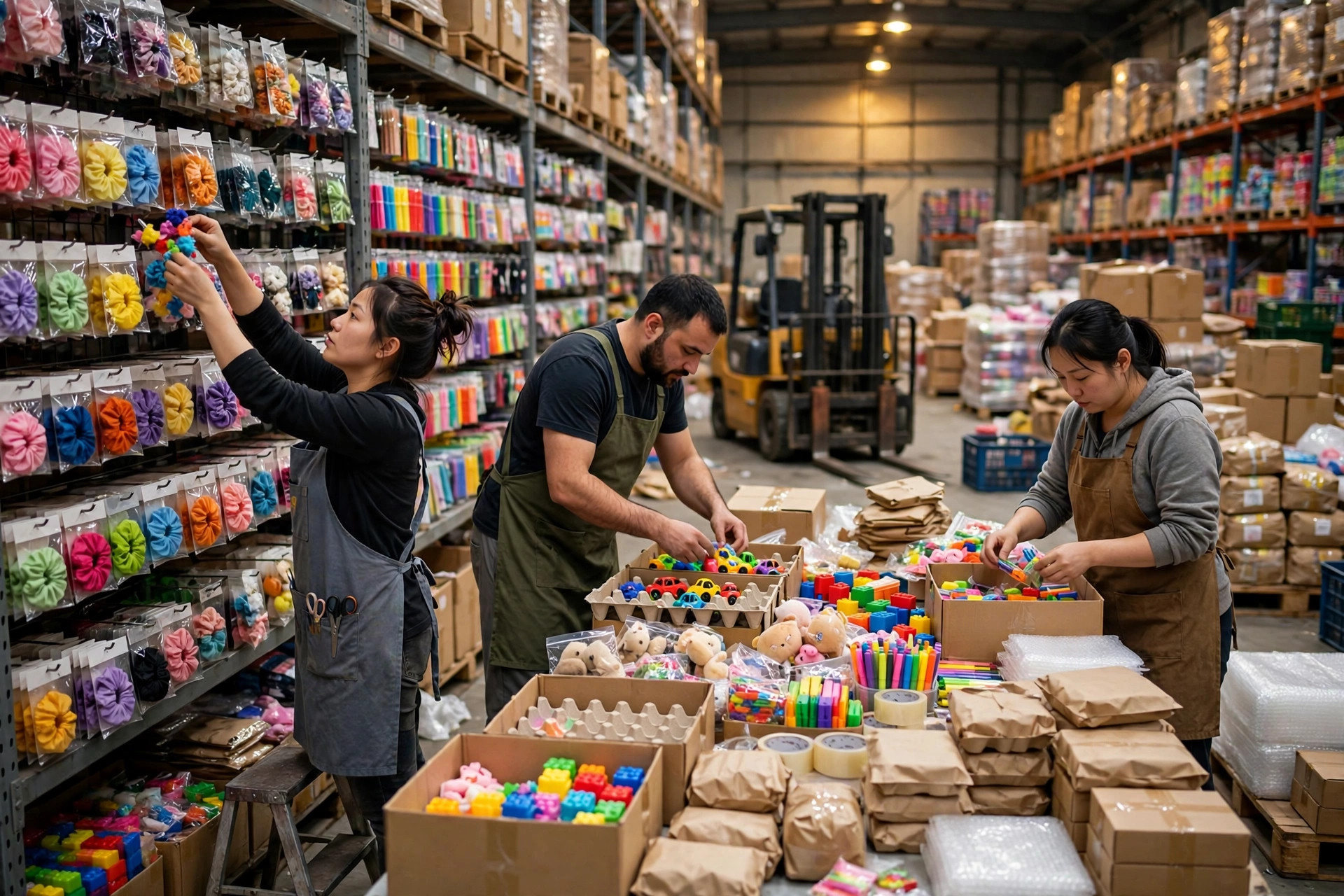
Yiwu International Trade City has over 75,000 booths across five districts, with 400,000-plus product varieties on offer. Minimum orders are often a single carton — 100 to 500 pieces. For a seller, that means one thing: your warehouse always holds hundreds of SKUs, a few cartons each.
With that structure, the most expensive thing isn't rent. It's your pickers' legs. My friend's 180 SKUs were spread evenly across 800 square meters, so every order meant walking the whole warehouse. The fix isn't complicated: split by velocity into three zones. A-items, the bestsellers that move every week, go in the golden zone right next to the packing bench. B-items, which move a few times a month, go in the middle. C-items, the long-tail stuff that barely moves, go to the back. That one change cut his pick time from over two hours to about 40 minutes.
One more detail: don't put small items on high racking. Hair clips, stickers, keychains — put them up high and you're asking for trouble, climbing a ladder every time and grabbing the wrong thing. My rule: light, small items all go on flow racks or pick walls at waist height, where you can see them and reach them in one motion. High racking is for heavy goods and full cartons only. The warehouse doesn't need to be big, but the travel path has to be short.
The 1039 Route Only Works If the Warehouse Matches It
A lot of Yiwu small commodities exports go through Market Purchase Trade, customs supervision code 1039. The route was first piloted in Yiwu in 2013. The core idea: mixed, multi-batch, small-volume goods can be exported compliantly even without VAT invoices — VAT-exempt, no refund. The cap is USD 150,000 per single customs declaration, and transaction details must be registered on the Market Purchase Trade online platform. As of July 2026 there were 39 pilot markets nationwide, but check the official policy for the latest rules.
This route puts specific demands on the warehouse. First, goods must match the declaration line by line — mixed loading is fine, but nothing vague. Product names, quantities, and values on the declaration have to match the physical goods, or the declaration gets rejected. Second, Yiwu Customs runs "inspect first, load later" for eligible loose cargo: goods selected for inspection are checked before loading. So you need an inspection zone kept clear in the warehouse — goods can't all be sealed into cartons the moment they arrive. Third, goods that can't use 1039 — state-prohibited or restricted exports, counterfeit goods — are simply off limits. Don't gamble on that.
Another friend of mine shipped Christmas decorations in November 2025, one container to the US. He sorted everything by declaration two weeks ahead, kept the inspection zone empty, and had the packing list and declaration paperwork ready the same day. The container was inspected and loaded the same day, and the sailing wasn't delayed at all. Another seller in the same season stacked everything together with no zoning; inspection picked his container, and digging through it cost two days. The ship sailed. His goods stayed behind. One week late on a container in peak season doesn't just cost freight — it costs the whole Christmas season.
Consolidation Is Where a Yiwu Order Actually Makes Its Money
The biggest cost killer in small-order, multi-SKU business is consolidation. A customer orders 200 SKUs, a few cartons each, and you can't fill a full container — so you consolidate. How well that goes depends entirely on how the warehouse is organized.
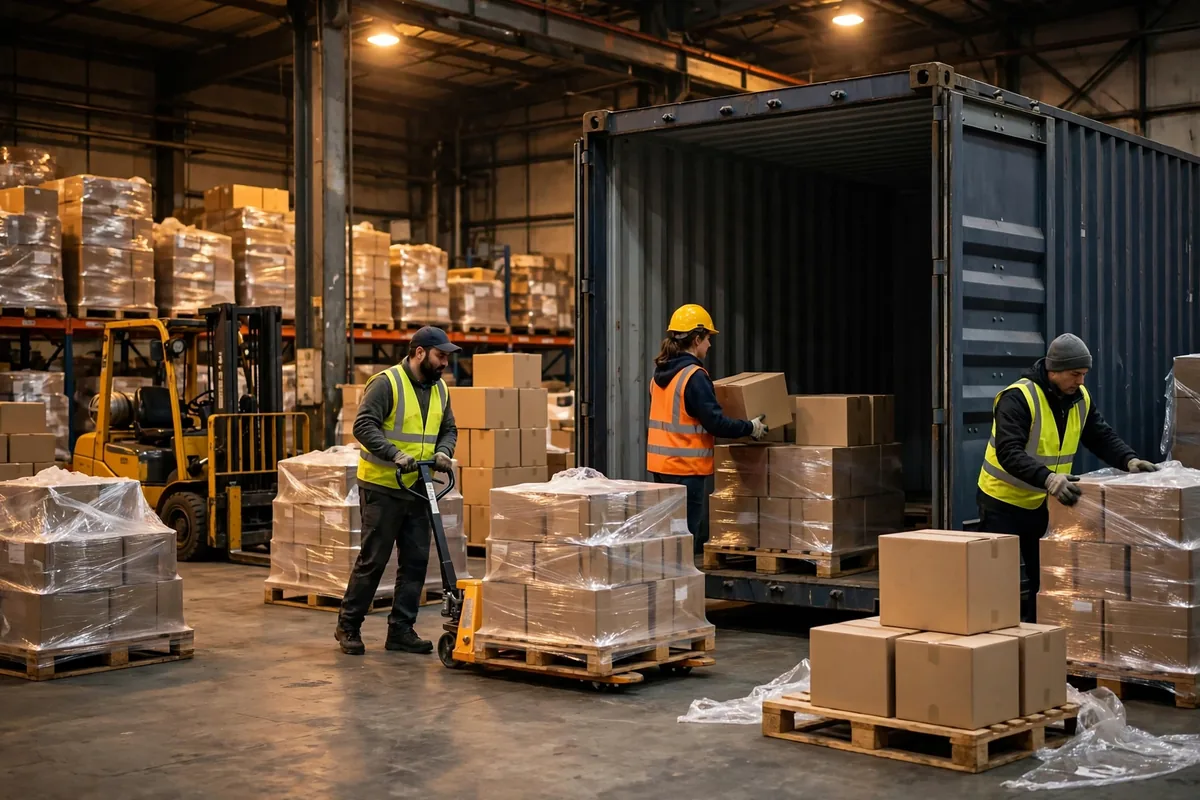
My method: set up a consolidation zone by sailing and container number. Goods for the same container get staged together in advance, with aisles between piles and the packing list stuck on the front of each pile. When goods arrive, they go to their container pile first, then onto shelves by SKU — reverse that order and pickers will spend all day hunting. And inspection has to happen before consolidation, not after. Find damage once the goods are in the container and the cost of stripping it back out exceeds the value of the goods.
Run the numbers and it becomes obvious. The table below is a hypothetical example, based on a 200-SKU order worth $40,000:
| Step | Working loose | Zoned by container + batch picking |
|---|---|---|
| Pick time | About 2.5 hours | About 40 minutes |
| Pick labor (hypothetical) | 3 people | 1 person |
| Mispick rework | A few items every order | Occasional |
| Loading time | Most of a day | About 2 hours |
The figures are hypothetical, but the direction is right: in a small-order, multi-SKU warehouse, the labor you save dwarfs the rent you save. Here's the counterintuitive part — in this business, cheap rent doesn't matter. What matters is how many orders one picker ships per day. Five orders a day versus fifteen, and your labor cost per order differs by a factor of three. That's where the profit actually lives.
Stocking: Don't Hoard Bestsellers, Don't Starve the Long Tail
Stocking is where sellers go wrong in two opposite directions: either they hoard because they fear stockouts, or they under-stock because they fear dead inventory. The trap with Yiwu small commodities is that bestsellers and long-tail items follow completely different stocking logic. Mix them up and the math breaks.
Bestsellers first. In early 2025, a friend selling nail stickers went viral in a short video — over 8,000 orders in a week. She got excited and stocked three months' worth at once. The hype lasted less than a month. She ended up with 20,000-plus boxes sitting in the warehouse and had to clear them at a discount, losing money on freight too. Bestsellers have short lives. Stock about 30 days' worth and top up weekly. Short replenishment cycles are fine — Yiwu booths usually hold stock, and an order placed today reaches the warehouse in a day or two.
Long-tail items work the other way. Hair clips, stickers, buttons — one SKU might sell only a few dozen pieces a month, but 200 long-tail SKUs together form a stable base. Don't be afraid to stock these: 60 or even 90 days' worth is fine. They're small, they take little space, and they don't go out of season. What you should fear is a stockout. A customer orders 200 SKUs, three are missing, and the whole container waits. One delayed sailing, and the freight and storage costs are wasted.
Don't skip inspection either. Yiwu's supply base is mixed — the same hair clip from three booths can differ by a whole quality grade. My rule: full inspection on a new supplier's first order, sampled inspection of at least 10% for established suppliers. Inspect before consolidation, not after. I once skipped sampling to save time, and 20 out of 300 cartons in a container turned out defective. The customer rejected half the shipment, and return freight plus reshipping wiped out the entire order's profit.
So keep the three budgets separate: bestsellers are about turnover, long-tail is about never stocking out, inspection is insurance. Get those three right and the warehouse stays clean.
One last honest word: this kind of warehouse isn't won on square meters. It's won on order. Hundreds of SKUs aren't scary — hundreds of SKUs with no system is. Sort by velocity, zone by container, keep an inspection area clear, and the warehouse runs itself. This one I've tested myself, and it works.
By Ah K, E-commerce Seller (5 yrs)