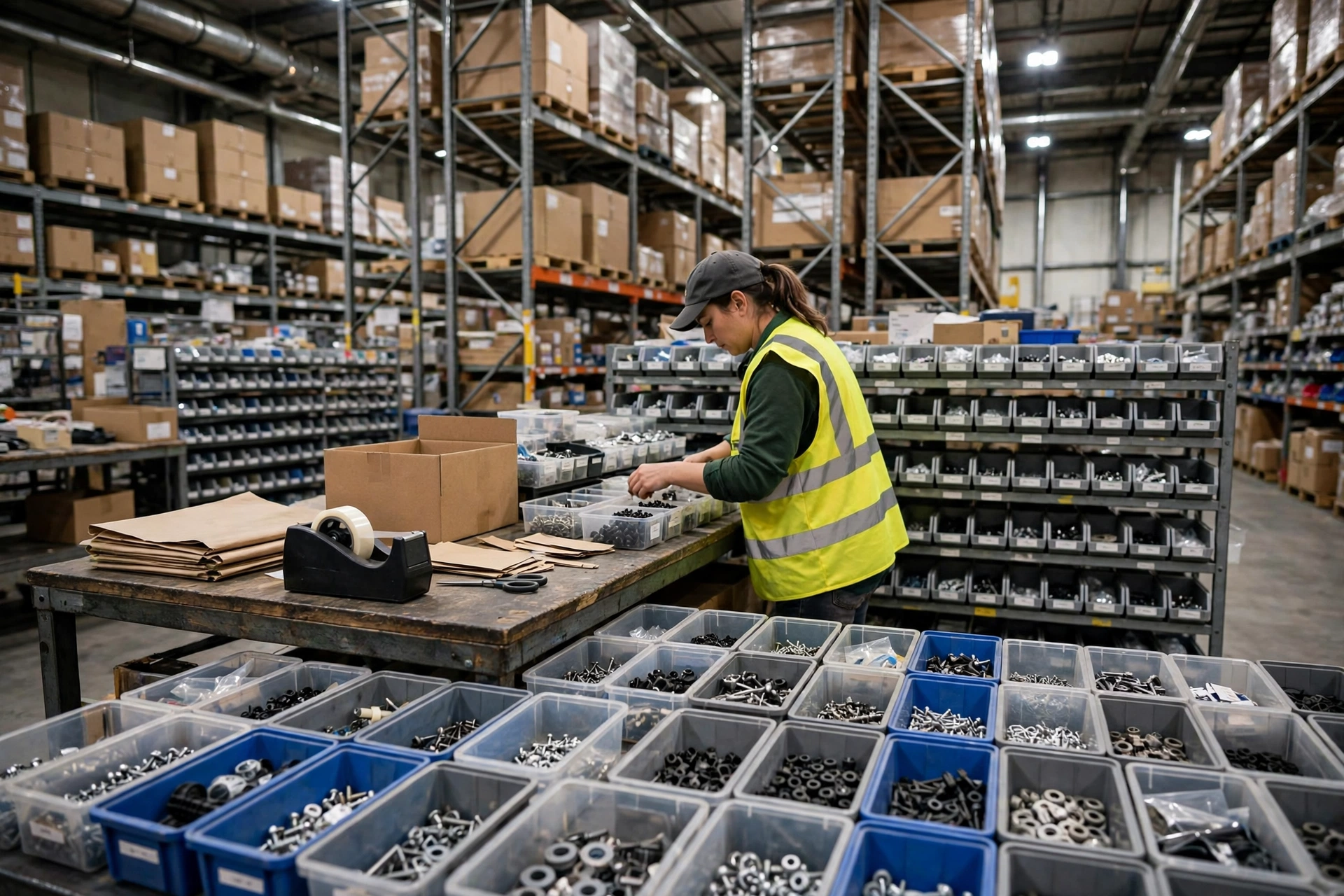
Walk into a third-party warehouse serving several clients at once, and a seemingly contradictory picture often emerges. Under the same WMS, one client's fast-moving goods sit in fixed locations that pickers can find almost from memory, while another client's seasonal products are assigned to whichever empty location looks best at that moment. Slotting, in practice, is rarely a matter of technical preference alone. It is an organisational choice shaped by product structure, and wms fixed vs random slotting locations is best understood as a trade-off to be weighed against warehouse conditions, not as a question with a universal answer.
Fixed slotting hands certainty to people. Each SKU maps to one location, or a small set of locations, which makes replenishment, cycle counting, and training comparatively straightforward. The cost appears when the range keeps expanding or seasonal swings sharpen: some locations sit idle while others overflow, and the system begins to rely on overflow locations. Once overflow becomes routine, the word fixed describes the intention rather than the reality.
Random slotting hands certainty to the system. The WMS places stock according to empty locations available at the time, together with size, weight, velocity, and the picking path. Its strength is higher space utilisation: slow-moving SKUs no longer hold prime locations indefinitely. Its cost is equally clear. Pickers cannot rely on memory, so the operation depends heavily on prompts, scan verification, and location accuracy. If occupancy data lags behind reality, the walking time saved can easily be consumed by searching and exception handling.
The numbers: a labelled worked example
To make the comparison calculable, consider the following worked example, presented explicitly as an assumption-based illustration rather than as industry statistics. Suppose a warehouse must complete 8,000 pick lines per day, with time per line split into walking, confirming, and exception handling. Under fixed slotting, assume confirming takes 4 seconds, walking 18 seconds, and exceptions once per 100 lines at 120 seconds each, adding 1.2 seconds per line: about 23.2 seconds in total. Under random slotting, assume better concentration of fast movers cuts walking to 15 seconds, while confirming rises to 6 seconds and exceptions to twice per 100 lines, adding 2.4 seconds: about 23.4 seconds in total. Under this set of assumptions, the two approaches are almost indistinguishable: switching slotting strategy alone does not guarantee faster picking.
Small changes in the assumptions change the direction of the result. If fast movers become more concentrated and the golden zone is defined more precisely, the walking advantage of random slotting may widen to more than 4 seconds per line. If location accuracy falls and exceptions rise to four per 100 lines, random slotting moves clearly behind fixed slotting. The variables that decide the outcome are often not the slotting rule itself but the three capabilities that support it: location accuracy, replenishment timeliness, and the precision of the golden zone.
| Dimension | Fixed locations | Random locations |
|---|---|---|
| Main time saved | Finding and confirming stock | Walking time and space-related waiting |
| Dependence on system accuracy | Relatively low | High; occupancy status must be current |
| Adaptability to SKU volatility | Weaker; surges cause overflow | Stronger; adjusts dynamically to free space |
| Ease of training new pickers | Easier; memory can help | Harder; heavily dependent on prompts |
| Counting and replenishment complexity | Relatively simple | Requires stricter replenishment and checks |
| Better suited to | Stable SKUs with clear velocity tiers | Volatile SKUs, tight space, strong seasonality |
Attribution: what saves time is velocity tiering and replenishment rhythm
According to the comparison above, a more accurate attribution is that differences in picking time come mainly from whether velocity tiering has been done well, not from whether locations are fixed. ABC classification exists to reserve a limited golden zone for genuinely high-frequency SKUs. If a warehouse has not carried out a serious velocity analysis, fixed slotting will lock the golden zone into historical habit, while random slotting will place stock in the wrong places with equal confidence.
A second attribution is replenishment rhythm. Fixed slotting tolerates delays comparatively well, because pickers know where stock should be. Random slotting is less forgiving: a late replenishment shows up directly as a picker arriving at an empty location, followed by a second walk and an exception. Many warehouses that switch to random slotting and find picking time rising have not chosen the wrong strategy. They have changed the slotting rule without upgrading the replenishment process that the new rule depends on.
A third attribution is order profile. Where small single-line orders dominate, walking accounts for a larger share of total time, so random slotting combined with wave picking offers a clearer benefit. Where larger multi-line orders dominate, confirmation and full-pallet handling carry more weight, and the certainty of fixed locations becomes more valuable. Judging whether a strategy saves time therefore requires an earlier answer: is most of the time being spent walking, or confirming and handling exceptions?
A counterintuitive judgement: hybrid slotting often beats either pure strategy
A counterintuitive judgement follows from this analysis. In many medium and large warehouses, insisting on an entirely fixed or entirely random approach often saves less time than a deliberate hybrid. A common pattern is to fix fast-moving SKUs in the golden zone, let the system assign medium and slow movers at random, and keep seasonal SKUs in a separate flexible area. Fixed and random slotting solve different problems for different SKU groups: fast movers need certainty and the shortest path, slow movers need spatial flexibility, and seasonal SKUs need rapid entry and exit without disturbing the existing structure.
The cost of a hybrid is higher management complexity. The WMS must support different slotting rules by SKU group, velocity boundaries must be reviewed regularly, and in-stock goods moved in a planned sequence when boundaries change. If no one owns that ongoing work, a hybrid can decay into placing stock wherever space happens to be available. A hybrid is therefore not a compromise for organisations avoiding a decision. It is a more demanding approach that only works when the supporting discipline is in place.
Fixed vs random slotting locations: five questions before switching
Before deciding whether to switch, five questions matter more than the strategy itself. First, has velocity data from the past quarter been cleaned, and are the resulting tiers stable? Second, what is current location accuracy? Third, can replenishment keep pace with picking under a random model, and is the contingency path clear when a location is empty? Fourth, is the golden zone large enough to hold the fast-moving range, or has it already become a bottleneck? Fifth, has the cost of switching been counted, including moving in-stock goods, retraining staff, and the efficiency dip during the early weeks?
If two or more of those questions cannot be answered positively, the safer sequence is to close the gaps first and discuss switching afterwards. If all five have reasonably clear answers, switching has a calculable basis. The switch itself should be staged: start with one SKU group or one zone, observe performance across at least one full velocity cycle, and only then decide whether to expand. A whole-warehouse switch in one step carries the risk that a systematic error will be expensive to correct.
The trend: from static rules towards dynamic optimisation
Over a longer timeline, the direction of travel is not a swing between fixed and random. It is a movement from static rules towards dynamic optimisation. As a WMS gains a better sense of velocity data, order waves, and location occupancy, slotting becomes less like a one-time decision and more like a continuing adjustment: fast movers shift with seasons and promotions, slow movers leave the golden zone, and picking paths adjust with order structure. Within that trend, the boundary between fixed and random becomes less sharp. What matters is whether a warehouse can keep correcting its slotting with data, rather than whether it chose the right strategy once.
That also changes how slotting should be evaluated. The relevant measure may shift from which strategy was chosen to how often it is reviewed and how reliable the evidence is. A warehouse that redefines its golden zone every quarter from real velocity data can keep saving time, whether it started from fixed or random locations. A warehouse that chooses a strategy and leaves it untouched for three years will gradually be dragged down by changes in its SKU structure, however good the original choice was.
Returning to the original question, then, which saves more picking time in the wms fixed vs random slotting locations comparison? On the evidence available here, the honest answer is that there is no general answer detached from warehouse conditions. The answer lies in velocity tiering, replenishment capability, and location accuracy. Perhaps the question worth asking is not which strategy is better in the abstract, but whether a warehouse already has the conditions that allow either strategy to work, and over what time window it is prepared to test the result.
By Dr. Chen, Supply Chain Researcher