The first lesson of west africa cocoa bean warehouse storage is a single number: moisture. In September 2026, New York cocoa futures were trading near $5,600 a ton — roughly double their February lows — while Côte d'Ivoire's 2025/26 output was projected to fall 10.8% year on year to 1.65 million tons. The more a ton of beans is worth, the more expensive every storage mistake becomes. And in origin warehouses, the number that decides whether a lot settles at $5,600 or gets written off is, more often than not, moisture content. This piece is about three unglamorous things: how moisture is managed, how mold and insects are kept out, and what a warehouse receipt is actually worth.
Start with the structure of the market. Côte d'Ivoire and Ghana together produce more than half of the world's cocoa, so a warehouse problem in either country is a chocolate-price problem everywhere. Ghana's 2025/26 deliveries exceeded 750,000 tons against a 650,000-ton target, while Côte d'Ivoire was heading for just 1.65 million tons. Tight supply raises the cost of every storage error — that is the premise behind every number that follows.
The moisture line that decides everything
Under ISO 2451, cocoa beans must not exceed 7.5% moisture by mass fraction; in commercial practice, 6–7% is the ideal band for ocean shipment and long storage. Above 8%, beans go moldy; below 5%, they turn brittle. The cruel part is how fast dried cocoa reabsorbs water: in tropical warehouses at 80–90% relative humidity, bean moisture climbs back above 10%, undoing half the drying work.
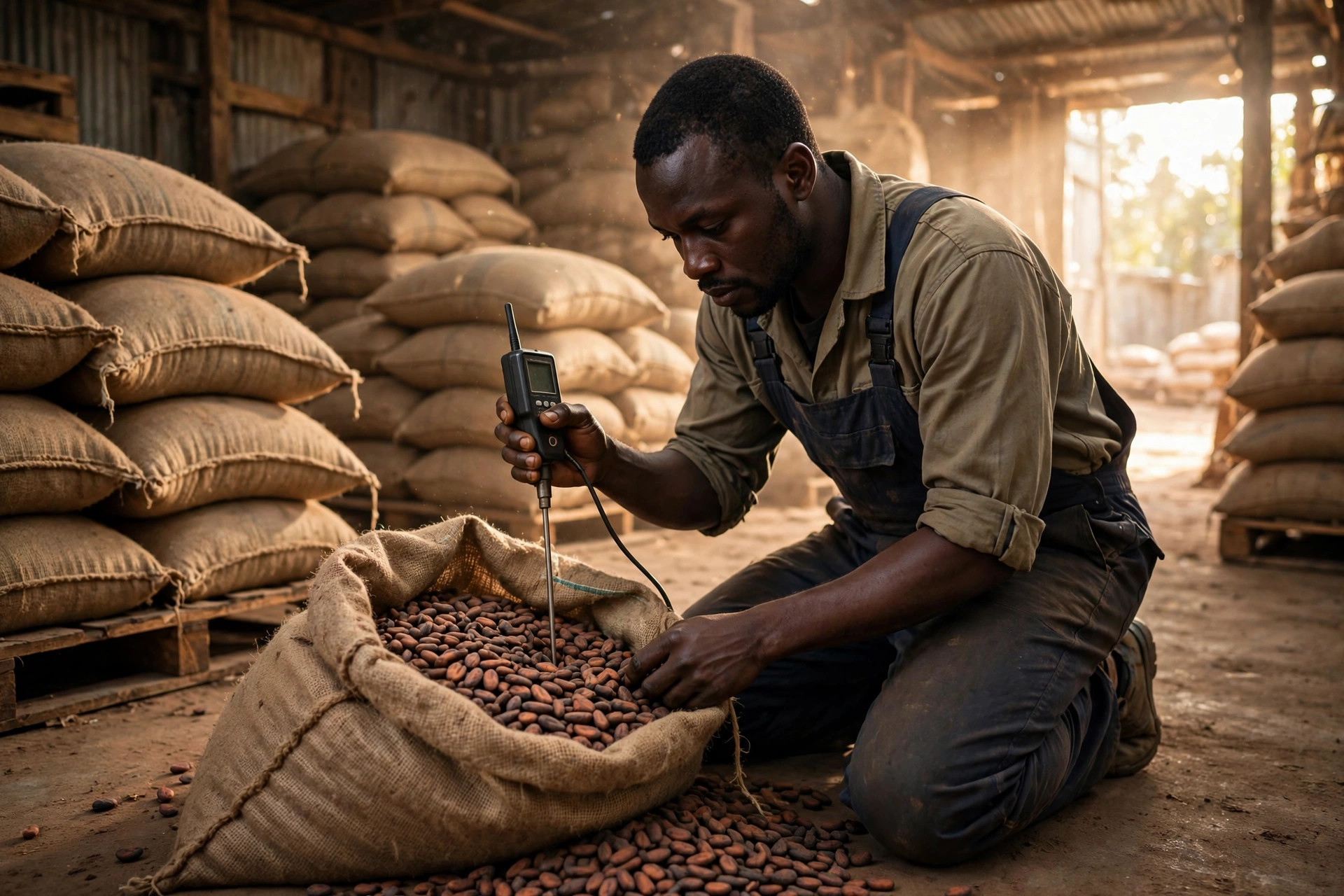
A study of buying stations in Ghana found that 97.5% of depot managers test moisture before receiving beans. That is not diligence for its own sake — it is a rule written by mold losses. One wet lot entering the store can spoil a whole stack, and the loss is priced by the lot, not the bag.
The intake dilemma: a lot testing at 8.3% — take it or turn it away?
September to January is Ghana's main crop (February to August is the light crop), and the busiest months for up-country buying warehouses. At the tail of the rains, farmers deliver beans that never fully dried. The meter reads 8.3%. Take them or refuse them?
Take them, and the warehouse absorbs re-drying costs, segregated stacking, and the risk that mold spreads from one bag across a stack. Refuse them, and the farmer sells to the buying station next door — with more than 800,000 smallholder families growing cocoa in Ghana, losing a village's supply over one refusal is a genuine commercial cost.
So experienced origin warehouses don't do blanket refusals. They triage. Compliant lots go to the main stacks; beans at 7.5–8% get segregated stacks, tagged, and shipped first; anything above 8% is rejected on the spot or accepted at a discount for re-drying, with the cost netted out at settlement. The arithmetic is public, and sentiment is kept separate from the rules.
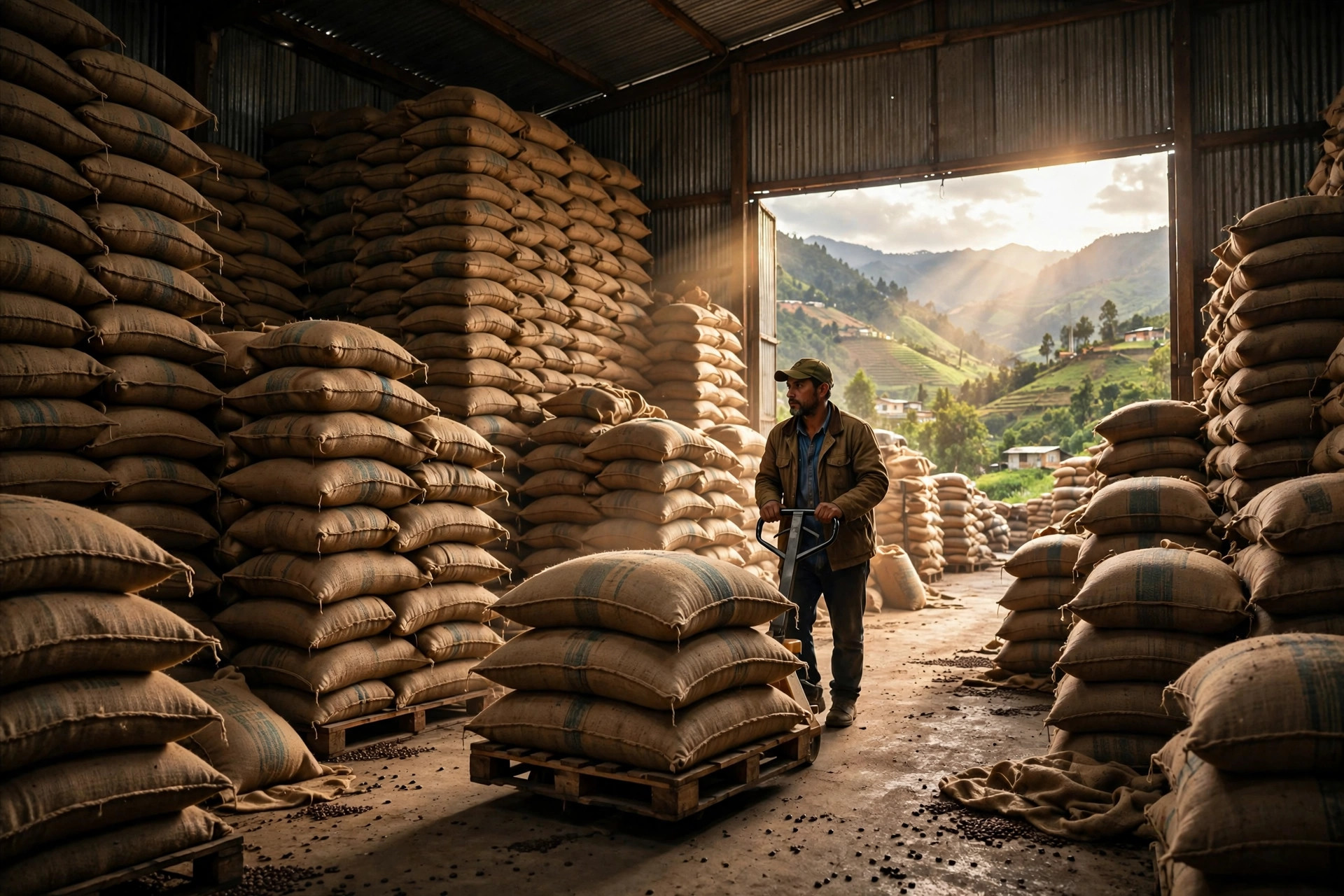
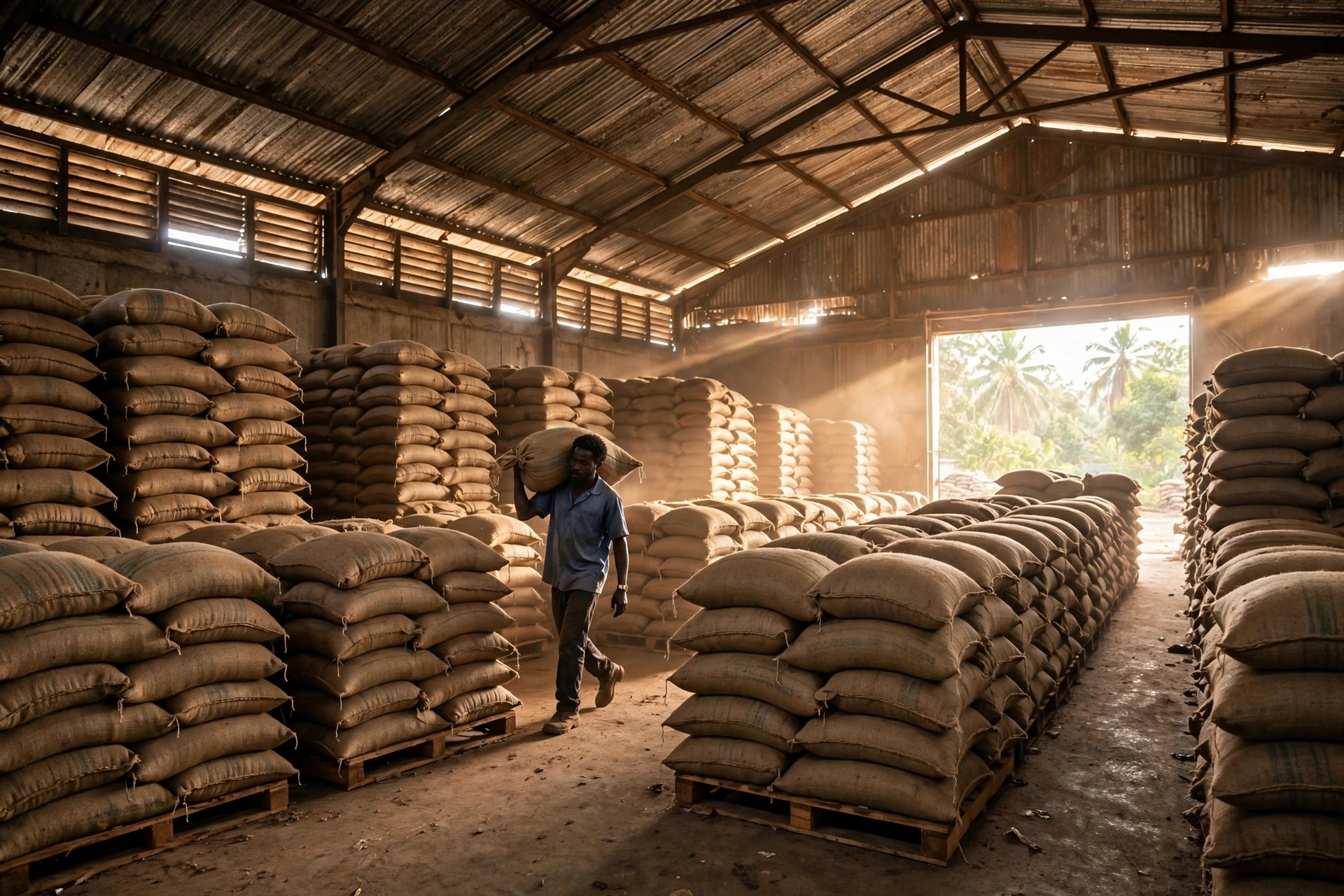
Stacking is moisture management too. Jute bags go off the ground and off the walls, on wooden pallets, with ventilation. Origin handling guides put it bluntly: in a tropical store, the speed of mold and infestation depends on ventilation, not air conditioning. Jute breathes, which prevents mustiness but also absorbs humidity — so stacking discipline matters more than any equipment.
The pre-shipment trap: insects, mold, and rain inside the container
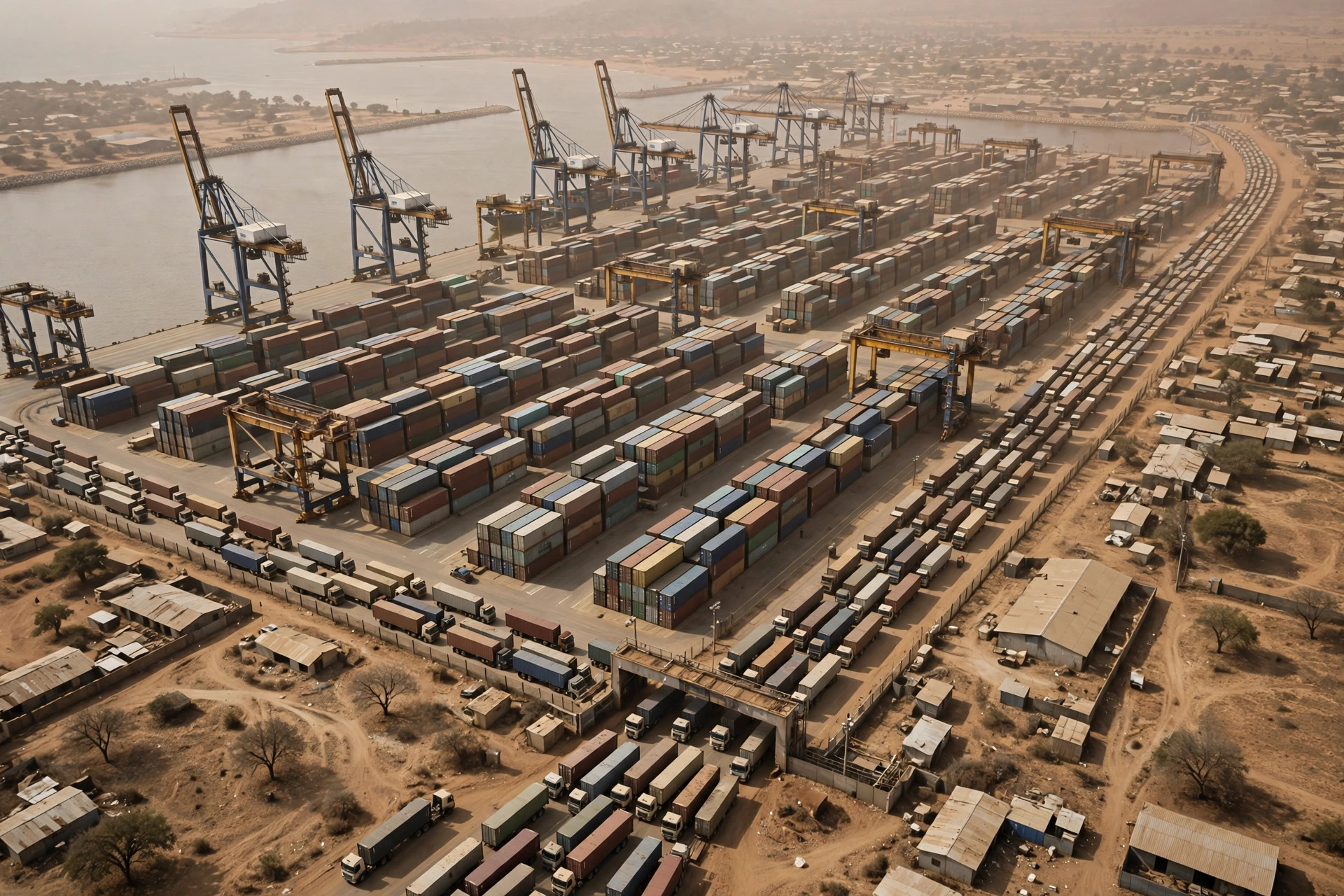
Beans wait two or three weeks in port warehouses at Tema or Abidjan. Near the sea, day–night temperature swings cause condensation inside containers — "container rain." Trade quality literature documents an instructive detail: condensation molds the top layer of beans, and at discharge those moldy beans get mixed back into the sound ones, lifting the whole container's mold count by averaging. The grading line is unforgiving: Grade I permits a maximum of 3% moldy beans on the cut test, and a fraction over it reprices the entire container.
Insects are the quieter front. The tropical warehouse moth targets broken or germinated beans; as the trade literature says, infestation is an "inherent vice" of cocoa — a warehouse can only manage it. Methyl bromide fumigation is banned, so origin stores have moved to phosphine or pyrethrin fogging, done at dusk when the air is still, aimed at roof and wall crevices where insects hide.
The arithmetic of a wet lot: a decision framework and a loss calculation
Here is the intake framework distilled into a table. Thresholds follow industry standards; actual execution should defer to buyer contracts and current ICCO and local warehouse policy:
| Intake moisture | Action | Basis |
|---|---|---|
| ≤7.5% | Normal intake into main stacks | ISO 2451 limit |
| 7.5–8% | Segregated, tagged, first-out, intensified inspection | Mold risk zone |
| >8% | Reject, or accept at a discount for re-drying, cost deducted at settlement | Mold threshold |
And a back-of-the-envelope loss calculation. Take a 500-ton lot at roughly $5,600 a ton (New York futures, September 2026): $2.8 million of value. If mold downgrades the lot at even a 10% discount, $280,000 is gone. A handheld moisture meter, a few pallets, and one fogging treatment cost a fraction of a fraction of that. On a commodity priced like cocoa, moisture control is the highest-ROI line item in west africa cocoa bean warehouse storage — not a metaphor, just division.
Three counterintuitive judgments
First, the most dangerous warehouse isn't the hottest — it's the stuffiest. Cooling a tropical shed is unrealistic; ventilation is. The stacking rules above are, at bottom, about giving air a path.
Second, drier is not better. Below 5%, beans go brittle — and lighter. Weight is money, so over-drying literally evaporates sellable weight. Many new warehouse managers have never done that math.
Third, a warehouse receipt's credit doesn't live on the paper — it lives on the issuer's balance sheet. In early 2026, Ghana's cocoa board struggled to honor payments, licensed buying companies warned they might halt purchases, and the IFC injected $300 million to backstop the flow of Cocoa Take-Over Receipts. Meanwhile, Ghana's IFC-supported Warehouse Receipts System and its electronic platform are turning moisture, grade, and quantity into pledgeable financial data. How much a receipt can borrow depends on two things: whether the warehouse's quality control is credible, and whether the issuer's credit holds. All of West Africa watched Ghana learn that lesson in 2026.
Trend judgment: in a high-price cycle, storage stops being a cost center
Three data points, three timelines. Price: futures near $5,600 a ton in September 2026 means every percentage point of loss costs more — the return on moisture control rises with it. Financialization: Ghana set its 2026/27 farmgate price at 42,400 cedis a ton (about $3,647), scrapped its 32-year syndicated-loan model for domestic bond financing, and put its electronic warehouse-receipt system through an evaluation round between late 2025 and early 2026 — the inventory ledger is becoming a financial ledger. Supply volatility as the norm: two countries hold over half of world output while disease, aging trees, and illegal mining keep their forecasts swinging year to year; warehousing is no longer a place to "just keep things," but the buffer that smooths the swings.
When a ton of beans is worth $5,600, every percentage point in west africa cocoa bean warehouse storage deserves to be recalculated. The question is whether origin warehouses are ready to do quality control at that price.
By Dr. Chen, Supply Chain Researcher