In October 2024, I had less than ten grand in my business account and about $170,000 in goods on my racks. Supplier payments were due, payroll was coming, the landlord was chasing rent — and every dollar I owned was bolted to a pallet. That night I stood outside my warehouse thinking: if only this inventory could spend like cash.
Turns out, it can: a warehouse receipt pledge — inventory as collateral for working capital from a bank or factoring company. Big companies have done this for decades; we small warehouse owners just never thought it was for us. After two years of asking around and trying it myself, here's the unfiltered version: what a warehouse receipt pledge actually is, how lenders value your goods, whether the math works, and the red lines you must never cross.
All My Money Is on the Racks, and I Can't Spend a Dime of It
Here's the death spiral every small warehouse owner knows: you stock up before peak season and cash goes into goods; goods sell slowly, so cash lies on the shelves; when money finally comes back, it's time to stock up again. On paper the year looks profitable. In your pocket? Cleaner than your conscience.
When cash runs short, the first instinct is to call the bank. I did. The loan officer was polite and blunt: the building is leased, the equipment is worthless as collateral, B2B payment cycles read like hieroglyphics to their risk team, and I'd missed a credit card payment by two days two years ago. Three strikes, out. Those glossy supply-chain-finance decks full of "core-enterprise credit pass-through" jargon? One page in, we small operators close the tab.
A warehouse receipt pledge is beautiful because it doesn't judge you — it judges your goods. You're broke? Fine. Are your goods worth something? That's the whole application. For small warehouse owners, that's tailor-made: we may not have much, but we have inventory.
So What Is a Warehouse Receipt Pledge, Really?
Plain English: you "pledge" a batch of inventory to a lender for a working-capital advance against a percentage of its value. The goods stay in your warehouse (or a supervised one), but from that day on, they get a babysitter — a third-party supervisor. Want to move them? File a request first.
Three common flavors:
First, a straight bank loan — the bank hires a collateral-management company to inspect, track, or station someone at your warehouse. Bigger amounts, highest bar, slowest process. Second, factoring companies — faster and more flexible than banks, but usually pricier. Third, industry-focused platforms specializing in one category, like grains or steel. They know the product, so valuation is quick, but they only take categories they understand.
How does the lender decide what your goods are worth? Three questions:
First, can it be resold easily? Standardized products, commodities, and fast-moving consumer goods are lenders' favorites — default, and they can liquidate them. Custom-shaped packaging or food with three months of shelf life left? They won't even look. Advance rates run 50% to 70% of appraised value (subject to each lender's current policy) — easier resale, higher ratio. Second, is the value stable? Swinging commodity prices get discounted hard, plus margin-call clauses: value drops below a line, you top up or repay early. Third, who pays for supervision? On-site inspectors or IoT sensors — that bill usually lands on you. A small line item on paper, real money over a year. Fold it into your total cost.
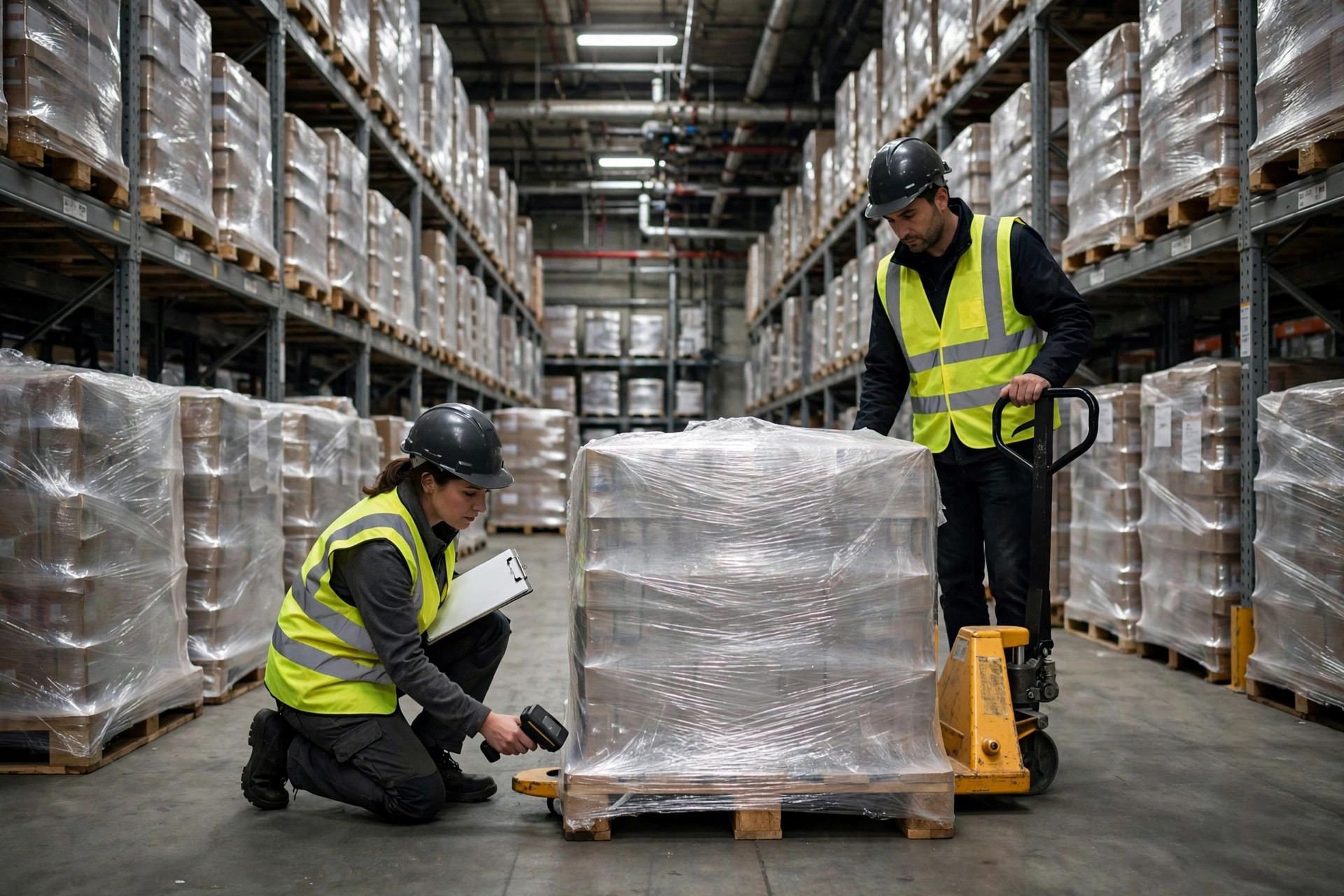
A true story. My neighbor Lao Chen runs a 3,000-square-meter 3PL warehouse in Dongguan, specializing in standard fasteners. In 2023 he landed a big client, needed to pre-stock about $110,000 in goods, but had only $40,000 — a $70,000 hole. Banks were a dead end, so he went to a factoring company: the fasteners appraised well at a 60% advance rate, and roughly $66,000 landed in under three weeks. Rates were subject to the lender's current policy, but his math was simple — the deal's margin covered the financing cost with room to spare. His words: "I used to think finance was a different planet. Turns out goods are money. The bank gets that better than we do."
The Math on Warehouse Receipt Pledges: I Did It So You Don't Have To
Concepts are cheap. Here's the math:
Say you're sitting on $140,000 of inventory (at cost). Pledge it at 60%, get $84,000. Cost has three parts: interest, supervision fees, appraisal and miscellaneous charges. Exact rates vary — subject to each lender's current policy, and I won't invent numbers. The real question isn't the absolute number, it's the comparison: what happens if you DON'T take that $84,000? Usually one of three endings: peak-season stockouts while customers walk away; buying on credit from suppliers who jack up prices or shorten terms; or private lenders at even higher cost. The right math: financing cost vs. stockout losses vs. the opportunity cost of tied-up capital. Plenty of small owners flinch at "interest" without counting how many orders each cash gap cost them.
Here's how the pledge stacks up against the usual ways small warehouse owners scrape together money:
| Financing option | What determines the amount | Relative cost | Barrier to entry | Biggest trap |
|---|---|---|---|---|
| Bank business loan | Cash flow + credit + collateral | Lower | High — no collateral, no chance | Slow approval; too late when you need it |
| Warehouse receipt pledge | Inventory value | Medium | Medium — good goods are enough | Goods under supervision; outbound isn't free |
| Receivables factoring | Quality of your receivables | Medium-high | Medium — depends on who your customers are | Trouble if the customer disputes the invoice |
| Credit cards / online loans | Personal credit | High | Low | Small limits; a bottomless pit if you roll it over |
| Borrowing from family | Reputation + pride | Zero on paper | Depends on the relationship | You owe favors, and those compound faster than interest |
(Cost levels are relative; actual rates and fees are subject to each lender's current policy.)
See the pattern? The pledge is the only row that says "we don't care who you are, we care what your goods are worth." Moderate barrier, moderate cost, and the amount scales with your inventory — the more you stock, the more you can borrow. For those of us whose only wealth sits on racks, that's a match made in heaven.
But look at the last column: goods under supervision, outbound isn't free. That's the biggest hidden cost — and the contrarian take I want to hammer home.
Warehouse Receipt Pledge Red Lines: Cross These and You're Done
Enough with the upside. The ugly part: a warehouse receipt pledge has red lines — cross them and you lose the loan at best, face fraud charges at worst:
First, double pledging is a death sentence. Pledging the same batch to two lenders is essentially loan fraud. Supervision systems are networked, with physical spot checks — don't gamble. In 2024 I heard of an operator who double-pledged one batch; when it surfaced, both lenders pulled at once, and the warehouse shut down.
Second, respect price volatility. Pledge swinging commodities and the contract will carry margin-call clauses: value drops, you top up or repay early — fail at either, and the lender can liquidate. Stick to price-stable, standardized goods.
Third, and most important: during the pledge, your goods aren't free. Every outbound shipment needs the supervisor's sign-off — half a day at best, several days at worst. Invisible in normal times, lethal in peak season. My friend Lao Zhou pledged consumer goods before the 2024 holiday rush; a key account then dropped a 20,000-unit emergency order, and approval took three days. The customer nearly walked. Now Lao Zhou pledges at most 70% of stock and keeps 30% completely free for rush orders, always.
The biggest cost of a warehouse receipt pledge isn't the interest — it's that your goods are no longer free. But the biggest surprise benefit is that it forces you to get your inventory records clean.
Before the money moves, the lender and supervisor tear through your inventory: SKUs, batches, quantities, values, aging — line by line. And let's be honest: small owners' records are a mess. The system says 100 units, the shelf holds 96, the other 4 are "probably on the way." A pledge forces real cycle counts, batch tracking, and FIFO discipline — or you fail the supervisor's report. Lao Chen told me after his deal closed: "Worth every penny. Getting forced to straighten out inventory will save me tens of thousands in lost goods next year." Big companies pay consultants six figures for internal discipline. We get the same workout, courtesy of a bank holding our money. Crude? Sure. Effective? Absolutely.
Small Warehouses Have Their Own Way to Survive
Hard-earned tips for fellow small operators, paid for with real tuition:
First, start small. Don't pledge the whole warehouse on day one. Take one batch of standardized goods, do one small deal, learn the process and the lender's temperament.
Second, pledge only "hard currency": standardized, long shelf life, easy to liquidate. Customized, seasonal, price-volatile goods — leave them alone.
Third, always keep a safety buffer. Don't max out the ratio. Keep 20% to 30% of stock completely free for rush orders and daily operations. Remember Lao Zhou's three days.
Fourth, count the TOTAL cost, not just the rate. Interest plus supervision plus appraisal plus your labor cooperating with inspections — add it all up, then compare against what losing orders would cost. Do the whole math, not half of it.
A warehouse receipt pledge isn't magic. It's a tool. Used well, dead money on your racks becomes live cash. Used badly, your goods lose their freedom, rush orders can't ship, and you'll cry about it. We small warehouses can't afford to burn money, so every dollar gets accounted for.
Big companies have their game: credit lines in the tens of millions. Small warehouses have their own way to survive: our goods are our leverage. Get your inventory straight, and the bank will happily talk to you. Having no cash in the account isn't scary. What's scary is sitting on $170,000 of inventory and not knowing it can turn into money.
By Xiao Ma, Small Warehouse Owner