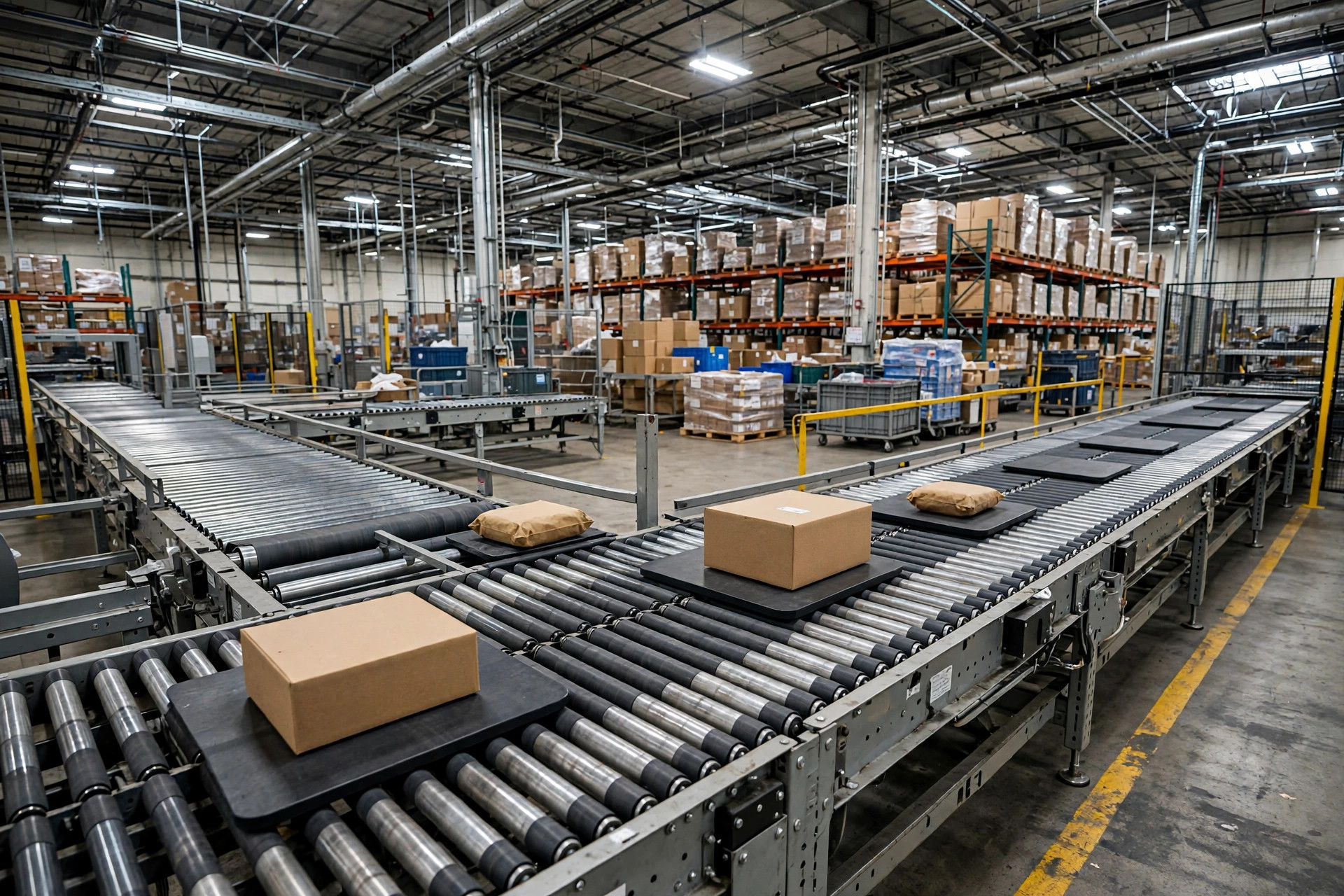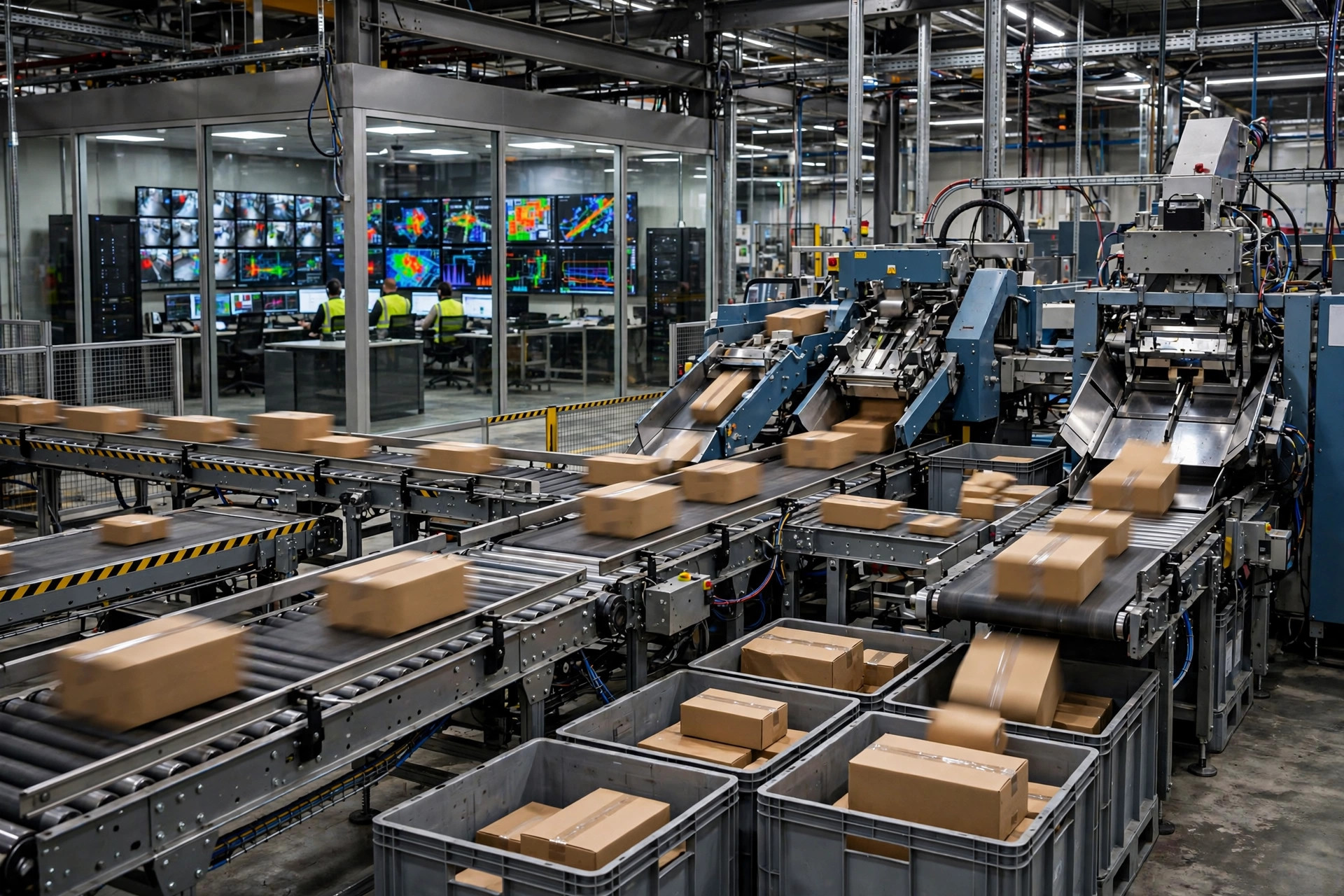
The month before peak season is my busiest time of year — not installing equipment, but going warehouse to warehouse asking: have you done your WCS load testing? Eight out of ten managers say yes. Then I ask how. "We ran a normal wave through it. Ran fine." Every time, I want to take off my hard hat. A normal wave is a fraction of peak load — judging a sprint by a morning jog.
WCS load testing isn't complicated, but nine out of ten warehouses do it wrong. Here's the checklist.
First, Be Clear: What WCS Load Testing Actually Stresses
One sentence for non-automation readers: the WCS (Warehouse Control System) is the commanding officer of all automated equipment. The WMS says "ship these orders," and the WCS translates that into machine language — which conveyor starts, which chute gets the cartons, which lift goes to which level. PLCs are the squad leaders; the WCS is headquarters.
A load test never really stresses the WCS server's CPU — it idles at 20% to 30% on a normal day, and maxing it out proves nothing. That's a physical exam that only weighs you. Three lines actually matter:
First, the WCS–WMS message channel. At peak the WMS hurls hundreds of tasks per second at the WCS; if the queue can't digest them, tasks pile up while equipment idles — headquarters' phones jammed, front line waiting.
Second, the PLC scan cycle — the fixed loop of read signals, run logic, send commands, normally a few to ten-odd milliseconds. Under full load the signal volume explodes, the cycle stretches, equipment moves "half a beat late," carton spacing goes wrong: that's how jams are born.
Third, network jitter. WCS, PLCs, scanners, HMI panels all hang off one industrial network. When the data flood hits at peak, switch ports fill up: packet loss, retransmissions, latency. The infuriating part is this failure never shows up on a quiet day — a load test that doesn't go far enough will never find it.
Any of the three can fail first with the same symptom: everything's jammed. But root causes and fixes differ, so don't just ask "did it run smoothly" — pull each line's data separately.

Use Last Year's Waves as the Exam Paper: The Checklist
What data? My answer never changes: replay last peak's real historical waves, unedited. Synthetic data is always subconsciously "reasonable" — and real peak data never is. Three hot SKUs jammed into one chute, a returns wave colliding with an outbound wave, one zone going out of stock and forcing task re-planning. The gremlins in real wave data are things you'd never invent.
The playbook:
Step one, set the target: last peak's highest single-hour wave volume times 1.2. The business always says "growing 20% this year" — build in the headroom. A system that can't handle 1.2x will blow up on peak night.
Step two, build the test environment: isolated from production, but WCS, PLC programs, and network topology identical. Testing in production "when there are no orders" is a cardinal sin — you'd never dare run production at full load.
Step three, replay the waves: use the WMS history interface on a compressed timeline. Keep the original fingerprints — peaks and valleys, SKU concentration, exception ratios. Don't "prettify" a single one.
Step four, watch three sets of numbers — WCS queue depth and dispatch latency, PLC maximum scan cycle, network port utilization and packet loss. Watching only "did it jam" is a physical that only weighs you.
Step five, run it long enough: four continuous hours at full load. Many failures are chronic — memory leaks, motor thermal protection, belt drift — invisible until hour two or three. Thirty minutes is a rehearsal, not a test.
November 2024, an apparel e-commerce warehouse in East China. Their "load test": one hour at 70% of normal load, and a beautiful report. At 1 a.m. on Double 11, the main conveyor trunk jammed: the PLC scan cycle had stretched, sortation signals arrived half a beat late, cartons rear-ended each other. Forty-plus people went manual until 6 a.m. Their own post-mortem: that night's losses would have paid for twenty proper load tests.
Counterexample: August 2025, a US West Coast 3PL prepping for Black Friday replayed last year's waves at 1.2x for six straight hours. In hour four, a real problem: the sorter's chute-allocation algorithm degraded under full load. Normal days spread SKUs out and the algorithm copes; when peak bestsellers concentrate, it piles cartons into the same chute and only alarms when it's full. You'd never catch this at 70% load — the tipping point sits right around 90%. Two weeks rewriting the weighting, and Black Friday night ran clean. The manager called it the best-spent two weeks of his year.
The Pass/Fail Lines: Red Lines You Don't Cross
The "life-or-death" table I hand clients — trip one red line and you won't sleep that night:
| Metric | Pass | Red line (fix before go-live) |
|---|---|---|
| Hourly wave throughput | Hits 1.2x last peak | Below 1.1x |
| WCS task dispatch latency | 95% dispatched within 1 second | Any backlog exceeding 5 seconds |
| PLC scan cycle | Max no more than 1.5x normal | Jitter causing visibly jerky equipment motion |
| Conveyor jams | Zero jams in 4 hours | One or more jams |
| Network packet loss | Zero loss for the full run | Any observable packet loss |
| Continuous full-load runtime | 4 hours with zero manual intervention | Needs manual restart or unjamming |
People tell me, "one jam is normal — we'll clear it by hand." Peak-night staffing is planned for normal waves; sending people to unjam at full load is like asking firefighters to find a hose after arriving at the fire.
Where Load Tests Usually Go Wrong
Pitfall one: the test environment is "close enough." One firmware version off, one switch missing, every result is a placebo. The worst I ever saw: the test environment ran a WCS backup from three months earlier. Clean test, big celebration — then a patch in the new version changed a message-queue timeout, and everything fell over on go-live night. Before any load test: copy down every production version number and match them one by one.
Pitfall two: you test the equipment but not the people. WCS alarms, HMI pop-ups, exception procedures — on peak night humans click through all of it. Inject faults during the test — unplug a scanner, simulate a full chute — and see if the person on duty can follow the playbook within five minutes. Equipment is iron; people freeze. The kid on shift at 3 a.m. might be two months in.
Pitfall three, the most counterintuitive: the hardest-stressed link is rarely the first to break. The WCS is software — under pressure it's "honest," it slows down or throws errors. The sneaky ones are the "reliable" neighbors: PLCs, scanners, switches. A scanner read rate dropping from 99.9% to 97% at speed looks like three points; at peak volume it's a disaster. A switch port at 90% utilization is fine on a calm day, but burst traffic starts dropping packets immediately. My trade-off advice: aim seventy percent of your firepower at interfaces and boundaries, thirty percent at the WCS itself. Don't turn it into a WCS benchmark contest — vendor salespeople love that; it does nothing for your peak night.
One more trade-off: pushing to the equipment's physical limit? Stop at 1.2x business peak. Motors at sustained full load take an MTBF (mean time between failures) hit — burning equipment life to test one extreme is penny-wise. Peak's real enemy was never the few minutes of absolute peak; it's the long hours of sustained high load. Load testing is an endurance race, not a sprint.
Whether the Money Was Worth It Comes Down to One Number
Every conversation ends the same way: the environment, the people, the downtime — is it worth it? The numbers below are hypothetical — plug in your own figures; the formula is the real part:
Say your peak does 10,000 orders an hour at $60,000 margin per hour. A two-hour jam forces manual sortation at a third of the efficiency — 14,000 orders miss their ship time. Refunds, bad reviews, platform penalties, plus overtime for forty people: one incident burns several hundred thousand yuan without blinking.
A proper load test? The isolated environment (many integrators throw it in) plus a week of two or three people's time — tens of thousands of yuan. So it comes down to one number: take your highest single-hour volume from last peak, multiply by 1.2, and ask whether your system can swallow it. If yes, the cheapest insurance in the building. If no, every yuan "saved" is crowdfunding for the accident on peak night.
A month before peak, stop asking "should we load test." Are the historical waves ready? Dare you write the 1.2x target into the report? If yes, go stress it; if no, there's still time.
By Da Liu, Automation Engineer