I'll be honest about why I started a warehouse waste management and recycling program: the trash bill drove me crazy. Our little warehouse can't afford to burn money like that — for us, garbage isn't something you "dispose of," it's money leaking out the back door every month.
Quick context on our place: a small warehouse in the US, under 10,000 square feet, six people on the team. Every day we break down cartons, stack dead pallets, and untangle stretch film. All of it used to go in the dumpster, with the hauler coming twice a week. Then one year I added up the hauling bills and realized we were spending the price of a baler every year just to make our trash disappear. That was the moment I started asking: how much of this "garbage" is actually sellable?
The Cardboard Baler: How to Write the Payback Math
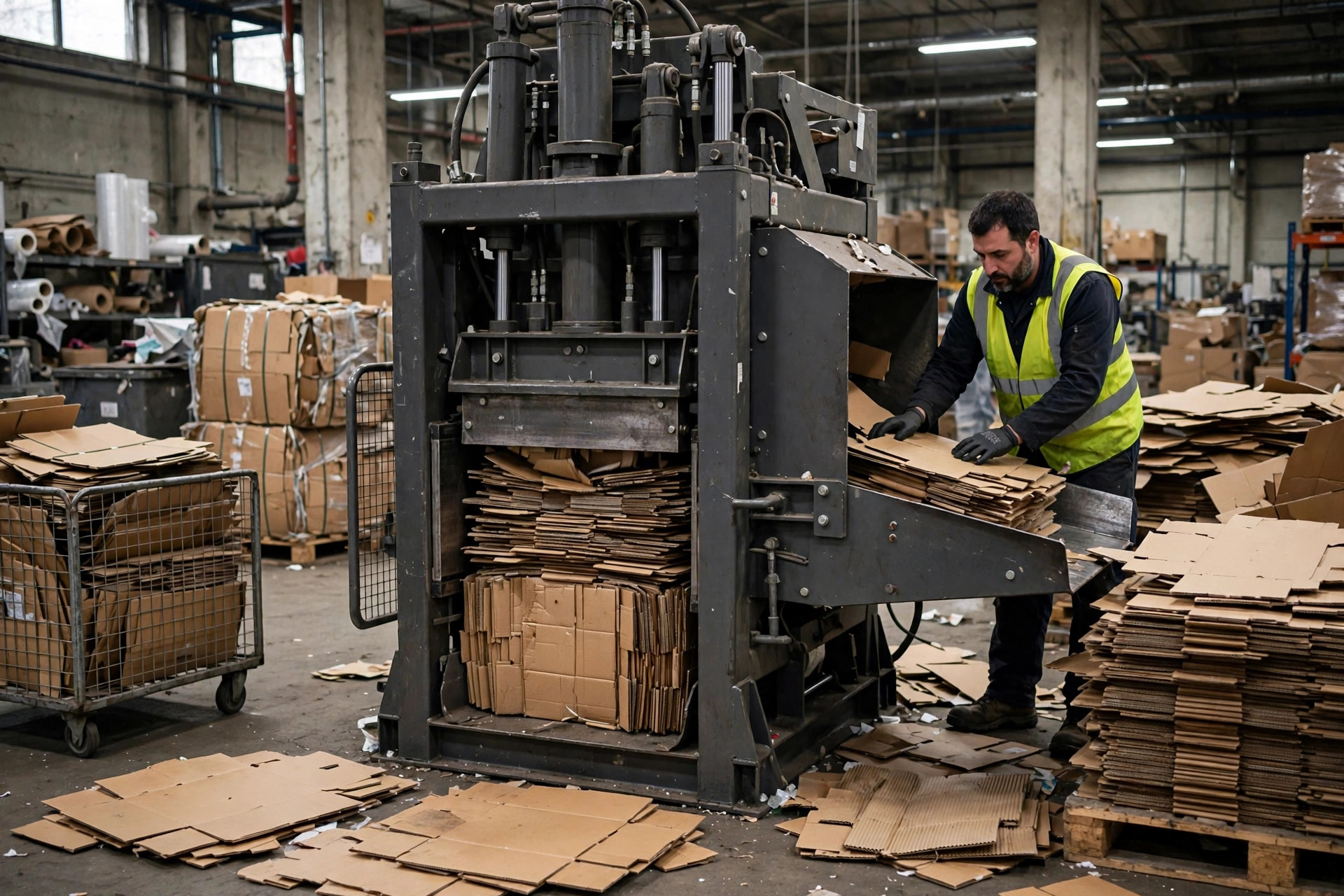
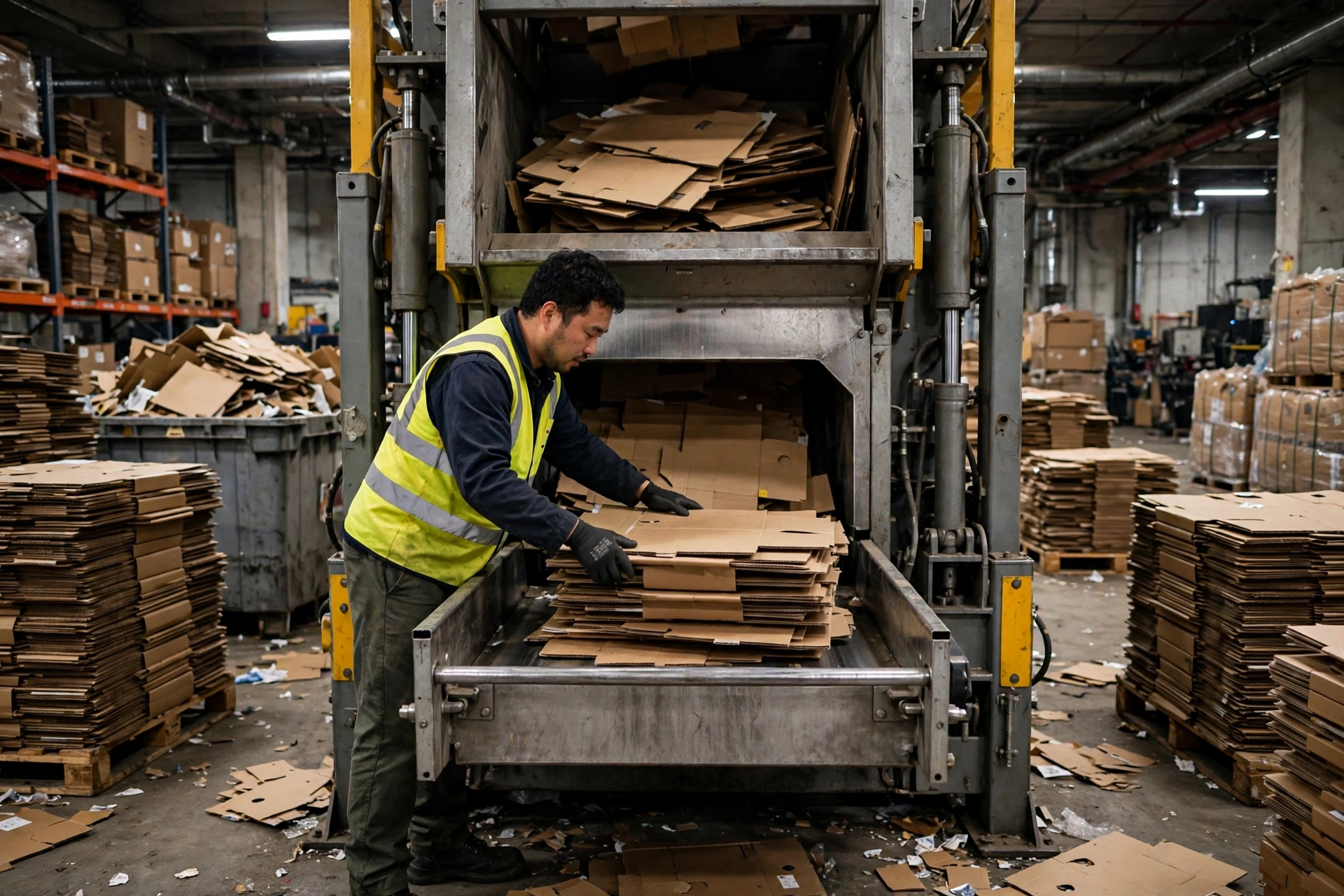
The single biggest line item in any warehouse recycling program is corrugated cardboard. The cartons you break down every day are the most stable "waste revenue" you'll ever find — clean, uniform, with a standing market price.
But first, a hard truth: small warehouses should not daydream about big equipment. Here's what the big guys play with — there's a public case from trigo-group where a mid-size site recycles an average of 160 tons of corrugated cardboard per month. That scale of equipment and floor space is not our world. Our approach: do the math first, then decide whether to buy a baler.
The math has three inputs:
One, revenue from cardboard recycling. Baled old corrugated containers (OCC) sell by the ton. Prices move constantly — get this week's quote from your recycler, and ignore whatever number I could write here, because it would be stale by the time you read this. Weigh your cardboard once a month (no scale? the recycler weighs it for you when he picks up). Revenue = monthly tons × quoted price.
Two, hauling fees you stop paying. Once cardboard stops filling your dumpsters, can you cut the hauler from twice a week to once? Renegotiate the contract — fewer pickups means a real monthly saving. For us, this line item alone saved a serious chunk of money every year.
Three, the baler's cost. Equipment price and payback period should always come from the vendor's quote. Don't believe any blog post claiming "pays for itself in three months" — those numbers are computed on big-warehouse cardboard volumes. The small-warehouse formula is: equipment cost ÷ (monthly recycling revenue + monthly hauling savings) = payback months. If that number exceeds what you can stomach, don't buy. Do the other things below first.
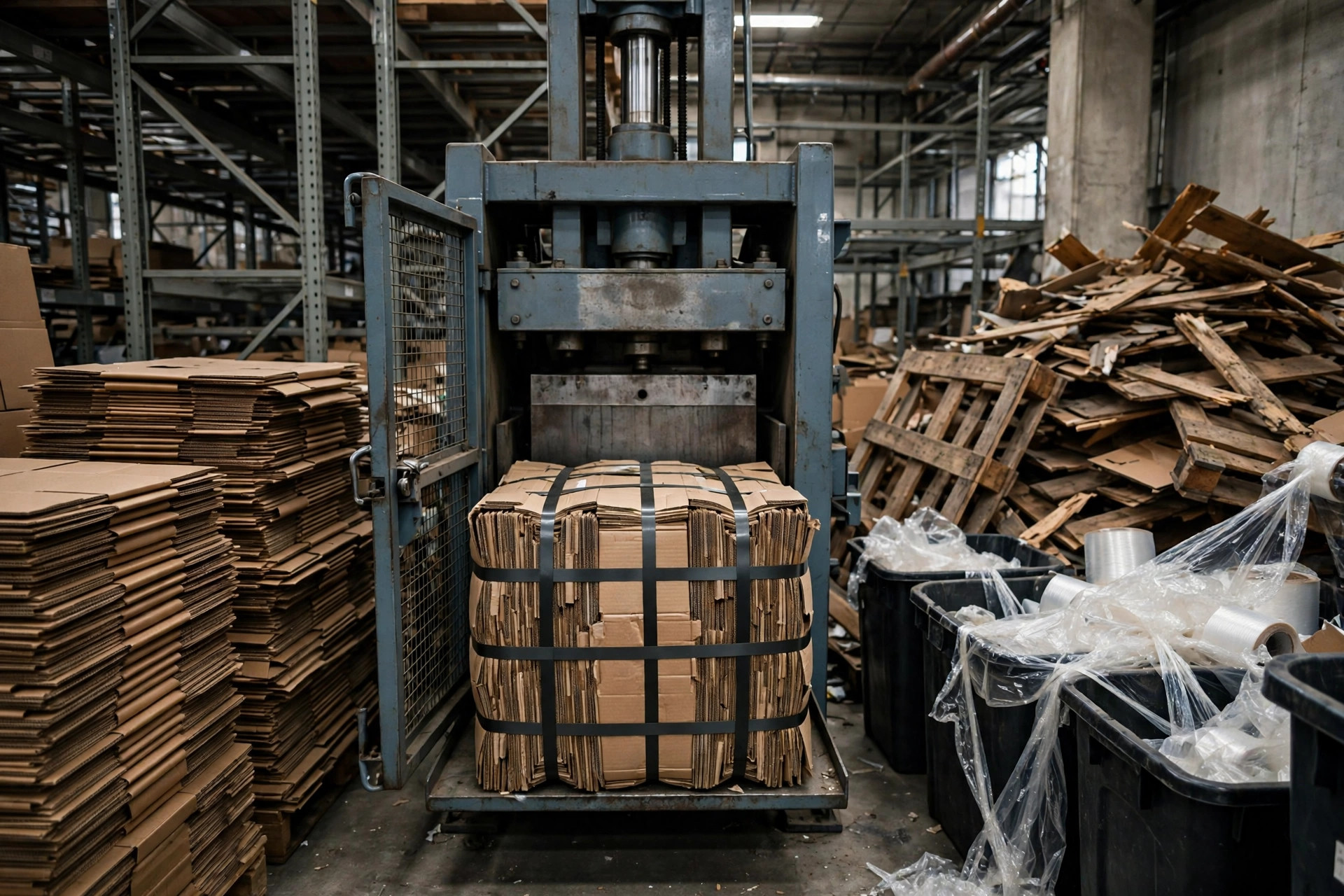
We ended up buying a small vertical baler — tiny footprint, two people can run it. One question to ask the recycler before you buy anything: "What bale size do you take?" If your bale size doesn't match his equipment, he'll either refuse the load or discount it. We nearly learned that the hard way.
Pallet Recycling: Stop Throwing Dead Pallets Away
The second big line item is pallets. Our old routine was embarrassing: dead pallets piled up against the wall, and when the pile got too big we paid someone to haul them away — paying money to get rid of something we could sell. What were we thinking?
Then we copied a playbook: ask a pallet recycler to drop a trailer at your door. Here's how it works — the recycler leaves an empty trailer at your dock, and you throw every dead pallet into it: the reusable ones, the repairable ones, the totally smashed ones, all of it. When the trailer's full, he hauls it away and settles the bill: good pallets buy at per-unit price, damaged ones he takes for repair, the destroyed ones he processes.
This drop-trailer model is a known industry play (rosepallet runs exactly this kind of program). Our deal: intact usable pallets sell by the unit, damaged ones go at a recovery price. Note that pricing varies by region, by condition, and by wood versus plastic — go by your recycler's quote, not by any numbers you see in this article.
The effect was immediate: the wall corner got cleared, the "pay someone to haul it" expense went to zero, and we gained a small side income. Best part: this move costs nothing — you don't buy a single piece of equipment, you just let a trailer sit at your door.
Selling Stretch Film Separately: The Money Nobody Notices
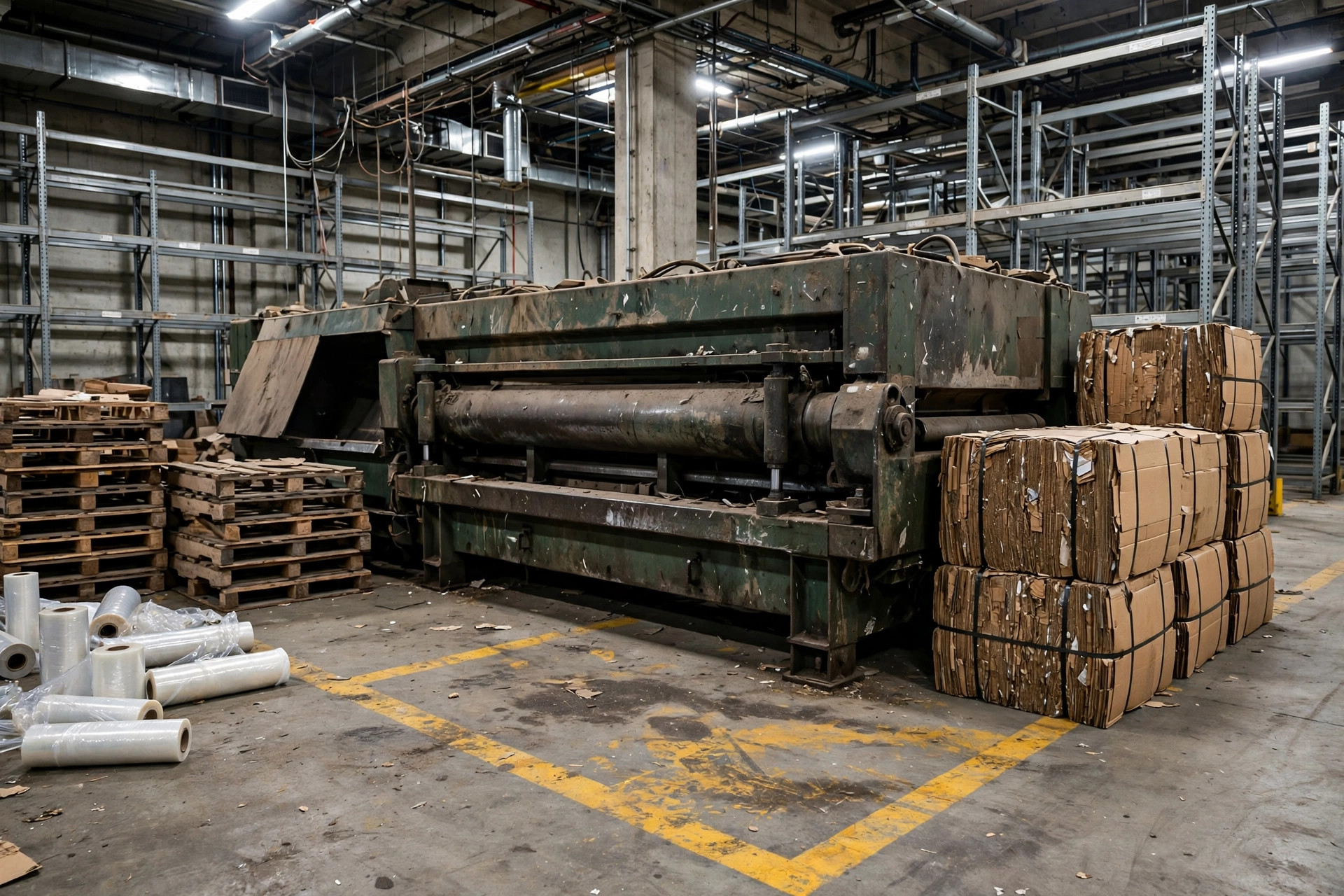
Stretch film — the plastic wrap on pallets — is the easiest money small warehouses ignore. We used to toss film in with the cardboard. Then we found out baled film sells on its own — wastecare has public numbers on this: a compressed stretch film bale runs 900 to 1,200 pounds, and 38 to 42 bales fill a full truckload.
Our volume will never fill a truck, but the play scales down: keep film in its own big gaylord box, call the recycler when it's full, and he weighs it and buys it. A ton is a ton of money. The only discipline required: don't let film contaminate the cardboard pile. Film mixed into cardboard downgrades the whole bale and the recycler discounts it. Separate it, and both streams are worth more. Zero-cost management move, pure habit.
One more: if your suppliers will do take-back — collecting their shipping packaging back — take the deal. One of our suppliers ships in heavy-duty cartons; we worked it out so he picks up last trip's cartons strapped on his next delivery. We break down less trash, he buys less packaging. Win-win.
Start With a Waste Audit: A 30-Minute Walk-Through
Before you buy equipment or call recyclers, spend 30 minutes on a waste audit. It's embarrassingly low-tech:
Take a sheet of paper, walk the warehouse, and log everything that looks like trash by category: how many piles of cardboard, how many pallets, how many boxes of film, how many bags of misc. Then weigh it daily for a week at close of business (borrow the recycler's scale, or buy a cheap hanging scale). After a week you know exactly what dominates your trash stream and what's worth the most.
The audit has a hidden benefit: walk in with data, and the recycler's quote gets better. "I have roughly X tons of cardboard a month" gets you the walk-in price. "I weighed it for four straight weeks, average X tons a month, let's talk annual contract" gets you the contract price. Data is bargaining power, and that's how a small warehouse builds bargaining power.
The Uncomfortable Truth: Trash Is the Only "Inventory" You Pay Someone to Remove
Here's the contrarian take: of everything in your warehouse, trash is the only inventory you pay someone to haul away. Product inventory is money. Packaging inventory is money. Even dead stock is technically money. Only trash costs you money to make disappear.
So a warehouse waste management and recycling program isn't an environmental feel-good project — it's part of inventory management. Flip the mindset and every action changes: cardboard is no longer "break down and toss," it's "OCC inventory awaiting sale." Pallets are no longer "broken, toss it," they're "assets awaiting assessment." Even the hauling contract gets renegotiated like a lease.
We can't copy the big-company playbook — automated sorting lines, LEED certifications, that's not our league and doesn't need to be. Our scrappy four moves: run the math on cardboard before deciding on a baler, recycle pallets with a zero-investment drop-trailer, bale stretch film separately, and renegotiate the hauling contract on a schedule. None of them cost real money. All of them stop money from leaking out of the dumpster.
Small warehouses have their own way of surviving — and if even the trash can turn into revenue, that's exactly how it should be.
By Xiao Ma, Small Warehouse Owner