
It was a Tuesday morning last April. I was standing by the receiving doors, watching the line of trucks roll in, when my boss called. "Chen, the audit team from that furniture account is coming next Tuesday. They want our TRIR numbers for the last three years."
I froze. I knew TRIR was the injury rate. But what was ours? I had no idea.
I hung up and pulled out our injury log. My stomach dropped. Stitches, twisted backs, pallets dropped on feet — a dozen-plus recordable incidents in a year. Guys, I've run warehouses for years. I tracked units shipped, I tracked attendance, but I never tracked the one number that actually mattered.
Here's how the number actually works
The formula is dead simple:
TRIR = recordable injuries × 200,000 ÷ total hours worked
That 200,000? It's 100 full-time people working a year (100 × 40 hours × 50 weeks). So the number reads: out of 100 workers in a year, how many recordable injuries.
The whole game is in the word "recordable." I learned this the hard way and went through OSHA's website line by line. The rule of thumb: stitches, prescription meds, days away from work, job transfer, loss of consciousness — all recordable. Band-aids, ice packs, an ibuprofen from the first-aid kit — not recordable. But OSHA tweaks the details, so for any borderline case, check OSHA's current published guidance. Don't guess.
Let me run the math on my own building. About 210 people, roughly 420,000 hours a year, 10 recordable injuries: 10 × 200,000 ÷ 420,000 = 4.8.
What does 4.8 mean? The Bureau of Labor Statistics data puts the warehousing and logistics industry average somewhere around 3 to 4, give or take (check BLS's latest release for the exact figure). We were worse than average. Not a little worse. Noticeably worse.
And the audit had a hard line. The furniture company's supplier standard said it plain: TRIR under 3.0, two years running. 4.8 against 3.0. The auditor looked at the spreadsheet and frowned. We kept the account, but only by signing a corrective-action letter — get under 3.5 within a year or we're out next round.
It wasn't the veterans getting hurt. It was the new hires.
After signing that letter, I sat down with our safety lead and went through three years of injury reports, one by one. What I found chilled me.
The people getting hurt weren't the ten-year veterans. They were the new hires in their first 90 days. Forklift backing up into someone who didn't hear it — a new hire. Climbing to grab a box and missing a step — a new hire. A temp twisting his back in his first week of peak season — always a new hire. The veterans knew which floor was slick and which corner needed a horn blast. The new kids knew nothing, and we were handing them the heaviest work and the hottest waves.
One more thing. Our peak runs October through December, and we bring in 60-plus temps. In the 2024 peak, we had 4 recordable injuries in two months — nearly half the year's total. In other words, this annual average was mostly built in three months of the year.
That actually made it fixable. The problem wasn't luck. It was: nobody mentors the new people, and nobody manages safety during peak.
What we do now — and it's still in place
Year one, we did three things. All of them unglamorous. All of them worked.
First: no new hire works alone for the first 30 days. They shadow a veteran with three-plus years on the floor. The veteran gets a $200 monthly mentoring bonus — but if their trainee gets hurt, the bonus and the quarterly bonus both go away. A few guys complained to me: "Chen, that's not fair." I told them: "Fair? If your trainee twists his back, you didn't teach him right. That's it." New-hire injuries in the first 90 days fell by more than half. For that $200, the veterans taught better than any training video ever could.
Second: near-miss reporting pays, and nobody gets punished. Report a near miss — something that almost happened — and get a $25 gift card. At first nobody believed me: "Do we have to write a self-criticism?" No. You report, you get the card, your name stays off the board. First month we collected 11: a charging cable tripping people in the forklift area, a loose rack beam, a dead lighting zone on night shift. All real hazards. We fixed them one by one. Three months later, near-miss reports went up and real injuries went down. A near miss is the universe texting you a warning. Ignore it and the next one is a real accident.
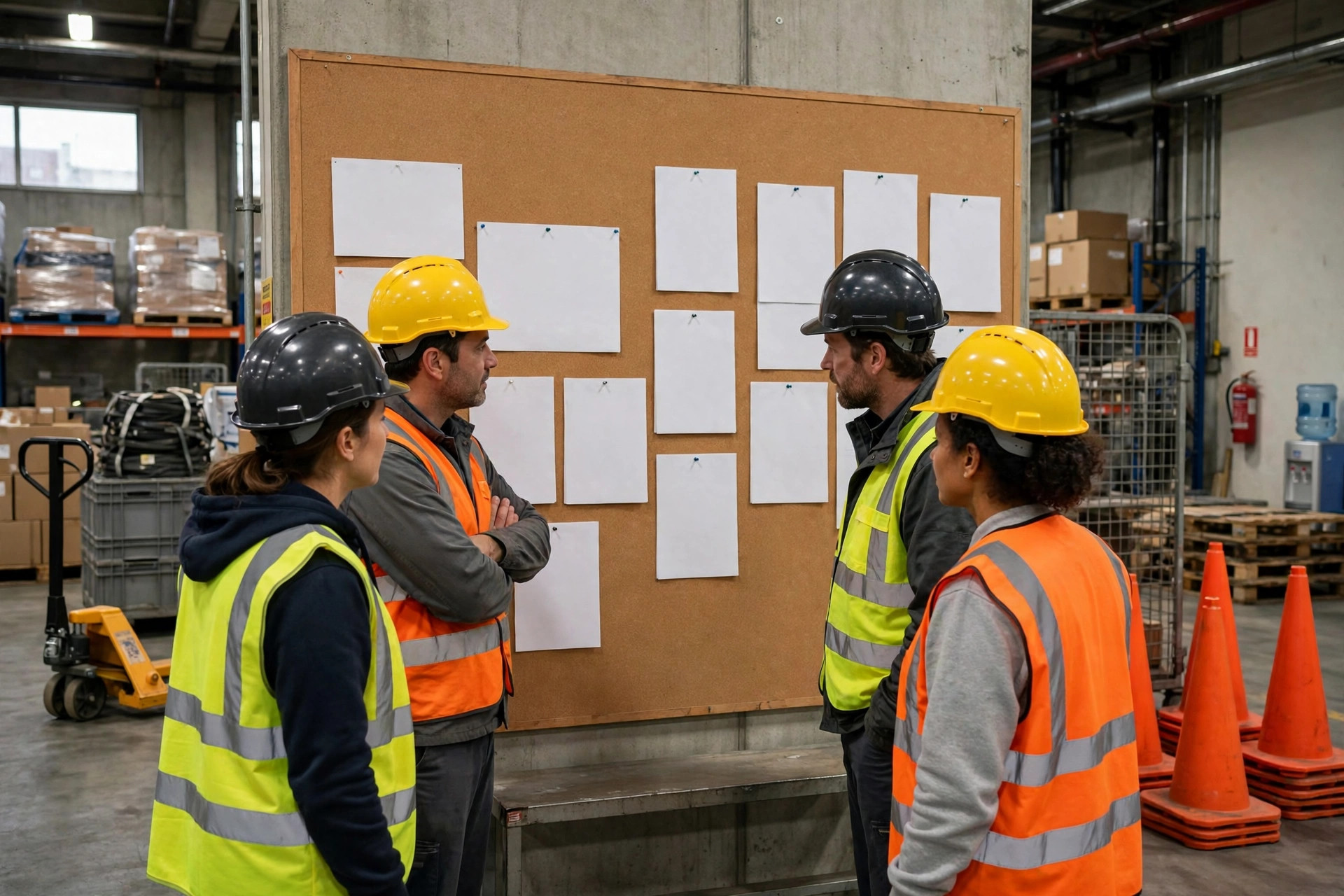
Third: five minutes of every monthly pre-shift meeting is TRIR. I write the number on the safety board by the break room — red marker if it's up, blue if it's down. Everybody walks past it every day. One month it hit 3.9, and I told the whole shift: "Anyone skipping PPE to go faster this month — if you get hurt, don't expect sympathy from me." Rough words. They worked.
Three years later, we went from 4.8 to 2.4. When workers' comp renewed in year two, our broker came back with a lower quote — the exact savings depend on your carrier, so get your own quote, but the direction is real: insurers live and die by this number. Make the number good and the money conversation gets easy. The furniture account came back for year two, saw 2.9, and the auditor just nodded. The corrective-action letter went in the shredder.
The uncomfortable truth: a pretty number can lie
Years on the floor taught me something I need to say straight, and it's the most important line in this piece.
A low TRIR does not mean a safe building. I've seen a warehouse with a TRIR of 1.5. The auditor asked for their near-miss log — there wasn't one. The workers told us privately they went to their own clinics when hurt because reporting meant losing the bonus. That number wasn't earned. It was squeezed. And when a real disaster hits, those are the buildings that blow up first.
Flip it around: a building brave enough to put near misses on the board might see TRIR tick up in the short term — because the stuff that used to be hidden is now on paper. But hear me on this: reported problems are small problems. Hidden problems are the big ones. Experienced auditors know this. They look at TRIR, but what they're really reading is whether you have a living system — report, fix, review, repeat.
So my advice is one sentence: don't fight the number, fight the system. The number is the outcome. The system is the cause. New hires get mentored, hazards get reported, somebody reads the board out loud every month — do those three things and TRIR comes down on its own, and it stays down, and the next audit doesn't scare you.
Guys, go run your building's TRIR tonight. The formula's right up there. Ten minutes, tops. If you're over 4, don't panic — sort your injury log by hire date first, and tell me if I'm wrong about who's getting hurt.
By Chen Feng, Warehouse Operations Manager