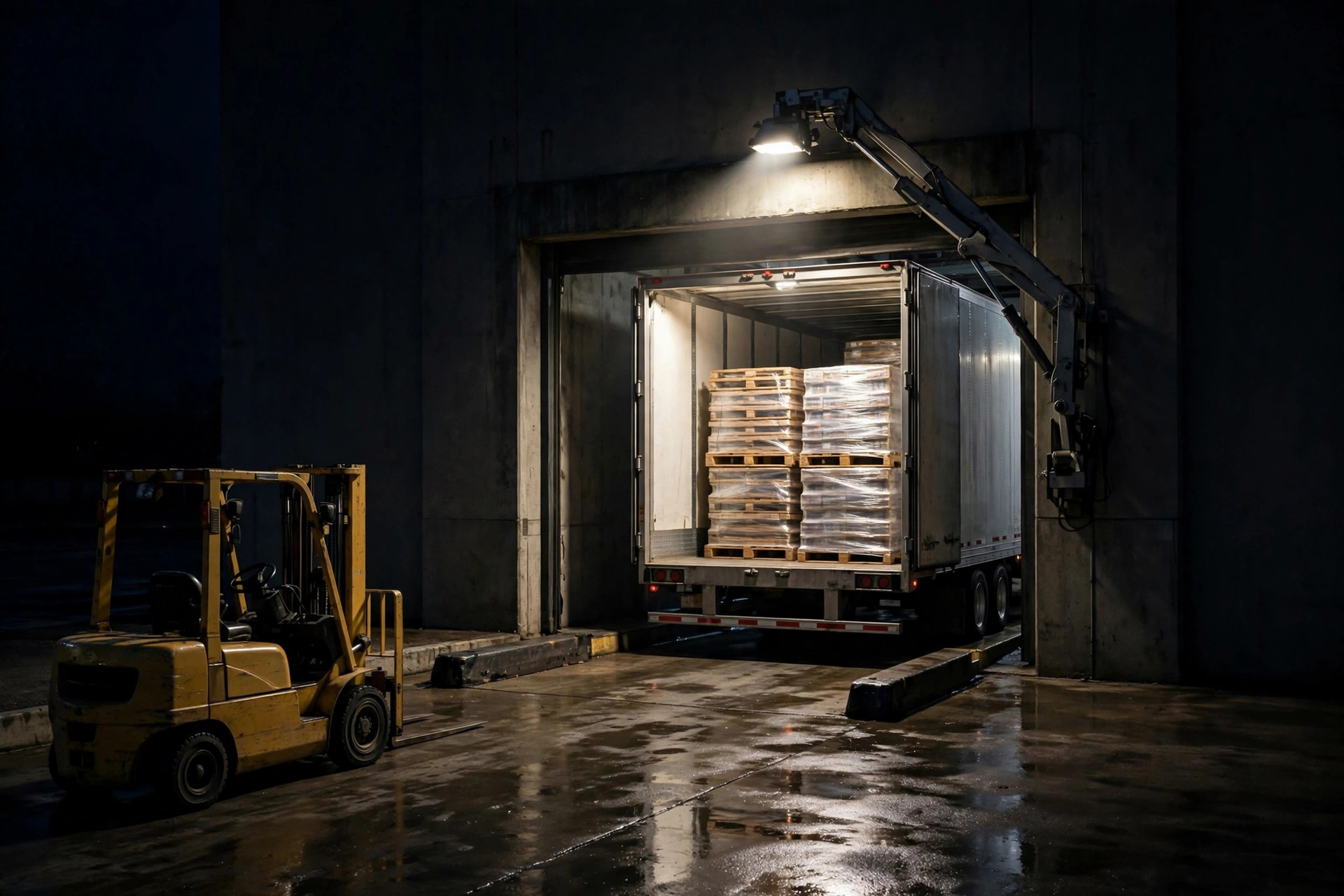
Let me tell you something after all these years on the road. What scares me most is not traffic on the highway, and not hunting for parking at midnight. It is pulling into a warehouse where somebody is in a hurry to open the trailer doors before the truck has truly stopped. The dock looks flat and harmless. It is where things go wrong. When a trailer moves with a person inside it and a forklift at the edge of the dock, a small shift turns into a big accident fast. So today I want to talk about wheel chocks and dock locks, and the simple math behind them. Once you work out that math, you will see those few minutes are worth every second.
Wheel Chocks Are Not Decoration: I Watched a Trailer Walk Away on Its Own
A couple of winters ago I was delivering to a food distribution warehouse outside Columbus, Ohio. It had just snowed, and the ground in front of the dock was slick. The stretch of pavement looked level, so the driver set the parking brake, hopped out to sign the paperwork, and put nothing behind the wheels. Then a forklift drove into the trailer. The trailer body sank and rose, and the whole rig slowly rolled backward. A gap opened up between the dock and the trailer floor. Luckily the forklift was only halfway in, and the operator backed out in time. Nobody got hurt, but a pallet of frozen food tipped at the dock edge, melted all over the place, and the cleanup and rework ate up most of the day.
Another time, at a general goods warehouse in California's Inland Empire, the truck was chocked, but nobody was watching the dock end of things. Forklift after forklift rolled in and out, the trailer floor bouncing up and down under the weight, and the trailer crept forward a little at a time. That slow creep is the sneaky kind. By the time anyone noticed, the trailer floor and the dock were out of line by several inches, and a forklift wheel caught in the gap. It nearly tipped. Ever since then I have had one habit: no matter how rushed I am, the first thing I do after getting out is walk around to the wheels, look at the chocks, and give one a kick. If it does not budge, we are good.
The Dock Safety Ledger: Can You Afford the Five Minutes You Saved?
A lot of folks treat chocking wheels and engaging a dock lock as wasted time. Save a few minutes per stop, run one more load a day, sounds great. But that is not how the math works. Think about it. How long does it take to set two wheel chocks? Get out, bend down, wedge them in tight, give them a kick. Less than a minute. Engaging a dock lock? Walk to the rear of the trailer, hook it on, check the light. A few extra steps. Put together, two or three minutes at most.
Now think about what happens when you skip those two or three minutes and something goes wrong. Damaged freight to pay for. A truck to repair. And if someone gets hurt, that is beyond money: the warehouse stops work, the insurance back-and-forth drags on, the driver is out of commission, and every one of those costs is counted in days, not minutes. A fleet owner I know once told me that one dock accident would have paid for a decade of wheel chocks for his whole fleet. Rough words, but the logic holds. Safety looks like a cost on a normal day. On the day something goes wrong, you realize it was the thing saving you money.
Here is a judgment that surprises most people: the most dangerous dock is not the steep one. It is the one that looks perfectly flat. On a slope, everyone is careful, so fewer accidents happen. On flat ground, people assume the truck cannot possibly move, their guard drops, a forklift loads weight onto the trailer, the ground is a little slick, and the trailer quietly shifts. The seasoned drivers I know are most careful exactly where everything looks safe.
How Dock Locks and Wheel Chocks Work Together: The Check I Run Every Time
Wheel chocks, dock locks, and chock-and-restraint combinations each do a different job, and one cannot replace another. Here is the simple way I think about them:
| Tool | What it stops | Weak spot | Best used when | | Wheel chocks | Wheels rolling, trailer drifting forward or back | They hold the wheels only, not the trailer body rising and falling | Every single stop, no exceptions | | Dock lock | Trailer separating from the dock, floor misalignment | Needs matching warehouse equipment, which older docks may lack | Any dock that has one, every unload | | Chock-and-restraint combination | Wheels and body held together | Takes a few extra minutes to set up | Heavy loads and long unloads |
My own checklist is short, and I run through it before unloading and again before leaving: chocks wedged tight behind the wheels; dock lock engaged, indicator light green; someone keeping an eye on the gap between trailer and dock while forklifts move in and out; and chocks picked back up before I pull away, so they are not left lying on the dock to trip up the next truck. I keep that list taped behind my sun visor. It has kept me out of trouble for years.
One more thing worth saying plainly: a locked dock is not a guarantee. The lock is a piece of hardware, and people still need to pay attention. The trailer body keeps moving up and down during unloading, so the driver and the warehouse crew need to keep talking to each other. If the trailer shifts, stop first, sort it out, then carry on. Equipment helps you relax. It does not take responsibility for you.
Three Practical Suggestions for Shippers and Warehouses
To shippers, I have one line: do not rush the driver. Pressuring a driver to unload faster is the same as pressuring him to skip the safety check. The minutes you save are not worth a load of freight, let alone a person. The reliable carriers are the ones that build the dock check into their routine. Two minutes slower, freight intact, everyone goes home fine. That is the better deal.
To warehouses, I have three suggestions. First, keep plenty of wheel chocks right at the dock, where drivers can grab them without hunting around the yard. A tool that is within reach is a tool that gets used. Second, if you can, install dock locks with signal lights. A red or green light is something the driver and the forklift operator both understand at a glance, no shouting required. Third, make it a written rule: no forklift enters the trailer until the chocks and the dock lock are confirmed. Put that rule on the handover sheet. One written rule beats ten posters on the wall.
As for the specific OSHA requirements, my advice is to hold to one principle: stop the truck, secure it, confirm it, then unload, and check the latest official guidance for the details that apply to your own operation. Rules on paper are fixed, but every dock is a little different, and the people on the ground have to make the rules real.
After all these years on the road, I stand by one saying: when the truck is truly stopped, your mind settles; and when your mind settles, the freight gets where it is going in one piece. By Shifu Zhao, Trucking Veteran (15 yrs)