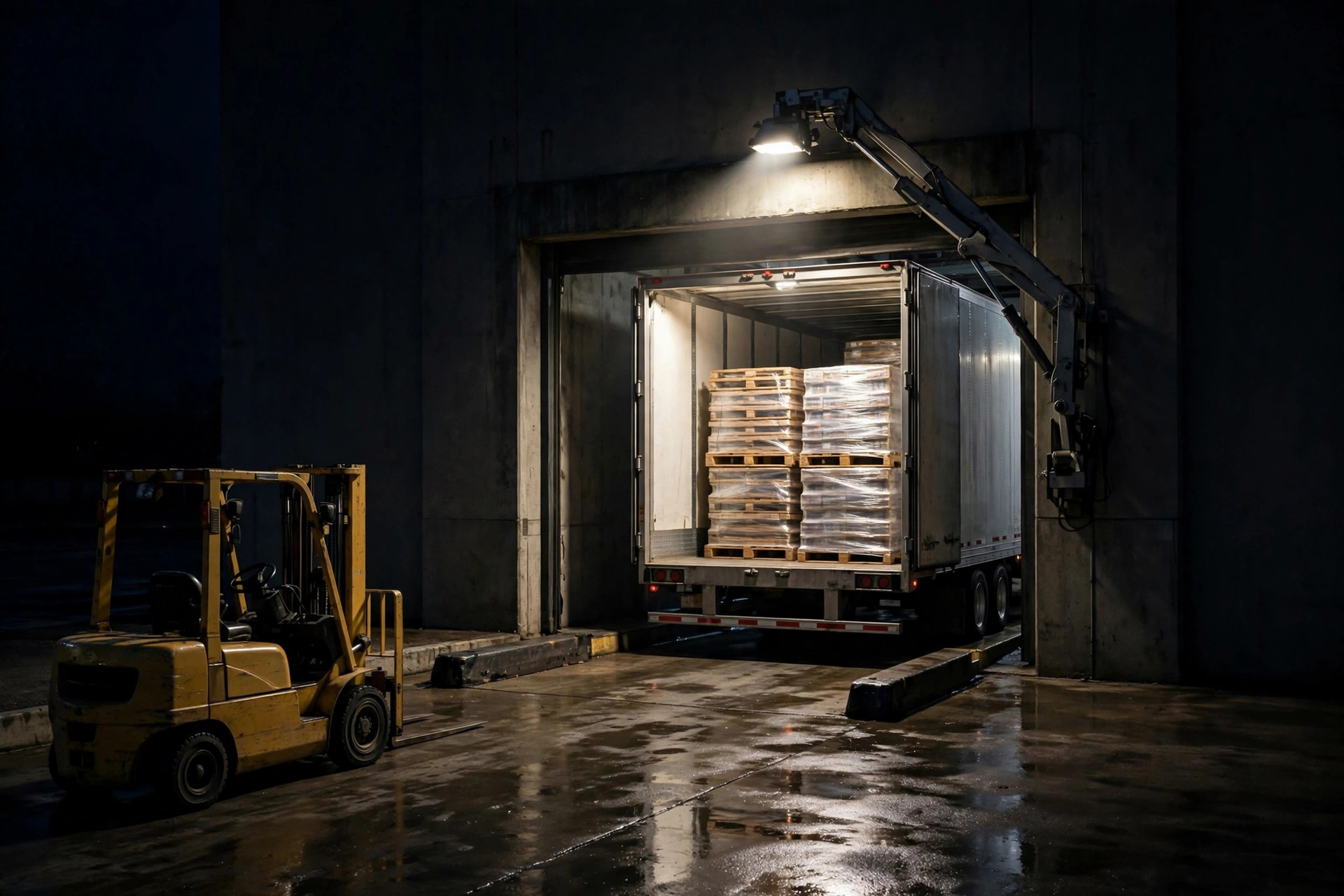
At 2:30 on a rainy night, a food distribution warehouse in Indiana had four pallets left in a trailer at Door 7. The forklift driver stopped at the dock edge, leaned in, and pulled back. The trailer was dark past the first few feet. All he could see was a bright patch at the doorway, where pallet edges, wrap glare, and wet floor blurred together. The dock light over that door was on. The lamp head was aimed at the doorway, and the light never made it inside the trailer. The driver reached in by feel and clipped a pallet corner deep inside, tearing the outer wrap. Nobody got hurt, and nothing went into a report. The shift lead wrote one line in the handover book: Door 7 too dark at night, be careful next time. That line told me everything: next time would be the same, because the problem was never attention. The light was landing in the wrong place.
Dock Light Basics: Light Belongs on the Freight, Not on the Door
The principle is simple, and most warehouses get it backwards. What the driver and the loader need to see is inside the trailer, not on the dock. A bright doorway, dock floor, and canopy do not mean a bright trailer interior. This is like shining a flashlight at a warehouse door and calling the racks behind it lit. You can think of it as a delivery problem, not a brightness problem: reach and angle matter more than raw output, and a modest lamp pushed into the doorway and aimed at the freight beats a powerful lamp washing the doorway.
Walk a dock at night and the failure mode is obvious. The lamp sits above the door header, throws a white pool onto the dock, and everyone standing on the dock at commissioning says it looks bright enough. Then a trailer backs in, the forklift drives inside, and truck body and pallets block most of that light. The driver works across a hard edge, from glare to darkness, eyes readjusting constantly. That switching is worse than steady dimness: pallet corners disappear exactly when he judges distance. Aim the head too low and flat, and the beam goes straight into his eyes. Bright is not the same as visible, and at night that distinction is the whole job.
The red and green signal at the door is a separate system. It tells the driver and dock team whether the trailer can move and whether the door can be operated: communication between truck and dock, not illumination of the freight. A dock can have a perfect signal setup and still load in the dark, because no signal lamp lights the back of a trailer. Treat the signal as the lighting plan, and night loading stays a guessing game with better traffic lights.
In summer 2023, an Ohio auto parts warehouse showed me the textbook version: twelve doors, two shifts deep into the night, repeated complaints that the trailer back was hard to read. Management first replaced the header lamps with brighter ones. Complaints did not fall; drivers added glare to the list. On site we measured lamp heads more than 3 meters from the doorway, angled down, with almost no direct light 6 meters into the trailer, only weak spill from the doorway. On four high-use doors we swapped in adjustable long arms over the opening, tilted onto the load face. Complaints stopped that month. No extra lamps, no extra wattage. The light just landed on the freight.
The Dock Light Selection Line: Brighter Is Not Better
Selection of a dock light comes down to three questions, and wattage is not one of them. Can the arm carry the beam into the trailer? Can the head angle be adjusted? Will the beam blind the driver? An arm too short never reaches the back rows. A long but fixed arm goes out of alignment the moment a different trailer height shows up. A head that cannot be tilted settles, over time, into lighting the doorway and nothing else. Fail any one of those three and the spec sheet is decoration.
Here is the counterintuitive part most buyers resist. Night loading incidents are often not caused by darkness alone, but by violent contrast: blazing doorway, black trailer interior, eyes flicking between the two while a forklift moves. Uniform, adequate, glare-free light beats peak brightness every time. I have watched warehouses chase higher output, then watch drivers squint through night shifts, clip pallets, and bump door frames more often than before. Treating brightness as safety is a pseudo-need, and glare dressed up as brightness is its favorite costume.
Prices below are the actual paid range from an eight-door retrofit I handled last year, not a market average, so use current supplier quotes before you budget:
| Option | One-time cost per door | Load-face effect | Fits best | Where it fails | | Fixed short-arm fixture | A few hundred dollars | Doorway bright, deep rows weak | Mostly daytime use | Loses alignment | | Adjustable long-arm fixture | Around one thousand dollars | Aims at the freight | Regular night loading, mixed fleet | Arm drifts if unlocked | | Temporary interior supplement | Tens of dollars per use | Light where dark, on demand | Overtime, deep trailers | Cables on the floor |
The deciding number is not the fixture price. It is minutes lost per trailer at night. One door loading six trailers a night, losing 10 minutes per trailer to poor visibility, burns an hour a night. Over a peak month, that dwarfs the short-arm/long-arm price gap. Flip the situation and the answer flips: a door loading at night twice a month does not need the full long-arm setup, and a fixed short arm plus a temporary supplement is the honest, cheaper choice. Draw the dividing line there and you are engineering. Draw it on wattage and you are shopping.
Lamp type deserves the same plain treatment. LED heads save energy and last longer, but a headline spec is measured in open air. Mount it on a dock, change height and angle, add a trailer body in the way, and the real result changes. Halogen heads look warm and render color comfortably, but they run hot and burn out faster, so night shifts end up changing bulbs more often than planned. Do not buy from the spec sheet alone. Stand in the forklift seat at night and check whether pallet corners and floor edges separate cleanly and your eyes are comfortable.
On regulation, keep it honest: rules change, so check the official source for current requirements before writing any rule into your own standard.
Maintenance Traps: Still Lit Does Not Mean Lit Enough
Installation is the easy half. Maintenance is where these systems quietly fail. The most common trap is an arm knocked out of alignment with nobody noticing. Forklifts pass under it, trailers back into it, canopy work bumps it, and ten or fifteen degrees moves the beam from freight to trailer wall. The lamp is still on, someone walking the dock sees light and moves on, while the night crew works in the dark part. Put arm angle into the weekly dock walk, judged from inside the opening looking in, not from the dock.
Dust on the lens is the slow version of the same failure. In food and dusty operations, a lens can film over within a month, fading so gradually that nobody registers a single bad night. A loose head is sneakier still, because forklift vibration walks the angle a little further every week. Wiping the lens, nudging the arm, and checking the locking screw takes under 5 minutes on a walk.
Tape this pre-shift check to the wall by the door, not in a system nobody opens at 2 a.m.:
- Arm over the opening, aimed at the freight, not just the doorway
- From the forklift seat, corners and edges read cleanly, no beam in the driver's eyes
- Door signal checked separately from illumination
- Lens clean, head locked, cables out of the forklift path
- Arm out of line or light faded, reported that shift, not next day
Back in Indiana, the fix was small. Door 7 and two other regular night doors got longer arms tilted lower onto the load face, and the inspection sheet gained one line for arm angle. Three months later the night lead put it plainly: drivers no longer lean in and guess, and loading runs faster than before. Whether the money was worth it comes down to this one number: did the minutes lost per trailer to poor visibility go down at night? If that number fell, the dock light earned its keep. If it did not, the brightest fixture on the dock is still just decoration.
By Da Liu, Automation Engineer