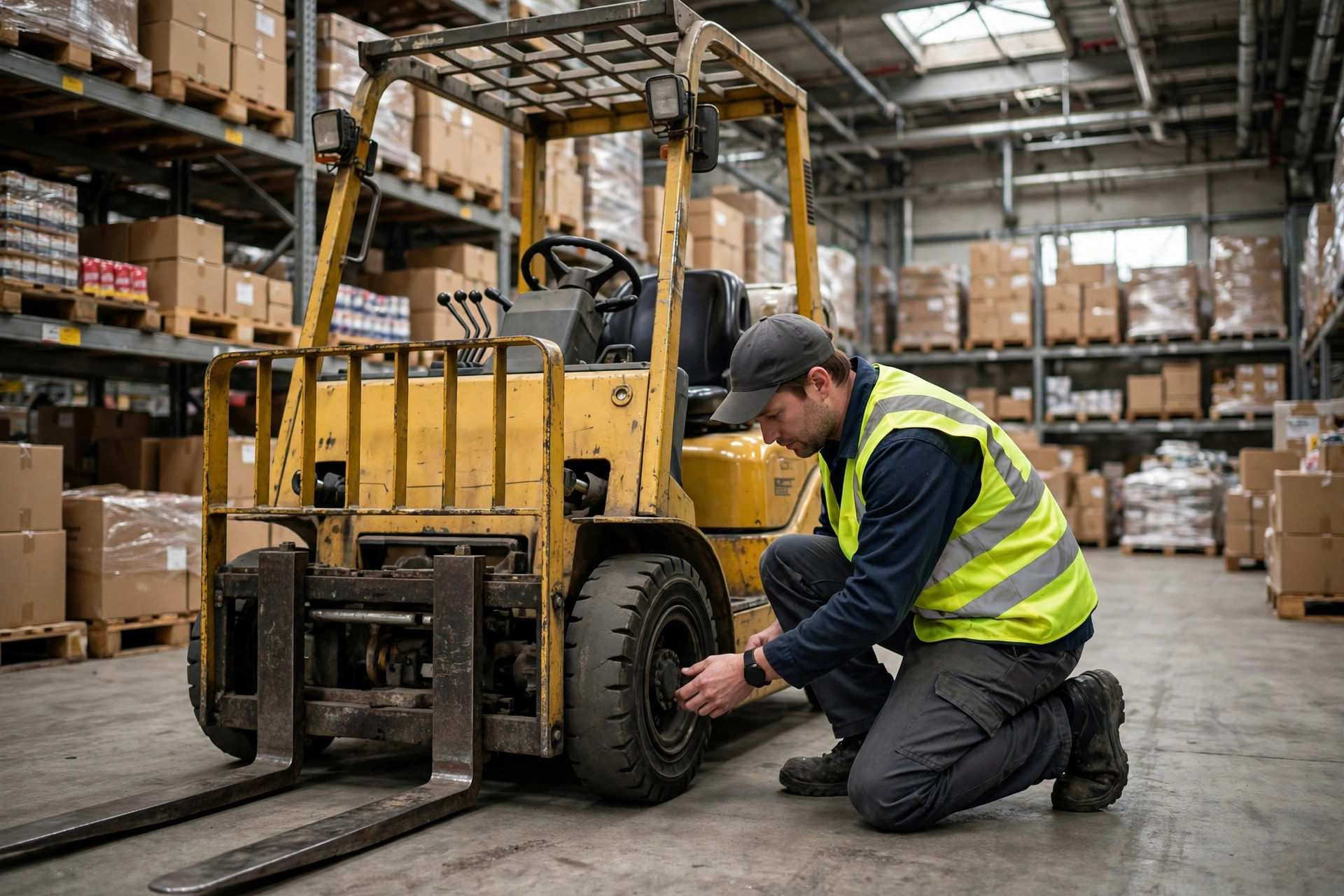
One Monday morning last November, 6:45 a.m. I was standing by Door 2 in receiving when Lao Wang's forklift slammed to a stop at the corner. Xiao Li, pushing an empty pallet jack, was maybe half a meter from the forks. Both of them went white.
That half meter is why our warehouse has a safety committee today.
Turns out the convex mirror at that corner had been half-blocked by new racking for a month, and the yellow floor markings were worn down to ghosts. Lao Wang said, "I told my lead about that mirror twice." The lead said, "I told the supervisor." And then? Then nothing. By the third retelling, nobody cared.
Let me be blunt: 90% of near-misses in a warehouse follow this script. Somebody saw the problem long ago, but there was nowhere to say it — and saying it changed nothing. Federal OSHA doesn't require a warehouse safety committee (a few states have their own rules — check your state's current requirements), but when it matters, this thing can save lives.
How Our Safety Committee Got Started
The day after the near-miss, I pulled 8 people into the break room: Lao Wang, Xiao Li, veteran reps from each shift, and our HR girl. I said: every Wednesday before first shift, 30 minutes, one topic — what's wrong in this warehouse this week.
Someone rolled their eyes: "Another meeting?" I said: "No big meeting. Thirty minutes, we can stand. But here's the rule: whoever spots a problem owns it until it's fixed. If you can't get it fixed, I'll go ask the boss for money myself."
In the first month, the safety committee collected 14 issues. Moving the mirror and repainting the floor lines were cheap. The one that chilled my spine was number three: Ah Hai from night shift said a beam safety pin was missing on a high-bay rack in Zone C, and pallets wobbled when the forklift loaded them. "How long?" "Two, three months, I'd say. Nobody fixed it."
Two or three months. High-bay racking. A missing safety pin. If a pallet had slid off with someone walking underneath — I don't even want to think about it. That's the day I understood: a safety committee's real value isn't surviving an OSHA inspection. It's giving frontline people a channel to report problems without getting punished for it. The veterans always knew about the hazards. They just had nowhere to say it.
Summer 2024: The Committee's First Real Fight
July 2024, the California heat wave. Inside the warehouse it hit 100°F in the afternoon. Our building has a metal roof that holds heat — at 11 p.m. the night shift walked into an oven.
First someone got dizzy, sat in the break room for half an hour, recovered. Under the old process, that would've been the end of it. But at that Wednesday's meeting, Xiao Zhang from picking said: "Real talk — three people got dizzy this week, all second half of night shift."
The safety committee decided three things on the spot: a big fan at every aisle entrance, paid from the maintenance budget; mandatory 15-minute breaks every two hours on night shift, in the air-conditioned break room; two cases of electrolyte drinks per team, with the lead making sure people drank them.
For the rest of that summer — two months — heat-related incidents on night shift: zero. I put it in my quarterly report. The boss read it and said one sentence: "This committee thing actually works."
The solutions always come from the floor. If I'd tried to think it up in my office, the best I'd have done is send a "stay hydrated" memo. Worthless.
The Three Things Our Committee Does Every Week
After a year of this, every Wednesday is locked in. Three things, nothing more.
First, a 20-minute floor walk. Eight people, two groups, Zones A and B. Phone cameras out. Expired fire extinguishers, blocked aisles, broken pallets, worn forklift tires — photograph it, log it on the spot.
Second, close the loop. Did last week's issues actually get fixed? Every issue has an owner and a deadline. Not closed? The owner explains why, right there, and it rolls to next week. Two weeks with no movement, it escalates to me.

Third, the 30-day rookie buddy system. Ah Hai's idea: every new hire gets a veteran shadow for their first 30 days, teaching one thing — where you don't walk and where you don't stand. It used to be two hours of training videos and a signature. Now it's a mentor, and the mentor shares the blame if something happens. Sounds harsh? New hires are the highest-risk group in any warehouse. The money and effort are worth it.
Doing the Math: What Does a Committee Actually Cost?
People ask: eight people meeting half an hour a week, plus fix-it money — that adds up, right?
Let's do it: 8 people, average $25/hour (your mileage may vary), 30 minutes a week, 52 weeks — about $5,200 a year in labor. Fix-it materials ran us about $8,000 last year. Total: a little over $13,000 a year.
Now the other side: one forklift-pedestrian accident — medical, comp, downtime — starts at six figures. One OSHA citation can cost more than several years of this committee. Your insurer raises premiums the next year by more than a decade of Wednesday meetings. And if something truly terrible happens, the boss isn't sleeping well either.
You can do this math yourself. Safety is always "spend a little to prevent a lot," and the committee is the mechanism for spending the little.
The Counterintuitive Part: Big Meetings Kill Safety Committees
Here's the counterintuitive take: nine out of ten failed safety committees died because they became a "monthly safety assembly" — management reading slides, workers on their phones, nothing changing after.
Our experience is the opposite: the smaller the meeting, the better it works. Eight people, 30 minutes, standing is fine. One topic: "what's wrong this week." No KPIs, no slide decks. Big problems go up to management naturally; small ones get decided on the spot. A monthly assembly is for the inspectors. A weekly huddle is for the people doing the work.
One more trade-off: frontline workers have to be the majority. We run 5 floor people out of 8 (forklift, picking, receiving reps) and 3 managers. Drop below half floor representation and it becomes management talking to itself. The floor stops telling the truth, and the whole thing is theater.
Three Reminders for Fellow Managers
If you want to start a safety committee, real talk — remember three things.
First, the floor has to be the majority. Otherwise nobody tells the truth.
Second, every issue must close. Owner, deadline, in days not weeks. Unclosed issues roll forward until they're done. A committee's credibility is built one "we said it, they fixed it" at a time.
Third, never turn the committee into a blame session. Punish the person who reports a hazard and nobody reports anything next time. Thank the reporters, penalize the hiders — set that tone in the very first meeting and never let it slip.
OSHA doesn't require it. But when something happens and OSHA shows up, their first question is: "How do you normally manage safety?" A year's worth of meeting notes and a closed-loop issue log beats any speech you could give. When it matters, this thing saves lives — your crew's lives, and your job.
By Chen Feng, Warehouse Operations Manager