Let me start with the math.
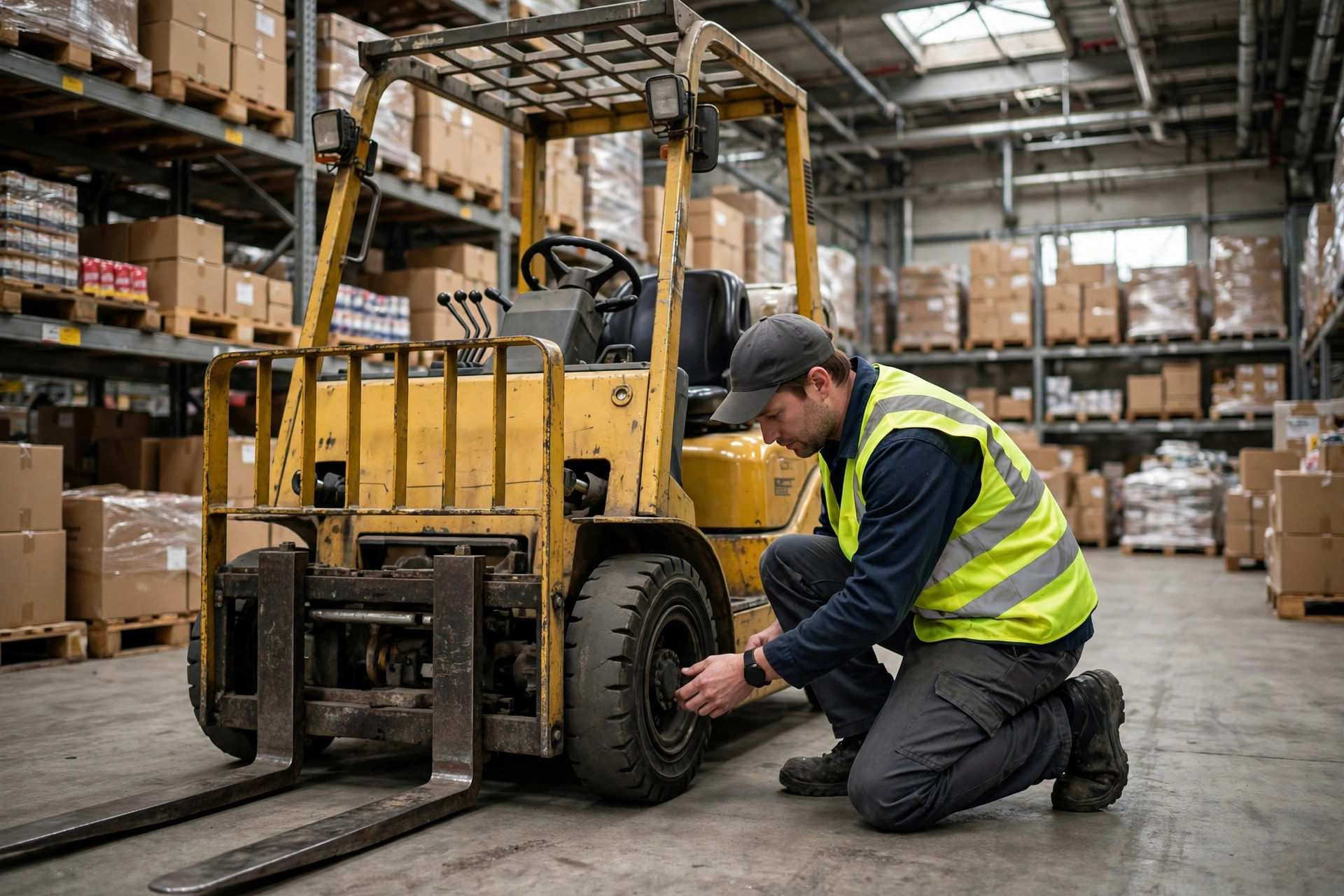
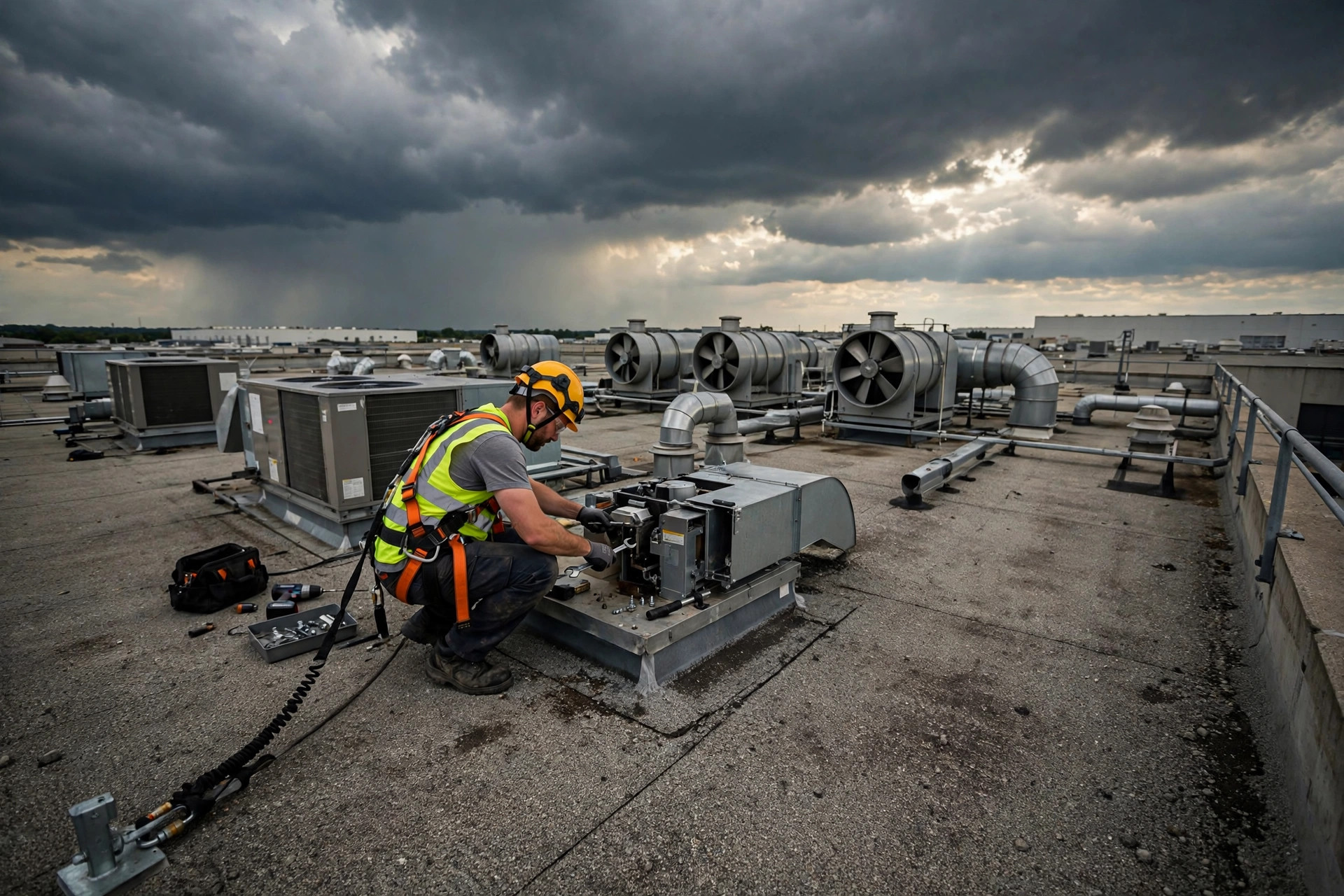
Fall 2024. A 120,000-square-foot 3PL warehouse in the Inland Empire. Roof leaks. They send two of their own maintenance guys up. Three days, no harnesses, no anchors. Job done. On day four, OSHA shows up and writes three citations. Under the penalty schedule in effect since January 2026, a single serious violation runs up to $16,550. Three of them: a theoretical ceiling near $50,000. That is before lawyers and before the shutdown for abatement.
The fall protection gear that would have made those three days compliant? Under $3,000.
That is the whole argument. The rest is detail. I am Lao Zhou, a cost analyst by training. I do not do safety sentiment. I do numbers, because numbers do not lie.
First, Classify the Work: Which Line Applies
Most people quote "OSHA requires fall protection above 6 feet" like it is the whole story. It is half the story.
The federal construction standard (29 CFR 1926.501) does set the trigger at 6 feet (1.8 m) — but that covers roofing construction, like a full re-roof. Routine warehouse roof work — patching leaks, swapping exhaust fans, servicing HVAC units — usually falls under the general industry standard (29 CFR 1910.28), where the trigger is 4 feet (1.2 m). Stricter.
The classification rule is simple: it is the nature of the work, not the industry of the employer, that decides which standard applies. Full roof replacement is construction; tightening bolts and patching membrane is maintenance. This is where warehouses get burned — they walk in with the construction 6-foot number in their head, and OSHA writes the citation under 1910's 4-foot line.
California adds another wrinkle: Cal/OSHA has its own rules for commercial low-slope roofs that do not map cleanly onto the federal scheme. Multi-state operators should budget compliance to the strictest state they touch. My standing advice to clients: stop gambling on the classification. Prepare to the 4-foot line. The equipment costs almost the same either way; the penalty exposure is night and day.
What Fall Protection Actually Costs
Take a representative job: four workers, two days, a 100,000-square-foot flat warehouse roof — leak patches plus two exhaust fan replacements. Here is the compliance bill, itemized:
| Item | Qty | Unit price (market) | Subtotal |
|---|---|---|---|
| Full-body harness + shock-absorbing lanyard kit | 4 | ~$150 | $600 |
| Temporary reusable roof anchors | 8 | ~$60 | $480 |
| Mobile guardrail / warning line (2-day rental) | 1 lot | — | ~$400 |
| Third-party fall protection training (half day) | 4 workers | ~$300/person | $1,200 |
| Written fall protection plan | 1 | self-written from template | $0 |
| Total | ~$2,680 |
Those unit prices are not guesses. A complete personal fall arrest kit (harness, lifeline, anchor) retails around $146; temporary roof anchors run $40 to $65; permanent commercial anchors run $320 to $670.
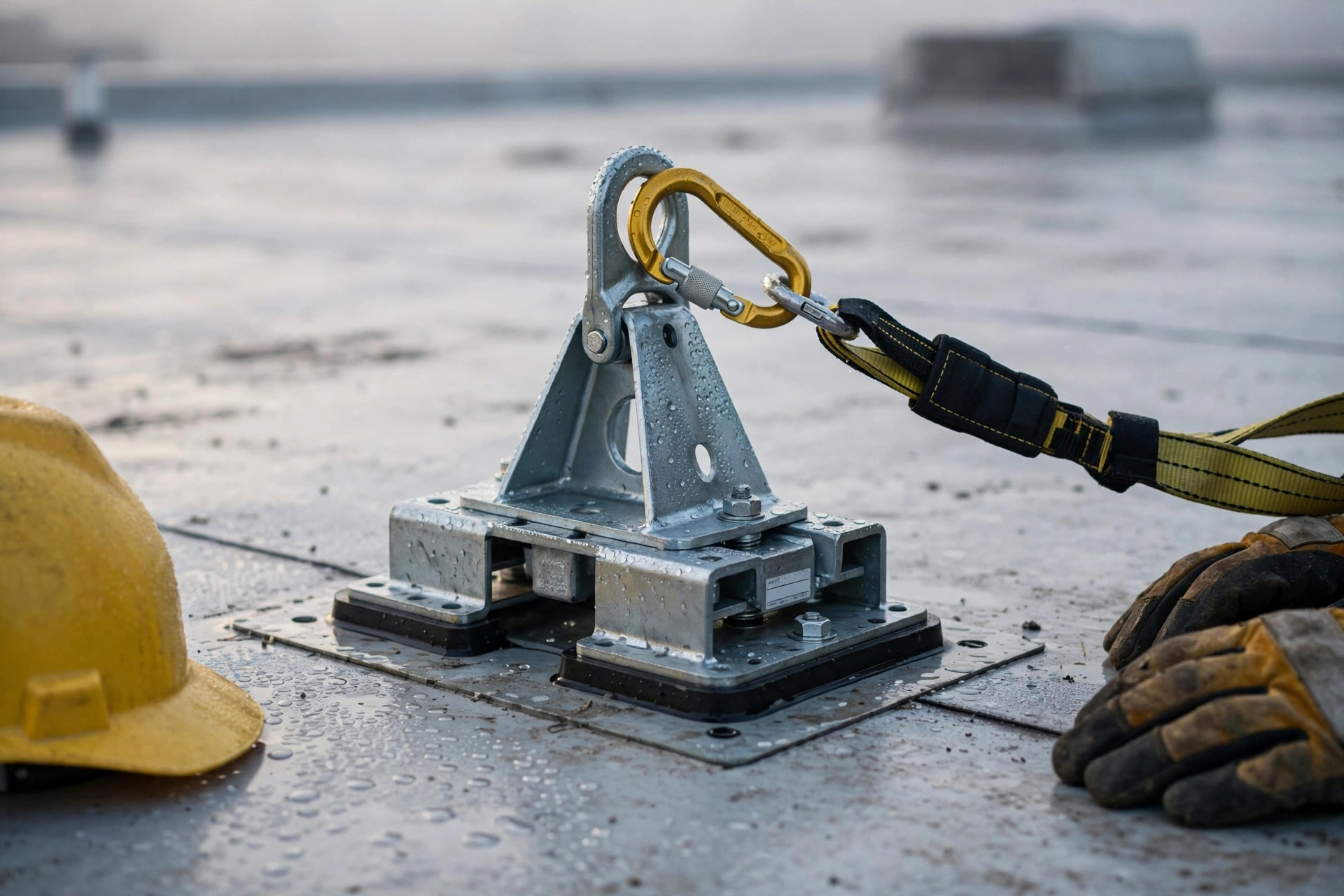
Harnesses and anchors are reusable — the $2,680 is not burned in one job. It carries forward, and the marginal cost of the next roof job drops close to zero.
Put $2,680 against the operating budget of a 120,000-square-foot warehouse and it does not register. Annual rent alone runs into the hundreds of thousands. One leak that soaks inventory costs more than this in cargo damage.
The Real Bill for One Fall
Now the other side. One roof fall — even one where nobody dies — generates a bill like this:
| Item | Amount |
|---|---|
| OSHA penalty (serious, per violation) | up to $16,550; a single inspection typically yields 2–3 items |
| OSHA penalty (willful or repeated, per violation) | up to $165,514 |
| Emergency care, surgery, rehab | easily six figures |
| Shutdown, investigation, abatement | varies with the warehouse's daily throughput |
| Workers' comp premium increase | experience modification rate (EMR) bump, paid over the next three years |
| Legal fees, settlement | on top |
Look at the first two rows. OSHA's public enforcement records include a Jacksonville roofing company cited in 2015 for workers on a ~12-foot roof with no fall protection — the same company had already been cited twice before under the same provision, 29 CFR 1926.501(b)(13). Repeat violations climb toward that $165,514 ceiling. Many warehouse operators think "it was just this once." OSHA's logic is: you had better hope this is the first time anyone noticed.
Run an expected value: suppose a warehouse goes up on the roof six times a year and has one OSHA-reportable incident in ten years — a conservative frequency. Price that single incident at $200,000 all-in (penalties, medical, shutdown, premium hikes — and that is a low estimate). Annualized expected loss: $20,000. Amortize the $2,680 compliance spend over ten years: $268 a year. Expected loss runs more than 70 times the spend. You do not need to run this calculation twice.
Three Levers to Spend Less
The math is settled. Now, how to spend the least? Three levers:
First, the cheapest fall protection is not sending your own people up. Subcontract roof work to a licensed roofing contractor, and write the contract so the contractor bears full responsibility for its crew's fall protection compliance and carries the insurance. The bid typically runs 20–30% above doing it in-house — but you export the entire tail risk: citations, injuries, premium hikes. The labor dollars you "save" doing it yourself do not cover a fraction of one serious citation. Small warehouses get this backwards constantly. The visible contract price looks expensive; the invisible risk is cheap.
Second, if you go up more than four times a year, install permanent anchors. A commercial permanent anchor runs about $500. Ten of them: $5,000 once, good for a decade. That is $125 per roof job, and you stop renting mobile guardrail. Go up once a year? Temporary anchors plus rental guardrail win. The break-even point: four or more roof jobs a year favors permanent anchors; fewer favors the temporary setup.
Third, stop buying training as an annual subscription. Fall protection training has no blanket annual-retraining mandate (check OSHA's current standard for the exact requirement). The requirement that bites is: new hires must be trained before exposure, with records. Many warehouses spend thousands a year on training courses while missing the two things OSHA actually asks for first — a written plan and training records. No records, no training, as far as the inspector is concerned.
The Decision, in Calculable Form
Roof fall protection is not a safety question. It is a finance question:
- Four or more roof jobs a year: install permanent anchors (~$5,000 one-time). Amortized cost lands around $125 per job. Cheapest option.
- Fewer than four: temporary anchors plus rental guardrail — keep single-job compliance under $3,000. Or subcontract to a licensed contractor and transfer the risk by contract.
- Every warehouse: prepare to the 4-foot line (the 1910 standard), not the 6-foot one. Keep a written plan and training records — the inspector reads the paper first.
$2,680 against $16,550. That is the entire thesis. Among all safety spending, fall protection has the highest ROI — because the denominator is embarrassingly small and the numerator is terrifyingly large.
By Lao Zhou, Logistics Cost Analyst