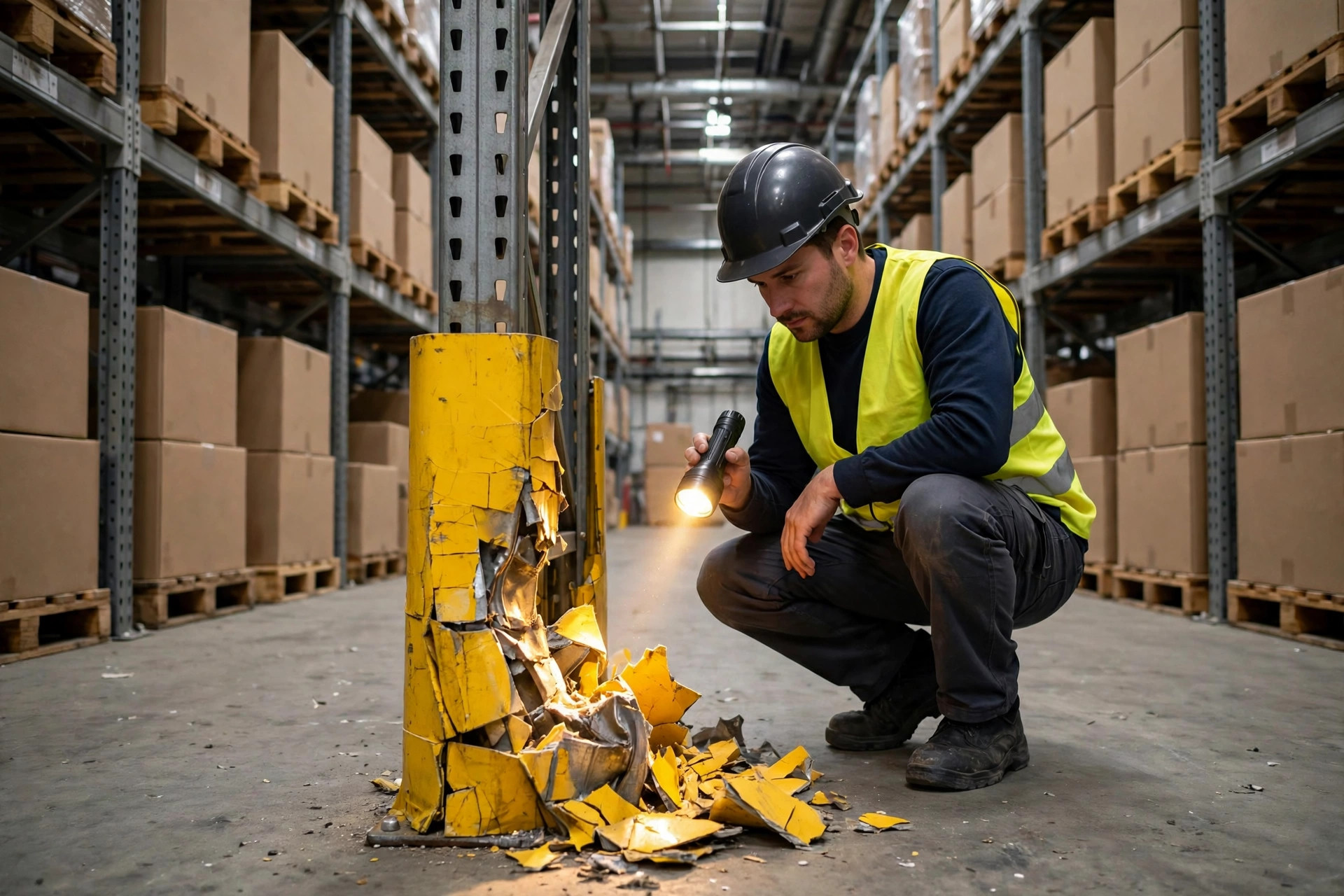
2 a.m. Old Wang swept aisle 7. My thought: a warehouse racking inspection checklist nobody really follows will get someone hurt. It was the end of night shift, flashlight in hand, and that thought would not leave me alone.
Let me be straight with you. I used to think inspection meant walking the aisles and signing a form. The racks are standing right there, looking fine. What could possibly go wrong? Two close calls changed my mind. After that, inspection in our warehouse stopped being paperwork for auditors and became a gate every night shift has to pass before handover.
What a Usable Warehouse Racking Inspection Checklist Actually Looks Like
Our first form embarrasses me now. Dozens of line items, from anchor bolts to deck flatness, crammed onto one sheet. Nobody filled it out honestly. The night crew was half asleep, ticking boxes down the aisle just to get it done. The more complete the form looked, the less anyone actually looked at the racks.
So we cut it down to five things: is the upright bent, dented, or cracked; is the beam clip fully seated and undeformed; is the column protector present and intact; are the anchor bolts loose or missing; is the bay overloaded or is product sticking out past the beam. Five items, about thirty seconds per bay. A form nobody can finish is a bad form. A form people can actually finish is a good one.
Staffing changed too. Now we go in pairs: one holds the flashlight and reads the items out loud, the other touches and judges. Veterans pair up with newcomers — the newcomer reads and records, the veteran decides whether a bay is safe to use. We rotate aisles every month, because the same person staring at the same row every night eventually stops seeing it. And there is one hard rule: never schedule inspection in the last half hour before clock-out. Tired eyes are decorative. Starting half an hour earlier beats a walk-through done by people who can barely keep their eyes open.
How we treat people who find problems matters just as much. Our rule: nobody gets punished for finding a problem, and nobody gets punished the first time they bump a rack — what gets called out in the team meeting is hiding it. Report a hit and it is dealt with, end of story. Hide it and let someone else discover it, and that is a different conversation. Veterans teach newcomers this on day one: reporting is not shameful, covering up is. During peak season, when new hires come in fast, that one sentence does more than any line item on the form.
Inspection also cannot be dumped entirely on night shift. Day shift now spot-checks the aisles it just worked before clocking out: shake the beam you just loaded, glance at the protector on the lane you just drove. When everyone owns a small piece of it, there is less resentment and fewer surprises at handover. That is how morale actually works — not slogans, just nobody carrying the whole load alone.
Two Close Calls, Both in Places That Looked Fine
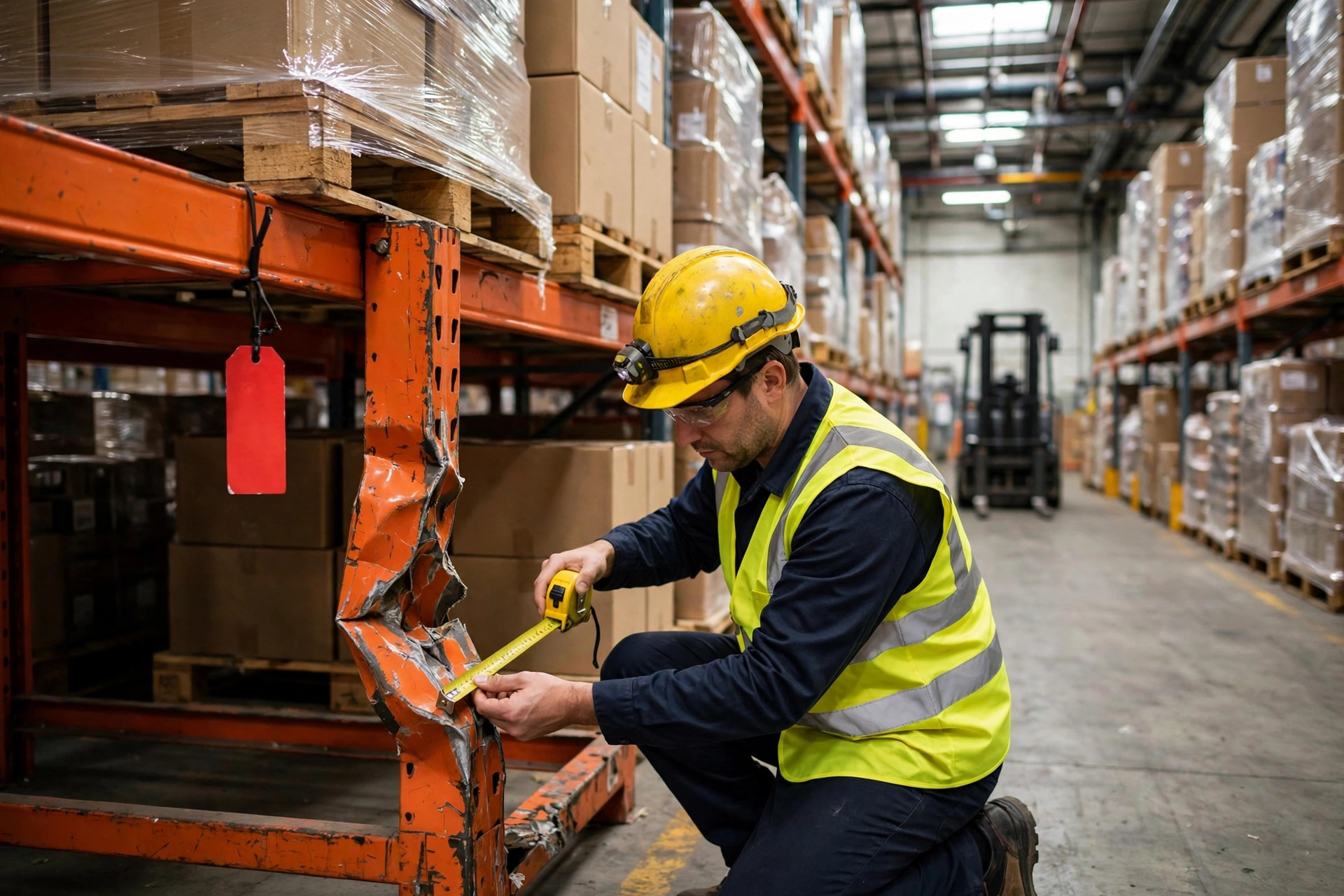
The first was last November, right in the middle of peak. A forklift clipped an upright in aisle 3 while reversing. The protector was dented, the upright showed one faint mark, and from a few steps away nothing looked wrong. The shift lead wanted to log it and deal with it in the morning. Old Wang said no, sealed the bay, and hung a tag on it. The next day, once the pallets were moved and the protector came off, we found a crack on the inside of the upright, right at the base. That bay was holding more than 40 pallets. If day shift had kept loading and unloading around it, I do not want to think about what would have happened. Since that night, our order is fixed: a hit upright gets sealed first and assessed second, never the other way around.
The second was this March, a new hire who had been with us about two months. He set a beam in place and both ends looked level and tidy. In reality, one clip had never seated — it was just resting on the connector. A forklift nudged it and half the beam dropped on the spot. Luckily that level held only one layer of light product, and nobody was standing underneath, so nobody got hurt. We rechecked the whole zone that same night and found 3 more beams seated the same sloppy way: level to the eye, loose to the hand. Clips are like that — your eyes will lie to you, your hands will not. Now the rule is simple: after a beam is loaded, grab it and shake it. If it moves, it is not seated. Do it again.
Put together, those two nights taught me something counterintuitive: a month full of findings is not necessarily bad news. The scariest result is several weeks with zero findings. Zero usually does not mean the racks got better. It means people started gliding through the check — tired, rushed, or just going through the motions. In our monthly meeting, the first thing we look at is not how many problems were found, but which aisle reported nothing for two straight weeks. That aisle gets priority the following week.
Beyond the Warehouse Racking Inspection Checklist: The Repair Log That Makes It Stick
To be honest, the warehouse racking inspection checklist itself is not worth much. What is worth something is the repair log behind it. A problem found and not fixed is the same as a problem never found. Our log has three tiers, posted on the office wall where everyone can see it:
| Tier | Action on the spot | Cost of putting it off |
|---|---|---|
| Red: cracked upright, deformed beam, failed clip | Seal the bay and tag it immediately, report for repair the same day, reopen only after a recheck | One collapse means at least half a day shut down, and possibly someone injured |
| Yellow: dented protector, loose bolt, minor dent | Fix within 48 hours, with height and weight limits until then | A small repair grows into replacing a whole run of uprights |
| Green: surface scratches, unclear labels, light overhang | Note it on shift, tidy it up within the week | Nothing urgent, but you will waste time writing it up again next inspection |
That log also makes the budget conversation easy. Three months of entries show exactly which aisle takes the most hits and which failure shows up most often — no arguing, just the record. Sealing a bay during peak hurts, no question; one less bay means less room to maneuver. But that cost is visible and bounded. A collapse is the invisible, unbounded one. That is how we do the math in our warehouse now: the price you can see is almost never the expensive one.
Spare parts have to follow the log, too. We used to order a replacement upright after one failed and wait two weeks with a bay sealed. Now we keep two spare uprights in common sizes, a few protectors, and a bag of clips on hand. It does not cost much, and a red-tier problem can be worked on the same day. A checklist without parts in the building is just a wish list. In our warehouse, the sheet, the log, and the spares all have to be in place, or the whole thing does not close.
One last thing on compliance, and I will keep it plain: rack safety in the US is regulated, and the specific requirements can change, so check the latest official guidance rather than copying an old post off the internet. Our approach is to keep the internal routine fixed as described above and recheck it against the latest official word once a year, updating the form whenever something changes. The form is just paper. The yearly recheck is what keeps it honest.
So, fellow managers, before tonight's handover, do not just sweep the aisles with a flashlight and sign. Crouch down and look at the base of the uprights. Grab the beams and shake them. Write down a dented protector instead of walking past it. Racks do not talk. Before they fail, all they give you is a crack, a loose clip, a small warning. Hear it in time, and it is not too late.
By Chen Feng, Warehouse Operations Manager