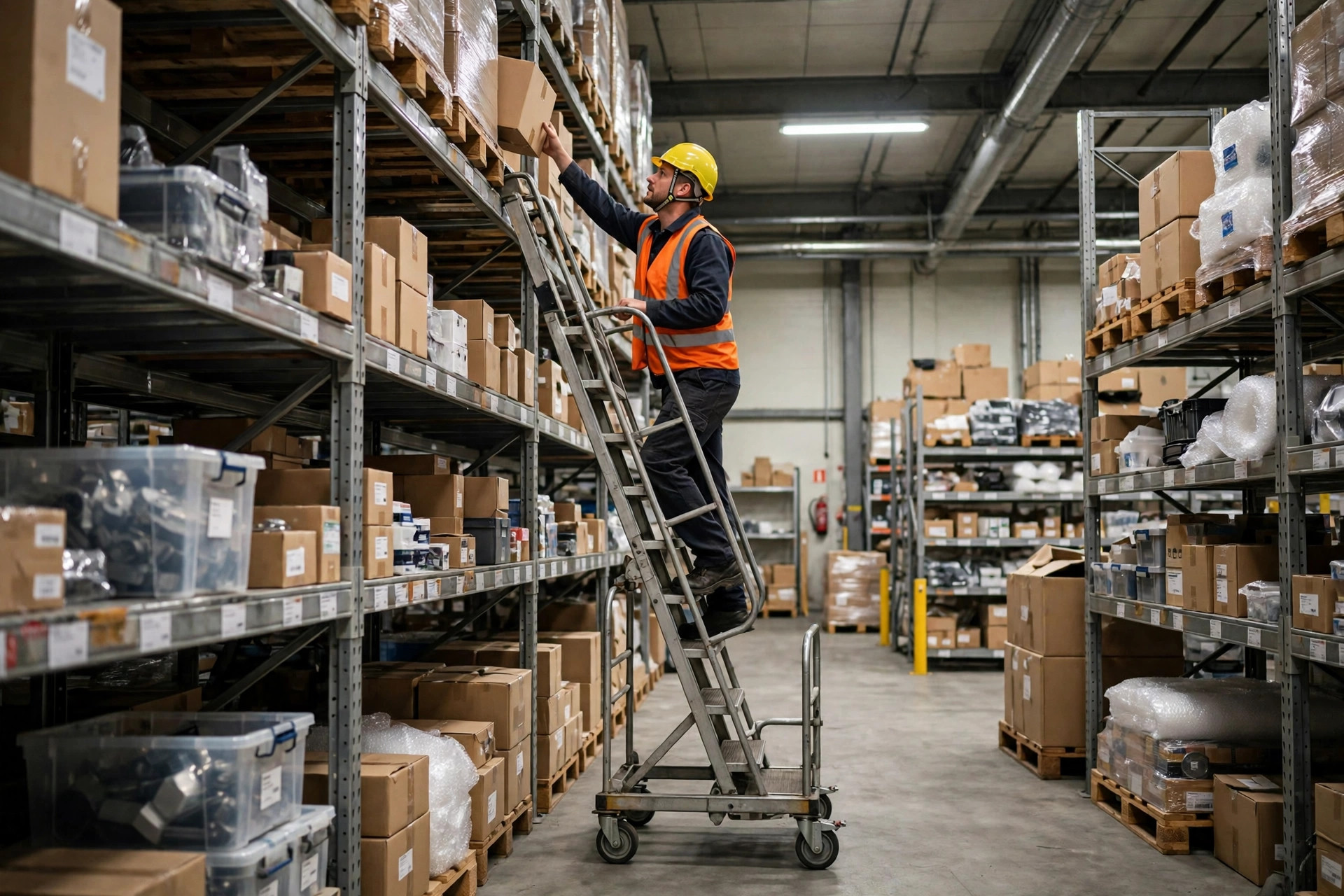
Think of a ladder as the cheapest piece of elevated-access equipment in the warehouse, and also the most overlooked one. An order picker truck costs tens of thousands of dollars, and before buying one, a warehouse runs justification, procurement, and training. A ladder costs a few hundred dollars, gets leaned against a wall, and anyone can climb it. And yet, nine times out of ten, a ladder fall is not caused by the ladder breaking. It is caused by the wrong ladder, the wrong use, or a ladder that was never inspected.
Start with the principle. There are two kinds of ladders, and their logic is completely different. A portable ladder is leaned, climbed, and put away. A mobile ladder stand carries its own platform and guardrails, rolls on casters, and locks in place, so standing on it is like standing on a small balcony. You can think of it this way: the first is for climbing up to grab something, and the second is for standing up there to work. Low-frequency picks, light goods, and heights of a couple of meters can work with a portable ladder. High-frequency picks, time spent standing, and two-handed work call for a mobile ladder stand. Using a portable ladder for a mobile stand's job is like riding a bicycle on a freeway. It will not necessarily end badly, but it is only a matter of time.
The ladder selection line: frequency and dwell time, not price
The selection line we draw for warehouses is simple, and it uses just two numbers: how many times a day someone climbs, and how long they stay up there.
Climb once or twice a day, grab one item, and come straight down, and a portable ladder can work, provided it has anti-slip feet, is set at the angle required by the current OSHA text (for a straight ladder, the four-to-one rule: the base sits about one quarter of the ladder's height away from the wall), and offers a handhold when stepping on and off. Exact dimensions should be taken from the current OSHA 1910.23 text, not from a vendor's sales page.
Climb a dozen times a day, stay up there for minutes at a time, and pick and scan with both hands, and a portable ladder is the wrong tool. Go straight to a mobile ladder stand with locking casters. The critical part of a mobile stand is the lock. If the casters do not lock, the stand is a skateboard. When selecting, check the lock mechanism first, foot-operated or handle-operated, then the platform guardrail height and the rated load. The rated load must cover person plus goods plus tools, not body weight alone. Many warehouses buy a stand by checking whether a person fits on it, never checking the rated load, and then overload it without knowing. That is a textbook pseudo-requirement: cheap at purchase, dangerous in use.
| Situation | Choose | Key checks |
|---|---|---|
| Low frequency, short dwell, light goods | Portable ladder | Anti-slip feet, set angle per the standard, handhold on and off |
| High frequency, long dwell, two-handed work | Mobile ladder stand | Caster locks, guardrails, rated load covering person, goods, and tools |
| Beyond safe ladder height | Order picker truck or lift platform | When the ladder runs out, change equipment, do not extend the ladder |
The ladder inspection checklist: caster locks come first
Ninety percent of ladder maintenance failures are inspection failures. Our plant's inspection checklist has only five items, and none of them can be skipped. First, locking casters: step on the lock and check whether it actually holds; replace it the moment it slips. Second, steps and platforms: deformation, cracks, and oil, fixed the moment they are seen. Third, handrails and guardrails: tighten anything loose, and take out of service anything that cannot be tightened. Fourth, anti-slip feet: replace them when worn flat, not after someone slips. Fifth, ladder labels: a ladder whose rated load and model markings have worn off goes out of service first, because a ladder with an unknown load rating must not be used.
Inspection frequency follows use frequency. High-use stands get inspected before work starts each day. Low-use portable ladders get inspected weekly. The inspection record hangs on the ladder, signed after each check. The record is not for passing inspections. It is for proving, when something happens, whether the ladder was checked yesterday with good locks, or should have been taken out of service yesterday and nobody acted. Those two situations carry completely different responsibility.
One more thing to call out about pseudo-requirements: vendors sell ladder extension sections and height add-ons that let you bolt extra height onto a ladder. Do not buy them. A ladder is not a building block set. Extending it changes the load path and the center of gravity, and voids the manufacturer's rated load. If the height is not enough, change the equipment, do not extend the ladder. Is the money worth it? Look at this one number: the direct and indirect cost of a single fall buys how many compliant mobile ladder stands? Anyone who has done that math stops cutting corners on ladders.
Taking ladders out of service: a broken ladder never works again
The last step of inspection is taking ladders out of service and scrapping them. Many warehouses find a problem during inspection and do only one thing: stick a "to be repaired" note on the ladder and leave it where it is. The next day, someone grabs it out of habit and uses it anyway. My rule is that a ladder that fails inspection gets moved out of the work area on the spot, locked in the repair area, and only returned after repair and re-inspection. A ladder that cannot be repaired gets scrapped and dismantled, never left around to be "used for now."
Scrapping criteria should also be written down. A bent frame, a cracked step, a failed lock, or a broken guardrail is each enough to cross the scrap line. Scrapping is not waste. It is loss control. Keeping a broken ladder in use saves a few hundred dollars on a replacement and gambles the full cost of a fall. Supervisors can do that math, and so can workers. The key is making "out of service" easier than "make do." The repair area should be close, the scrap process should be short, and a replacement ladder should always be available. When taking a ladder out of service is hard, workers will make do. When it is easy, they will take it out of service.
A final word for supervisors. Ladder safety does not come from buying expensive ladders. It comes from choosing the right ladder, inspecting the right items, and taking broken ladders out of service. Get those three right and a ladder is a tool. Get them wrong and a ladder is an accident waiting to happen.
By Da Liu, Automation Engineer