Rack decking is the part of a pallet rack that buyers most often ignore. It looks like a simple panel, so people assume any panel will do. Then fire inspection stalls, small parts slip through the gaps, or a forklift catches a warped pallet, and the warehouse learns that the panel was never a cosmetic choice. Decking is the last interface between the load and the beam: it carries weight, lets water and smoke through, and stops small items from falling. Get it wrong and even a strong rack frame cannot save the operation.
Think of decking as a small bridge laid across two beams. The load presses down, and the bridge must neither collapse nor sag too far. That gives us the first two numbers that matter: rated load capacity and deflection under load. The third number is the one most buyers miss: how much water and smoke can pass through. Sprinkler water must reach a fire on the level below, and smoke must rise to trigger detection. A solid panel on every level acts like a ceiling on each tier, and the fire system behind it is effectively blocked.
Rack Decking Basics: Load, Deflection, and Water Penetration
You can understand the trade-off this way: a deck panel is judged on four things at once — how much it holds, how far it bends, what falls through it, and what it blocks. Load capacity should come from the manufacturer's load table for that exact panel, not from a competitor's brochure or a rule of thumb. Deflection matters because a sagging panel traps pallet corners; a forklift operator then has to rock the pallet free, which slows every putaway and retrieval on that level.
Water penetration is a fire question, not a housekeeping one. In a rack fire, sprinklers above the rack need to wet the burning level, and water that cannot pass through a solid deck simply pools on top of it.
Wire Mesh Decking: The Default for Sprinklered Racks
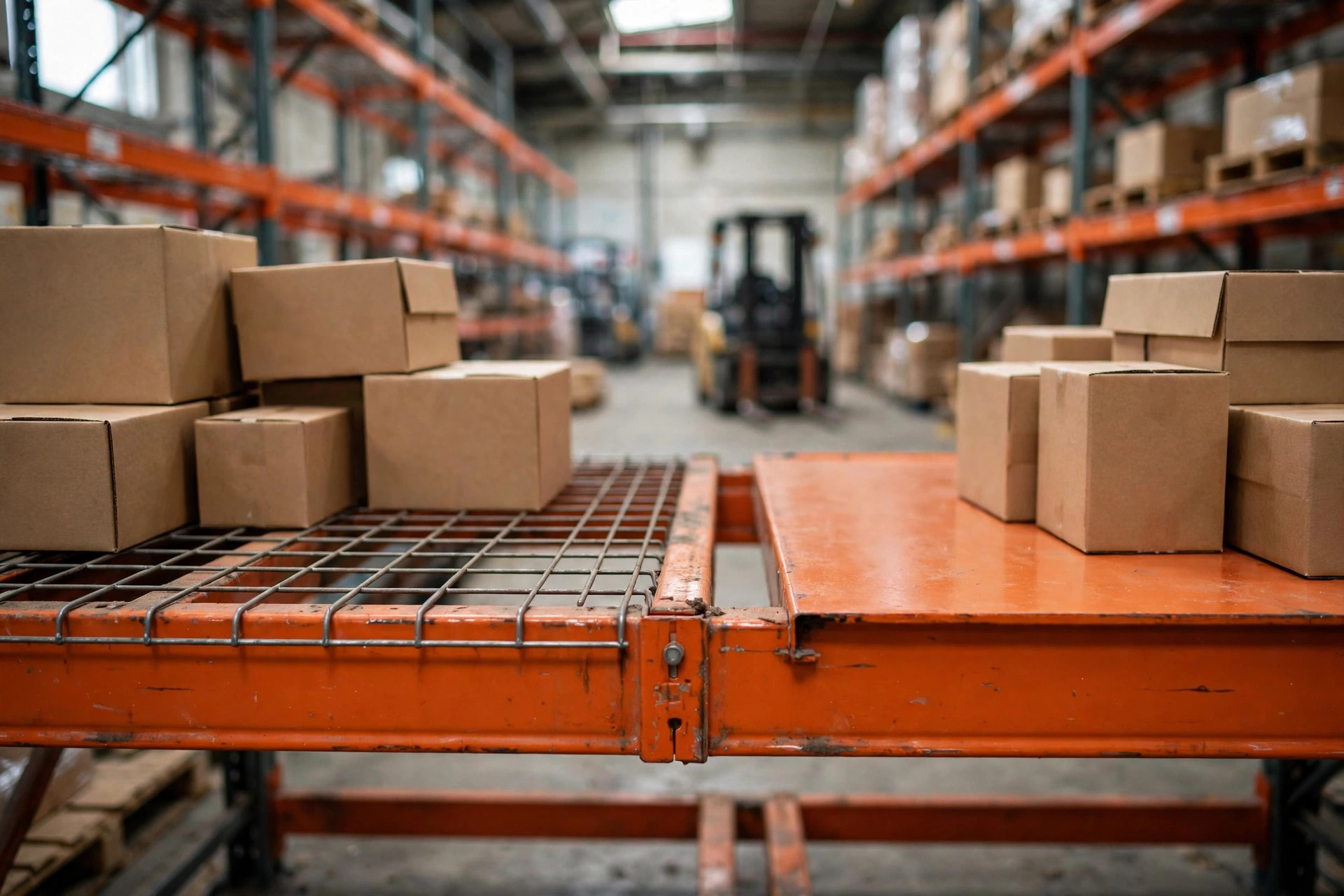
Wire mesh decking is the most common choice, and for good reason. Steel wires welded into a grid, reinforced with support channels underneath, sit in the beam step and carry a standard pallet load comfortably. Water passes through, smoke rises, and sprinkler coverage is barely affected. In load terms, a standard mesh panel with proper reinforcement sits squarely in the medium-duty range; the exact figure belongs to the manufacturer's load table, and any serious comparison should use that table rather than a generic claim.
I saw the failure mode firsthand in an e-commerce warehouse in eastern China. The operator had bought thin mesh to save money: fine wires, too few supports. Under a full pallet the mesh sagged, pallet corners caught in the grid, and operators had to jiggle every pallet before the forklift could pull it out. Swapping to heavier wire with three support channels fixed it overnight. Same beams, same pallets, same forklifts — only the decking changed, and the aisle suddenly ran smoothly.
Mesh has a real weakness, though: small parts fall through it. Hardware, fasteners, odd-shaped components, and loose items drop through the grid or wedge into it. A parts distributor that decks everything in mesh will find itself sweeping components off the floor below. The fix is a liner or a thin panel over the mesh, but that adds cost, and it should be priced into the decision from the start rather than discovered later.
Steel Panel Decking: Heavy Loads and Small Parts
Steel panel decking is a formed sheet of cold-rolled steel, folded at the edges for stiffness. It is the strongest of the three options, and it is the right call for heavy dies, full coils, and dense loads that would deform mesh. Small parts cannot fall through it, the surface is flat, and pallets sit stably without the local sagging that mesh can show.
The price is fire performance. A solid steel panel blocks water and smoke almost completely. You can understand it as building a solid floor on every rack level. Fire design then has to compensate, often with in-rack sprinklers on each level, more sprinkler heads, and re-routed pipework. Each of those items costs more than the panels themselves. Steel panels are also heavy: replacing one at height takes two people, while a mesh panel can be carried up by one.
An auto-parts warehouse I worked with learned this the expensive way. They decked the whole building in steel because it felt sturdier, then fire inspection required in-rack sprinklers on every level. The retrofit cost several times the decking budget. Had they used steel only in the heavy-load zone and mesh elsewhere, most of that retrofit would never have been needed. The lesson is not that steel is bad; it is that decking should be zoned, not applied uniformly.
Wood Decking: Cheap, Until Fire and Moisture Arrive
Wood decking — plywood or multi-layer board, cut to size — is the cheapest option, and it is popular in small warehouses, temporary storage, and light-duty areas. It carries light to medium loads, its surface grips well so cartons do not slide, and it is easy to cut and replace. For a short-term overflow area, it is hard to beat on price.
But wood has two hard limits. The first is fire: wood burns, and it becomes fuel in a rack fire. Fire codes restrict wood decking heavily, and some areas prohibit it outright. The second is moisture. A roof leak, floor dampness, or cold-storage condensation soaks into wood, cuts its strength sharply, and causes warping and mold. Mold then contaminates food, cosmetics, and consumer goods stored nearby. A consumer-goods distributor I know discovered mold on its bottom-level wood decks after a rainy season; the outer cartons of a whole batch had to be repacked, and the loss dwarfed any saving on the panels.
Wood is not forbidden. It belongs in dry, light-duty, fast-turnover areas where fire rules allow it, and it should be treated as a consumable: inspect it regularly and replace it on schedule, not once a decade.
Choosing Rack Decking: A Decision Table
| Load and setting | Recommended decking | Why it wins |
|---|---|---|
| Standard pallets, sprinklered warehouse | Wire mesh decking | Water and smoke pass through |
| Heavy dies, coils, dense loads | Steel panel decking | Highest load capacity, flat surface |
| Small parts, fasteners, components | Steel panel, or mesh with liner | Stops items falling through |
| Light goods, temporary, dry areas | Wood decking | Cheapest, but replace on schedule |
| Cold chain, damp areas, fire-restricted zones | Wire mesh or steel panel | Wood fails on moisture and fire |
Cost comparison should never stop at unit price. A mesh panel may cost more than a wood board, but it avoids fire retrofits, replacement labor, and product damage that quickly erase the difference. Conversely, forcing mesh into a heavy-load zone creates sagging, pallet jams, and forklift delays that cost more over a year than the steel panel would have.
Decking Maintenance: The Pitfalls After Installation
Most decking problems are installation problems. Mesh that is not seated in the beam step shifts when a forklift bumps it. A steel panel whose folded edge is not engaged lifts and cuts pallet bottoms. A wood board with loose screws works free under load. None of these are panel defects; they are acceptance failures. Check a sample on installation day: can the mesh be rocked by hand, does any steel edge lift, does any wood board creak underfoot?
Quarterly inspection is worth the hour it takes. Look for broken welds and bent supports on mesh, rust and cracked folds on steel, and dampness, mold, and splitting on wood. Replace a deformed panel immediately, especially at height.
Here is the counterintuitive point: thicker is not automatically better. A thicker steel panel is stronger, but it is also heavier, pricier, and worse for fire design. Heavier mesh wire is stiffer, but smaller openings reduce water penetration. Decking selection is a balance among load, water passage, fall-through, and cost, not a race to maximize one number. A competent buyer starts from the manufacturer's load table and the fire inspection requirements, then matches the load type, and only then looks at price.
So is the money well spent? Look at one number: over the life of the decking, the total cost of fire retrofits, product damage, downtime, and replacement labor caused by the wrong panel, versus the money saved by choosing the cheapest panel on day one. Most warehouses that run that calculation end up with mesh as the default, steel only where loads or small parts demand it, and wood confined to genuinely temporary, dry, light-duty corners.
By Da Liu, Automation Engineer