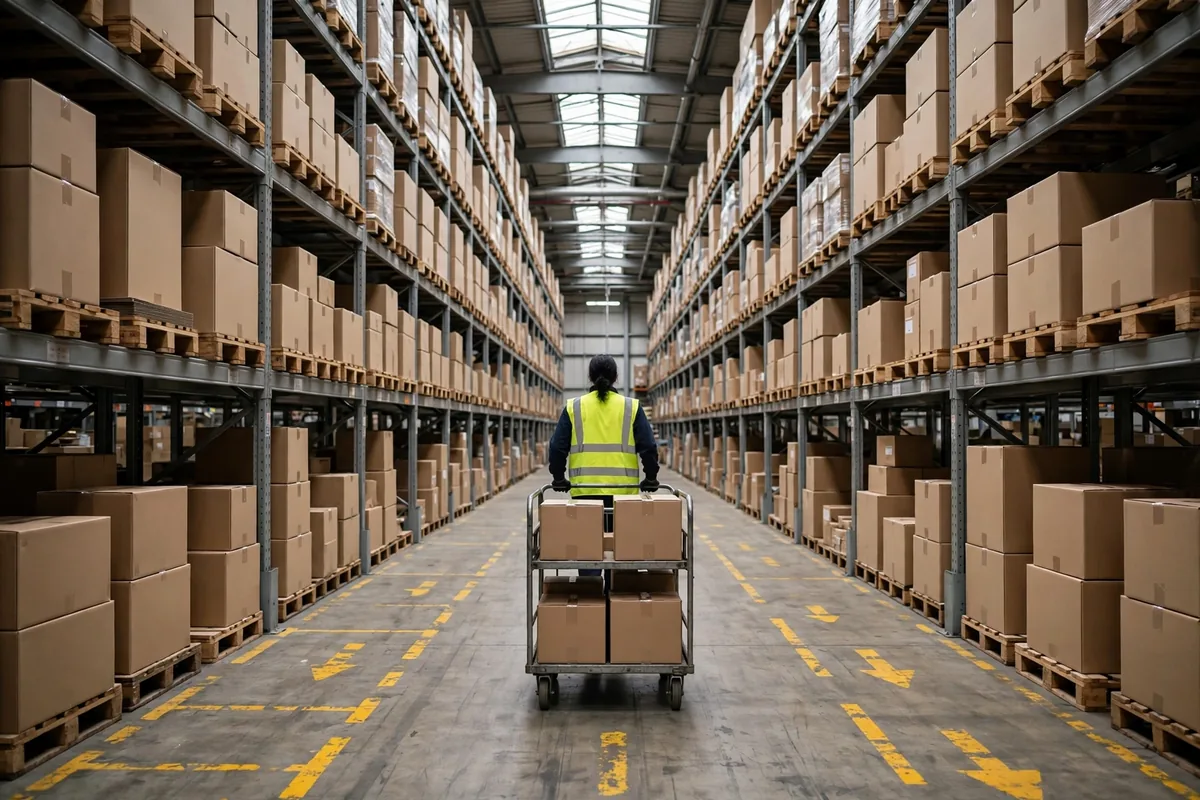
It was a Tuesday morning last peak season, about 6:40, and I was standing on the mezzanine looking down at the floor. Night shift had just handed over. The day crew was coming in, and Lao Zhang, one of our pickers, pushed his cart out of Zone A, walked all the way to Zone F for two items, turned around, went back to Zone B, then doubled back again to Zone E. One order, four items, three trips down the same aisles. I did not say anything. I was doing the math in my head. About half of that walk was wasted.
Let me be straight with you. Backtracking on the warehouse picking path is the easiest waste to miss in a warehouse. It does not show up like a stockout or a mispick. It hides in the step count. Guys finish a shift with sore legs and figure that is just the job, but a lot of that tiredness is the layout making them walk in circles.
How Picking Path Backtracking Creeps In
Our location codes were set the year the warehouse opened, in the order freight arrived: whatever came first got the spots near the door, whatever came later got pushed deeper inside. Over time, fast movers and slow movers ended up mixed together, and one order could send a picker across half the building. The order was fine. The locations were the problem.
Then there is the wave sequence. Our waves were released in the order orders came in, not in location order. The system handed out picks one by one, and the picker followed the list wherever it led. Same aisle three times today, four times tomorrow. Nobody thought it was strange, because the orders still went out on time.
The worst one, for me, is replenishment fighting picking for the same aisle. Eight to ten in the morning is our outbound peak, and it is also the replenishment peak. A forklift comes in with a full pallet while a picker tries to get out with a small cart, and the two of them stand there letting each other pass. Two minutes here, two minutes there, and over a day that is dozens of orders a picker does not get to. The veterans are used to it; a new hire freezes at the end of the aisle, unsure whether to go in or back out.
I pulled up Lao Zhang's order later that day. Four items in Zones A, F, B, and E. Walked in location order, it is one clean pass. Walked in the order the list printed them, it is two extra round trips. I asked him about it and he said, "Boss, I walk like this every day. I am used to it." Used to it. That is the hardest part. Waste you are used to never gets fixed.
A bad picking path does not just cost speed. It costs you new people, because a new hire has no veteran's shortcut in his head to fall back on, and every extra lap makes him feel slower than the team. Hiring and training a replacement costs a lot more than moving a few locations.
How We Measured the Backtracking on Our Picking Path
Feeling is not enough. You need numbers, but they do not have to be fancy.
We tried a low-cost method first. For three days, a team lead followed pickers with a printed floor plan and drew a line for every order: where it started, which zones it crossed, where it turned around. After three days, the thickest lines on that map were the problem. The line between Zone A and Zone F was so thick it was almost black.
We also counted steps. Nothing formal, no pedometers. The lead followed a dozen or so pickers for half a day each with a phone. Our own measured figure, and I want to be clear this is our warehouse's number, not an industry benchmark: before the fix, a picker walked roughly 200-plus meters per order on average. That number landed hard with the crew. It meant the extra walking each day added up to several laps around the building.
The check I trust most is pick time for the same kind of order. One picker finishes in twenty minutes, another takes thirty. The difference is rarely hand speed. It is the route. The fast picker has figured out his own smooth path in his head. He goes to the far end first and works his way back. The new hire follows the list as printed and zigzags all day. When your best speed depends on veterans carrying the route in their heads, your layout is failing your new people.
Three Fixes We Tried on the Picking Path
The first fix was moving zones. We moved a few dozen of our fastest-moving items into the two zones closest to packing. It sounds simple. It took three nights of moving stock when there were no orders, and we had to watch cycle counts closely so nothing got misplaced. Within a week, the average walk per order dropped from over 200 meters to a little over 100 in our own measurements. Pickers finished shifts less worn out, mispicks did not go up, and the cost was those three nights plus tight supervision of the counts.
The second fix was smaller. We moved items that almost always ship together onto adjacent locations in the same aisle. Two products that always show up on the same order used to sit at opposite ends of an aisle. Now they sit side by side, and the picker grabs both with one reach. That idea came from the pickers themselves. They know better than anyone in an office which items are partners.
The third fix cost nothing at all. We changed the pick sequence in the system so picks print in location order, near to far, instead of in the order the orders arrived. One pass, one direction, no turning back. It was a small change in the WMS that took two days of back and forth with the vendor. After that, no order jumped from Zone A to Zone F and back to Zone B again.
| Fix | What changed in our warehouse (our own measured range) | What it cost |
|---|---|---|
| Fast movers to near zones | Average walk per order down by roughly half | Three night shifts of moves, tight cycle counts |
| Partner items side by side | Far fewer turnarounds inside one aisle | Ongoing feedback from pickers |
| Picks sequenced by location | Orders stopped jumping between zones | Two days working with the WMS vendor |
Here is the counterintuitive part, and I know some people will disagree with me. The shortest picking path is not always the fastest picking. We once packed every fast mover right by the door, and that aisle jammed solid. Pickers, replenishment forklifts, and packers were all squeezed into the same stretch, and nobody could move. We ended up shifting some fast movers one zone back. The walk got a touch longer, but the aisle stayed open, and overall we got faster. Do not just measure distance. Measure flow.
Replenishment now runs in the low-outbound window, two to four in the afternoon. Mornings are for picking only, unless a location is genuinely about to run dry. People complained at first that the window was too short, but after two weeks mornings stopped jamming, pick speed went up, and afternoons turned out to be plenty of time. Keep the two crowds out of the same aisle at the same hour. That is all it is.
Once a month we look at the route map again, and when demand shifts, locations shift with it. On a new hire's first day, the team lead walks the smooth route with them before they pick a single order. We do not let them figure it out by trial and error, because the price of that trial and error is backtracking. And before any big promotion, we check the locations of the top few dozen sellers first. Do not wait until peak season to discover your best sellers are buried at the back of the building.
If you run a warehouse, go stand on the mezzanine some morning and follow one picker for one order. Count how many times they turn around. The answer is right there. Backtracking is not hard to find and it is not expensive to fix. The hard part is admitting it is there. Do not wait until peak season, when you are already short-handed, to find out your people have been walking the wrong way all year.
By Chen Feng, Warehouse Operations Manager