If you are buying used pallet racking, the photos will lie to you long before the seller does. A fresh coat of paint costs almost nothing, and it makes ten-year-old steel look like three-year-old steel. I spent years on the integration side watching buyers celebrate the discount, then quietly pay it back in repairs, downtime, and rework. The trick is not learning to spot a bargain. It is learning how racking fails, and then refusing to negotiate with damage that cannot be fixed.
Used Racking: How It Actually Fails
Think of a rack bay as a table. The uprights are the legs, the beams are the supports under the tabletop, and the pallet load travels down through the beams into the legs and into the floor. If a leg is crushed, it does not matter how flat the top is. If a beam has gone soft, it does not matter how thick the legs are. You can understand most used-racking problems by asking one question: where did the load path get broken?
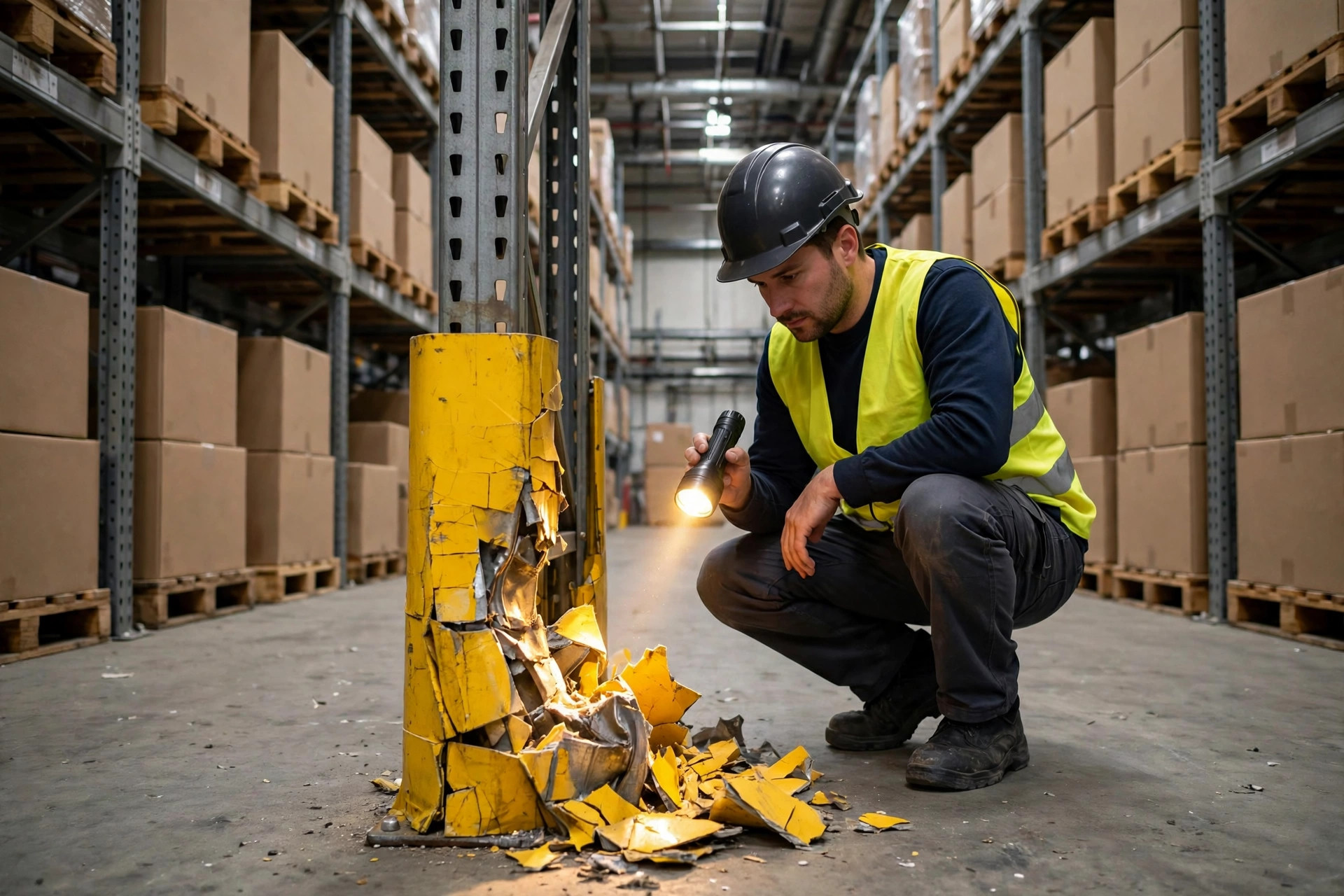
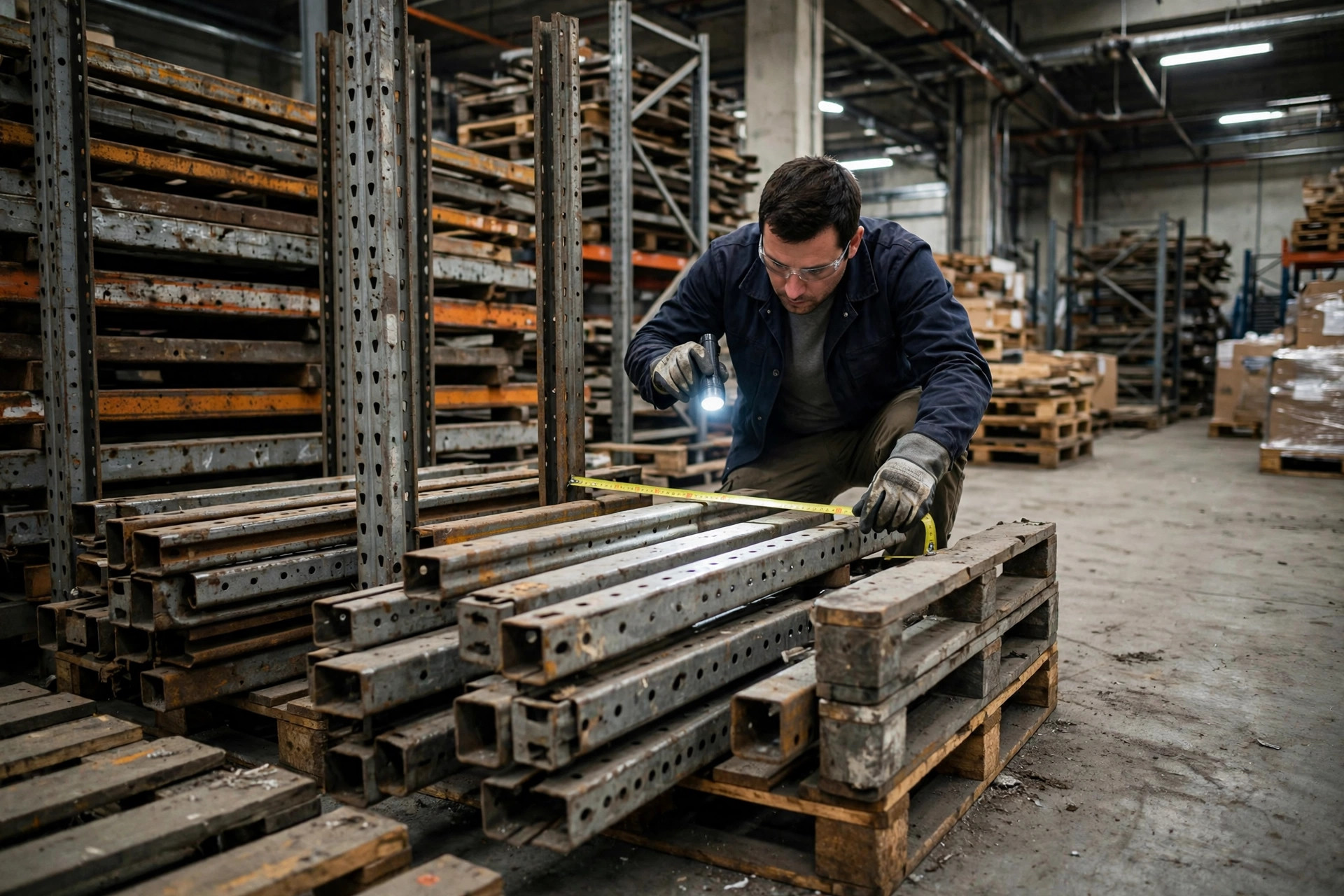
Four kinds of damage do most of the harm. Upright deformation comes first, usually from forklift strikes: dents, twists, and torn steel at the base. A dented upright does not lose ten percent of its capacity in a neat, predictable way. It drops into a different class of risk altogether. Beam deflection comes second. Years of overloading bend a beam slowly downward, and the bend stays even after the load comes off. Connector failure comes third, and it is the quietest of the four: worn beam clips, missing safety pins, stripped bolts. Small parts, big consequences, because a beam that unseats does not warn you first. Corrosion comes fourth. Surface rust is mostly cosmetic. Section loss is not. When rust has eaten the wall thin, a knock test sounds dull and a thickness gauge tells the truth that the paint was hiding.
My working rule is blunt. If an upright shows a clear visible bend, or a dent deeper than the thickness of a coin, reject that upright. For beam deflection, a widely used industry rule of thumb is span divided by 180. I cite that as common practice, not as a standard number, and you should confirm the applicable requirement with the manufacturer and the latest standard before you sign anything. For corrosion, measure wall thickness. Do not judge by color. Rust-through, flaking layers, and visibly thinned sections are automatic rejections.
Buying Used Pallet Racking: Five Defects That End the Deal
In autumn 2023, a consumer-goods warehouse outside Jiaxing, China, asked me to look at a lot pulled from a closed facility. The price was roughly forty percent of new, and the seller described three years of light use. I sampled twenty bays. Six of ten upright bases I checked carried impact marks, two had torn steel at the foot, the beam clips were polished bright from wear, and nearly thirty percent of the safety pins were missing. I told the buyer to walk away. The seller dropped the price another twenty percent. The buyer still said no. A few months later I heard the lot had gone to another operator, and within half a year a beam unseated and dropped two pallets. The repair bill and the shutdown cost more than the original saving.
That story is why the inspection order matters. Anyone buying used pallet racking on photographs alone is skipping the only step that protects the saving. Walk it in sequence, and stop at the first hard failure.
Start with the nameplate and the paperwork. No nameplate, or no original load documentation from the manufacturer, and there is no price worth discussing. This is the counterintuitive part. Most buyers treat missing paperwork as an administrative gap. It is not. It is the difference between a rack you can engineer and a rack you can only guess about. Without a rated capacity, every later calculation is fiction, and you are the one holding the liability if something falls.
Next, inspect the uprights from top to base, with extra attention on the bottom 30 centimeters and the forklift working height. Scratches are fine. Deformation is not, and a straightened upright is not a repaired upright. Steel that has yielded once will yield earlier the second time.
Then check the beams. String a line across a beam and measure mid-span sag. Check every clip for thinning, cracking, and distortion. Count safety pins and bolts as missing parts with real prices, not as things you will sort out later. A connector you cannot source in the right size is the same as no connector at all.
Then look for corrosion and weld problems with a flashlight, not from three meters away. Damp warehouses hide rust inside upright faces and at beam ends. Cracked welds and field re-welds deserve the same suspicion: a factory weld and a site repair are not the same strength, whatever the paint suggests.
Finally, count completeness bay by bay against a full-bay parts list. Used lots are almost always short on something: safety pins, foot bolts, row spacers, decking. Each item looks cheap alone. Together they commonly add ten to twenty percent to the purchase price, and that is before you pay anyone to install them.
A second case, from Foshan in summer 2024, shows the other outcome. An auto-parts warehouse bought used racking retired from an integrator project. The nameplates were intact, the load documents and layout drawings came with the lot, the uprights carried only light scratches, and measured beam deflection sat inside the common rule of thumb. The buyer spent two weeks inspecting bay by bay, rejected about ten percent of the uprights for impact damage, and replaced the safety pins and foot bolts with new ones. Landed cost came in roughly thirty percent below new, and two years on there has been no structural incident. Same market, opposite result. The difference was not luck. It was inspection discipline.
Used Racking vs New: The Total Cost Math
The most common mistake in buying used pallet racking is comparing purchase prices. Compare cost per pallet position, fully loaded, and the bargain usually shrinks.
| Cost item | Used racking | New racking |
|---|---|---|
| Purchase price per position | Low, roughly 35 to 55 percent of new | Baseline price |
| Missing and replacement parts | Safety pins, bolts, spacers, decking, typically 10 to 20 percent on top of purchase | Near zero |
| Transport and dismantling | Old components arrive less uniform, so handling and sorting take longer | Factory-packed, predictable handling |
| Installation and leveling | Wider tolerances on old parts mean more shimming and adjustment | Consistent tolerances, faster install |
| Engineering review | Without nameplates and load documents, review can double in cost and time, or fail outright | Manufacturer documents supplied directly |
| Maintenance and downtime risk | Damaged and corroded members enter their repair cycle early, and shutdown cost is hard to forecast | Low risk inside the warranty period |
Engineering review is the line buyers underestimate most. Some landlords and insurers ask for load certification. A lot without documents may need an independent assessment, and one assessment fee can wipe out half the saving. There is also a trade-off nobody puts in the spreadsheet: used racking saves money and spends your time. Inspecting bay by bay, counting parts, chasing connectors, and leveling old steel all need someone who knows what they are looking at. If your team does not have that person, the time cost shows up later as rework.
So here is my selection line, and I do not soften it. Buy used only when three conditions hold at once. First, nameplates and load documents are complete. Second, after rejecting damaged members, the fully loaded cost per position still beats new by more than twenty percent. Third, you or someone you trust can inspect every bay, not just approve photographs. Miss one condition and the honest move is to buy new, or to buy new for the core aisles and expand later. A smaller safe warehouse beats a larger doubtful one every time.
Whether the money is worth it comes down to one number: after rejecting bad members, replacing missing parts, and adding installation and engineering review, is your cost per pallet position still more than twenty percent below new? That is the test I apply whenever someone asks me about buying used pallet racking. If yes, negotiate. If no, the cheap price was only a loan, and the repayment comes later.
By Da Liu, Automation Engineer