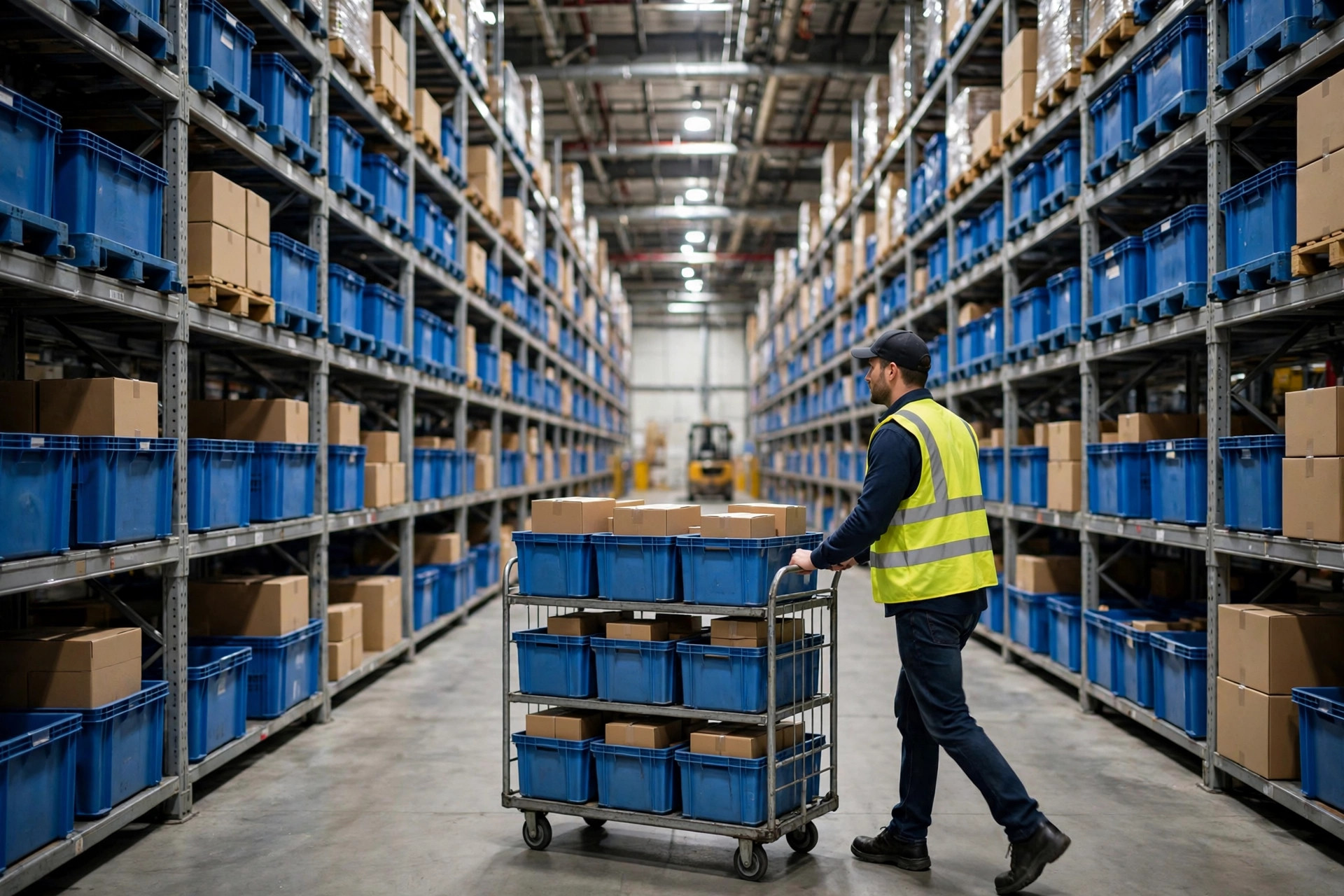
Our warehouse pick path optimization story did not start with a vendor demo. It started with my picker, Xiao Chen, telling me his legs were jelly by the end of every shift. I thought he was exaggerating until I walked a full shift with him and my step tracker passed ten thousand steps by three in the afternoon. That was the day I understood our real problem: in a small warehouse, the issue is rarely a system that is not smart enough. It is the walking itself.
Our warehouse is just over 3,000 square meters, built from two long aisles and a few short rack sections stitched together. Orders are mixed and modest, usually two to three hundred a day, doubling on a busy day. The big-company playbook, real-time routing engines and automated task assignment, is not just too expensive for us. It is also overkill. With our volume, the system would need more babysitting than it saves. So I took a low-tech route: change nothing in the software, change only how people walk.
Warehouse Pick Path Optimization Starts With a Hand-Drawn Walking Map
The first thing I did was draw our floor plan on a sheet of A3 paper, marking every aisle entrance, exit, and hot zone. Then I asked Xiao Chen and Lao Li to each walk one order while I followed behind, tracing their routes. The result looked like two balls of tangled yarn. Both of them entered the same aisle four or five times a day, and once Xiao Chen walked an entire aisle just to grab one small item at the far end for a single order.
That map was ugly, but it was honest. Stack a week of those traced routes on top of each other and the patterns jump out: which aisles get walked back and forth for nothing, which fast-moving items sit far apart even though they often ship together, and which corners nobody wants to walk to. In our case, the fastest-moving small items sat at the deepest end of the aisle nearest the door. I moved the top twenty or so small items to short racks near the entrance, so pickers grab them first and then work their way inward. It cost nothing but an afternoon of moving boxes. The next day, Xiao Chen told me his legs felt normal again. I did not count steps yet. When the feeling is right, then you measure.
S-Shape or Largest Gap? The Dividing Line for Warehouse Pick Path Optimization
The next question was which walking pattern to use. I tried both of the usual ones, and both bit me. In the S-shape pattern, you walk an aisle from end to end, then snake into the next one, like writing the letter S. In the largest-gap pattern, you only walk as far as the farthest pick in an aisle, then turn back, leaving the biggest empty stretch unwalked.
At first I was loyal to the S-shape, because walking the whole aisle felt thorough. On slow days it was pure waste: one pick at each end of an aisle and dozens of meters of empty walking in between. Then I switched to largest gap, which saved legs on slow days but broke down on busy days. When picks were dense, pickers kept turning back at the aisle entrance and colliding with each other. The time spent waiting to pass someone was longer than the walking itself.
So I set my own dividing line, and we still use it:
| Situation | Pattern we use | Why |
|---|---|---|
| Fewer than 3 picks in one aisle | Largest gap | Least empty walking, no wasted trip |
| 3 or more picks in one aisle | S-shape | One clean pass, fewer turn-backs and collisions |
| Oversized items needing two people | S-shape, at a staggered time | Keeps the aisle from getting blocked |
That line is not an industry standard. It is what our warehouse figured out by trial and error. The point is not to marry one pattern. Volume changes every day, so the pattern has to change with it. I print the pattern on each pick list, so pickers do not have to decide. I do the deciding for them, once, up front.
Waves and Off-Peak Timing: The Cheapest Moves in Pick Path Optimization
Beyond the walking pattern, two moves cost almost nothing and I still feel like I got away with something. The first is cutting orders into waves. We used to pick each order the moment it arrived, so pickers ran around like firefighters all day. Now we batch orders every two hours and assign one person to one zone per wave. The same aisle gets entered twice a day instead of a dozen times. On slow days, a two-hour wave is just right. On busy days, I switch to one-hour waves so orders do not pile up and customers do not wait too long.
The second move is dodging the bottleneck hours. We have one narrow aisle where, around two in the afternoon, pickers, replenishment staff, and pallet jacks all arrive at once. It used to jam solid. Widening the aisle was not an option: the landlord would not allow structural changes, and the cost made no sense. The workaround was almost embarrassingly simple. Picks from that narrow aisle are now scheduled before ten in the morning or after three in the afternoon, and the middle of the day is reserved for wide aisles. The jam disappeared, and speed went up.
Here is a second concrete case from the same warehouse. Last August, on a Thursday, Lao Li handled more than 40 oversized items on his own, crossing that narrow aisle six times and getting stuck twice in one afternoon. After we moved oversized picks to the morning and left small-item top-ups for the afternoon, a similar load of more than 40 items mostly went out in one smooth pass, without fighting replenishment staff for space.
For a measured check, I had Xiao Chen wear his step tracker on an ordinary Tuesday last October, using the old way of walking. He finished the day at more than 14,000 steps, with a large share spent on turn-backs and waiting to pass people. After we changed the pattern, batched waves, and dodged the bottleneck, a Tuesday in November with a similar order load came in at about 9,800 steps. That is roughly thirty percent fewer steps, and orders finished half an hour early. I am not presenting that as an industry benchmark. It is one small warehouse, one layout, one month apart. Your numbers will differ. The direction, though, is real: fewer wasted steps, less tired people, fewer mistakes.
A Counterintuitive Trade-Off Small Warehouses Should Respect
Here is the counterintuitive part, and I want to be blunt about it: the shortest route is not always the best route. For a while I chased step counts so hard that pickers started cutting across zones and skipping check steps to save distance. Our mispick rate went up instead of down. That taught me the real trade-off in warehouse pick path optimization: you can shorten the route, but you cannot remove the check. You can batch waves, but you cannot keep customers waiting forever. You can dodge peak hours, but you cannot push everything into overtime.
So my advice to other small warehouse owners is just three things. First, do not buy a system before you draw a week of walking maps. The problems are all on that paper. Second, switch patterns with volume instead of worshipping one pattern. The S-shape and the largest gap are both tools, not beliefs. Third, after every change, measure something real: steps on a tracker, time to finish picking, mispick counts. Do not settle for "it feels faster."
Small warehouses have their own way of surviving. Big companies compute the perfect route with software. We use a hand-drawn map, timed waves, and off-peak scheduling, and we still walk fewer wasted steps. When legs stop aching, people stay, and orders ship on time, that is enough for us.
By Xiao Ma, Small Warehouse Owner