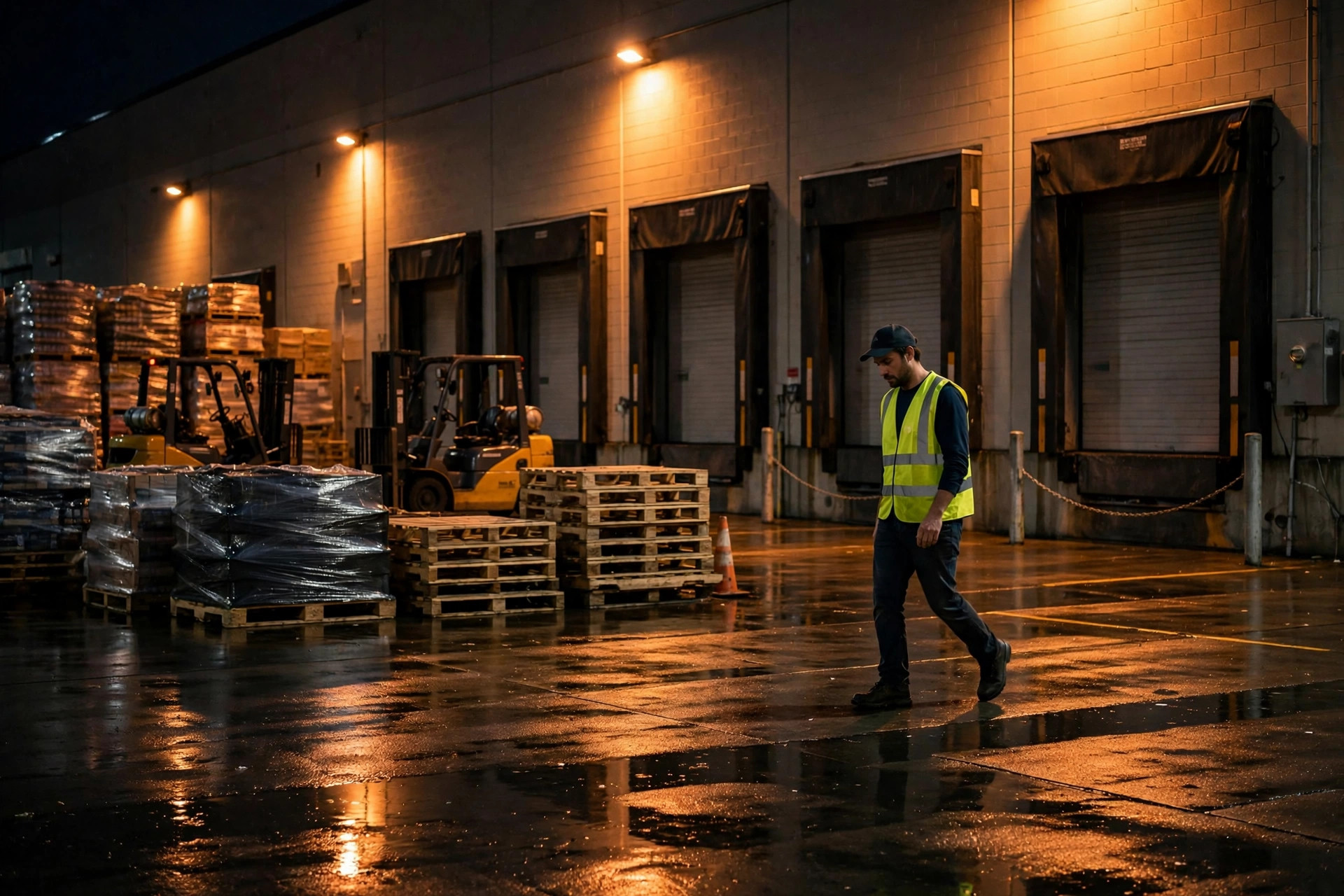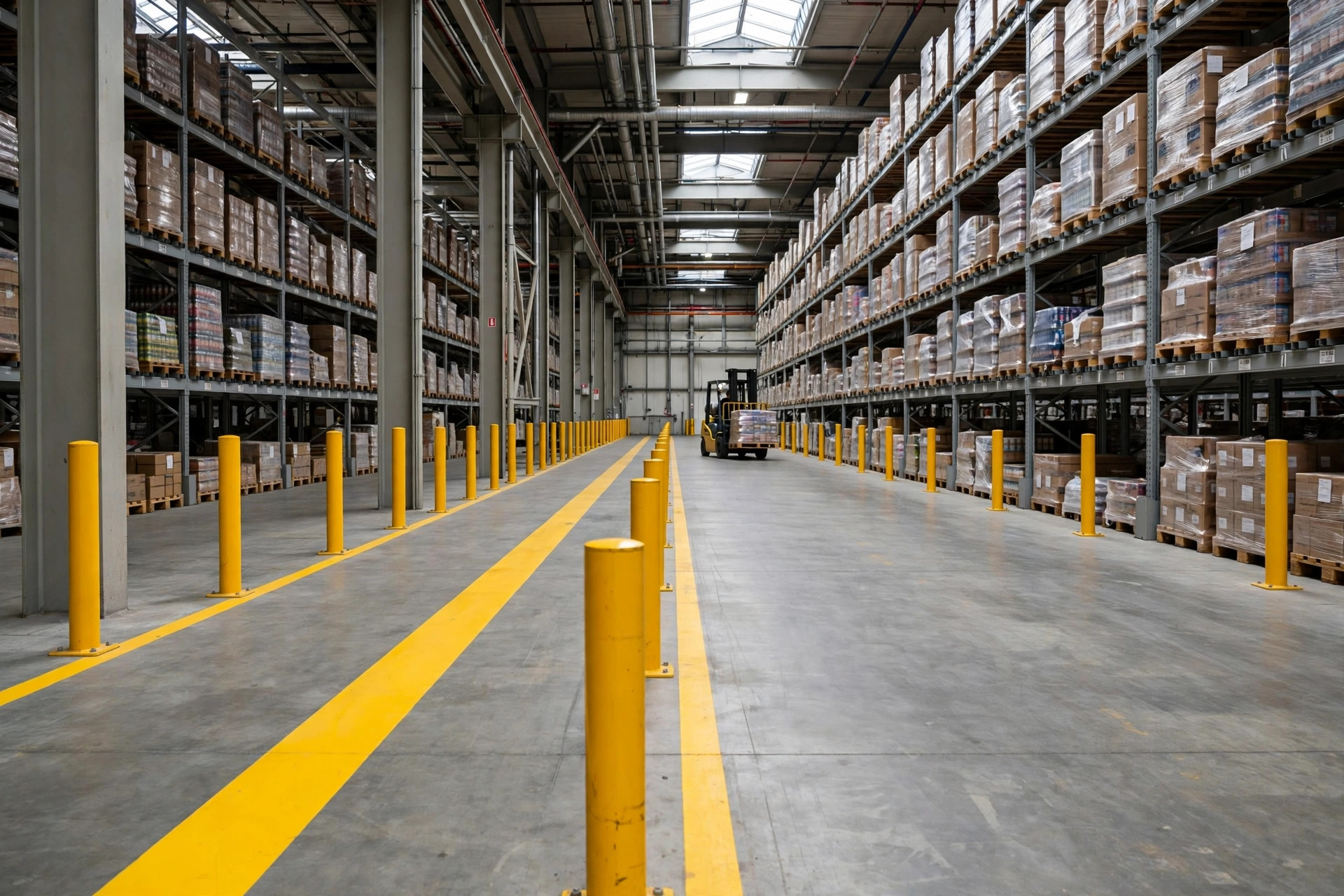
September 2023, Ontario, California. I was doing a quarterly safety walk at a 3PL client's warehouse — 180,000 square feet, forty-plus trucks a day through the shipping area. The operations manager was walking me past the intersection of dock 12 and the receiving zone when I told him to stop. A picker pushing a hand cart had just cut straight across the forklift lane, less than ten feet from a forklift backing up. The driver never saw him. The manager went pale. "We almost had an incident here last month," he said. I told him his problem wasn't training. It was the missing lines on the floor.
Three months later, an OSHA inspector stood at that exact intersection and wrote two serious citations. Combined fines: over $30,000. When the manager called me, the regret in his voice was unmistakable. "If I'd known those yellow lines were worth that much."
I tell this story a lot, because it kills a stubborn misconception: a lot of warehouse operators treat pedestrian walkways as a nice-to-have, something to get around to. OSHA treats them as a red line.
What the regulations actually say — know your red lines first
Here's the thing most people get wrong: OSHA never published a little booklet called "The Pedestrian Walkway Standard." But three pieces of regulation, read together, are the yardstick every inspector carries.
First, 29 CFR 1910.22. Aisles and passageways must be kept clear, in good repair, with no obstruction across or in aisles that could create a hazard. This is the most-cited one, and it's brutal in its simplicity. A pallet "temporarily" parked in a walkway for two days counts as an obstruction. The inspector doesn't have to prove it blocked anyone. A photograph is enough.
Second, 29 CFR 1910.178(m)(6): forklift drivers must slow down and sound the horn at cross aisles and other locations where vision is obstructed. Read it backwards and it's revealing — the regulation assumes intersections are dangerous by default. So when an inspector stands at your intersection, the first question is always: "Do your drivers sound the horn here?" If the answer is a shrug, or "they usually do," a citation is already taking shape.
Third, a cold fact most operators don't know: OSHA has never specified how wide a pedestrian walkway must be, and it has never set an in-warehouse forklift speed limit. The standard just says "safe enough." That's a double-edged sword. You say "our aisle is wide enough," the inspector says "I disagree," and he holds the pen. Wherever the regulation gives you no number, you need visible evidence to argue your case: striping, signage, physical separation.
The penalty math is worth stating upfront, because it frames everything else. Per OSHA's penalty schedule effective January 15, 2026, a serious violation runs up to $16,550 per item; willful or repeat violations go up to $165,514 per item. And walkway problems rarely come as a single citation — three blocked aisles means three items. That Ontario client paid over $30,000 for two serious violations. The fix — striping plus a handful of bollards — cost under $4,000. Any owner can do that arithmetic.
Striping that survives an inspection
What follows is the standard I install for clients. One disclaimer: this is field practice refined over twenty years of surviving inspections, not the text of the regulation. Cross-check it against OSHA's current published guidance before you implement.
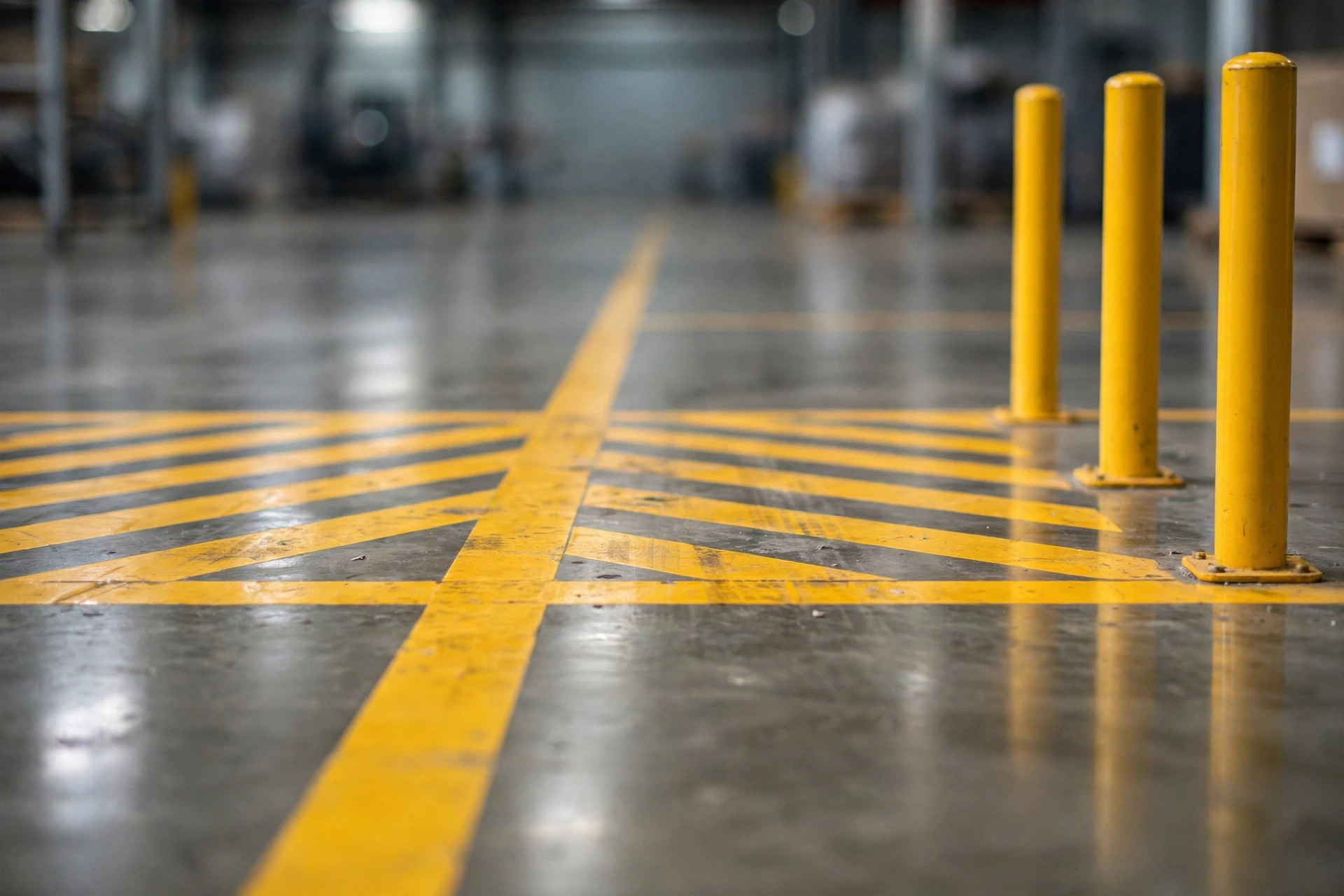
Mark pedestrian walkways with 4-inch solid yellow lines, and leave roughly 0.9 meters of clear width — enough for an adult pushing a hand cart to walk through without turning sideways. Paint it on the floor. Don't use tape. I've seen too many warehouses stripe with yellow floor tape; an inspector crouches down, peels up a corner with his finger, and writes down "markings not maintained." The regulation demands good repair. Tape doesn't survive a peak season under forklift tires.
Between the walkway and the forklift lane, put physical separation at every intersection and around the dock area: steel bollards or guardrail. There's one question inspectors love to ask, and I'd suggest every manager memorize it — "Can a pedestrian walk this entire walkway from end to end without ever stepping into the forklift lane?" If you can answer yes, your walkway passes. If you can't, the citation is practically pre-written.
Paint crosswalks at intersections and mount convex mirrors on both approaches. A good wide-angle mirror costs under a hundred dollars, and it answers the inspector's second favorite question: "At this blind intersection, how do pedestrians see the forklifts?" Mirrors, crosswalks, horns — get all three in place and the intersection is defended.
On cost, here's a straight number from recent jobs: contractors I've used charge roughly $2 to $5 per linear foot for floor striping, with floor prep and primer extra. For a 100,000-square-foot facility, a main pedestrian walkway system typically lands in the low thousands of dollars. Next to a single serious citation, that's pocket change. Use an epoxy-based durable paint with hardener, not cheap floor paint — forklifts will grind ordinary paint off in three months, and worn-off striping counts as no striping.
Where the citations really come from
Twenty years in, I've noticed that walkway citations almost never land on facilities that did nothing. They land on facilities that did something and then let it slip. The patterns repeat.
The lines are painted, but there's freight on them. This is the single most common citation scenario — not "no walkway," but "walkway blocked." Peak season hits, receiving overflows, and pallets end up staged in the pedestrian lane. The inspector doesn't even have to frame the shot. My rule for clients: anything sitting in a walkway gets cleared on the shift it appears. There is no "just for now."
Nobody sounds the horn at the intersection, and there's no mirror. The driver says "I honked." The inspector asks, "Where's the mirror? Where's the record?" A verbal habit proves nothing; hardware proves everything. Convex mirrors and stop markings at the intersection are your evidence.
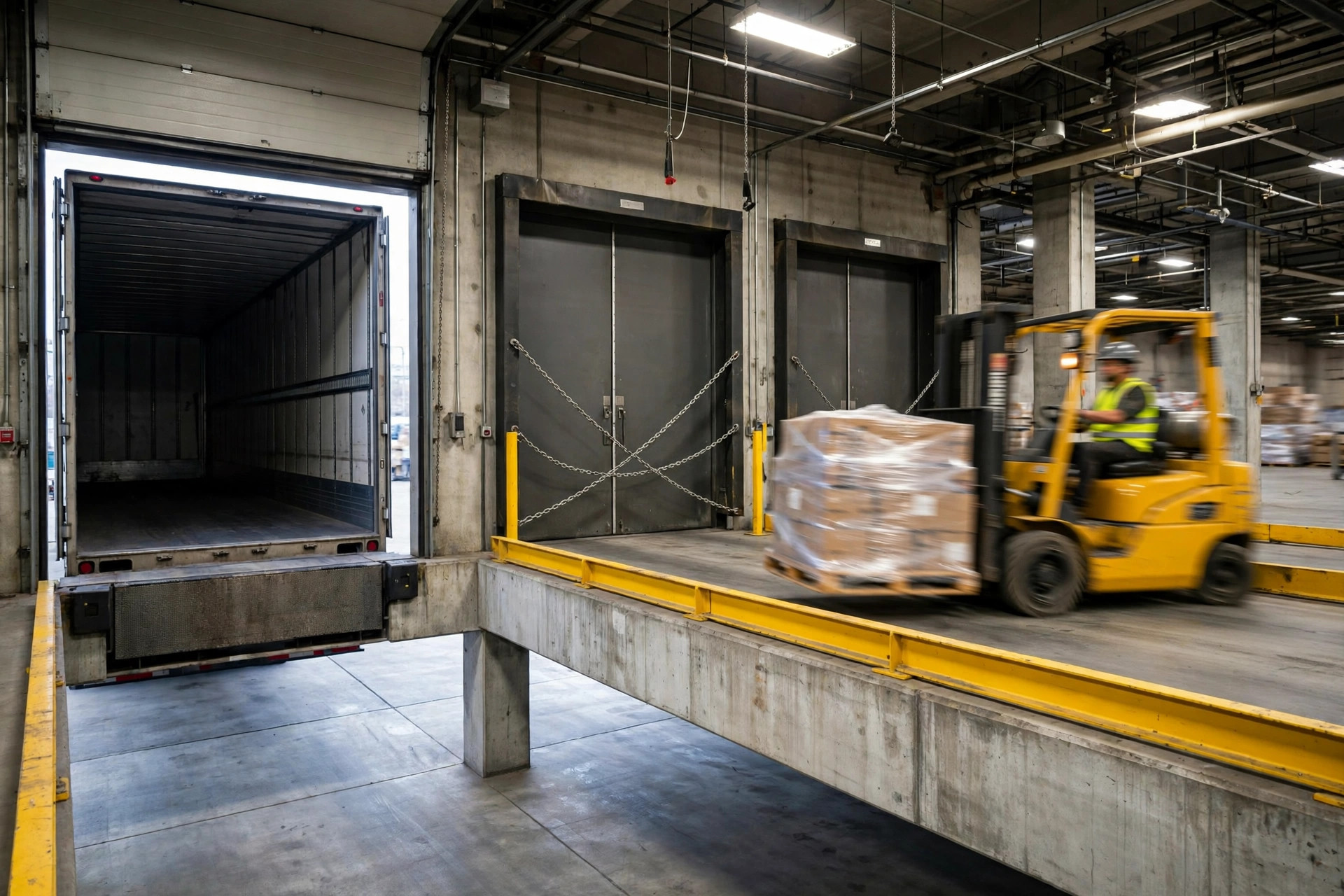
Pedestrians mixing with forklifts at the dock. A typical dock sits about 1.2 meters above the floor. People hug the dock edge while forklifts back up alongside them — when this goes wrong it goes very wrong, and inspectors are hypersensitive about docks. The fix is a dedicated pedestrian route on and off the dock, railed off from the forklift work zone. Never bet on a driver's mirrors.
Temporary walkways nobody maintains. The yellow lines you pulled for peak season wore off three months ago, which means they don't exist. The regulation demands continuous maintenance, not a good-looking opening day. Put walkway condition on the weekly safety inspection sheet, and repaint the same week it wears through.
The personnel door opens straight into a forklift lane. An employee pushes out of the break room and steps directly into traffic. That's a design defect, and the fix is cheap: a short run of guardrail funneling foot traffic into the marked walkway. Small money, big effect — and when an inspector sees a fix like that, his overall impression of your facility goes up, not down.
A 15-minute pre-shift walkthrough
This is the checklist I give clients. Print it, pin it on the office wall, and have the shift lead walk it before every shift. Fifteen minutes:
- Walk the full length of every pedestrian walkway. Is there any point where you're forced to step into the forklift lane? Flag it for same-day correction.
- At each intersection: is the crosswalk still visible? Are the convex mirrors angled correctly? Stand there for five minutes — do forklifts sound the horn as they pass?
- Is anything — pallets, empties, trash bins — "temporarily" sitting in the walkway? Clear it on the spot.
- At the dock: is the pedestrian route on and off the dock separated from forklift traffic?
- Any bollards bent or knocked over? Straighten the bent ones, replace the fallen ones.
- Take six photos and file them: walkway overview, each intersection, the dock area. This is your strongest evidence in an inspection — "we maintain this continuously" only counts if you can show it.
Tomorrow morning before the shift starts, walk your pedestrian walkway yourself. Every step that forces you into the forklift lane is where a citation grows — clear the freight from that stretch first, and everything else can wait.