
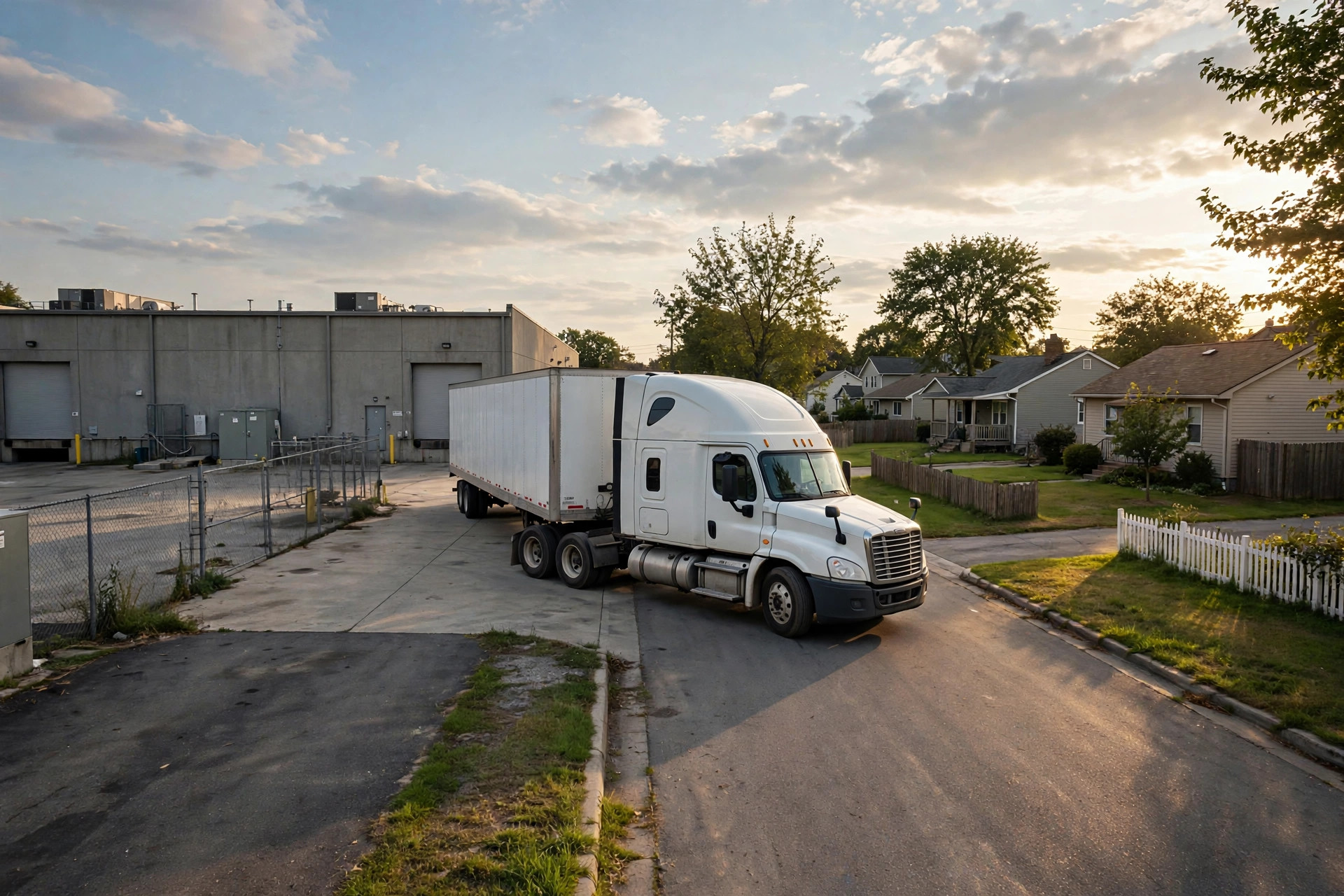
Here is my verdict up front: your relationship with your warehouse's neighbors is not a PR problem. It is an operating permit problem. In the US, these fights have a name — warehouse neighbor complaints — and the trigger is almost always truck noise: one backup beeper at 2 a.m. can send your expansion plan straight into a public hearing. Put bluntly, your neighbors hold more power over your business than you think. They just need to stand up at a council meeting and say, "My kid can't sleep at night," and your project gets delayed by months, loaded with conditions, or killed outright.
I have seen too many operators walk into this trap. Their shared mistake is not that they are unreasonable. It is that they did the math wrong. They budgeted for rent, labor, equipment — everything except "the street next door." On day one, nobody treats truck routes, nighttime receiving cutoffs, or yard light angles as serious decisions. By the time complaint letters stack up at city hall, fixing it costs ten times what prevention would have.
This thing cuts both ways. Your business genuinely needs to run at night: customer cutoffs, carrier pickup windows, peak-season waves. But the people next door have a right to a normal life, and being jolted awake at 2 a.m. by a reversing truck would make anyone furious. Neither side is wrong. The mistake is on the warehouse's side, for never treating "don't wake the neighbors" as a real operating metric.
How a Warehouse Neighbor Complaint Escalates
Complaints rarely start at a public hearing. They climb a ladder, and at every rung you get a chance to stop them.
Rung one is a private gripe. A neighbor talks to your guard or knocks on your door. An apology and one adjustment usually end it. This is exactly where most warehouses blow it — the guard says "I don't know," the manager is never there.
Rung two is a formal complaint to the city. Once it enters the system, it is on record. Code enforcement shows up and starts building a paper trail.
Rung three is conditions. The city adds constraints: no receiving at night, no trucks on certain streets, lights angled down, idling capped — and once written into your permit, they are hard constraints. Break one and you get a warning; keep going and you get a revocation hearing. Worse, these conditions tend to surface when you apply for something good — an expansion, a renewal — and the city settles old accounts.
Rung four is the hearing and the zoning vote. Your opponent is now an organized community with photos, videos, and complaint logs. You hire lawyers and commission studies, but council members answer to voters, not to your throughput.
In Columbus, Ohio, a warehouse and business rezoning drew neighbor opposition over noise, traffic, safety, and air pollution. The council approved it 5 to 4 — only after the developer agreed to add fencing and trees to the 2.3-acre site. In South Fulton, Georgia, a rezoning for roughly 1.5 million square feet of warehouse space across three buildings was denied outright after sustained community opposition. And in Mesquite, Texas, the council voted 6 to 1 to deny a rezoning for a contractor shop after neighbors objected to noise and truck access. Once you reach a vote, your warehouse is not "local jobs" in a council member's eyes. It is "voters' problem."
Truck Noise Is Only the Loudest of Five Problems
When people hear "neighbor complaints," they think noise. Fair enough — but you will miss the other four:
| Source | What neighbors experience | How to manage it | Cost of ignoring it |
|---|---|---|---|
| Backup beepers | Piercing beeps through the wall at 2 a.m. | Broadband alarms, less reversing, loop routes | Most-cited item in complaints |
| Diesel idling | Roar plus exhaust; windows stay shut | Cap idling, driver waiting area, engines off in queue | Explicit idling limits in many states; officers can cite on the spot |
| Nighttime truck traffic | Heavy trucks waking the whole block | Receiving windows, arterial routes, staggered waves | Easiest to capture on video — most damaging evidence at a hearing |
| Yard lighting | Floodlights in bedroom windows, all night | Aim fixtures down, shields, dim non-work areas | Some permits directly cap light color temperature and angle |
| Dust and traffic | Damaged roads, dust, school-hour gridlock | Water surfaces, speed limits, avoid school hours | Spills into road safety — fastest way to ignite a community |
Start with the backup beeper, the most counterintuitive one. The first instinct is "just disconnect it." Don't. Safety rules require that vehicles with an obstructed rear view have a backup alarm audible above the surrounding noise, or a ground observer signaling that it is safe. Disconnect it and you trade a neighbor complaint for a safety violation. The real fix is a broadband alarm — the "shushing" white-noise kind. It doesn't carry as far, but it is easier to locate by direction, and facilities that have retrofitted report neighbor noise complaints dropping to zero. That is how you handle a trade-off: safety stays non-negotiable, but the way you deliver it changes.
Then idling. California's Air Resources Board limits diesel truck and bus idling to 5 minutes, including within 100 feet of restricted areas such as schools, homes, and hospitals. Plenty of drivers still pull in and idle for half an hour — engine roaring, exhaust drifting into neighbors' yards. The fix is simple: hand every driver a card at the gate stating the 5-minute limit, engines off in queue, and where the waiting area is.
Lighting is the one everyone underestimates. Yard lights are tall and powerful, and one tilted fixture can blast straight into a bedroom across the street. Some permit conditions cap lighting color temperature — one conditional use permit in the public record capped it at 3,000 Kelvin, with compliance review and possible revocation. The fix is cheap: aim fixtures down, add shields, dim non-work areas. The hard part is standing in front of your neighbor's house at 10 p.m. and seeing where your light actually lands.
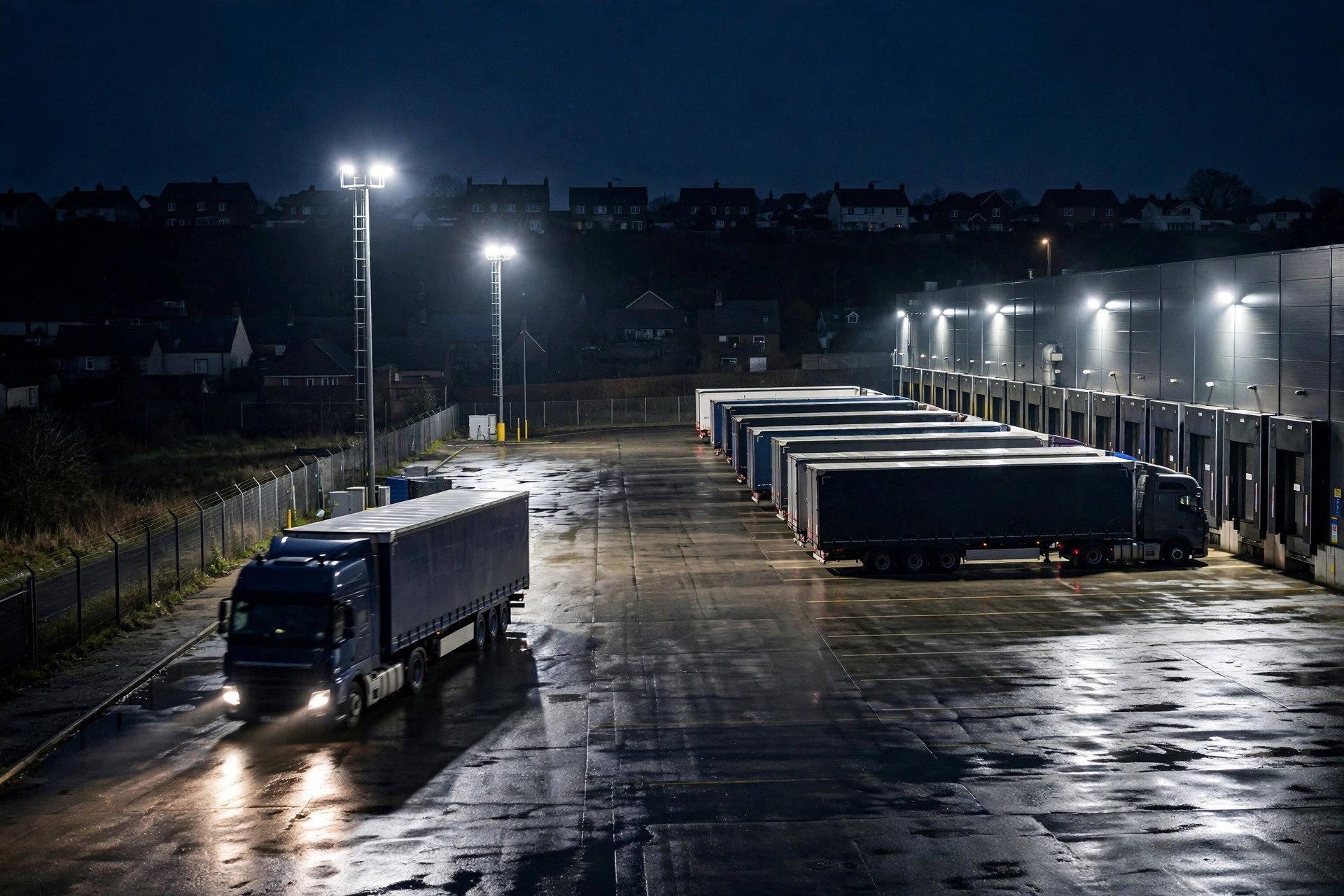
Traffic is about the route, not the volume. The same 40 trucks a day look completely different depending on whether they use the arterial road or cut through residential side streets. Some cities ban deliveries near homes at night — Santa Monica bars businesses within 100 feet of residentially zoned property from taking deliveries between 11 p.m. and 6 a.m. Check your own city's rules with the planning department. Once your route is set, write it into the appointment confirmation. Drivers follow their GPS, and GPS doesn't care who lives next door.
Seven Things to Fix Before the City Gets Involved
None of these seven requires serious money. The hard part is doing them.
First, go stand outside your neighbors' houses for a night. Pick your busiest night, stand near the closest homes between 10 p.m. and midnight, and listen. How far does your beeper carry? Where does your light fall?
Second, set receiving windows. Night receiving should be concentrated and predictable. Bunch overnight arrivals into a defined block.
Third, draw one truck route. In and out via arterials only, written into appointment confirmations. Post the map in the guard shack.
Fourth, switch to broadband backup alarms. Every forklift, yard jockey, and spotter truck that moves at night gets one.
Fifth, set an idling rule. Five minutes is California's line; your warehouse can set a stricter one. Signs in the queue area, a card at the gate. And check the current rules wherever you operate — idling limits vary.
Sixth, fix the lights. Aim every fixture down, add shields, dim non-work areas. Then go stand outside your neighbor's house again and confirm.
Seventh, talk to the community first. Before you open, expand, or change operating hours, show up at the community meeting and explain what you plan to do and how you plan to manage it. What neighbors hate most is often not the noise itself — it is that you never told them. Keep a public complaint line, answer every complaint within 24 hours, and keep your own complaint log. When the city comes asking, that log is your proof.
One last piece of advice. When people pick a warehouse site, they look at rent, highway access, labor. Nobody walks the next street over to see who lives there, where the school is, or how quiet the night is. By the time the complaints arrive, you realize you didn't buy a warehouse — you bought a long-running lawsuit with the whole street. When was the last time you talked to the people living one block from your dock? If you can't remember, start tonight.
By Lao Mi, Supply Chain Veteran (20 yrs)


