Let me start with the bill, because the bill is the whole argument. Take a warehouse shipping 20,000 orders a month with a mis-pick rate of 0.3%. That is 60 wrong orders a month. A good share of those come from one dumb cause: somebody copied a location code wrong. Location A-03-12 and location A-03-21 look like twins. A scanner reads one digit wrong, or a picker types 12 as 21, and the wrong product goes in the box. That is what the warehouse location barcode check digit is for — one extra digit at the end of the location code, calculated from all the digits before it, whose only job is to prove the code was copied correctly.
What does one mis-pick actually cost? Here is the breakdown. These are illustrative figures, based on typical costs at an ordinary 3PL warehouse — swap in your own numbers and the structure stays the same.
| Cost item | Illustrative cost per order | What it covers |
|---|---|---|
| Return shipping | $2.50 | Getting the wrong item back |
| Re-pick and repack | $1.80 | Labor plus packaging materials |
| Customer service time | $1.20 | Calls, tickets, calming the customer down |
| Refunds and lost repeat business | $6.00 | The hardest to measure and the most expensive |
| Total | $11.50 | 60 orders a month = $690 a month, over $8,000 a year |
Over $8,000 a year, spent on mistakes that never had to happen. And not one dollar of it fixes the problem. Every cent goes to cleaning up after it.
Same mistake, with and without that final digit — the outcome is completely different.
| Without that final digit | With that final digit | |
|---|---|---|
| Caught when | The customer receives the wrong item | At the scan, on the spot |
| Where the error goes | Already shipped, cannot be pulled back | Still on the shelf, never leaves |
| Cleanup cost | Return, reship, and refund, the full set | One rescan |
| Who pays | The warehouse | Nobody — a few seconds of time |
What a Check Digit Actually Catches
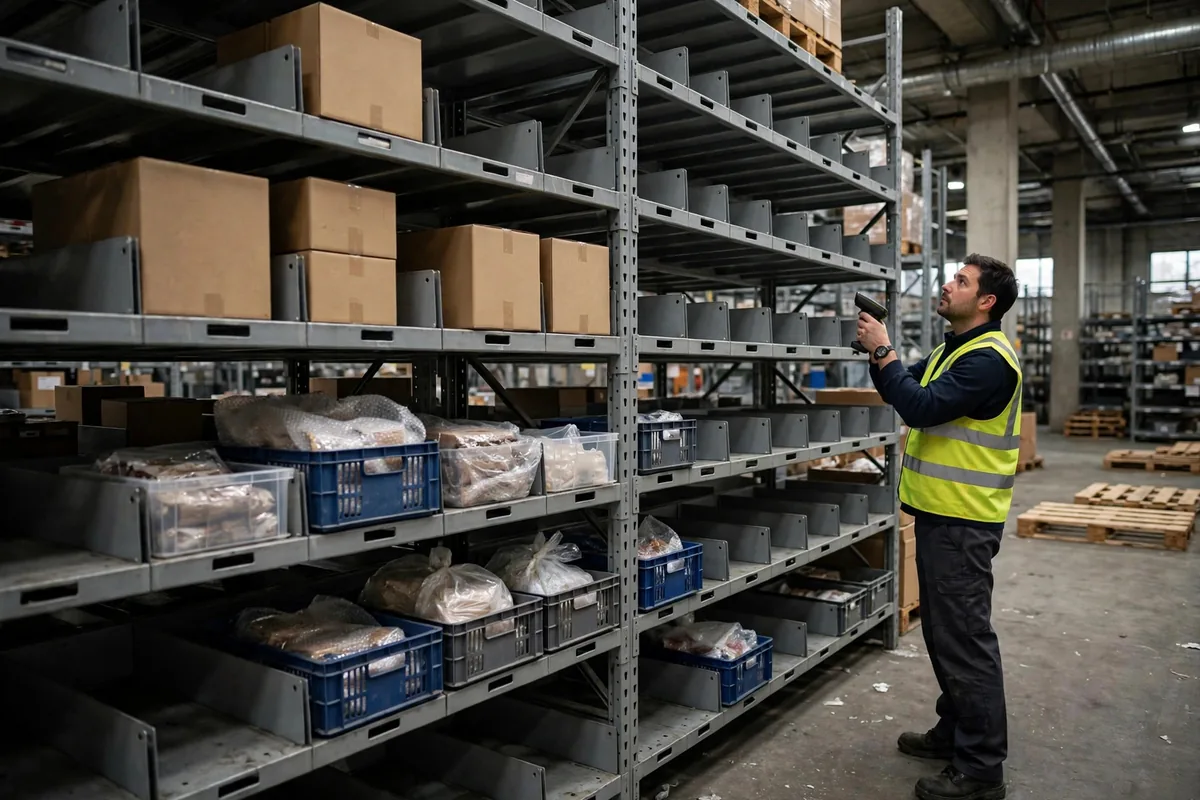
Two years ago I visited a 3PL warehouse in Ontario, about 80,000 square feet. Eleven mis-picks in two months, and the complaints were piling up on the operations manager's desk. When we dug in, seven of the eleven traced back to location codes: the pickers were scanning correctly, but the labels themselves were wrong. When the location labels were first printed, A-04-17 came out as A-04-71, and the system stored the wrong code too. No scanner can save you from that.
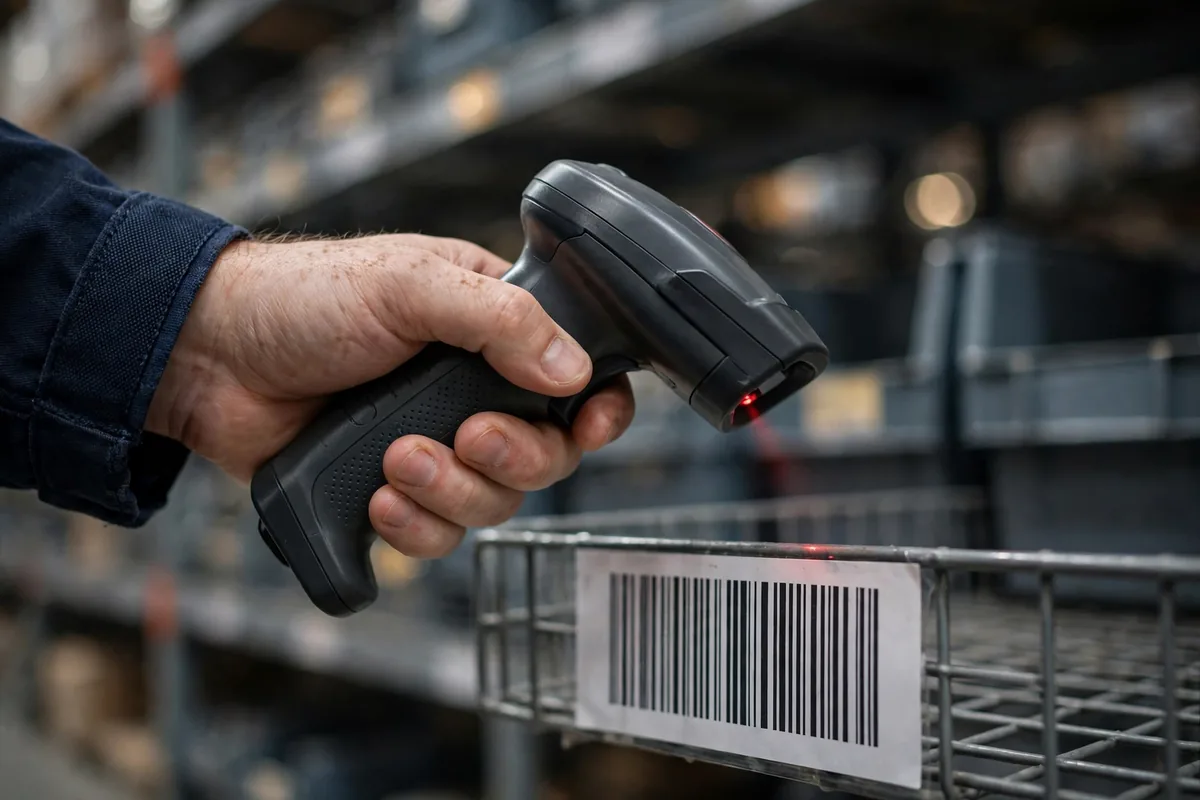
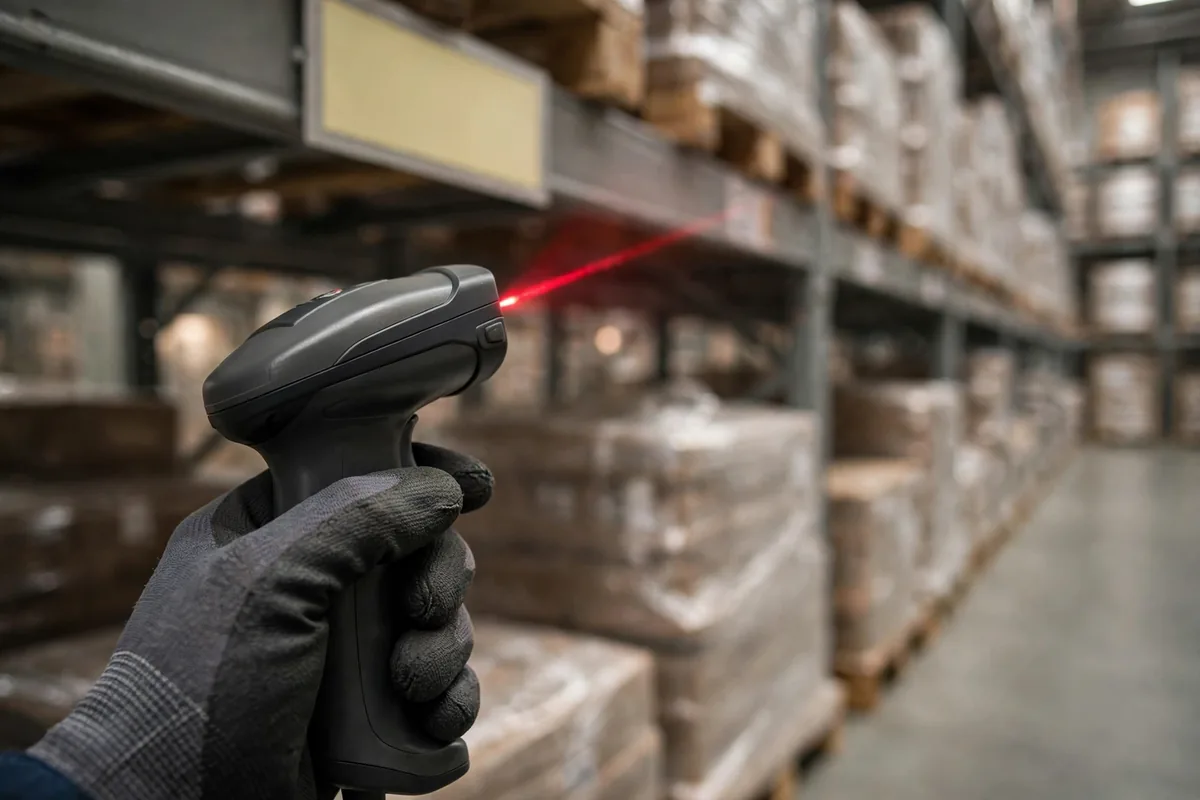
They fixed it by adding a final digit to every location code. The rule is simple: the last digit is not chosen freely. It is computed from all the digits before it by a fixed algorithm. At scan time the system verifies that digit first. If it does not match, the scan is rejected on the spot and the picker cannot move on.
What that final digit catches is copying errors, not scanning errors. It catches practically every single-digit typo and most swaps of two neighboring digits — that is the published claim for the GS1 Mod 10 method, and it is the reason the digit earns its keep. A picker can be fast and sloppy; as long as the code was copied wrong by one digit, the computed digit will not match, and the system stops the pick cold. One digit buys you a checkpoint.
But let me be straight about what it does not catch: a label stuck on the wrong rack. If the A-04-17 label was physically pasted onto the A-04-71 shelf, that final digit still verifies fine, because the code itself is correct — only the physical placement is wrong. The digit polices the numbers, not the shelves. Keep those two problems in separate columns, and do not expect one digit to solve both.
The second scenario is even more common: the night-shift picker keying in locations from memory. In the daytime the scanners are in hand and errors are rare. At night, when guns are short or batteries are rotating through the charger, somebody starts typing codes straight into the terminal. Without that verifying digit, a mistyped code is accepted as given, the wrong item gets picked, and it only surfaces at the check station — and when the check station is slammed, it slips through and ships. If the hand-keying gap stays open, daytime scanning accuracy does not matter.
Two Algorithms, One Sentence Each
Location codes in warehouses generally use one of two methods for computing that final digit. Both are simple once you see the idea.
The GS1 Mod 10 method works by weighted addition. Counting left from the final digit, the preceding digits are weighted 3, 1, 3, 1 in turn, added up, and that final digit is whatever brings the total up to the next multiple of ten. This is the method behind every product barcode you have ever scanned, and it is verified by GS1's own published worked examples — a twelve-digit body with a weighted sum of 89 takes a final digit of 1, because 89 plus 1 is 90.
The Code 39 Mod 43 method works by table lookup and remainder. Every Code 39 character carries a fixed value from 0 to 42. Add up the values of all the characters in the code, divide by 43, and the remainder points to the check character. The published worked example: the characters in CODE39 add up to 75, 75 divided by 43 leaves a remainder of 32, and the character with value 32 is W. Code 39 handles letters, which fits location codes that carry letters, such as zone A or zone B.
Which one to use? My rule is blunt: all-numeric codes take Mod 10, codes with letters take Mod 43. Do not invent your own algorithm. The advantage of a standard method is that scanners and warehouse systems already support it, so compatibility costs you nothing.
Retrofitting Check Digits onto Old Locations
The usual objection is: we already have thousands of locations. Does adding a final digit mean shutting down to relabel everything? No. There is a workmanlike way through the transition.
Start by computing that final digit for every location in the system and generating the new codes — but do not reprint labels yet. Then run old and new codes in parallel for a while: the system accepts both, and quietly logs which locations are still being scanned with the old code. Then reprint labels starting with the highest-error zone — usually the aisles where similar codes cluster, the rows where codes differ by a single digit. As each batch of labels goes up, the old code for those locations is retired. Once scans of old codes have been at zero for two straight weeks, switch the system to new codes only.
You can also pilot it on the 200 highest-error locations first and watch the numbers for two weeks: did mis-picks from those locations drop to zero, and did pickers lose any time to the extra digit? If the pilot numbers look good, roll it out across the warehouse. If they do not, stop and find out why — you have only lost 200 labels.
How long does the transition take to pay for itself? Take an illustrative example: a 5,000-location warehouse, relabeling plus labor at $1,100 in total. From the table above, 60 mis-picks a month at $11.50 each is $690 a month. If adding that final digit cuts miscopy mis-picks by half, you save $345 a month, and the payback lands a little over three months. After that, every month's saving is pure gain. Swap in your own numbers, but the formula stays the same: payback equals the one-time cost divided by the monthly mis-pick cost avoided.
That brings the whole argument to a number you can calculate: pull your mis-pick records for the last three months, count how many came from miscopied locations, and multiply by your real cost per mis-pick. That is your annual saving. If it is bigger than the cost of reprinting labels, start computing warehouse location barcode check digits next week. That final digit costs nothing. Mis-picks are what cost money.
By Lao Zhou, Logistics Cost Analyst