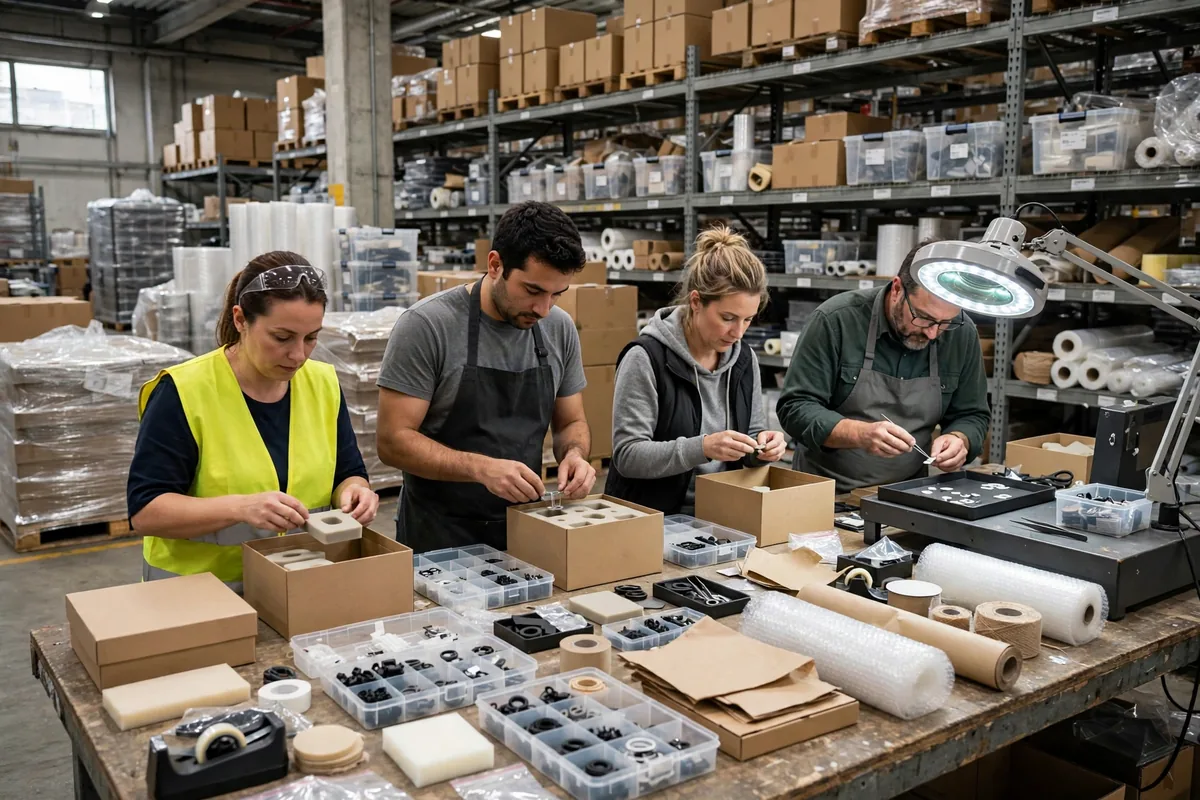
We had a client, a home goods brand, come to me last spring with a familiar opening line: it is just putting three things into one box, how expensive can it be? I smiled and said nothing. After a hundred-plus warehouse contracts, I have learned that warehouse kitting and postponement lives or dies on exactly that misunderstanding. Kitting means pre-assembling components into a ready set. Postponement means holding the final step — labeling, configuration, channel-specific packing — until the order or the channel is actually known. Clients see box stuffing. A 3PL sees labor, rework, version control, and a peak-season fight for the same people who pick the main warehouse orders.
A story, with the numbers softened but the shape true. Before the 2023 peak, a beauty brand handed us its holiday gift sets with a clean, approved bill of materials. On day three of production the brand swapped the free gift. On day five a retail channel demanded its own insert card, and the instruction leaflet turned out to exist in two versions. We reworked two rounds that week, retrained temp labor, and lost half a day of line time waiting for corrected materials. If the contract had no change clause, we would have eaten all of it. Eating a change once is goodwill. Eating changes for a whole season is subsidizing a client's planning with your margin. That is why my kitting conversations now start with the uncomfortable clauses, not the price.
Three ways kitting gets priced, and where each one bites
Per-piece pricing is what clients ask for first: one set, one price, clean and simple. It works only when the work content is frozen — how many components, whether boxes are folded, labeled, scanned, weighed, or photographed. The classic trap is scope creep in slow motion. The quote covers a plain set; execution quietly adds scan verification, photo proof, and channel labels, until the team is building the deluxe version at the basic price. My fix is to attach the unit price to a written work-content list. Anything off that list is either priced separately or repriced. On paper, in advance.
Per-hour pricing fits projects where even the client does not yet know what the set looks like, typically a first launch. Force a per-piece quote there and one side will lose money; it is only a question of who. The trap on hourly work is the productivity argument, because the client watches your crew and decides they are slow. The cure is a paid pilot run: produce one batch together, time it together, sign the agreed pace together, and settle against that pace afterward. Skip the pilot and you have bought yourself a season of arguments.
Project pricing suits one-off builds — holiday boxes, channel-exclusive bundles, a fixed scope for a fixed fee. Its trap is expansion: one batch becomes two, one channel becomes three, and the deadline moves forward anyway. A project quote must state the number of batches, channels, and delivery waves it includes, plus the unit basis for anything beyond that. Detailed contracts are not unfriendly. In peak season, the detailed contract is the only friendly thing left.
| Pricing model | Best fit | Classic trap | What to pin down |
|---|---|---|---|
| Per piece | Stable, repeatable sets | Silent add-on tasks | Work-content list and add-on rates |
| Per hour | Launches and unsettled designs | Disputed labor productivity | Pilot-run pace, jointly signed |
| Per project | One-off gift and channel builds | Extra batches and channels | Scope limits and overage pricing |
Postponement is the service clients undervalue most, and it is the half of warehouse kitting and postponement most often left out of the first quote. Its real worth is inventory: the shipper keeps generic semi-finished stock with us and commits to channel labels and final configuration only when demand is real. That saves their inventory money by consuming our flexible capacity, so the price must carry a response-time promise — how fast after order release, what rush work costs, and who owns label-version accuracy. A postponement deal negotiated on unit price alone ends, reliably, in midnight phone calls.
When the client changes the BOM mid-run
A bill of materials is our construction drawing. Changing it mid-production is changing the blueprint after the walls are up. My worst case came in 2024, when an electronics accessories client swapped a cable in the set two days before shipment because purchasing had changed suppliers. The new cable did not fit the tray, the leaflet model numbers no longer matched, and finished sets had to be opened and rebuilt. We absorbed it for the relationship. Then I rewrote our change clauses, and they have been detailed ever since.
A workable change clause has four parts. First, a freeze window: the BOM locks a set number of hours before production, and changes after the freeze are billed as rework, with the exact window set in your contract. Second, rework economics: how teardown, rebuilding, and scrapped packaging are charged, agreed as a formula before anyone is staring at a pile of opened boxes. Third, material responsibility: if client-supplied materials arrive late or in the wrong version and the line stands idle, waiting time has a price, even a modest one, because the crew's wages are real. Fourth, written confirmation: every change travels by email or system ticket, never by phone call alone. That clause has saved us more than once, usually when a client's new coordinator declines to honor a predecessor's verbal promise.
Fairness to shippers: change clauses are not a revenue scheme. Your plans will change; we know that. But booked labor, printed packaging, and half-built sets are real money. Writing change costs into the contract also protects you, because it forces your own organization to pause before casually revising a set mid-run.
Peak season: the real enemy is fighting your own warehouse for people
Here is the seasonal knot in warehouse kitting and postponement: demand for gift sets and channel builds peaks in exactly the weeks when the main warehouse is drowning in outbound orders. Both sides want the same workers and the same floor space. If the loudest voice wins, management has already lost.
Our answer is capacity reservation, done early. Two months before peak we sit with each major kitting client and map expected sets against delivery weeks, asking what can be pre-built. Whatever can move earlier becomes semi-finished stock in the quiet weeks, leaving only final assembly and labeling for peak — postponement quietly rescuing kitting capacity. The contract then states the reserved volume we guarantee and the honest basis for extra volume: we will try, priced and promised against real capacity, not hope. Clients used to find this bureaucratic. One peak season of industry-wide labor shortage converted all of them.
Space and training get the same treatment. The kitting area's peak footprint is drawn on the floor plan in advance, never negotiated when cartons are already blocking an aisle. Temp workers start on simple builds before peak, because a new hire's first-day defect rate on detailed sets is nobody's friend. None of this is glamorous, and every peak-season failure I have audited failed on exactly these basics.
So, shippers, three questions for your next negotiation. Ask whether the quote can be priced line by line against a work-content list, because the cheapest total usually forgot verification and rework. Ask how peak capacity is reserved and what happens to overage, because a 3PL that will write it down has actually planned it. And ask how pilots and BOM changes are handled, because a team with a clear process will not be learning its craft on your inventory. Kitting and postponement buy you certainty, not box stuffing — and the partner who can price the uncertainty out loud is the one worth signing.
By Susan, 3PL Sales Director