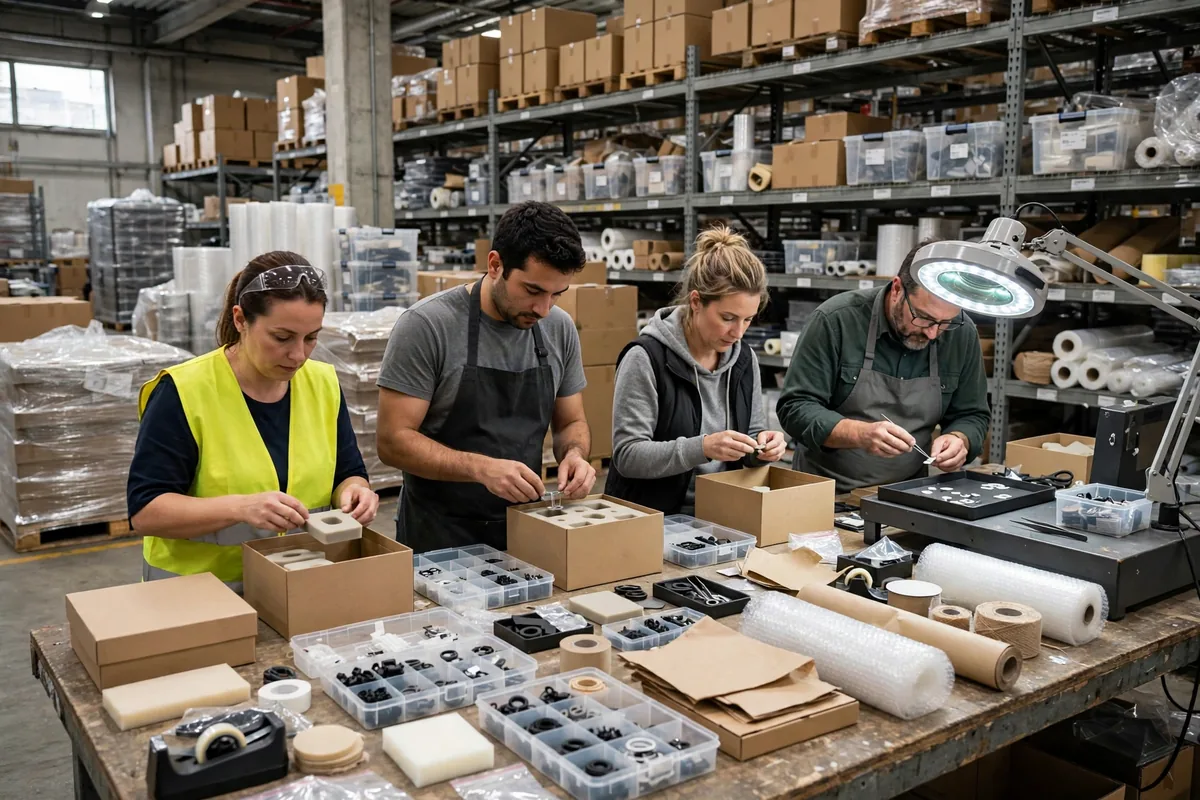
We had a client in home goods who came to us holding a competitor's quote, pointed at the labeling line, and asked why ours cost more. I smiled, because I had seen that quote format before: the cheap labeling price said nothing about relabeling, cover-labeling, or rework. He signed with them anyway. Three months later he was back at my table saying, Susan, save me, every invoice lands higher than the quote and my finance team has stopped approving them. That is the whole lesson of 3pl value added services warehouse pricing in one story: the standard charges are fairly transparent, but the extras are where invoices quietly double.
Storage, picking, and outbound handling get compared line by line in every negotiation, so nobody can stray far from the market there. Kitting, labeling and relabeling, quality inspection, returns grading, gift wrapping, and display building are different. They look like small favors next to the big warehousing numbers, most clients skim that page of the contract, and then peak season arrives and the value-added section of the invoice is suddenly the fastest-growing number in the building. Everything below uses an illustrative example wherever money appears. None of it is a market rate or any company's actual price list; real pricing is whatever is written in your signed rate card.
How 3PL value added services are actually priced: three models, three traps
Inside any 3PL sales office, value-added work is quoted in one of three ways, and each way has a job it suits and a place where cost can hide.
| Pricing model (illustrative example) | Best suited for | What the client must pin down |
|---|---|---|
| Per unit | Labeling, relabeling, simple kitting, gift wrapping: standard motions, stable volume | The definition of one unit: does it include picking the components, is a cover-label one unit or two, how is rework charged |
| Per hour | Inspection, returns grading, display building: non-standard work, variable handling time | Headcount cap, when the clock starts and stops, and a productivity baseline, so hours cannot quietly stretch |
| Per project | One-off relabeling clearances, seasonal kit builds, display programs | Acceptance standard, what counts as finished, and the unit price for volume beyond the agreed scope |
Then come the two charges clients forget to ask about. The first is the setup fee: training workers, writing the work instruction, preparing packaging and a workstation for a new program is real work, and a one-time charge for it is legitimate. What you must ask is whether it is truly one-time, or whether every new product family triggers it again. The second is the monthly minimum. A warehouse holding trained staff for your program through a quiet month will often set a floor, and that is not unreasonable either. What is unreasonable is a salesperson who never mentions it until your slowest month produces a surprise invoice. Both items are fair when they are on the table before signing and indefensible when they surface afterward.
Inspection deserves its own warning. Sampling ratio, full inspection versus sampling, and whose standard decides pass or fail must be written down as a signed attachment, with defect grades and re-inspection rules spelled out. Clients who wave a hand and say use your judgment have, in my experience, pre-booked an argument about who pays when a full batch bounces back for re-checking.
Here is an illustrative example of how the trap springs. Imagine a beauty brand building a holiday gift set: three products and a card into a gift box, finished with a seasonal label. One quote prices the kitting per unit and looks cheaper. Another prices it per hour and looks dearer. The per-unit quote wins, and the peak invoice still comes in far higher, because component picking was billed separately as regular picking, damaged boxes that had to be rebuilt were charged again as full new units, and an expediting fee nobody had discussed appeared at the top. The client was not cheated on the unit price. The client bought a unit price with no boundaries around it.
Warehouse pricing at peak: your kitting crew is also the picking crew
Clients ask me every year why value-added work gets slower and more expensive exactly when they need it most. Here is the honest insider answer: your kitting crew and the picking crew are the same people. In a normal month there are hands to spare, and labeling and kitting flow nicely. When orders spike, the floor supervisor's first move is always to pull value-added staff into picking and packing, because a late shipment hurts immediately, while your gift sets can slip two days without anyone screaming. Your project goes to the back of the queue, and buying your way forward is what an expediting fee really is: a payment for scarce peak labor.
That produces the most counter-intuitive rule in this business. At peak, the most expensive arrangement is rarely the one with the highest quoted rate. It is the one with no capacity locked in the contract. Run the illustrative example: a program kits ten thousand sets in a normal month and thirty thousand at peak. With a peak capacity guarantee and an agreed expediting formula in the contract, the extra cost is predictable. With nothing written down, you negotiate at peak with your inventory already sitting in their building, and moving warehouses mid-season costs more than any surcharge. That is why I tell every client that the heart of 3pl value added services warehouse pricing is not the off-peak unit rate. It is three peak clauses: how much capacity is guaranteed, how expediting is calculated, and who gets scheduled first.
One more inside story, since we are being honest. Rework loops billed twice are a real habit in the less disciplined corners of this industry. If the warehouse mislabels your goods, tearing off and reapplying labels is their cost, full stop. But sloppy operators fold their own rework back into normal billable volume, where it is nearly invisible on an invoice. The defense costs you one sentence in the contract: rework, relabeling, and re-inspection caused by provider error are free of charge, and rework volume appears as its own line on every invoice. That single line ends most of the argument before it starts.
What to lock into the contract before you sign
None of this means value-added services are a scam, or that every 3PL is hunting your wallet. These services are genuinely non-standard, which is precisely why handshake understandings do not survive a peak season. My advice to buyers is always the same four locks. First, attach the complete value-added rate card to the contract, and require a written change order for any new charge; verbal promises do not exist. Second, define the metering for every service: what one unit includes, step by step, and exactly how rework is treated. Third, turn inspection sampling standards into a signed attachment instead of a conversation. Fourth, write peak capacity, expediting rules, and any monthly minimum into the contract, and require invoices broken out by service line, with rework shown separately.
Do those four things and you will notice something useful. A well-run warehouse will not resist any of it, because that is how its own costing already works. The operator who keeps urging you to sign now and settle details later is telling you something, and you should listen. Those of us who sell warehousing for a living make our money on renewals, not on one invoice full of surprises, even if saying so annoys a few of my competitors.
So, next time you negotiate a contract, remember to ask these three questions. One: what exactly does one unit of this service include, step by step, and who pays for rework? Two: how much of my peak capacity is guaranteed, and by what formula is expediting charged? Three: will the invoice show every value-added service and all rework as separate lines? Ask those three, and judge the provider by how quickly and precisely they answer. Speed and precision, in 3pl value added services warehouse pricing, are the sound of a warehouse that has nothing to hide.
By Susan, 3PL Sales Director