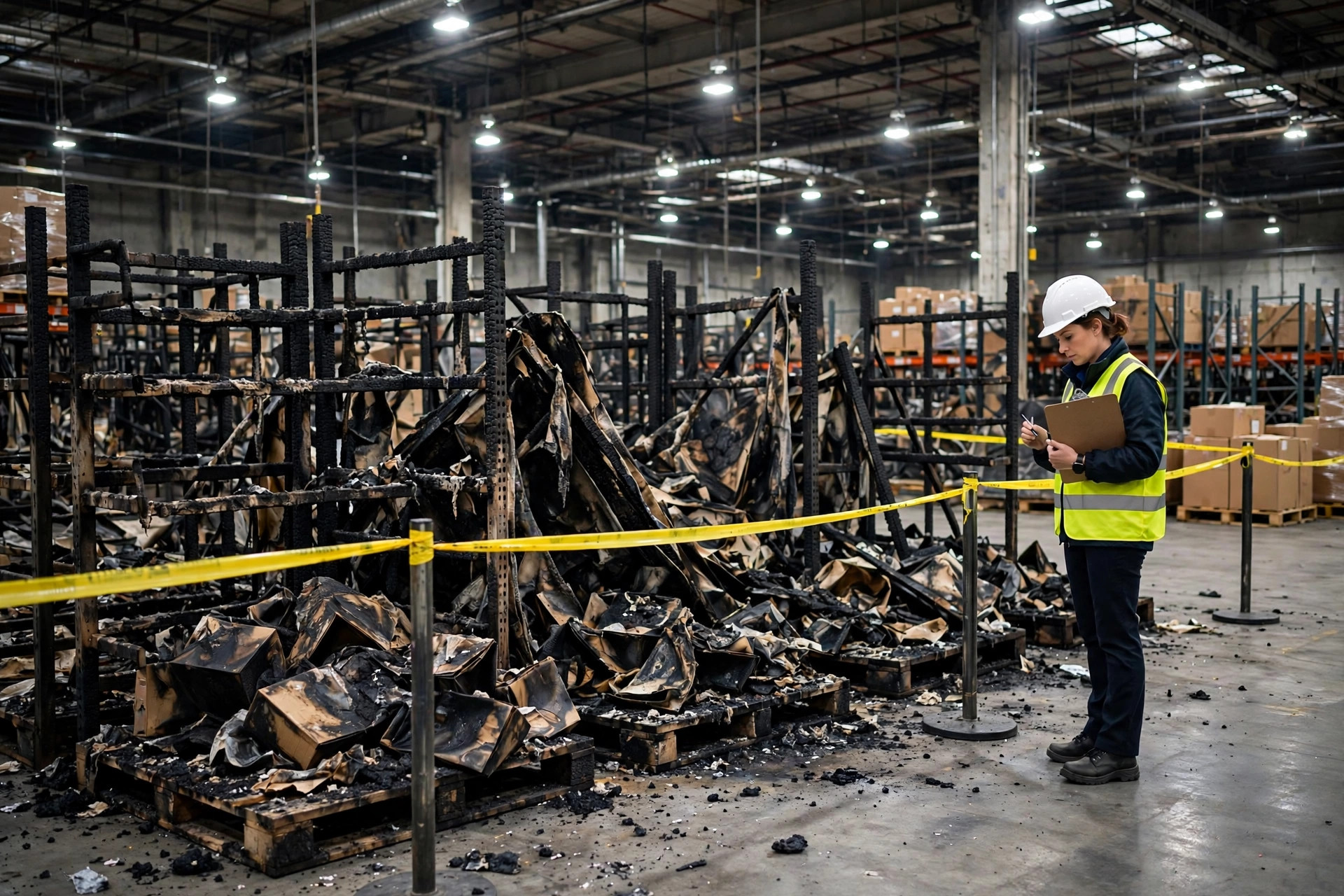
Last fall, a 3PL warehouse in Ontario, California caught fire on the roof. Two rows of racking burned. The inventory on the books was worth $860,000, and the warehouse insurance settlement came to $410,000. The $450,000 gap in the middle was the warehouse's own problem. I spent an afternoon pulling that settlement apart, and the conclusion was one sentence: that $450,000 was not an act of God. The policy was bought wrong.
Let me show the math first. The two burned rows held goods for two clients, one in small appliances, one in home goods. The property policy paid $120,000 for the warehouse's own racking and fit-out. Warehouse legal liability paid $290,000 for part of the clients' damaged goods. Where did the other $450,000 go? Part of it was under-declared inventory value: the stock limit on the policy was set from an off-season count, and the fire hit during peak-season build-up, when the value on the floor was far higher. Part of it was business interruption: the warehouse shut for six weeks, two clients walked away, and nobody paid for the shutdown because business interruption cover had never been bought. The rest was shaved off one cut at a time by the deductible and the coinsurance clause. One fire, three leaks, and every leak traced back to money saved when the policy was bought.
What warehouse insurance actually covers: four policies, not one
Warehouse insurance is not a single policy. It is four policies, each minding its own corner. Plenty of operators buy a commercial property policy and assume the job is done, then discover at claim time that every policy has things it does not touch, and the missing one is exactly the one that would have applied.
| Policy | Covers | Does not cover | | Commercial property | Your building, racking, forklifts, equipment, inventory | Flood and earthquake usually need separate cover; client goods are not your property | | Warehouse legal liability | Client goods damaged by your negligence while in your care | No payout if it was not your fault; the limit must track peak client inventory value | | Cargo / inland marine | Goods in transit and during loading and unloading | Once goods pass through your dock door, a different policy takes over | | Business interruption | Lost income and continuing fixed costs while shut down | Nothing if you never bought it; a short restoration period leaves the second half on you |
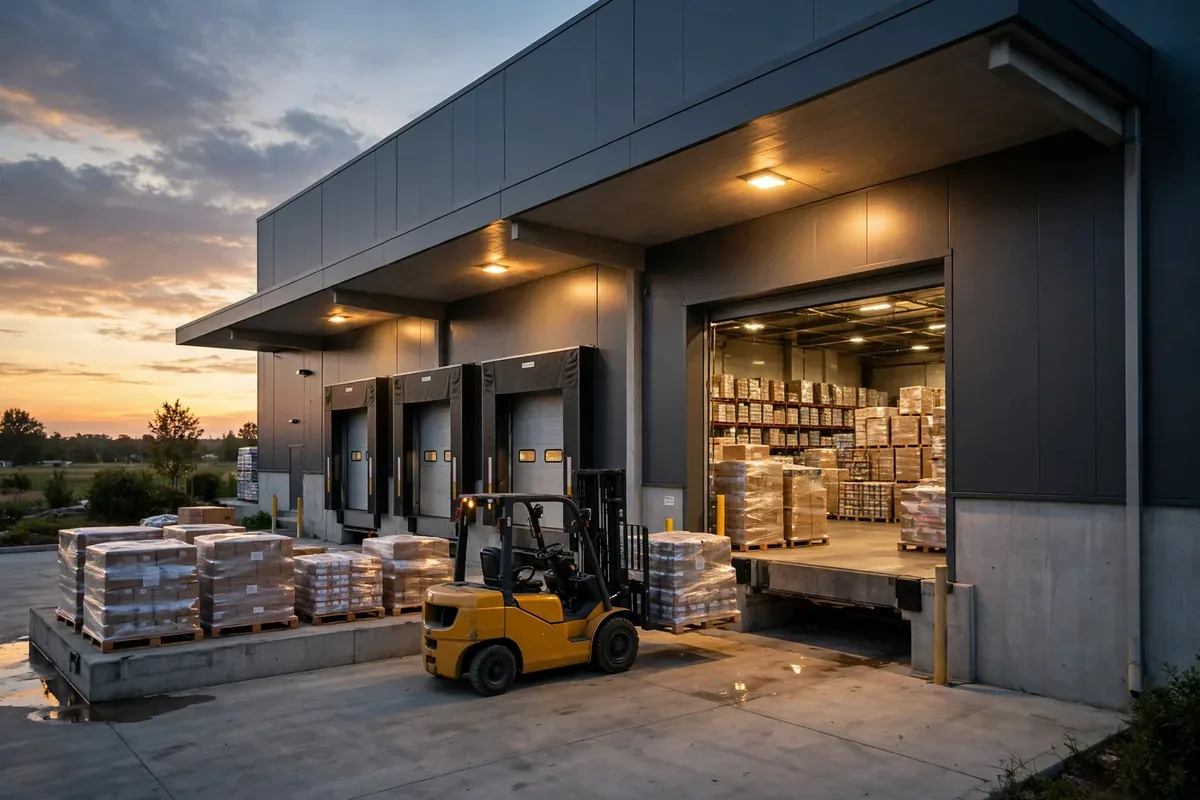
The two rows people trip over most are the second and third. Warehouse legal liability only pays when your negligence damaged client goods, and the limit has to follow the peak value of client stock, not the average. Set it on the average and you are self-insuring the difference. Cargo cover handles goods on the road; once they enter the warehouse, warehouse legal liability takes over, and the handover happens on the loading dock, which is exactly where neither policy wants to own the loss.
A warehouse in Houston learned this the wet way in the summer of 2024. A storm flooded the dock and soaked a batch of boxed goods. The owner filed under his property policy and was turned down. Property covers listed perils like fire, wind, and theft. Flood was not on the list, and flood needs its own cover. He had believed for over a decade that a property policy meant water damage was covered. The warehouse ended up compensating the client out of its own pocket. The lesson is cheap: ask your broker, in writing, whether the policy covers flood and earthquake, and keep the answer in an email.
Here is a number most operators do not know. Under the federal Carmack Amendment, a carrier's default liability for interstate freight loss is $0.50 per pound per article. At that rate, a carton of electronics written off by weight pays almost nothing. So the in-transit leg cannot lean on the carrier's default liability. Cargo cover has to be bought properly, and premium figures should always be taken from the insurer's latest quote, not from a number a peer mentioned over lunch.
The coinsurance clause in warehouse insurance: the most expensive lesson
The coinsurance clause is the most expensive lesson in the whole policy, and the most commonly skipped. It says the policy requires you to insure to a stated percentage of replacement cost, commonly 80%. Insure to the full requirement and losses are paid in full. Fall short, and every claim is cut proportionally, even small ones.
The arithmetic makes it plain. The example below is illustrative. Say a warehouse has a replacement cost of $1,000,000, so the 80% requirement means at least $800,000 of cover. The operator, trying to save premium, buys $600,000. Then a small fire causes $200,000 of loss. The payout formula is: payout = loss x (cover carried / cover required) - deductible, which is $200,000 x (600,000 / 800,000) - $10,000 = $140,000. A $200,000 loss, a $140,000 cheque, and $60,000 gone.
The counterintuitive part is this: buying too little cover does not only hurt when disaster strikes. Many operators assume small losses are always paid in full. They are not. Under coinsurance, any claim is first multiplied by that ratio, then reduced by the deductible. The deductible works the same way in reverse. Whether it is set at $10,000 or $25,000 matters less for the premium saved than for what you pay out of pocket when two or three small claims land in one year. Raising the deductible to save premium means saving a certain small amount and betting on the luck of no loss. Anyone with a finance background runs that calculation once and never runs it again.
Business interruption deserves its own line of arithmetic. The warehouse stops, income stops, and rent, payroll, and system fees keep coming. Whether the restoration period is set at 6 months or 12 months decides whether someone is still paying your bills in the second half. Industry material notes that rebuilding and re-racking after a major fire commonly drags on for 18 to 24 months. Set the restoration period short and the building is fixed while the money has already run out. Before buying business interruption cover, answer one number: what are your fixed costs for one month shut down? Multiply that by the restoration period, and that is the minimum this policy has to carry.
After a loss, protect the evidence chain first
A good policy still needs evidence to pay out. After a loss, the warehouse's first-hand evidence chain has four pieces: temperature and humidity logs, camera footage, cycle count records, and receiving photos with signed delivery notes. The adjuster's first request on site is for these. Every missing piece adds a month of argument.
Camera footage is the easiest to lose. Many warehouses keep only 30 days of video, overwritten automatically. The first job after a loss is to export and back up the relevant footage, right away, not tomorrow. Temperature logs matter just as much: for cold-chain claims, the temperature curve is what decides liability, and a broken curve means liability cannot be pinned down. Count records have to match locations: which row, which level, what the system says. If the paper count and the system stock disagree, the adjuster doubts your management before doubting your loss.
Once a year, before peak season, run three numbers: peak inventory value, replacement cost, and the fixed costs of one month shut down. If those numbers do not match the limits and the restoration period on the policy, call your broker and change them. The few thousand saved on premium will never cover the zero missing from the settlement cheque. Warehouse insurance does not buy you a policy. It buys you the ability to still open the doors after something goes wrong.
By Lao Zhou, Logistics Cost Analyst