Let me put the conclusion first: 3PL warehouse liability insurance covers what the 3PL is legally liable to pay, not the value of your inventory. Goods get lost or damaged, and the first question is never "how much is the insurance?" It is "how much does the contract say the 3PL owes?" If you sign a contract with a low liability cap, the policy follows that cap, and your invoice value stops mattering. I have watched too many shippers learn this after the loss, when it is too late to renegotiate.
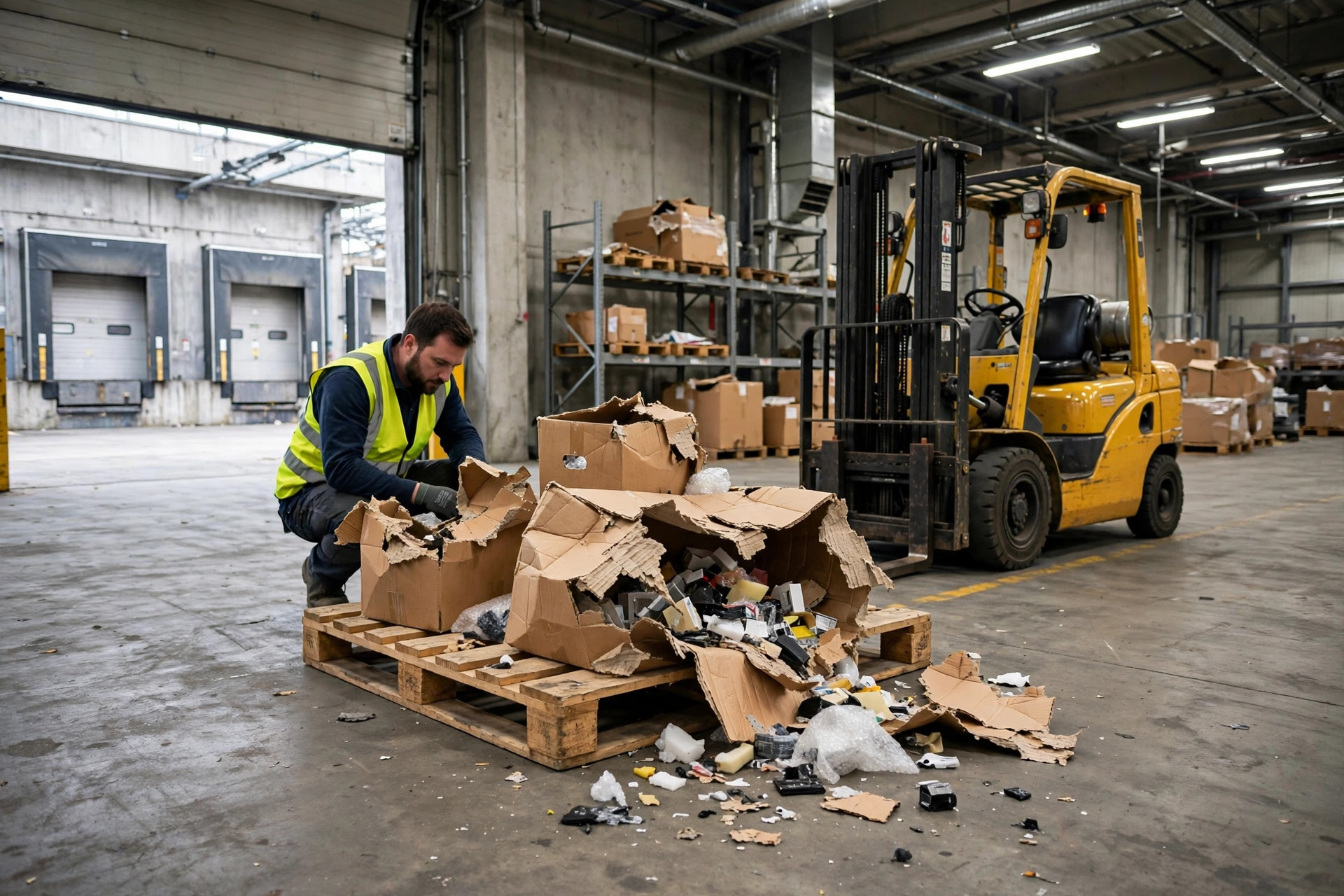
A home-goods seller I worked with stored roughly $180,000 of inventory at a 3PL warehouse in Ontario, California, in the fall of 2024. One night a leak soaked several dozen cartons stacked against a wall, causing a little over $20,000 of damage by invoice value. The 3PL pulled out the contract: liability was capped at $0.50 per pound, a very common figure in US warehouse agreements. The soaked cartons weighed about 800 pounds, so the payout under the cap was $400. The seller was stunned. The 3PL was not being difficult; it was following the paper both sides had signed. The numbers in this story are an illustrative scenario, but the ratio is real, and it is the whole point: a low cap turns a five-figure loss into a three-figure check.
3PL Warehouse Liability Insurance Covers Liability, Not Your Goods
This is the confusion to clear up first, because everything else hangs on it. A warehouse's property policy covers what the warehouse owns: the building, the racking, the forklifts, its own stock. Your goods sitting on its shelves are not in that policy. General liability has its own trap: it usually excludes property in your care, custody, or control, which is exactly what stored customer goods are.
The legal backbone in the US is UCC Section 7-204. A warehouse is liable for loss or damage caused by its failure to exercise the care a reasonably careful person would exercise under similar circumstances, and it is not liable for a loss that reasonable care could not have avoided. The same section lets the warehouse receipt or storage agreement limit the amount of that liability, and lets the customer ask in writing for a higher limit, usually at a higher storage rate. Read that twice. The insurance payout ceiling is set by the contract first and the policy second.
There is a second misunderstanding worth killing here: declared value on a parcel is not insurance. UPS and FedEx both default to $100 of carrier liability per package. You can declare a higher value and pay for it, but both carriers state in their terms that a declared value is not insurance and that they do not provide insurance coverage. If you want the value of the goods protected, you buy cargo or stock-throughput insurance separately, from an insurer. Declaring value raises a liability cap. It does not buy a policy.
The Exclusions in 3PL Warehouse Liability Insurance Worth Asking About
Exclusions are where the real negotiation happens. Wording varies by carrier and policy, so treat the list below as the questions to ask and confirm against the actual policy and the insurer's latest published terms, not as a quote of any one policy.
Mysterious disappearance comes first. Stock turns up short at a physical count, with no sign of break-in or damage, and many policies will not pay. The defense against this one is not insurance at all; it is the evidence trail from receiving: weights, photos, cycle counts, batch records. Without evidence, a claim adjuster has little to work with.
Spoilage is next. Refrigeration failure or temperature swings that ruin cold-storage goods typically need a separate endorsement. If you sell food or pharmaceuticals, a policy that does not mention your cold chain in writing effectively does not cover it.
High-value and target commodities are third. Electronics, pharmaceuticals, alcohol, and tobacco often carry sublimits or outright exclusions. If that is your category, get the sublimit in writing before you sign, not after a loss.
Earthquake and flood are fourth, and they matter a lot in California. Both are frequently excluded or separately limited. Ask whether the warehouse sits in a flood zone and whether water damage is covered. One question now saves a long argument later.
Here is the checklist I use at the negotiating table. Figures marked as typical ranges come from published industry guides; confirm the specifics against your own policy and the latest terms from the insurer.
| What to negotiate | Common wording | What to push for |
|---|---|---|
| Liability cap | $0.50 per pound, or $5 to $25 per unit | Work the cap back from your per-unit cost, or declare higher value in writing |
| Policy limit | $500,000 to $2 million of warehouse legal liability | The limit should cover your peak-season inventory value on site |
| Declared value | Parcel carriers default to $100 per package | Declare high-value parcels separately, and do not treat it as insurance |
| Mysterious disappearance | Often excluded | Agree in writing how count discrepancies are handled |
| Spoilage | Needs an endorsement | Cold-chain goods must be confirmed in writing as covered |
| Earthquake and flood | Often excluded or limited | Ask plainly whether they are covered, and buy separately if not |
A Cheap Premium Means Nothing If the Claim Cannot Be Paid
Look at it from both sides, because both sides have a point. For the 3PL, the premium tracks the value and category of the goods it takes in and the liability cap it agrees to. Raise the cap and the premium rises, so the 3PL will not raise it for free. For the shipper, $500,000 of inventory sitting in a warehouse with a $500,000 policy limit is fine in February and underwater in November, when peak-season stock doubles. I have seen too many shippers compare storage rates and pick fees line by line, then skip the liability page entirely. The few dollars saved on handling do not cover one bad claim.
My approach is unglamorous, and it works. Before signing, do three things. First, ask for the certificate of insurance and check the warehouse legal liability limit and the expiry date; "we have insurance" said out loud is not evidence. Second, circle the liability cap, the exclusions, and the declared-value clause in the contract, and run the math: if a loss is paid at the cap, how much do you actually get back, and can you live with that number? Third, decide whether to buy your own cargo or stock-throughput policy. For inventory above $100,000 in value, I generally recommend looking at it seriously; published guides put typical pricing around 0.15% to 0.40% of annual inventory value, but get a real quote from an insurer before budgeting on it. And do not leave the claims side vague: photograph damage, notify the 3PL in writing, and follow the contract's claim procedure and deadlines. A phone call is not a written notice, and plenty of claims stall because the notice came late or the evidence was never kept.
Here is the counter-intuitive judgement to take with you: a 3PL with a bigger policy limit is not automatically safer. A warehouse advertising $2 million of cover with your commodity excluded is worth less to you than a warehouse with $1 million of cover, a reasonable liability cap, and tight receiving and cycle-count records. Insurance is not judged by the number on the sales deck. It is judged on the day a loss happens, by whether the money actually reaches you.
Do not file the contract away after signing. Recheck your on-hand inventory value against the policy limit before peak season, ask whether a new product category is covered before it ships in, and keep the claim procedure somewhere you can find it at midnight. Nobody wants a cargo loss. When one happens, the argument is not won by the loudest voice in the room. It is won by the clauses negotiated on the day the contract was signed.
By Lao Mi, Supply Chain Veteran (20 yrs)