Here's the deal: most warehouses are flying blind on noise. The sorters roar all day, earplugs show up only if the boss feels like it, and everyone assumes handing out plugs counts as compliance. It doesn't. OSHA clips a dosimeter on your worker, runs an 8-hour time-weighted average, and the moment it hits 85 decibels, you owe them an entire hearing conservation program — monitoring, audiometric testing, training, records. The earplugs are the cheapest line item in the whole package.
Let me break the 85-decibel line wide open: the two numbers that decide everything, the steps you can't skip, and the noise-control moves that actually pay off.
The Pit I Watched Happen: A California 3PL Bought Earplugs and Called It Compliance
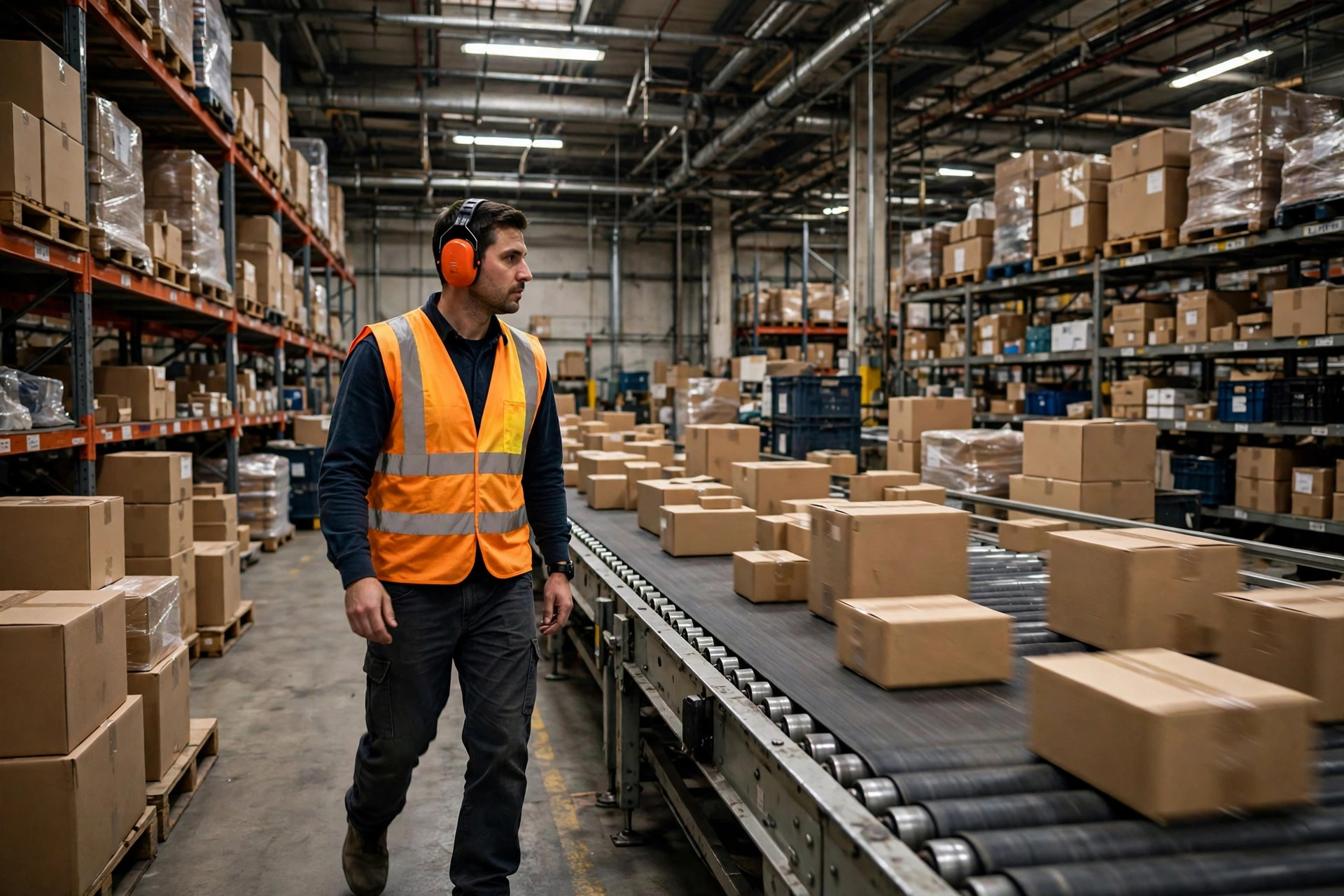
I've seen this movie too many times. In 2021, a home-goods 3PL warehouse in California ran six conveyor lines in the sort area, night shift ten at night to six in the morning. Workers wrote a joint complaint letter: the sorters were too loud, people went home with ringing ears and couldn't sleep.
The owner's response? Two cases of foam earplugs, handed out, done.
Six months later OSHA showed up — a complaint-driven inspection. The compliance officer calibrated a noise dosimeter, hung it on sorters for two full shifts, and calculated an 8-hour TWA of just over 88 dBA. 88 is only 3 decibels past 85, but those 3 decibels are a different universe: at or above 85, the employer must administer "a continuing, effective hearing conservation program" under 29 CFR 1910.95(c)(1). That's OSHA's exact language, no wiggle room.
The warehouse had no monitoring records, no baseline audiograms, and a blank training sign-in sheet. The hearing conservation findings alone produced several serious citations, over ten thousand dollars in penalties — and OSHA's published enforcement records show five-figure penalties are routine in these cases. The owner asked me, "But I gave them earplugs." I told him: you bought protectors; OSHA wanted a program. Money spent, job not done.
The Trap Almost Nobody Knows: The 85-Decibel Line Doesn't Apply to 12-Hour Shifts
Here's another pit with even fewer survivors. In 2023, a cold-storage warehouse in Texas ran two 12-hour shifts through peak season. The safety manager told me, chest out: "We measured. Average 84 decibels. We're under 85, we're fine."
I shook my head. The 85 dBA action level is for 8-hour shifts. Longer exposure gets a stricter limit — OSHA's Table G-16a spells it out: 83.4 dBA for 10-hour shifts, 82.1 for 12-hour, 80 for 16-hour. Their 84 was already over the line for a 12-hour shift, and the full program was owed just the same.
Two sides to this one: overtime shifts earn money, but the ears keep a separate ledger. Any warehouse running 10- or 12-hour shifts needs to look up the threshold for its own shift length first — check the current OSHA guidance before declaring victory. A lot of "we're at 84, we're safe" stories come from measuring with the wrong ruler.
Warehouse Noise Has Two Lines That Matter: The 85 Action Level and the 90 PEL
The regulation is two lines. Memorize them:
85 dBA (8-hour TWA) — the action level. Meet or exceed it, or hit a 50% dose, and the employer must launch a hearing conservation program. One critical detail: exposure is computed without regard to any attenuation provided by hearing protectors. OSHA says it plainly. Plugs in or not, if the number is over, the program is owed.
90 dBA (8-hour TWA) — the permissible exposure limit. At this line, the employer must drive exposure down with engineering and administrative controls. PPE is the last resort, not the plan.
The biggest misconception in the industry: "we're under 90, so we're fine." Program obligations start at 85. Wait until 90 and you owe the backlog too.
The Five Moving Parts of a Hearing Conservation Program
OSHA doesn't want a binder on a shelf. It wants five real things:
1. Noise monitoring. A full baseline survey first, then re-survey whenever processes, equipment, or production levels change. The dosimeter rides on the worker for a whole shift — OSHA doesn't accept someone waving a handheld meter next to a machine for thirty seconds.
2. Audiometric testing. Baseline within 6 months of first exposure (one year if you use a mobile test van), then annual tests compared against that baseline to catch a Standard Threshold Shift. Hearing loss is cumulative and permanent; the baseline is your "factory setting." Without it, you can prove nothing later.
3. Hearing protectors. Free to the employee, and offered in multiple styles — at minimum plugs and muffs. A protector nobody wears is money in the trash.
4. Annual training. What noise does, how to wear the protectors, what the testing means. Keep the sign-in sheets and the materials.
5. Recordkeeping. Monitoring data and audiometric records, filed by a named owner, ready for inspection. Records are the first thing OSHA asks for.
Real Noise Control: Run the Math Before You Spend
Here's how I'd rank noise-control moves from the field (figures are experience-based; verify against actual product specs and measurements):
| Measure | Upfront cost | Typical reduction | The catch |
|---|---|---|---|
| Foam earplugs | Pennies a pair | High on paper, varies wildly in practice | Doesn't fix program obligations; wearing compliance is voluntary; blocks communication |
| Earmuffs | Tens of dollars each | More consistent than plugs | Hot and miserable in summer; still doesn't fix program obligations |
| Equipment enclosures | Thousands to tens of thousands | 10–20 dB | Traps heat, complicates maintenance; long lead times |
| Layout separation | Move and partition costs | 5–15 dB | Forces a flow redesign; small sites can't do it |
| Acoustic panels | Priced by area | 3–8 dB | Limited effect, a supporting act at best |

And here's the contrarian take: the cheapest noise control isn't earplugs — it's moving the loud equipment somewhere else.
Sound punishes proximity. A sorter sitting next to the pack stations, one meter closer to human ears, can mean several decibels of difference. My favorite example: a warehouse moved two label applicators from the pack area to the far end of the conveyor, with a rack row in between. The sort area's TWA dropped from 89 to 84 — zero dollars spent, and they never crossed the 85 line at all.
Two sides to the ledger, and bosses need to see the whole thing: PPE is the cheapest line item and the most expensive compliance package — for a hundred-person warehouse, annual audiograms, training, and record management add up to tens of thousands a year, forever. Engineering controls and layout changes cost more up front, but get exposure under 85 and the entire program burden disappears.
Build a Program in Seven Days: The Checklist
If you're starting from zero, you can stand this up in a week:
- Hire a qualified firm for baseline monitoring — dosimeters on workers, every role and every shift covered.
- List everyone in the program using the 85 dBA line (adjusted for your shift length).
- Schedule baseline audiograms within 6 months.
- Buy and issue protectors, keep an issuance log.
- Run one full training round, keep sign-ins and materials.
- File everything — monitoring reports, test records, training records — with a named owner.
- Re-survey annually and close the loop.
One last word of advice: noise is cruel because it doesn't bleed. 88 decibels today, a hearing-loss report in ten years, an occupational illness on your OSHA 300 log — and when you look back for a baseline test that was never done, the fines will be the least of your problems. Want to take that bet?
By Lao Mi, Supply Chain Veteran (20 yrs)