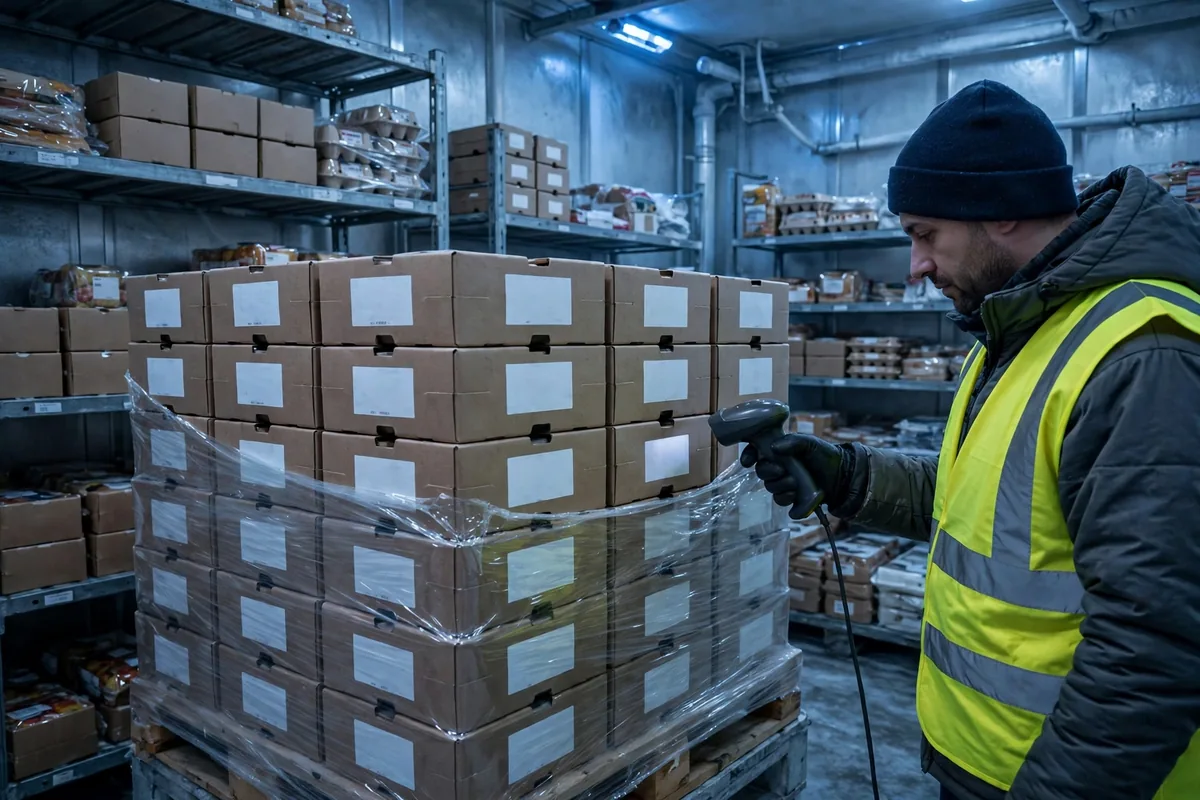
Here is the conclusion up front: food warehouse batch expiry management cannot run on FIFO alone. FIFO tracks the order stock arrived. A food warehouse has to track the order stock expires. The same yogurt can arrive in two batches where the batch that came in first has nine months of life left and the batch that came in two weeks later has two. Ship by FIFO and the first batch goes out fine while the second one dies on the shelf. FEFO, first expired first out, fixes that mismatch: it ships whatever expires soonest, no matter when it arrived.
I have watched this exact failure three times. The third one stays with me. An imported-dairy client near Los Angeles had two batches of the same butter in one cold room. Batch A arrived first with nine months of life left. Batch B arrived two weeks later with four months left. The system picked FIFO, so A shipped and B sat. Three months later somebody noticed B had two weeks left, and the customer required at least 60 days of remaining shelf life on arrival. That batch could not ship anywhere. It was written off in full. On paper it looked like an inventory problem. The real problem was that the pick rule had never been tied to expiry dates.
Food Warehouse Batch Expiry Management Starts Where FIFO Stops
FIFO and FEFO look identical most days. They only disagree in one situation: when arrival order and expiry order do not match. A supplier changes production lines, stock from two plants lands in one order, or a short-dated batch comes in on a promotion price. In a food warehouse with many batches, that mismatch is not an exception. It is the normal state of things.
| FIFO | FEFO | |
|---|---|---|
| Sorts by | Receiving date | Expiry date |
| Data needed | One receiving date per batch | One expiry date per batch |
| Fits | Undated dry goods and packaging | Food, dairy, supplements, anything dated |
| Fails when | Expiry order disagrees with arrival order | Expiry data is missing |
The second half of that table matters more than the first: FEFO demands far better data than FIFO. Lose a receiving date under FIFO and a picker can still guess. Lose an expiry date under FEFO and the rule itself stops existing.
Food Warehouse Batch Expiry Management Fails at Three Data Breaks
Across more than 30 go-live projects, my conclusion is that FEFO does not fail at the pick face. It fails wherever expiry data drops out between receiving and shipping. There are usually three breaks.
The first break is receiving. Plenty of warehouses scan the product barcode at the dock and never record the batch or the expiry date. Once the goods are put away, the expiry lives only as print on the carton. The fix is to make batch and expiry capture mandatory at receiving. Under the GS1 standard, Application Identifier (10) is the batch or lot number and (17) is the expiry date in YYMMDD format. If the supplier label carries both, one scan captures everything. If it does not, key it in by hand and print your own label. Ten slow minutes at the dock beats a batch with no identity in the system.
The second break is storage. One location holding two batches leaves the picker choosing by eye, and FEFO becomes a poster on the wall. My rule is strict: one batch per location. When locations must be shared, split them with a divider, label each side, and keep the two batches as separate location records in the system. Color dots are low-tech and they work: red for under 30 days, yellow for under 90, green for over 90. A night-shift picker can steer clear of red without even opening the system.
The third break is picking. A pick list that names the product and the quantity but not the batch hands the decision to the picker's habits. The system has to assign the batch when it creates the task, and the picker has to scan the batch code. A wrong scan blocks the pick. That block feels like friction. It costs far less than writing off a whole batch.
There is also a compliance tailwind worth naming. The FDA Food Traceability Rule under FSMA 204 requires lot-level traceability for foods on its list, with records producible within 24 hours of a request and kept for two years. The original compliance date was January 20, 2026, later extended to July 20, 2028; check the FDA site for the latest status. Dates can move. The direction does not: batch and expiry data will have to live in the system, and building that habit now is cheaper than building it under a deadline.
How Much Shelf Life Is Enough to Ship? Ask the Customer First
Here is the counterintuitive part: FEFO does not mean sending the earliest-expiring stock to every customer. Customers set different minimums for remaining shelf life on arrival. A grocery chain may demand 90 days, an e-commerce channel may accept 60. Ship 40-day stock to a 90-day customer and it comes back refused. You still write it off, plus a round trip of freight.
So FEFO needs a customer shelf-life table: every channel and every major customer, with its minimum acceptable days, loaded into the system as a shipping check. The pick rule then has two layers: sort by expiry, then filter by the customer's threshold. The shortest-dated stock goes to the most forgiving channel. The freshest stock is reserved for the strictest customer.
The math below is an illustrative example, not a real client's numbers, but the logic is real:
| FIFO only | FEFO plus customer thresholds | |
|---|---|---|
| Monthly volume (assumed) | 8,000 cases | 8,000 cases |
| Monthly write-offs (assumed) | ~96 cases | ~32 cases |
| Write-off rate (assumed) | ~1.2% | ~0.4% |
| Value per case (assumed) | $40 | $40 |
| Monthly write-off loss (assumed) | ~$3,840 | ~$1,280 |
Most write-offs are not bad product. They are good product shipped to the wrong place. Over a year, the savings cover more than the product itself: the cold storage rent and the labor that went into handling it.
The Go-Live Night Checklist I Walk With
The night before FEFO goes live, I walk the warehouse with this list. Anything unchecked stops the launch.
- Receiving: batch and expiry are mandatory fields, and a load with missing expiry cannot be put away
- Storage: mixed-batch locations are cleared and color dots are in place
- Picking: pick lists name the batch, and a wrong-batch scan blocks the pick
- Alerts: 30, 60, and 90-day near-expiry lists have a named owner every day
- Customers: the shelf-life threshold table is loaded and the shipping check is switched on
- Recall drill: pick any batch at random and prove within half an hour where it went
The list looks fussy. Every FEFO failure I have investigated traces back to one of these lines being waved through. In the projects I have worked on, the sites that had an expiry incident in the first week of go-live could always point to the checklist item they had skipped.
Food warehouse batch expiry management is not a contest over who buys the most expensive system. It is a test of whether expiry data survives the trip from the receiving dock to the shipping dock without breaking. Break it once, write off a batch. Run the checklist above, and the gap FIFO leaves behind finally closes.
By Lin Xiao, WMS Implementation Consultant