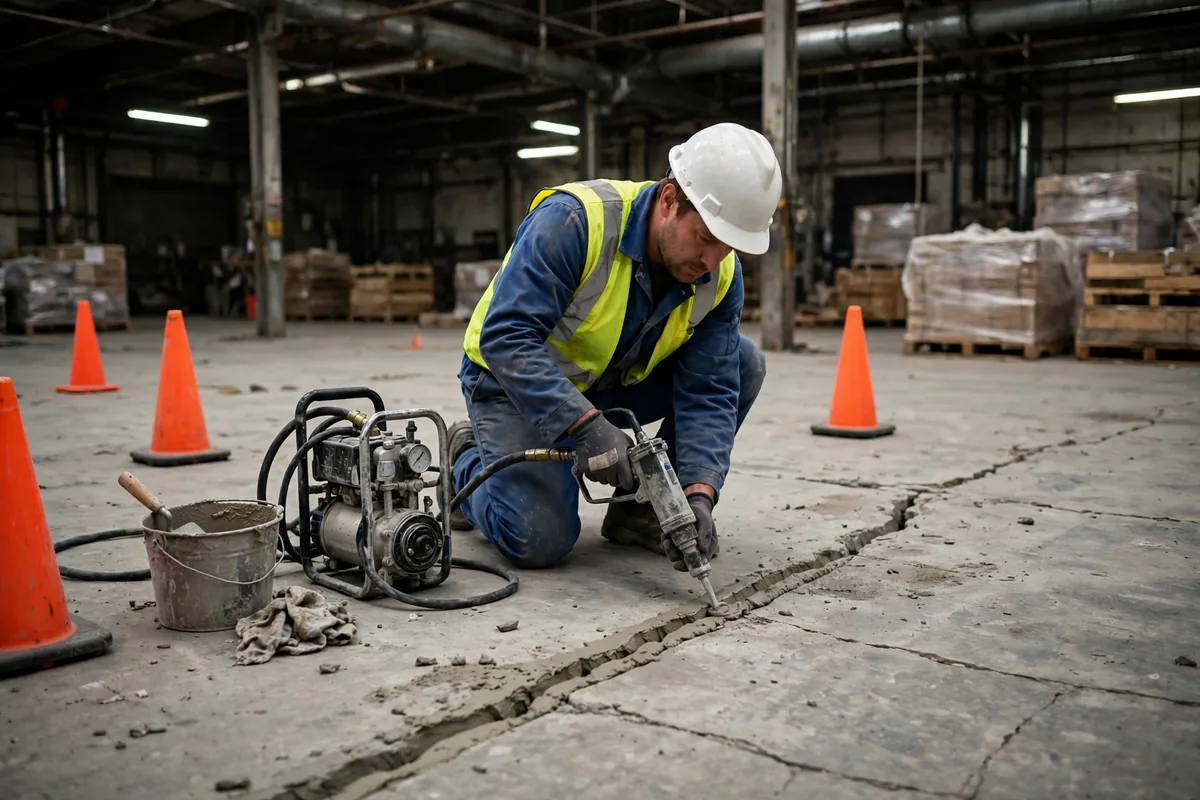
At 6:30 in the morning I had barely put my bag down when the night-shift lead blocked my office door. A forklift driver on aisle three was getting his wrists jarred on every pass. I crouched down and looked. The warehouse floor crack repair cost we had been avoiding was now unavoidable. Last month that crack was hairline thin. Now a coin could slide into it.
I will be honest with you. Most warehouse managers delay floor repairs. If people can still walk and forklifts can still roll, it feels like it can wait. It cannot. Water gets in, the base washes out, edges crumble, and a cheap sealing job turns into a slab replacement. The money gets spent either way. The only question is how much.
Grade the crack before you price the crack
In our building we use three grades. The list is taped to the maintenance room wall, and every new hire learns it in the first week.
Grade one is a hairline crack. It is shallow, the edges are solid, and a forklift passes without a bump. Most are shrinkage cracks. Photograph them, log the location, and check again in three months. Do not spend real money yet.
Grade two is a working crack with spalling edges. Small chunks break off, wheels thump, and moisture comes back up after floor scrubbing. This grade already slows work down. Leave it alone and you will pay in tires first, then in uneven loads around rack uprights.
Grade three is structural or settlement damage. One side sits higher than the other, the surface sounds hollow when tapped, and the crack keeps widening. Stop guessing. Get a proper inspection and find out whether the base or the subgrade has failed.
| Grade | What you see | Typical fix | Operational impact |
|---|---|---|---|
| Hairline | Thin, shallow, solid edges | Seal and monitor | Almost none |
| Working / spalled | Chipping, bumps, dampness | Joint filling or epoxy mortar | Half a day to a day per zone |
| Settlement / structural | Offset, hollow sound, growing width | Partial slab replacement | Several days per zone, rerouting needed |
Here is the counterintuitive part. The widest crack in a quiet corner is rarely the most expensive one. The medium crack on a forklift route is. It gets hit hundreds of times a day, and its edges fail far faster.
warehouse floor crack repair cost: three fixes, three different jobs
Joint filling suits hairline cracks and early working cracks. Crews clean the joint and fill it with a flexible material. It is fast, it is the cheapest option per metre, and it can be done in sections. It also only seals. It does not add strength. If the crack is still moving, it will reopen after peak season. That is not bad material. That is the wrong method.
Epoxy repair suits spalled edges and shallow surface loss where you need flatness back. It gains strength quickly, often allowing traffic the next day. Its weakness is moisture. If the base is damp and nobody deals with it, the repair can blister. We learned that the hard way, on a night shift, with a queue of orders waiting.
Partial slab replacement is the last resort. You cut out the failed section, rebuild the base, and pour it back. Per square metre it is the most expensive choice. For settlement and hollow bases, though, it is the only choice that stops repeat spending.
Take this hypothetical example only to understand the proportions, and always use local quotes for a real budget: a 30-metre working crack on a main aisle might cost in the low thousands in total if filled, roughly three to five times that if repaired with epoxy edging, and well into the tens of thousands if 20 square metres need slab replacement, before you even count labour for moving stock and rerouting traffic. Do not take those figures to finance. Take the ratios to your boss. The ratios are what help you decide.
In 2023, before peak season, I saw a 12,000-square-metre apparel warehouse in East China take the cheap route on a 40-metre crack. Everything was filled, nothing was strengthened. On day three of the big promotion, the edges broke open, picking carts caught their wheels, and more than 200 orders were delayed in one night. The emergency epoxy work cost about four times the original saving.
So ask three questions before accepting any quote. Is this crack still moving? Is the base hollow? Do heavy forklifts run over it? If nobody can answer those, do not sign anything.
warehouse floor crack repair cost when you cannot close the warehouse
Brothers ask me this all the time: we cannot shut down, so how do we do the work? We follow a fixed routine now.
First, protect one main route at all times. Split aisles into A and B groups. Close A today, B tomorrow. Draw the temporary forklift route on the morning-meeting whiteboard a day ahead. If a driver has not understood it, he does not drive.
Second, use nights and the gaps between waves. Work that needs curing happens between 10 p.m. and 4 a.m. Daytime is only for preparation that can move aside quickly, like cleaning and cutting.
Third, moving stock takes longer than repairing concrete. In May 2024, at a food warehouse in South China, we repaired a settlement crack near the dock. The concrete work took two days. Moving and re-slotting the stock took three. Nobody had planned for that, and the client chased us every day. Now our rule is simple: the first line of any repair plan is the stock move — who owns it, where it goes, and when it comes back. No plan, no start.
One more detail. Stop floor scrubbing near fresh repairs. Water is the enemy in the first days. Put it on the duty roster in writing, or someone helpful will undo your work with a scrubber.
The lease trap nobody budgets for
Owning your building is straightforward. Leasing is where the traps are.
At move-in, photograph and film the floor zone by zone. Mark every crack on a floor plan and get both sides to sign it. Wide scenic photos are useless in a dispute. At move-out, if the landlord points to an old crack and calls it your damage, you need dated proof.
In 2022 I helped a friend with an exit dispute on an 8,000-square-metre leased warehouse. A large repair sum was withheld, and about half the cracks in question had existed at move-in. The handover note had said only that the floor was "generally in good condition." That one vague sentence cost two months of argument.
Our handover now has three non-negotiables: a crack register with numbers, photos, and widths; a separate check of heavy-load zones like docks, charging areas, and rack aisles; and contract language that separates normal wear from operator damage before anyone moves in. It takes an extra hour of talking. It saves real money at exit.
Keep monthly evidence too. Walk the main aisles once a month and take dated photos. If a crack suddenly widens, you can show whether it was gradual wear or a single heavy impact. Responsibility looks very different in those two cases.
Why forklift routes destroy cracks faster
The same crack behaves differently depending on where it sits. In a pedestrian area it may not change for a year. At a forklift turning point it can fall apart in three months. Turning wheels twist as they cross, and that twisting tears at crack edges far more than straight travel does.
Watch three places closely: charging-area entrances, dock ramp thresholds, and aisle intersections. We inspect high-frequency turning points every two weeks. As soon as an edge starts to chip, we stabilise it with epoxy instead of waiting for a bigger failure. And speed limits in rough zones have to be real, not just signs on a wall. Slower traffic saves tires and floors at the same time.
My closing advice to fellow managers is this. Do not leave your crack register buried in a spreadsheet. Print it, pin it in the maintenance room, cross off every repair, and add every new crack the day you find it. When you know every crack in your own building, nobody can sell you a vague lump-sum repair — and when your boss asks why the money is needed, you will have an answer ready.
By Chen Feng, Warehouse Operations Manager