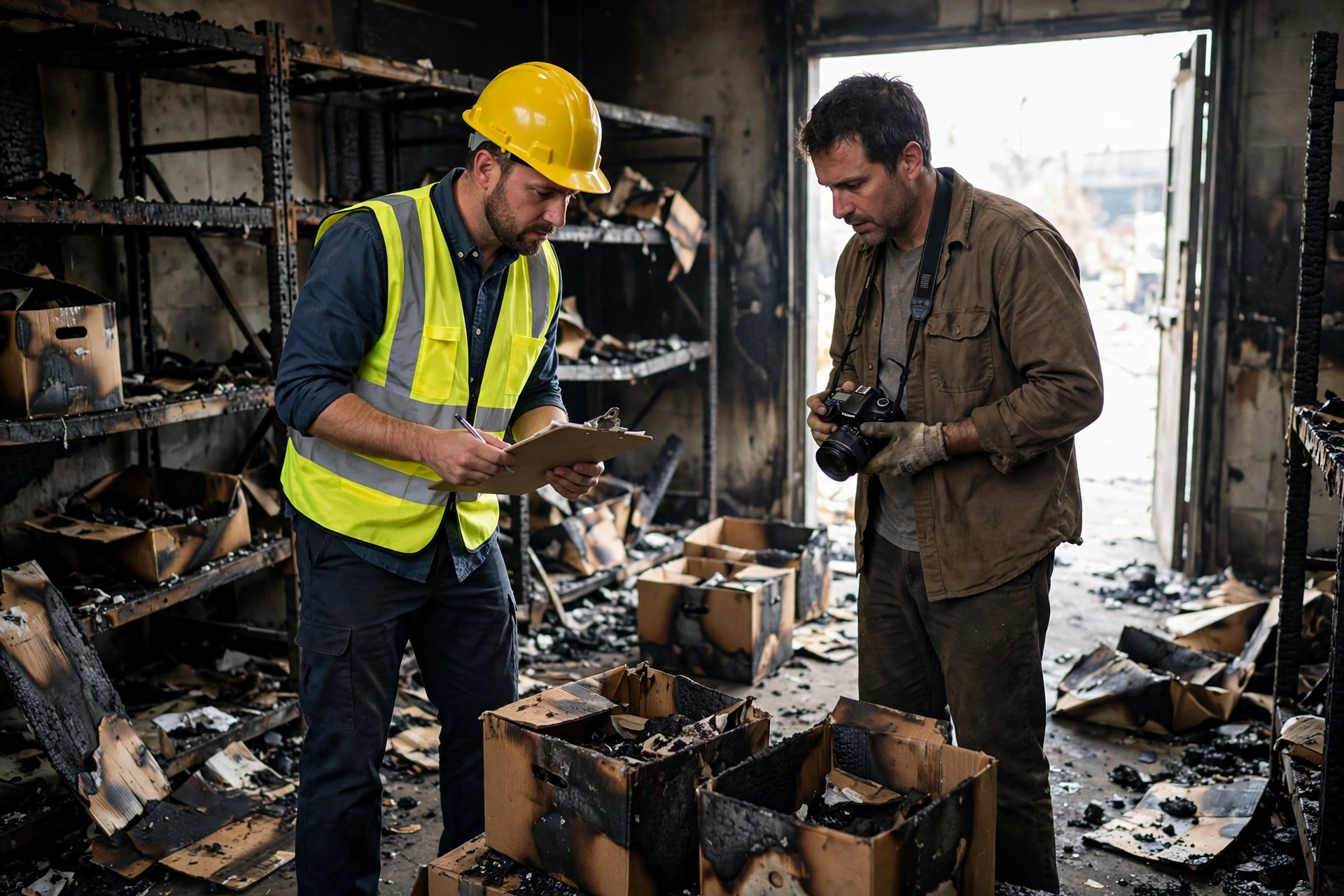
My phone rang at 2:40 in the morning — the night my warehouse fire insurance claim began. Old Wang from the warehouse next door was shouting that smoke was coming out of my roof. I threw on a jacket and ran, thinking: this is it, we're finished. A small warehouse like mine cannot afford to burn. The fire was not huge — one row of racking and a few dozen cartons. I felt relieved. The real headache started the next morning, when the insurance company called. Their first questions: did you report the claim? Did you touch the scene? Did you take photos? I was baffled — the fire was out, what was left to report? That was when I learned the hard truth: a warehouse fire insurance claim is mostly decided on the first day after the fire. A previous article covered how to set your coverage amount; this one is only about after the fire — how the money comes back.
Warehouse Fire Insurance Claim Step One: People First, Then the Scene
The most important thing first: if everyone is safe, everything else can be fixed. Do not play hero in a fire scene or go back in for stock. Until the fire crew says the site is safe to enter, nobody goes in. No exceptions. Once the fire is out and the site is released, the claim clock starts ticking, and the order of steps matters.
First, report the claim. Most policies require notice within 48 hours of the loss. Reporting late does not automatically kill the claim, but if the delay makes it impossible to establish the cause or extent of the loss, the insurer can refuse the part it can no longer verify. My rule: call as soon as the fire is out. Give the time, the location, where the fire started, and a rough idea of the damage. Write down the claim number and who you spoke to. What matters is a timestamp proving you did not drag your feet.
Second, do not start cleaning up. Burned racking looks ugly and water-soaked cartons are heartbreaking, but photograph and video everything before you move a single box: wide shots, close-ups of every damaged spot, rack numbers, carton labels, warped equipment. Then pick up the shovel. And get the fire department's report — the key paper for establishing what caused the fire. Without it, half your arguments fall apart.
Third, make a loss list: what burned, what got soaked, how many units, what you paid for them — one line at a time. It does not need to be complete on day one — start with what you are sure about and add the rest later. Memory is at its worst right after a fire; three days later you will not remember which cartons were on that rack.
Evidence Is Something You Save Before the Fire, Not After
Here is an uncomfortable truth: plenty of small warehouse owners lose not because the fire was too big, but because they kept nothing. An insurer only pays for what you can prove. You say a hundred cartons burned; they ask for purchase orders. You say the stock was worth a fortune; they ask for the count sheet. No documents, no money.
A small warehouse cannot afford a full-time archivist, so we use cheap tricks. Once a month, I walk the racks with my phone and film everything end to end, then save the video to the cloud with the date in the filename. Purchase orders, sales orders, and outbound slips get photographed and uploaded, originals in a moisture-proof box. The count sheet gets updated monthly and pinned on the office wall. The whole routine takes less than an hour a month. When a fire happens, that hour is the money.
Two scenarios, both hypothetical — the numbers are made up so the math is clear, but the lessons are real.
Hypothetical scenario one: in autumn 2024, a friend in Guangzhou who sells small appliances had a night fire that destroyed more than three hundred cartons. His purchase orders were in the warehouse office — the fire took them, and hose water drowned the computer. He could only report from memory, and the insurer paid only for the documented part: less than half of what he claimed. The insurer was not being evil — my friend had no cards in his hand.
Hypothetical scenario two: a small daily-goods warehouse owner in Langfang had a similar fire, but he filmed his stock monthly and kept purchase orders in a cloud drive. On the day of the loss he sent the videos, orders, and count sheets to the adjuster in one package, and the adjuster accepted almost the whole list after checking them twice on site. The two fires were about the same size; the payout gap came entirely from that one hour a month.
Here is the counterintuitive part: the first to get paid is often not the one who burned worst, but the one with the best evidence. How bad the fire was is luck; how good your evidence is, is a skill — and skills can be practiced.
How the Warehouse Fire Insurance Claim Gets Calculated
When the adjuster visits, losses fall into three buckets: stock destroyed, stock damaged by smoke or water, and damage to the building and equipment. Burned-to-ash stock is valued at purchase cost. Smoke-damaged goods depend on whether they can still be sold — unsellable is a full loss, resalable at a discount counts only the price difference. Equipment depreciates by age; the building is priced by repair quotes. Keep the three buckets separate. Mix them and you invite a single sweeping discount.
The table below is hypothetical — I made up the numbers to show the calculation, so do not apply them to your own warehouse:
| Loss item | Hypothetical claimed amount | Typical adjuster outcome | What decides it | | Destroyed stock | 300,000 yuan | Accepted against purchase records | Purchase orders and count sheets | | Smoke and water damaged goods | 120,000 yuan | Only the price difference if resalable | Photos of the original condition | | Racking and equipment | 80,000 yuan | Depreciated value | Purchase invoices and age | | Business interruption | 50,000 yuan | Only if the policy covers it | Whether the clause is in the contract |
A few hard deadlines from the Insurance Law are worth knowing — check your own policy and the insurer's latest rules: for complicated cases, the insurer should complete its assessment within 30 days; once a settlement is agreed, payment is due within 10 days; a denial must be issued in writing with reasons within 3 days of the assessment; if the amount cannot be fixed within 60 days, the determinable part must be paid in advance; and the limitation period is 2 years. You will probably never need these numbers — until the day you do.
The Adjuster Is Here: Don't Panic, Remember Three Lines
The adjuster is not here to fight you — he is here to do math. Three lines to remember. First: if you do not understand something, ask. Deductibles, proportional payouts, underinsurance — every term has a precise meaning, so ask him to explain and put it in writing. Second: never sign the assessment on the spot. Take it home, read it slowly, mark every line you disagree with, and schedule another talk. Third: keep a record of every conversation. Whatever was agreed on the phone, confirm it by message right after, in writing. If it is not in writing, it did not happen.
If you receive a denial letter, do not just accept it. The common reasons are a short list: late reporting, insufficient evidence, the loss falling outside coverage, or fire safety problems on your side. Check each one against your policy and your evidence, and answer in writing where you can. A denial must state its reasons — that is a legal requirement, and one without reasons stands on shaky ground.
A few honest words for fellow small warehouse owners: check fire extinguishers monthly — do not discover they expired after the fire. Keep flammables away from stock, give the charging area its own space, and replace aging wiring before it replaces your warehouse. Once you buy insurance, save the policy, the claim hotline, and your agent's number in your phone. On the day of the fire your brain will be mush; if you cannot find those numbers, you lose the whole day. One hour a month keeping evidence saves half a year of headaches.
Small warehouses have their own way of surviving. Big companies have legal departments; we have a phone, a cloud drive, and that one hour a month. Nobody wants a fire, but if it happens, panic helps no one — evidence and patience do.
By Xiao Ma, Small Warehouse Owner