Start with the money, because that is where this always ends up. Last year I helped a warehouse add up what its recounts really cost. The site ran about twelve thousand locations, and its cycle counts triggered more than eighteen hundred recounts in a year. Each recount sent two people back to the location to count again, trace the transactions, and write up an explanation. Add those hours up at local labor rates and the recount bill alone came to a serious five-figure sum in this worked example, using assumed wage and time inputs. The tolerance was set so tight that ordinary picking noise was being investigated like theft. That is the whole problem with warehouse cycle count tolerance thresholds in one story: the number you pick decides how much labor you burn chasing noise, and how much real loss you quietly write off.
Most warehouses set one flat percentage for everything, often two percent, and call it fair. It is the most expensive kind of fair there is. Ten missing pairs of socks and ten missing tablets can both be a small percentage of a location, but they are not the same event. One is sloppy picking. The other might be a box walking out the door. A single threshold is too strict for cheap goods, so your team recounts all day, and too loose for valuable goods, so real shrinkage passes with a smile. The fix is not a better single number. The fix is to stop pretending one number fits every SKU.
warehouse cycle count basics: count pieces or count dollars
You need both gates, and a variance should fail if it trips either one. A piece count tells you whether the operation is accurate. A dollar value tells you whether the mistake matters. A location holding a hundred two-dollar consumables that comes up two short has a two percent piece variance and a four-dollar problem. Sending two people to investigate four dollars is how counting budgets die. Flip it around: a location with twenty expensive circuit boards comes up one short. That is five percent by pieces, which sounds modest, but the dollar loss is hundreds of dollars in this illustrative case, and it deserves a freeze and a same-day investigation.
In March 2024 I visited a Bluetooth earbud warehouse in Shenzhen. The earbuds were valuable, tiny enough to hide in a fist, and exactly the kind of product that walks away. The site applied its standard piece tolerance, so a location short one or two units still passed and the system adjusted the books. The numbers looked clean for three straight months. Then a full count before peak season found the earbud zone short by more than two hundred units, and camera footage eventually showed a night-shift worker slipping units into a toolbox. The lesson is blunt: for small, valuable items, variance is not error. It is a signal, and tolerance is just a blindfold.
A Suzhou auto parts warehouse had the opposite disease in the autumn of 2023. Their tolerance was tight on everything, so brake pads short by two pieces triggered a formal recount. The supervisor told me his counters spent half their time recounting instead of counting. We pulled three months of recount records and found that the large majority closed as trivial causes: an extra piece picked here, a return put away to the wrong location there, each worth very little money. Meanwhile nobody had the hours left to dig into engine components, where a single variance actually hurt. A tight threshold does not just cost labor. It spends your team's attention, which is the scarcest resource in the building, on the cheapest problems.
Here is the counterintuitive part I have seen more than once: the warehouses with the worst real accuracy are often the ones with the strictest thresholds. Once recount volume grows past what the team can honestly do, people learn to fake the recount. They count fast, copy the book number, close the ticket. The process looks rigorous and catches nothing. A threshold so strict it cannot be executed is worse than a loose one, because it adds theater on top of blindness. Setting warehouse cycle count tolerance thresholds is a balancing exercise between recount cost and missed-loss risk, not a chance to look tough in a policy document.
tolerance thresholds by class: zero for A, breathing room for C
Grade your inventory by value and handling risk, the classic ABC split, then give each class its own pair of gates. The table below is the starting draft I use with clients. Every number in it is an example value only. Your warehouse has to recalculate from its own product values and labor costs before adopting anything like it.
| Class | What it looks like | Piece tolerance (example) | Value tolerance (example) | Action when exceeded |
|---|---|---|---|---|
| A | High value, small, easy to conceal | Zero, one unit fails | Zero | Freeze the location, recount and trace transactions |
| B | Mid value, normal turnover | About one percent (example) | A per-location value cap (example) | Recount the same day, no zone freeze |
| C | Low value consumables, bulky goods | About two to three percent (example) | Small amounts written off in batch | Review in aggregate, settle monthly |
The table only works if the grading is honest, and grading is where sites cheat themselves. Class A is not a category label, it is a calculation: the more a single unit is worth and the easier it is to pocket, the closer it belongs to A. A Dongguan warehouse I worked with in the summer of 2024 classified smartwatch straps as class B because a strap is cheap. But straps are tiny and shipped over a thousand a day at peak, so small picking errors were invisible, and by quarter end the strap zone was short by close to a thousand pieces, worth more in total than a few lost main units. They changed the rule so that small size plus high velocity automatically gets A-style treatment, and the variances tightened up within one quarter. Grade the product wrong and every threshold built on that grade is wrong too.
Class C needs a guardrail of its own. Loose does not mean ignored. Add a cumulative trigger: if the same location or the same product family keeps landing inside tolerance but always short, and always in the same direction, escalate it to a special count even though no single event broke the rule. Random error scatters in both directions. A steady one-way drift means a broken process, or someone who has learned exactly where your tolerance line sits and is working just under it.
Recount and freeze rules that keep thresholds honest
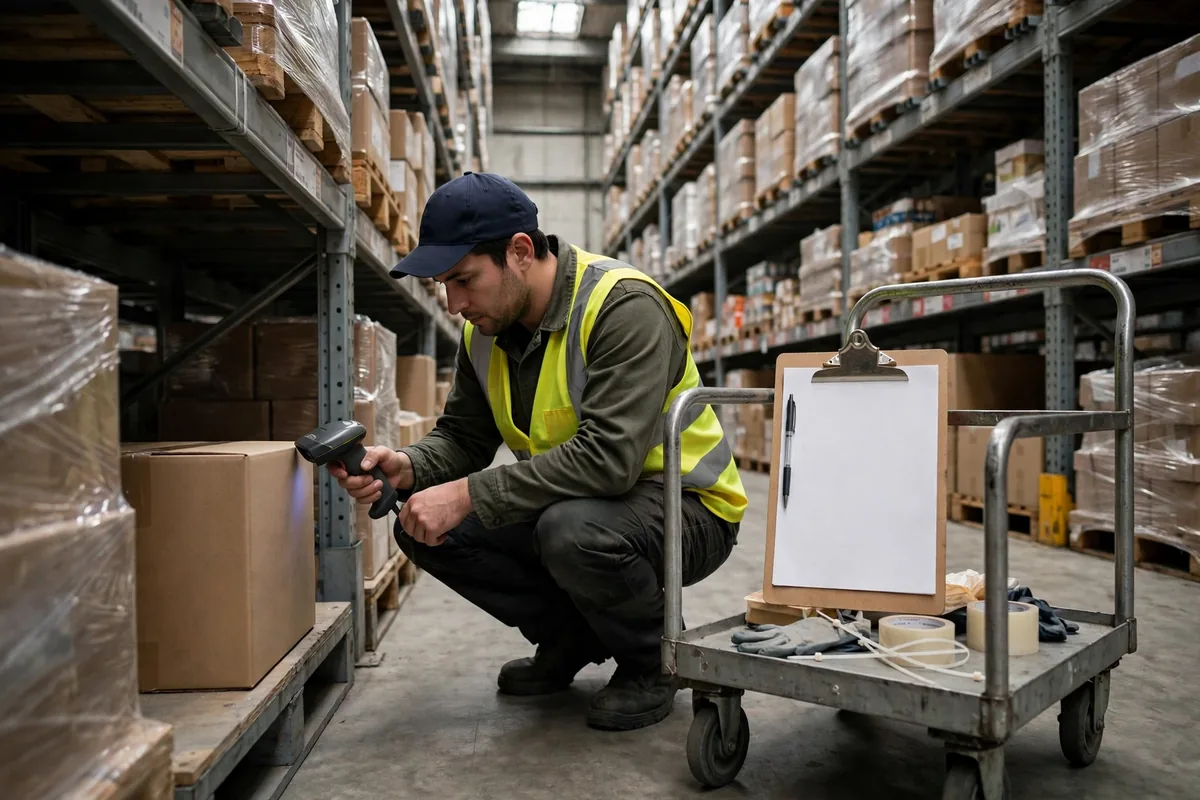
A threshold without a clean response procedure decays into paperwork. I use three rules. Freeze the single problem location, not the whole zone, because freezing a zone blocks shipping and teaches the floor to work around freezes. Use a different person for the recount, because the same counter will usually reproduce the same mistake. And force every recount to close with a cause code: data entry error, wrong putaway location, over-pick or under-pick, unreported damage, or unexplained. Watch the unexplained share. If it climbs, your variances contain something nobody can account for, and that is the number that should keep a manager awake.
Then run the affordability test before you lock anything in. Take your historical count data from the last three months and replay it against the thresholds you are considering. Count how many recounts the new rules would have triggered, multiply by your real recount cost per event using your own wage rates as inputs, and total the dollar value of variances the rules would have waved through. Those two totals are the price of strict and the price of loose, stated in money instead of opinions. If both numbers are survivable, you have found workable warehouse cycle count tolerance thresholds for your building. Recheck them every quarter, because the moment your product mix shifts toward pricier or smaller goods, last quarter's sensible threshold quietly becomes this quarter's open door.
By Lao Zhou, Logistics Cost Analyst