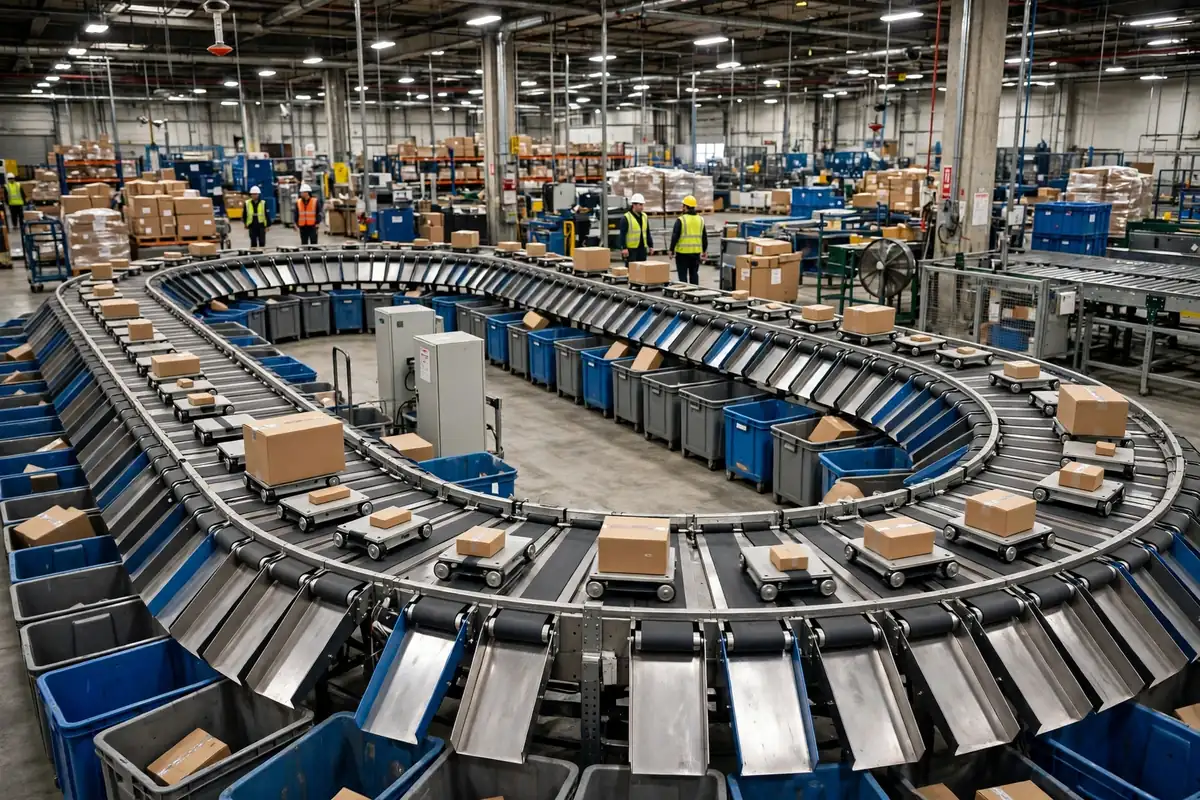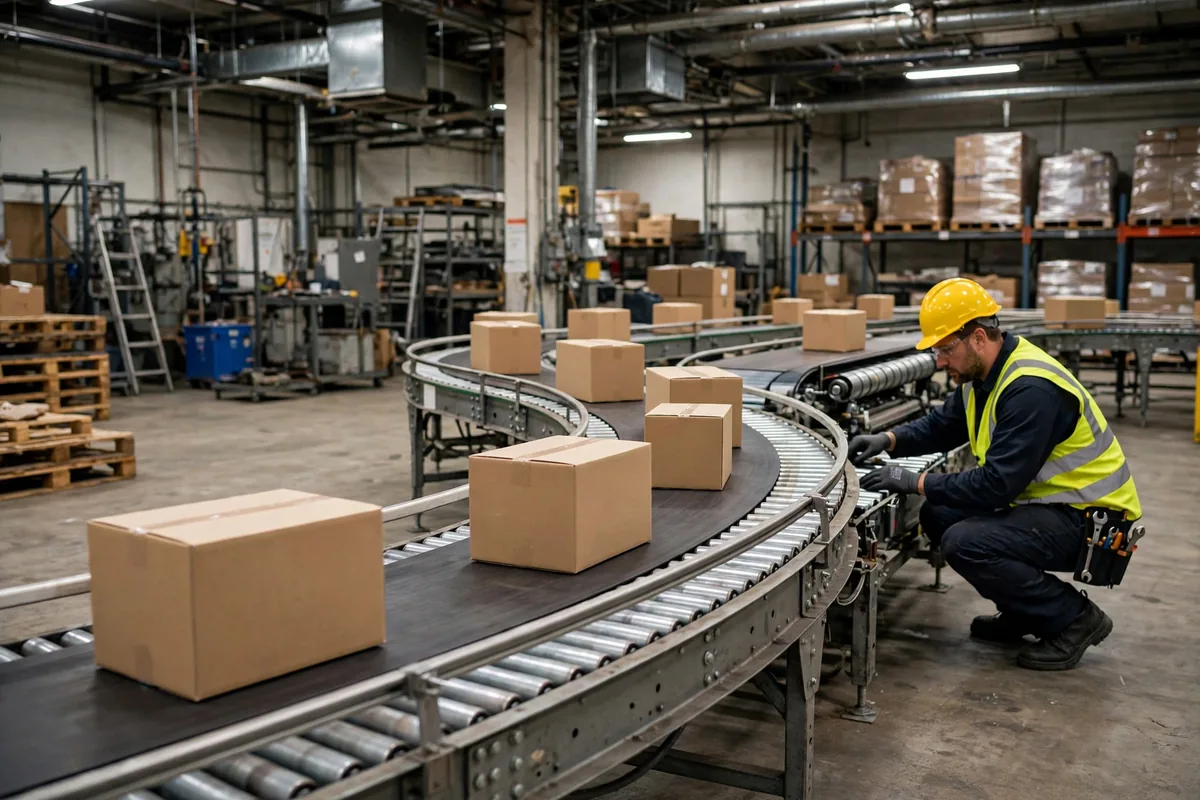
A warehouse conveyor curve jam rarely announces itself politely. One minute the line is flowing, the next minute cartons are wedged sideways in the bend, the queue behind them is growing, and someone is climbing over a guardrail to pull boxes out by hand. Straight sections get all the attention during design, but the curve is where a conveyor line shows its true character, because every carton has to change direction and keep moving at the same time. A straight section only asks a carton to go forward. A curve asks it to go forward and turn, and if the setup is wrong, those two demands fight each other until something stops.
I saw this play out at a parcel hub outside Columbus last peak season. The curve had been grumbling since autumn, jamming a small carton now and then, nothing the crew could not clear in a minute. Nobody treated it as a real problem because it always cleared. Then volume climbed, and the occasional jam turned into a nightly event. The worst night, the bend swallowed half the line's output, the crew had to stop everything and unload carton by carton, and they were still clearing the backlog at dawn. The bend was not broken. It was simply being asked to do something it had never been sized for, and peak volume finally exposed that.
Why a Warehouse Conveyor Curve Jam Usually Starts With Radius
Think of it like a car taking a corner. The tighter the corner, the harder it is to stay on line, and a carton behaves the same way. When the turn radius is too small, a carton cannot swing around the bend cleanly. A corner catches the guardrail, the carton stops, the cartons behind it pile in, and the whole thing locks up tighter with every carton that arrives. Many teams start by blaming the belt when a curve jams. The belt is usually innocent. Measure the bend first.
The dividing line at selection time is simple: can your largest carton make it around the bend without help? If it cannot, no amount of tuning elsewhere will save you. Small, light cartons forgive a tight bend. Big, heavy cartons expose it immediately. And a line that runs mixed carton sizes is the hardest case of all, because the bend that handles the small cartons fine may fail the moment the big ones show up. I always tell people to test a curve with the largest and heaviest carton on the line, run continuously, at peak flow. Testing with the smallest carton is like test-driving a car only on a sunny day and then being surprised when it rains.
There is a second radius effect that gets overlooked. The inside of a curve travels a shorter path than the outside, so cartons naturally drift toward the inside of the bend. You can think of it as a group of people rounding a corner together: the people on the inside always want to cut the corner short. If the guardrail is set wrong or the guide strip is worn smooth, nothing resists that drift, and cartons start going sideways. I have walked into warehouses where the guardrail still had the groove worn into it by years of cartons rubbing the same spot, and the team had spent months adjusting the belt while the real culprit sat there in plain sight.
Tension, Speed, and the Curve Jams They Create
An auto-parts warehouse I worked with had a completely different cause. Their cartons ranged from light paper boxes to heavy parts boxes, all on the same line. One winter, the belt on the curve section went slack. The light cartons started slipping in the bend and stalling, and the heavy cartons coming up behind them simply shoved the light ones over. The crew first blamed the carton mix and tried changing box types, which changed nothing, because the belt in the curve was no longer gripping the load.
Tension is a balance, not a setting you max out. Too tight, and the belt grinds against the rollers, wearing the curve section out ahead of the rest of the line. Too loose, and the belt slips, so cartons stutter through the bend and jam at the slightest squeeze. A rough but reliable check is to stop the line, press the belt on the curve section by hand, and then run it empty and listen for slipping. The common mistake is checking tension only on the straight sections. A curve section carries load differently from a straight section, so a tension reading that looks fine on the straight run tells you very little about the bend.
Speed is the third check, and it holds the most counterintuitive lesson in this whole subject. When the straight section and the curve section run at different speeds, cartons hit the bend and have to suddenly speed up or slow down, and the flow breaks apart right at the entrance to the curve. Most people's first instinct when a curve jams is to speed things up, hoping momentum will push the cartons through. In practice that usually makes the jam worse, because faster cartons arrive at the bend in a tighter, messier bunch. What a curve actually needs is steadiness: cartons entering the bend at an even rhythm, turning at a consistent pace. A slower curve section sounds like wasted capacity, but one line stoppage costs far more time than a slightly slower bend ever will.
A Fix-It Sequence You Can Run This Week
When you walk up to a jamming curve, do not start taking things apart. Match the symptom to the check first. This is the sequence I use, and it keeps teams from chasing the wrong cause.
| Symptom | Check first | What it tells you | | Big cartons keep catching the guardrail | Whether the radius fits your largest carton | If the radius is wrong, tuning will not help; the structure has to change | | Light cartons slip in the bend | Belt tension on the curve section alone | A healthy straight section says nothing about the bend | | Cartons bunch up right at the bend entrance | Speed difference between straight and curve sections | The flow is breaking apart where the two sections meet | | Jams every few days, fine in between | Wear on guardrails and guide strips | A worn groove only shows up when volume is high |
Two maintenance traps deserve their own warning. The first is replacing the belt without checking the rollers and guardrails. A new belt running against a worn-out guide strip will jam just as happily as the old one, and the money is gone while the problem stays. The second is leaving the curve off the inspection sheet entirely. Straight sections get checked every day, and the curve only gets attention when it fails, which means the most failure-prone part of the line is excluded from routine care. My habit is to give the curve section its own line on the sheet: guardrails, guide strips, rollers, and tension, looked at once a month. It takes little time and prevents a surprising number of midnight stoppages.
So when is it time to replace equipment, and when is tuning enough? The line is practical. If your largest carton physically cannot get around the bend, or the bend structure itself is deformed, stop tuning and replace the part. If cartons can get around but jam now and then, work through radius, tension, and speed in that order, and then watch what happens. The worst outcome is getting this backwards: throwing new hardware at a tuning problem, or endlessly tuning a structural problem.
Whether the money was worth it comes down to one number: how many times the curve stops the whole line in a week after the fix. If that number falls and stays down, the money was well spent. If it does not fall, the real cause is still hiding somewhere, and spending more on the same fix will not find it. A warehouse conveyor curve jam is rarely solved by one big repair. It is solved by finding the right place, applying the right amount of force, and then letting the following weeks prove the problem is actually gone.
By Da Liu, Automation Engineer