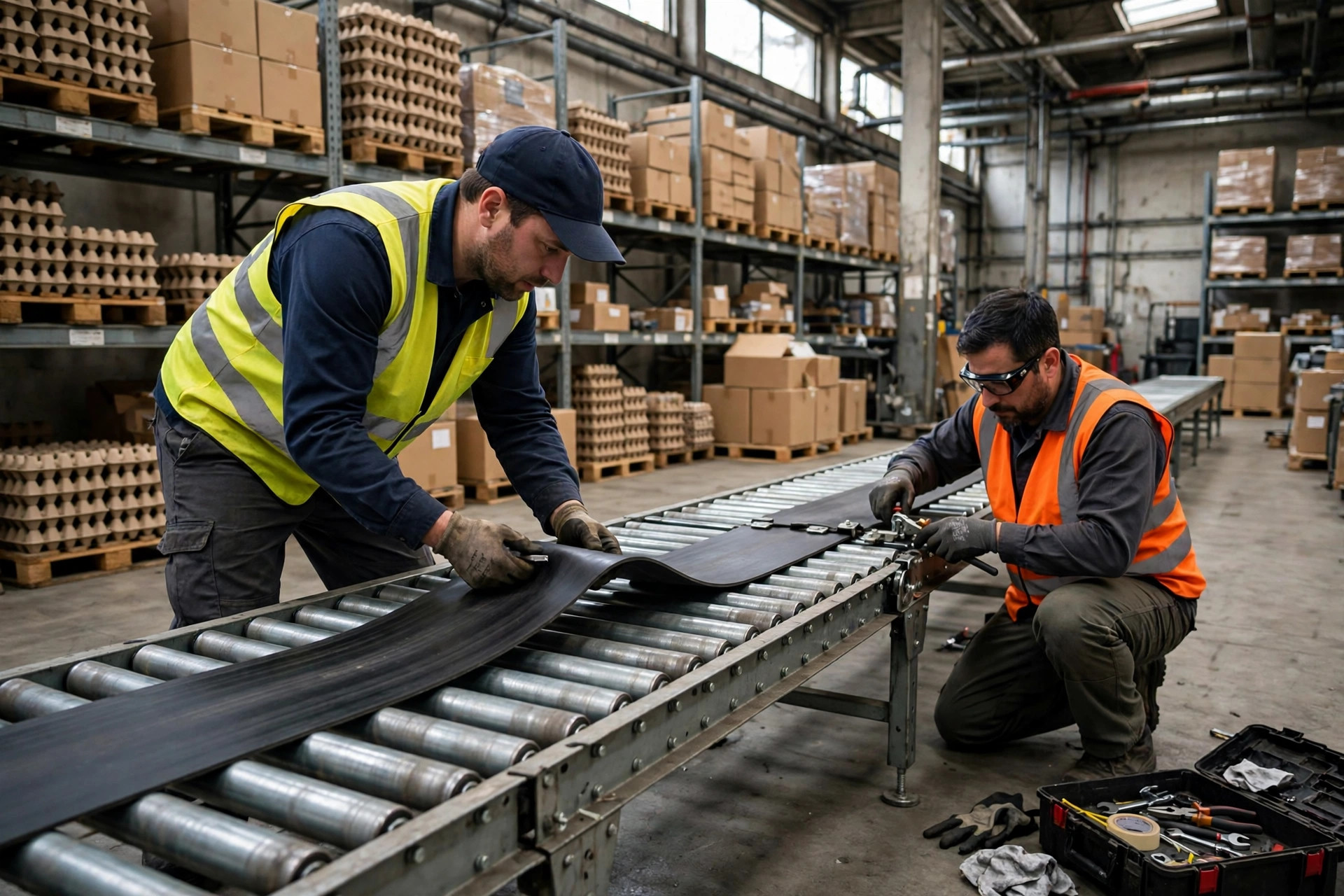
When people ask about warehouse conveyor belt replacement cost, the first question is usually how much the belt costs per metre. That is like pricing a tyre change by the tyre alone, ignoring labour and the delivery missed while the vehicle sits in the shop. A conveyor belt works the same way. The belt itself is often not the biggest line on the bill. The expensive parts are downtime, rework, and a second failure arriving far too soon after the first fix. I have seen warehouses treat a belt change as a purchasing decision, only to watch the line sit idle for most of a shift while orders pile up at the dock. Whatever they saved on the belt went straight into overtime and late shipments.
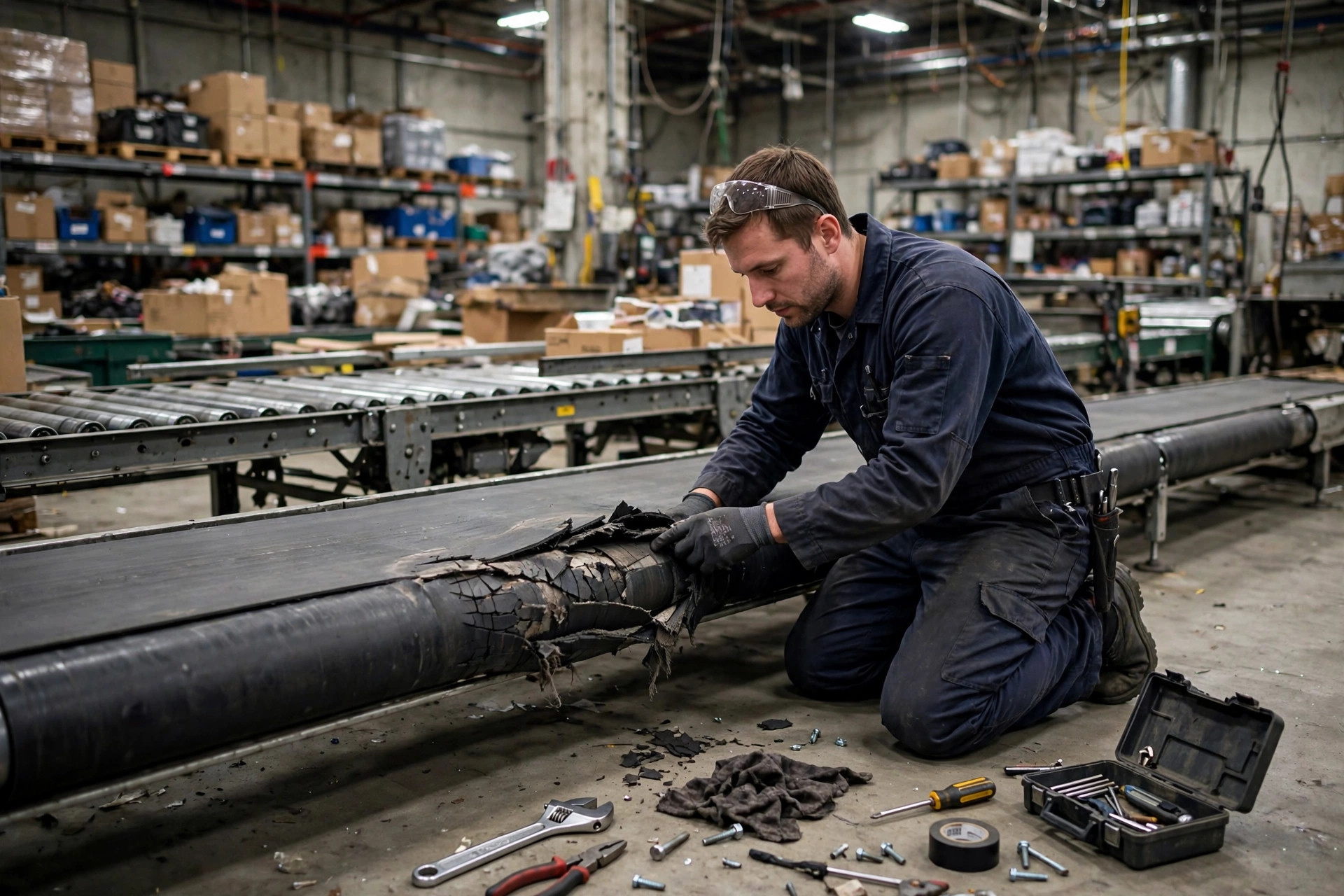
Let me start with a line I was called in to look at before peak season last year. An e-commerce warehouse in eastern China told me their belt kept drifting. On site, the story was written all over the belt: frayed edges, a splice peeling open layer by layer, and a ring of worn-off debris collected around the rollers. The operators had a workaround: adjust tension every morning and nudge the belt back whenever it drifted, just enough to get through the early shift. It looked like saving money. In practice the line stopped for adjustment every day, and once volume rose it could not run at full speed. In the end the belt was changed in the middle of the busiest days, at the worst moment, for far more than a planned change would have cost.
The opposite mistake showed up early this year at a third-party warehouse handling auto parts. The line developed an odd noise, and the maintenance team wanted to replace the whole belt. When we took it apart, the belt surface was not the real problem. Several rollers had seized, and they were grinding a groove into the underside of the belt. The belt still had life in it. The root cause was rollers and poor cleaning. Had they fitted a new belt on top of those dead rollers, the new belt would have picked up the same groove in short order. Both stories point to the same rule: before you change a belt, work out whether the belt is worn out, or whether something around it is killing the belt.
Warehouse Conveyor Belt Replacement Cost: What the Belt Is Telling You
Think of a belt as a loop constantly bending, stretching, and rubbing. Tension, rollers, drums, and cleaning all feed into it, and when any one is off, the damage ends up on the belt surface. Frayed edges, cracks creeping inward, a splice coming apart, or a patch of belt running thin are all the belt filing a report. A single crack on its own tells you little. What matters is whether it is growing, whether it sits near a splice, and whether several damaged spots are joining up.
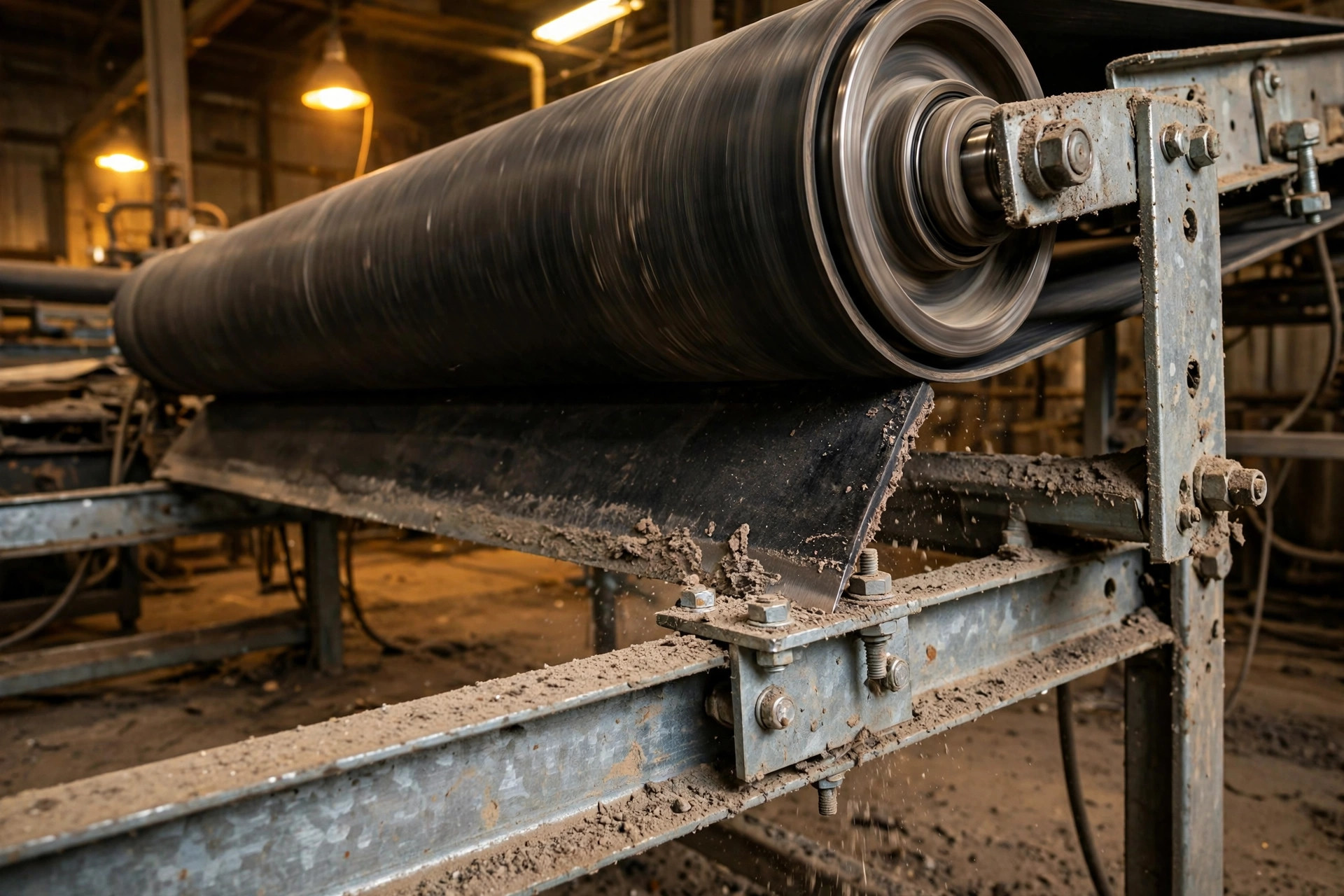
My working method is a damage log: at each inspection, note where the damage is, how it has changed, and how often the belt drifts. It does not need to be precise; it needs to show a trend. A crack that barely moves over several months is still controllable. A crack in the same spot that keeps returning after every patch means the belt body is fatigued — patching that is like tying a knot in a rope about to snap. Another missed signal is a sudden increase in debris under the cleaner. That usually does not mean the cleaner got better; it means the belt surface is shedding layers.
Now for a piece of false demand I will happily argue with. Whenever a belt change comes up, someone suggests upgrading at the same time: thicker, tougher, patterned, all in the name of doing it once and doing it right. But a belt is not better simply because it is thicker. A thick belt needs a larger bend radius and higher tension, and old drums and rollers may not be up to it; a mismatched new belt can wear faster than the one you took off. Before paying for an upgrade, answer one question: is the bottleneck really cover wear resistance, or tension, rollers, and cleaning that never kept up? If you cannot answer that, fix the root cause first.
Warehouse Conveyor Belt Replacement Cost: The Repair-or-Replace Line
The line between patching and replacing is not whether the belt is damaged. It is whether a patch can return the belt to stable running. Here is the line I use:
| Situation | Move | Why | | Small surface damage, splice intact, drift frequency unchanged | Patch locally and inspect more often | Damage is not spreading, and the patch holds for a useful stretch | | Same spot cracking again, splice delaminating, wide thinning | Replace the whole belt, stop patching | Patch intervals keep shrinking, and total stoppages end up larger | | Belt looks fair, but rollers seized or cleaning failed | Fix the surroundings first, then judge the belt | A new belt on the same fault repeats the same damage | | Peak season approaching and damage still worsening | Change it early, do not gamble on peak | A peak-season stoppage costs far more than an early change |
The trade-off behind that table is plain. Patching is cheap today and expensive in repetition: every patch needs a stoppage, labour, and a fresh tension adjustment, and once patches pile up, accumulated downtime passes one full change. The other way wastes money too, since throwing away a belt with stable life left pays for life never used. So judge the trend, not the single defect. Damage worsening across several inspections means stop hesitating; damage staying stable, even on an old-looking belt, means keep running it and tighten inspections.
Here is the counterintuitive part: the most expensive part of a belt change is often not the belt at all. Belt, labour, and splice can all be estimated in broad terms, but downtime is routinely underestimated: missed shipments, overtime to catch up, and temporary manual handling. Give downtime its own line in the estimate, spelling out how long the line stops and how much outbound volume is affected. Leave that line out and every price comparison is fiction.
Scheduling the Downtime Without Killing Shipments
Scheduling is where belt replacement cost is won or lost. Stopping the whole line at once is simplest, but it also stops outbound completely. Changing the belt in sections is more fiddly, but it protects part of your throughput. If orders must leave every day, section-by-section is the steadier play: replace the worst-worn section first, confirm it tracks true, then move on, leaving buffer time for tension and tracking correction between sections. It feels slower, but each finished section restores shipping capacity, and the risk is broken into pieces instead of one big gamble.
A few things must be locked down before the schedule starts. First, the spare belt must arrive early, unrolled and checked; discovering on stoppage day that it is the wrong size, or that splicing material never arrived, is a mistake you only need to make once. Second, plan staff and tools for the worst case, since removing the old belt, cleaning rollers, and setting tension are where time slips away. Third, do not run the new belt at full speed straight away. Run it empty, then lightly loaded, and only raise speed once tracking and tension are steady. Many belts that drift again the day after a change were never given that correction window.
One more note on spares, since it belongs in the same budget. A spare bought early and forgotten is no spare at all: left in a dusty corner for years, it can age, warp, or pick up moisture, then fail you when needed. Stock a spare matched to each critical line, enough for one full change, stored away from light and damp, and checked on a routine. The policy that saves money is a known spare in known condition, not a roll nobody has looked at since it arrived.
So a belt change is not a purchasing decision. It is a production decision: wear from the damage trend, repair-or-replace from shrinking patch intervals, scheduling from protecting shipments over convenience. And here is the one number to close on: this money is worth spending if, and only if, you look at one number — the total cost of one belt change divided by the months of stable running you expect from it. If that monthly figure is lower than what you are already paying each month for patching, adjusting, and stopping the line, change the belt. If it comes out higher, keep patching, keep watching the damage log, and change it when the trend turns.
By Da Liu, Automation Engineer