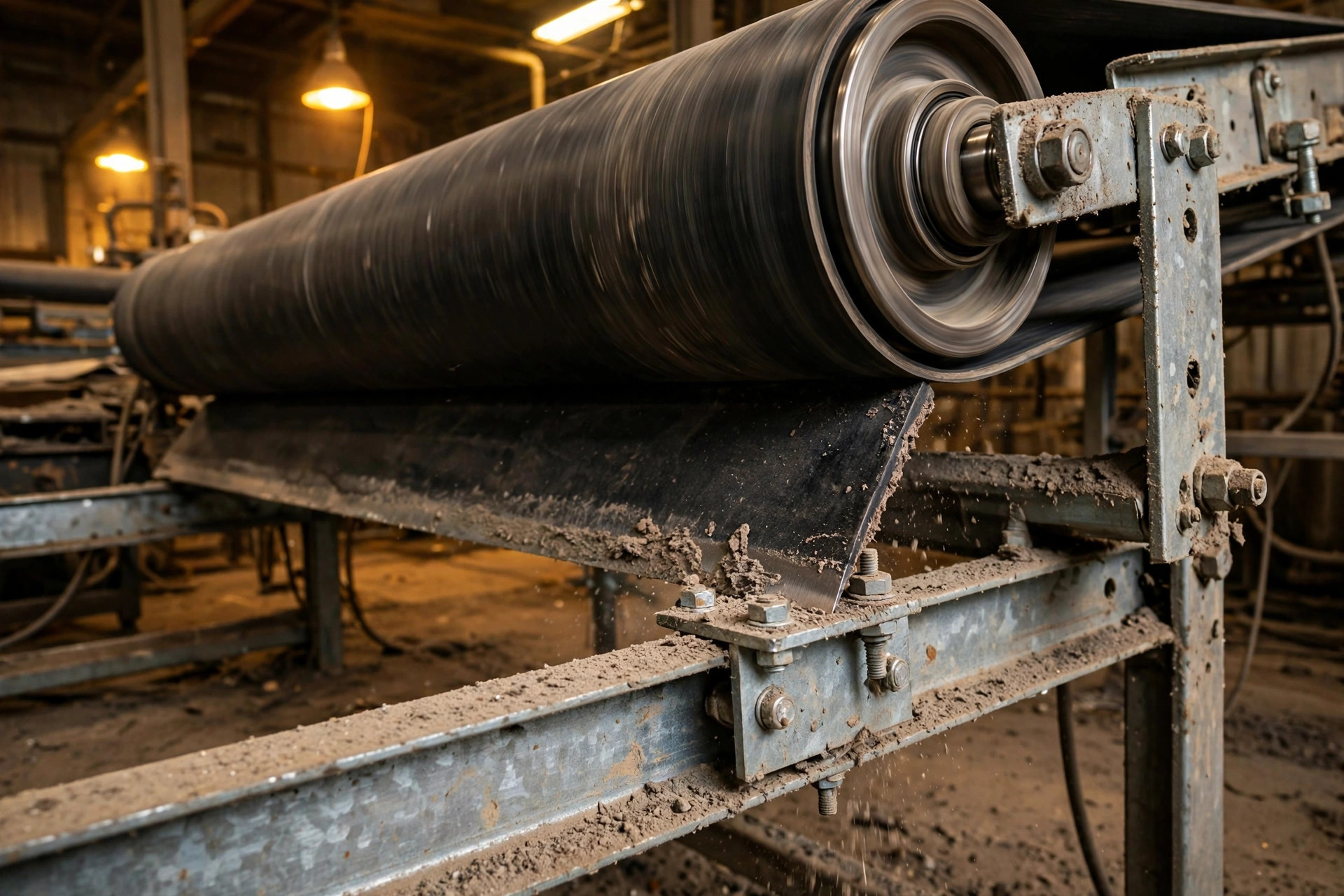
Start with the principle. Conveyor belt take-up tension is like tuning a guitar string — too loose and the drive pulley spins while the belt sits still; too tight and the splice and bearings pay for it. The take-up has one job: absorb the belt's elongation so tension on the slack side of the drive pulley — T2 in the trade — is always sufficient.
Belt is elastic. New belts stretch, vulcanized splices stretch, years of pulling stretch more. Elongation with nowhere to go means T2 drops, and the drive pulley transmits power through friction — so the pulley turns and the belt does not. The field calls it slip. A take-up is, at its core, a mechanism that automatically eats elongation: the most unglamorous part of the conveyor, and the one you least want to neglect.
Three Take-Up Types: Know the Dividing Lines First
Screw Take-Up: The Honest Cheap One
Two threaded screws push against the tail pulley bearing housings. You turn them by hand. Brutally simple: cheap, simple, anyone can fix it.
The dividing line: short lines. The common rule of thumb is conveyors under 50 meters (some draw it at 150 feet) — low tension, small elongation, manageable by hand. Beyond that, belt stretch outruns what a few screw turns can handle.
Adjustment procedure, in order:
- Stop the conveyor, lock out and tag out — non-negotiable;
- Turn both screws in sync — half a turn per side. Cranking one side alone manufactures trouble;
- Read the travel scale — both sides must match, not one notch off;
- Run it empty for a lap — listen, watch motor current;
- Re-tension after run-in. Fresh tension relaxes after a few hours; skip the second pass and the first was wasted.
Its weakness is equally honest: it depends on humans remembering. A screw with no grease seizes in half a year, and by the time someone remembers, the belt went slack months ago. The worst I have seen: screws rusted so hard a pipe wrench would not move them — we cut them off with an angle grinder. Every cent saved on grease was spent tenfold.
One line: short, light, within human reach — the screw take-up is the value king.
Gravity Take-Up: The Default Safe Bet for Long Lines
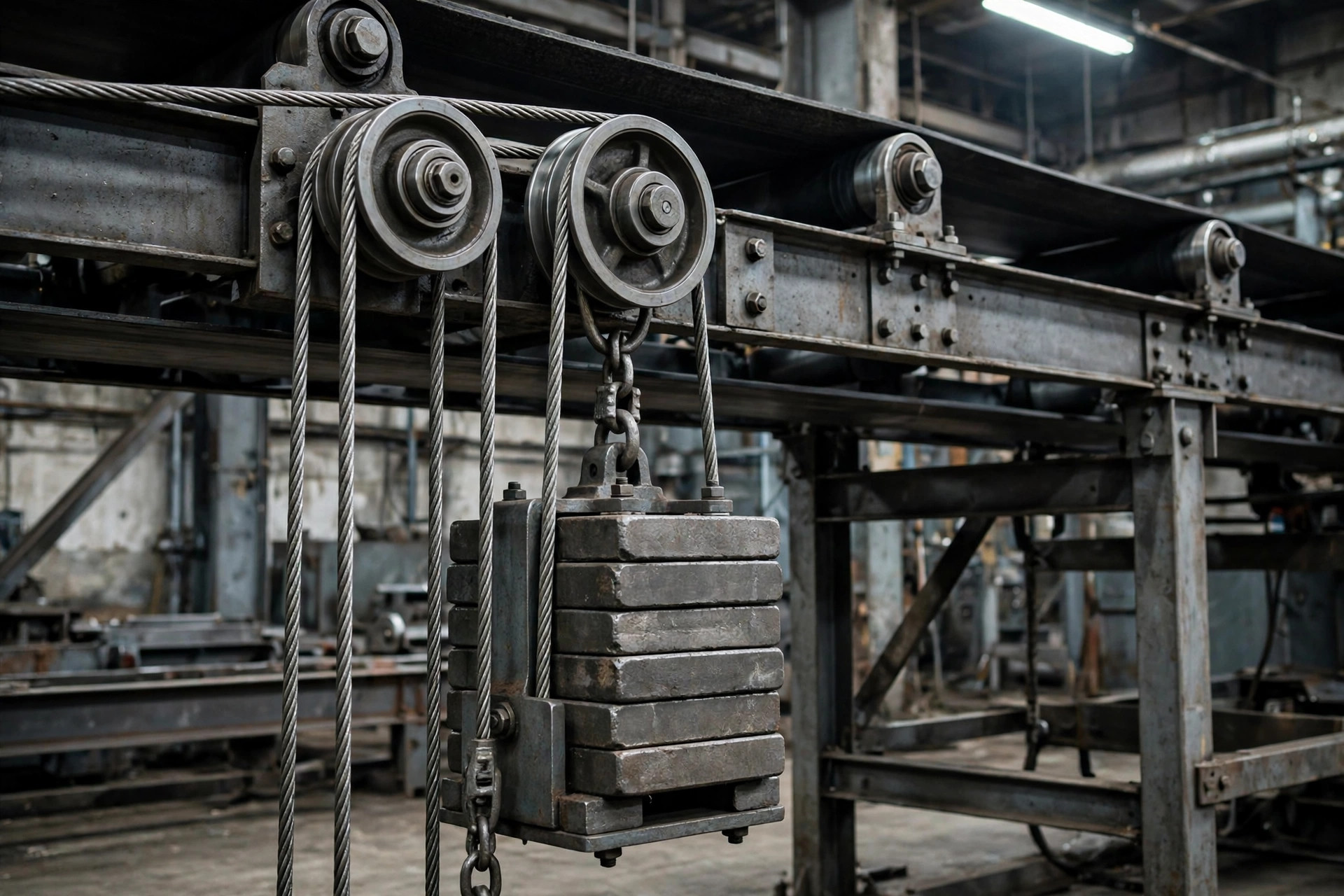
A counterweight hangs from the take-up pulley and pulls with gravity, delivering near-constant automatic tension. The belt stretches, the weight sinks, tension barely changes — those two words, "barely changes," are worth gold.
The numbers, straight up:
- Counterweight ≈ 2 × T2. Textbook example: T2 = 1,000 lbs means a 2,000-lb weight. Why double? The weight holds both belt strands — carrying and return — each taking half.
- Reserve 1.5%–2% of belt length as travel. A 100-meter line wants 1.5–2 meters; a kilometer-long line needs a dozen meters or more — hence take-up towers. Run out of travel and the take-up becomes decoration.
- The weight's position is the belt's fuel gauge. The lower it sinks, the more the belt has stretched. One glance tells you whether the belt is in its prime or near retirement — more intuitive than any sensor.
Its weakness: headroom. A wrench in the take-up pit, a rock in the guides, and the weight jams — automatic tensioning becomes automatic non-tensioning. And yes, I have seen counterweight blocks quietly "borrowed." Do not laugh; anything happens in the field. Add "take-up pit foreign-object check" to the inspection sheet.
Hydraulic Automatic Take-Up: Precise, but Delicate
A hydraulic cylinder drives the take-up carriage. Tension F0 = p × A: set the relief valve pressure and you have set the tension. A pressure sensor monitors it live, and it ties into the PLC for automatic control. Built for variable loads, long distances, and lines where tension accuracy matters.
Advantages: adjustable tension, fast response, remote monitoring from the control room.
The disadvantages, bluntly: first, cost — one hydraulic power unit plus controls buys several gravity take-up sets. Second, it is delicate — a leaking station means instant slack belt. Gravity at least has gravity as a backstop; when hydraulics lose pressure, tension goes to zero and all that tuning was for nothing. Third, maintenance is demanding: oil, seals, sensors — none tolerate neglect. Affording it is not the same as keeping it alive.
How Much Take-Up Tension Is Correct? Three Checks
Take-up tension is not set by feel. Three methods, each more reliable than the last.
First, the sag method — the workhorse: measure belt droop between idlers. CEMA's sixth edition draws the line at 2% of idler spacing for 35° troughing idlers, 3% for 20°. Note: that is the anti-spillage ceiling, not the target. Tuning to exactly 2% is standing on the red line — the target keeps a margin.
Second, the frequency method — the old-timer's trick, surprisingly accurate: pluck the return belt and measure its vibration frequency. Tension, mass per length, span, and frequency obey a fixed relationship: T = 4·m·L²·f². A phone app measures frequency today and rivals a handheld tension meter. A veteran with no instruments can pluck, listen, and know — provided he has plucked a few thousand belts.
Third, motor current as a cross-check: under the same load, persistently high current almost always means over-tension. Excess tension does not vanish — it becomes internal losses in bearings, idlers, and belt, and shows up on the power bill.
Over-Tension vs. Under-Tension: What Each Costs You
Under-tension: T2 insufficient, drive pulley slips — mild cases lose throughput and spill; bad cases burn the pulley lagging. Sag goes over the limit and spilled material buries the return belt. You will cry shoveling it out.
Over-tension: the splice is the first casualty. A vulcanized splice under chronic over-tension is not far from tearing — and the splice is the priciest part of the belt. Next come the idler and pulley bearings, running overloaded until you are replacing bearings and questioning your life choices. Motor current climbs; the power bill delivers the verdict.
The counterintuitive call: more tension is not safer. "Tighter is insurance" is wrong. Tension suffices when two conditions hold: the drive pulley does not slip, and sag stays within limits. Every bit beyond that is billed to the splice and bearings. That is not how you buy insurance.
Do Not Pay for Fake Requirements
"Our 40-meter line — should we go hydraulic automatic take-up, with PLC integration?" Someone asks every few months. My answer never changes: a sledgehammer for a finishing nail.
Under 50 meters, a screw take-up is enough. Spend the savings on grease for the screws and a real inspection roster — that beats any "smart" take-up. Take-ups have no hierarchy of prestige, only fitness for purpose. The belt does not care what you paid for the word "smart."
Two Field Stories
Story one: two years ago, at a California e-commerce DC, the screw take-up on a sortation line had not been touched in half a year. During pre-peak testing the drive pulley spun free and the belt slipped, smoking. Seized screws, a belt gone badly slack. The fix: cut off the rusted screws, install new ones, re-tension to the scale, re-tension after run-in. That line has been on the monthly inspection sheet since — never failed again. Lesson: the screw take-up does not mind being cheap. It minds being ignored.
Story two: a manufacturing plant, long-distance line, gravity take-up. Inspection found the counterweight sunk to the bottom of its travel — elongation had eaten the entire stroke. We scheduled a shutdown two weeks out, shortened the belt, re-vulcanized the splice. Without that glance, the belt would have gone fully slack and stopped not two hours of maintenance but a whole production line. Lesson: the counterweight "fuel gauge" is worth gold. Look at it daily.
Side by side, the three types:
| | Screw | Gravity | Hydraulic automatic | | Tension control | Manual, set and locked | Automatic, near-constant | Automatic, adjustable, PLC-ready | | Travel | Small | Large (1.5%–2% of belt length) | Large, controlled | | Best for | Short lines (under 50 m), low tension | Medium/long lines, high tension, critical lines | Variable load, long distance, high precision | | Cost | Lowest | Medium | Highest | | Maintenance | Human-dependent, screws seize | Watch the weight position, low effort | Hydraulic unit plus sensors, delicate | | Biggest trap | Forgotten adjustments | Foreign objects in the weight pit | Pressure loss = instant slack |
Whether the money spent on take-up tension was worth it comes down to one number: the tension margin on the drive pulley's slack side, T2. T2 steady — money well spent. T2 alarming daily — and no take-up at any price is more than decoration.
By Da Liu, Automation Engineer