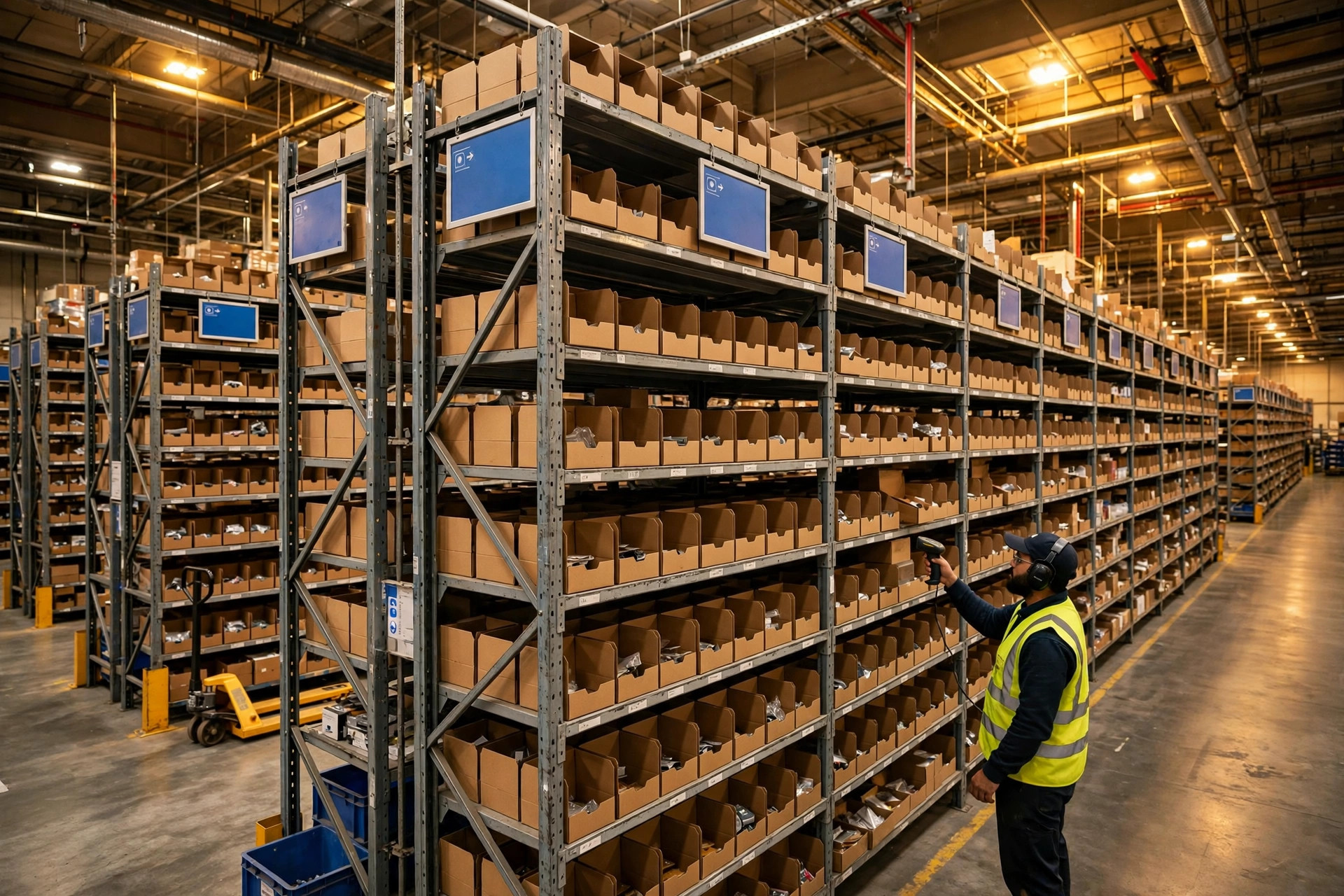
Short answer up front: bin capacity calibration answers one question — how much product can the WMS safely promise to put in this slot? And here is the conclusion before anything else: you are not calibrating the rack's theoretical capacity. You are calibrating the executable capacity — what actually fits on the floor, what the forklift can reach, and what the system dares to promise. Get this number wrong and every putaway suggestion, replenishment plan, and utilization report downstream is wrong too — quietly, until the chain reaction hits you.
Why Bin Capacity Calibration Deserves Its Own Workstream
Too many projects treat bin capacity calibration as "just loading some master data" and rush it. I have watched this exact mistake happen three times, and the root cause is always the same: paper data treated as floor data.
July 2023, a 3PL client in Shenzhen, 3,000-plus pallet positions. Their capacities were loaded straight from the rack manufacturer's nameplates: 2,000 kg per level, two pallets per level. Sounds fine, right? By week three after go-live, the floor was complaining: the slots the WMS suggested for putaway physically could not take the freight. Investigation showed the client's pallets were mostly over-height — stacked to 1.6 meters against a 1.5-meter beam clearance. The nameplate assumed a "standard pallet." The freight on the floor was not standard. Worse, the 2,000 kg rating was a lab number for evenly distributed load; the client stored machine parts, heavy in the middle, and a single 1,800 kg pallet visibly bowed the beam. In the end, two consultants and I re-measured all 4,000-plus positions with tape measures and laser distance meters, one by one. Nine days of rework. The client's boss got a darker face every single day.
March 2024, an e-commerce DC in Kunshan — the mirror image. Their capacities were "theoretical volume": inside dimensions multiplied out to a case count. The WMS made putaway suggestions off that number, and putaway operators complained daily that "the system's slot doesn't fit." The volume math was right, but nobody had deducted operating clearance — a forklift sliding a pallet in needs a few centimeters on each side and front to back. Theoretically it fit. Physically it did not. We switched to "net usable capacity" and putaway smoothed out immediately.
The Cost Chain of a Wrong Calibration Number
A miscalibrated WMS does not throw errors. It confidently gives you wrong suggestions. Let me lay out the math:
| Calibration error | What happens on the floor | Chain reaction | Who pays |
|---|---|---|---|
| Calibrated too high | WMS says 3 pallets fit; only 2 do | Operator can't place it, freight lands in the aisle; blocked aisle forces pickers to detour | Pick productivity drops, overtime climbs |
| Calibrated too low | Slot has space but WMS thinks it's full | New freight gets pushed to far slots; replenishment travel gets longer and more frequent | Forklifts and labor run wasted miles |
| Volume only, no weight rating | Heavy freight lands on light-duty beams | Beams deform; worst case means beam replacement and a shutdown | Safety risk plus repair bills |
Here is the counter-intuitive call: calibrating conservatively costs less overall. Try 90% of measured values. An overstated capacity buys you floor chaos — freight that won't fit, blocked aisles, overtime. An understated capacity only costs you a few unused slots. And slots are the cheapest resource in a warehouse; labor is the most expensive. Trading cheap resources to keep expensive ones out of trouble is arithmetic that always works.

Four Steps: Measure, Compute, Load, Verify
Step 1: Measure — trust the tape, not the nameplate
Two people, one measures, one records. For every slot: inside length, width, height (inside clear, not the rack's outer frame); beam clearance (top of beam to underside of the beam above); beam load rating (nameplate is reference only — for heavy-freight zones get the uniform-load figure from the manufacturer in writing); aisle width (decides whether the forklift can work normally). Two tools: a laser distance meter and a tape measure. Odd-profile racks, mezzanines, and flow racks each get their own measurement sheet. Never mix them.
Step 2: Compute — turn measurements into numbers the WMS can use
Convert measured dimensions into "pallet count" or "case count," then apply two deductions. First, operating clearance: 5–10 cm on each side of the pallet (depends on forklift model and operator skill — greener crews get wider margins). Second, take 80% of the rated load as the working limit. The result is the "executable capacity" — the only number that goes into the system. Remember the formula: executable capacity = measured capacity − operating clearance − safety margin. Keep all three numbers on file; you will need them at the next audit.
Step 3: Load — verify manually before any bulk import
One record per slot in the WMS location master. My routine: load 20 slots first, print them, and walk the floor checking each one against the sheet. If they match, bulk-import the rest. If they don't, stop and find out why — inconsistent measuring technique, or a batch of racks that genuinely isn't to spec? Bulk import feels fast; getting it wrong means reworking the whole building.
Step 4: Verify — the go-live night checklist
This is my fixed ritual, done the night before go-live, no exceptions: randomly sample 30 slots and compare floor measurements against system values line by line; any slot deviating more than 5% triggers rework of the whole batch — "close enough" is not allowed; sign and file the audit record so problems trace back to a person. And one more thing: bin capacity calibration is not a one-time job. Racks get hit, beams get replaced, product profiles change — recalibrate each time. I usually tell clients to re-sample every six months, quarterly for heavy-freight zones.
Where Teams Usually Get This Wrong
- Importing the rack manufacturer's nameplate data without ever walking the floor.
- Calibrating volume but not weight — guaranteed wreck in a heavy-freight building.
- Calibrating mixed and odd-size pallets as standard pallets, so system suggestions never match reality.
- Calibrating once and never re-auditing — nobody notices the deformed rack.
- One standard for every rack type and temperature zone.
- Setting operating clearance by gut feel instead of your actual forklifts and operators.
Bin capacity calibration is the least glamorous and most expensive-to-rework step in a WMS rollout. Get it solid and putaway, replenishment, and cycle counting all run smooth behind it. Fake it, and the smarter the system, the more spectacularly wrong it goes.
By Lin Xiao, WMS Implementation Consultant