The monthly leasing quote for a small AMR fleet was $4,800. The purchase price for the same fleet was $210,000. The operations director looked at the two numbers and said the lease was obviously cheaper. It is not. It is cheaper this month. Over five years, the lease costs roughly 30–50% more than buying — and that premium is the entire decision, because what you are really buying with it is the right to change your mind.
That is the frame for this whole question. Warehouse automation equipment leasing vs buying is not a price comparison. It is a bet on how stable your next five years will be. Buy, and you are betting the business, the SKUs, and the customer contracts stay roughly as they are. Lease, and you are paying extra to keep your options open. Both bets can be right. The expensive mistake is making one without knowing which you made.
Buying: cheaper in total, heavier up front
The cost structure of buying is simple to state and easy to get wrong in the details. You pay the equipment and implementation cost up front, then maintenance runs roughly 3–8% of hardware value per year, depending on the asset — AMRs with batteries and laser navigation sit toward the top of that range, plain conveyors toward the bottom. Over five years, total cost is roughly the purchase price plus five years of maintenance, minus whatever residual value is left at the end.
Residual value is where most buying business cases quietly cheat. Generic assets hold value: forklifts, standard conveyors, ordinary racking can still fetch something after five years. Customized automation often cannot. A sortation system built around your SKU profile is close to worthless to the next warehouse. The honest way to model it is to assume zero residual for customized systems and treat anything you recover as a bonus.
The real cost of buying is not on the profit-and-loss statement. It is cash. A seven-figure payment up front can draw down a credit line right before peak season, when that cash should be buying inventory. Depreciation and tax treatment also vary widely by jurisdiction — accelerated depreciation can help buyers in some regions, but the rules change often enough that any specific rate quoted here would be stale or wrong, so check the current rules where you operate rather than trusting a number in an article.
I ran the numbers for a 3PL in eastern China in 2024: a 12-AMR system, equipment plus implementation quoted at roughly $420,000. Their anchor customer contract ran three years, renewal uncertain. Bought outright, three years of depreciation came to about $140,000 a year. Leased, the monthly payment over the same three years came to more than the depreciation — on paper, buying won. The CFO chose the lease anyway. Her reasoning was one sentence: if the customer does not renew, a system customized to that customer's freight profile is scrap metal. The saving from buying was smaller than the loss from one lost contract. On the spreadsheet, buying won. In the business, leasing won.
Leasing: you are paying for freedom, not for hardware
A lease payment bundles three things: financing cost, maintenance and service, and residual-value risk taken by the lessor. Common lease terms for automation run 36–60 months, and shorter terms mean higher monthly payments and higher total cost. The first question to ask any lessor is which kind of lease it is. An operating lease is like renting a car — you hand it back. A finance lease is closer to buying in installments, with a buyout at the residual value. Two words apart on the contract, up to a fifth apart in five-year total cost.
Leasing earns its premium in three places. First, cash flow: near-zero down payment, and peak-season working capital stays free. Second, bundled service: many leases include maintenance, spare parts, and guaranteed response times, so downtime risk is shared rather than carried alone. Third, exit and refresh: at term end you can return, extend, or swap for the next generation. For AMRs and vision systems, where each generation is visibly better than the last, that option is worth real money.
The traps are all in the fine print. Are operating hours metered, with penalties for overuse? What does "return in original condition" actually mean — one contract I reviewed required equipment returned "to factory condition," a clause whose potential cost ran to several months of extra payments. What does early termination cost? Get the return standard and the exit fee in writing before you negotiate the monthly rate. A cheap monthly payment with a punishing return clause is not cheap.
Leasing or buying: run your own numbers on this table
Do not copy anyone else's conclusion. Use the illustrative example below — built on a $140,000 system, a five-year horizon, and maintenance at 5% of hardware value per year — and substitute your own quotes. Every figure in it is an assumption, clearly marked; actual rates, residuals, and tax treatment must come from real quotes and current local policy:
| Cost item (5 years, illustrative example) | Buy | Lease (60 months) |
|---|---|---|
| Day-one cash out | $140,000 | Near zero |
| Maintenance over 5 years | ~$35,000 | Included in monthly payments |
| Total lease payments over 5 years | — | ~$182,000–$210,000 |
| Residual value at end | $0–$28,000 (generic assets only) | $0 (equipment returned) |
| Five-year total cost (net of residual) | ~$147,000–$175,000 | ~$182,000–$210,000 |
| Biggest risk | Business change strands the asset | Contract fine print, early-exit cost |
The premium in that table — roughly 30–50% over five years — matches published comparisons of lease versus buy for AGV and AMR fleets, where a five-year lease on a roughly $385,000 system ran about 39% above the buy-and-maintain baseline. Your numbers will differ; the shape of the answer usually does not.
One more layer belongs in the model: downtime. If the lease carries an uptime guarantee and rapid swap-out, one avoided peak-season outage can be worth more than the whole lease premium. Conversely, a bought system with slow maintenance response can burn the entire saving in two days of stopped picking. Compare cost per productive hour, not monthly payments.
The decision rule compresses to four conditions: stable business, customer contracts of five years or more, generic equipment with resale value, and comfortable cash reserves. Meet all four, buy. Short customer contracts, volatile volume, fast technology cycles, or cash that peak season needs — meet two or more, lease. There is also a middle path that often looks best on paper: buy the parts that will not change, like conveyors and racking, and lease the parts that iterate fast, like AMRs and vision systems.
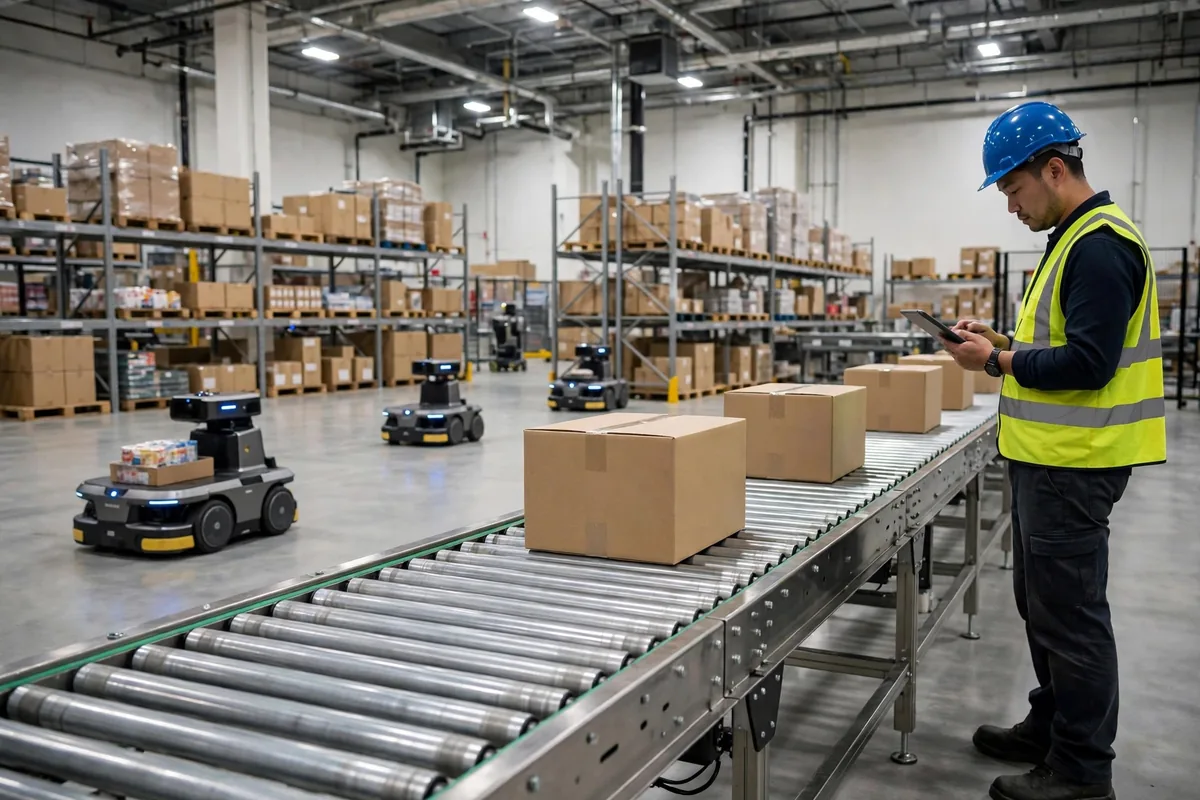
A small apparel e-commerce warehouse I advised took that middle path in 2025: six AMRs on a three-year lease ahead of peak. Volume doubled for three months and the fleet carried it; in the slow season they returned two units early and the monthly payment dropped with them. Under a purchase model, those six units would have sat in a corner depreciating through the quiet months. Asset-light does not mean spending less. It means spending only while the asset is earning.
Here is the counterintuitive judgment: leasing is not what you do when you cannot afford to buy. It is what a healthy business does when the future is uncertain. Buying locks in your technology choices for five years in one payment. Leasing lets you re-decide every term. The less predictable the technology curve, the more that re-decision right is worth — and AMRs today are visibly better than AMRs three years ago, at similar or lower prices. Who wants to bet that trend stops?
A calculable conclusion to close with: take your real quotes and compute two numbers — five-year total cost net of residual, and day-one cash out — then write your longest customer contract term next to them. If the contract is shorter than the financing term, lease. If the five-year cost gap is under a fifth and the business has real uncertainty, lease. Otherwise, buy. Run those two numbers and the answer argues for itself.
By Lao Zhou, Logistics Cost Analyst